Sandy Beach, Saturday, June 16: Why would Hudson not charge non-residents for the privilege of using the beach so that the Town can recoup the cost of securing and maintaining this lakeside jewel?
While Hudson debates whether to charge people for using the Jack Layton Park (JLP) boat launch and how to police and control access to Sandy Beach, here’s food for thought.
Between 2:45 and 3 p.m. Saturday, June 16 we conducted a 15-minute survey of people using the boat launch at JLP.
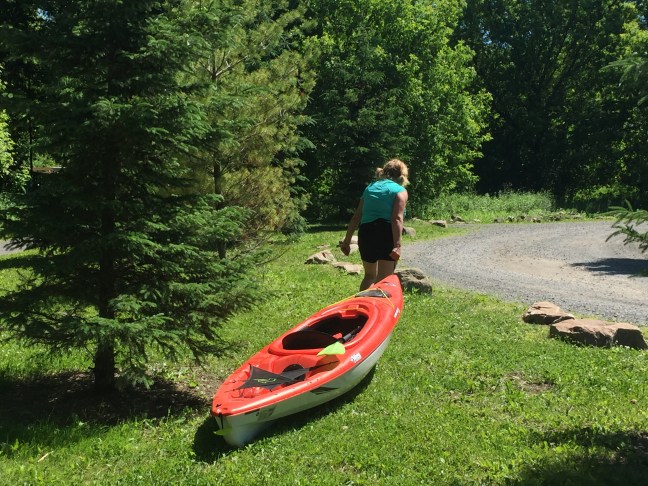
This St. Lazare resident and her partner launch and recover their kayaks from a small beach next to the motorboat launch. Why not give non-motorized users separate access to they don’t have to drag their craft across gravel and wait for a pause in the motorized boat-launch traffic?
We began by asking them where they were from. Two respondents — a couple kayaking and the owner of a 23-foot Sea-Doo runabout — were from St. Lazare. The others hailed from Les Cedres, Huntingdon and Lachine.
Asked whether they spent any money in town, all said no.
Asked whether they would pay $50 to use the launching ramp, all said they would go elsewhere.
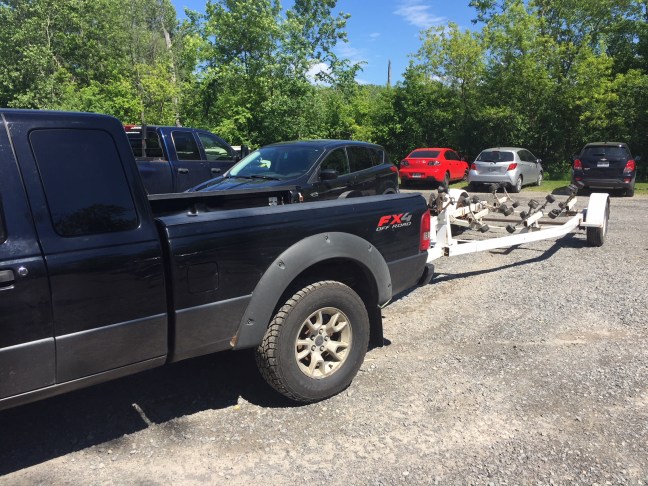
Lachine resident reloads his boat after a morning on the lake. If the town jacked the launch fee to $50, he says he would stop coming even though he prefers the Lake of Two Mountains to his home waters. Lachine charges $10 per vehicle and $10 per trailer so that boaters can use the launch ramp for free — and at their own risk.
The Lachine resident has been using the ramp for three years, including the season the town charged for the use of the ramp.
He said he finds the Lake of Two Mountains more interesting for boating and fishing than Lac St-Louis but wouldn’t return if the town charged $50 for use of the ramp. Lachine, he pointed out, doesn’t charge for use of the ramp. Instead, Lachine charges $10 per vehicle and $10 per trailer. Boaters using the ramp do so at their own risk.
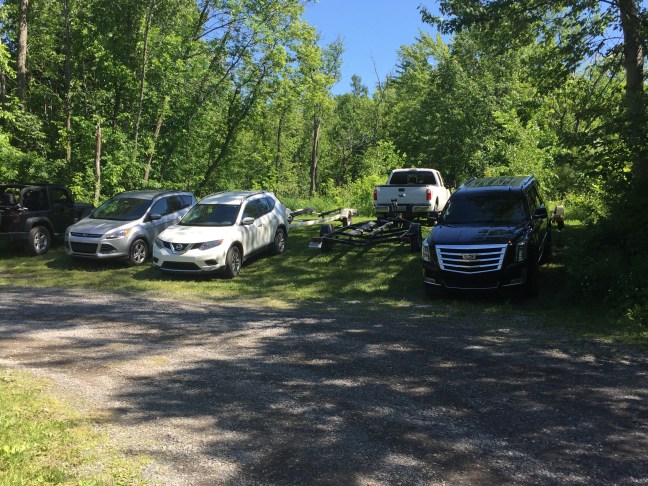
Because there is no supervision or control of who parks where, vehicles with trailers monopolize the free parking without regard for how they park. Result: other vehicles are blocked from leaving or finding parking.
Next, we tallied the number of vehicles with and without trailers in the parking lot.
We counted 20 vehicles with trailers and 40 vehicles without trailers.
Let’s say the town charges $10 per vehicle and $10 per trailer.
At $10 per vehicle and $10 per trailer, that amounts to $800 for one afternoon.
Since many won’t spend the whole day on the water, it’s a fair assumption this past Saturday would have pulled in $1600.
Multiply that by 32 weekend days and we come up with $51,000.
Assume rainy weekends will be more than offset by revenues from holiday weekends, when the ramp is in constant use from dawn to dusk.
Another reason to police parking at Jack Layton Park.
Assume another $42,500 for weekday use. Conservatively, parking for JLP and Sandy Beach could bring in $100,000 a year.
The only expense would be a parking attendant and gate at the park entrance on Halcro.
The benefits of charging for parking rather than for using the boat launch?
Beachgoers can enjoy a sunny Saturday on Hudson’s waterfront without spending a cent. Shouldn’t they at least pay for parking?
Non-residents enjoying Sandy Beach should be paying for the privilege as well as subsidizing the cost of parking-lot operation and park/beach bylaw enforcement. We biked to the far end of the beach and noted the number of off-leash dogs (the vast majority), coolers of food and alcohol, and overflowing garbage cans the Town pays to empty. How many bought their food and drinks locally before heading to the beach?
These boaters know the secret to not being boxed in.
Hudson residents pay dearly for all of this, so they should be alone in enjoying free parking by applying for a decal.
Beaches and greenspaces in our region— Pointe du Moulin, Oka Provincial Park, Plage Saint-Zotique, Plage Saint-Timothée, Base de plein air — all charge for vehicle access. Some offer reduced rates or free access to their citizens. Some exchange special access privileges.
To summarize, wouldn’t it be preferable to see Hudson’s lakeside jewel of a greenspace covering the cost of maintaining and securing it for Hudson residents? I can’t understand the mindset of those who say it will end up costing the town more to charge than to give it away.
Don’t believe us. Do the math. Take your own survey. God knows we have the Parks and Recreation staff.
This lengthy rig managed to occupy four parking spaces, but he’s blocked in by another rig parked in front of him. Good luck getting out.
I visited the Bradbury Park well site off Côte St. Charles Wednesday, May 23 to see the results of Samson’s test wells. These are photos of the test cores. Each of the piles in the photo represents five vertical feet. The ideal core forms a fairly solid, compact pile that looks like it was formed with an overturned bucket. The cores that look like mud pies indicate a mix of fine sand and silt, which quickly clogs intake screens. This is what happened to the adjacent Bradbury well barely two years after it began pumping.
The following account was compiled from information on the public record or freely available to enterprising residents.
The next to last item on the agenda for tonight’s June 4 Hudson council meeting — authorization for drilling piezometer – Wells 483, etc. — will mean nothing to most people. But for those following Hudson’s chronic water shortage saga, it’s confirmation of the latest failed attempt at finding a solution.
One of the last acts of the previous council was the approval of a $1.4 million loan bylaw to cover the cost of locating, authorizing, drilling and connecting a new well. At some point in the decision-making process, it was decided to concentrate the search for a new well in the same area of the Viviry Creek watershed where Hudson’s two producing wells are located.
Every step in that process was approved by council, beginning with $14,000 to consulting hydrogeologists Akifer to pinpoint the location of two drilling sites. Another $7,000 went to environmental consultants Sagie to steer the project through the environment ministry’s approval process. Another $36,500 went to Daoust for site preparation on a very short deadline, followed by $63,434 to Forage Samson, the winning bidder on the actual drilling of the wells.
Samson began drilling operations on Daoust’s temporary road below Hillcrest the third week in May. The contractor quickly concluded from core samples the site would not support a well capable of producing 600 gallons per minute on a sustainable basis. There was plenty of water starting at a depth of 150 feet— but the sand matrix was too fine and laden with silt to guarantee sustainability.
The best comparison is with a Slushie, those concoctions of sugar syrup and crushed ice consumed through a straw. If the ice is too coarse, you end up with a cupful of ice and no liquid. If the ice is too fine, it clogs the straw — essentially what happened with the nearby Bradbury well barely two years after it started pumping.
A second borehole confirmed Samson’s concerns. I have not seen the contractor’s drilling report but I strongly suspect it recommends against further drilling in the Viviry wetland because of the unsuitability of the water-bearing sand.
In other words, Hudson taxpayers paid in excess of $120,000 with nothing to show for it but another summer water ban.
What does Quebec have to say about the Town of Hudson’s annual well quest?
This morning I put that question to Hudson’s regional representative for the Sustainable Development, Environment and Fight Against Climate Change (MDDELCC).
“Every year, you spend more money and get no f**king results, just another interesting report,” he said. “When are you going to come to your senses, run a pipe into the lake and build yourself a treatment plant?”
With a provincial election this October and a federal election next fall, he added, there’s no better window of opportunity to pressure the politicians for subsidies. “Stop wasting time and taxpayer’s dollars!”
This evening’s Item 11.1 seeks council’s approval to conduct test drilling in one or more of the piezometers (test wells) surrounding Well #483, the town’s single major source of drinking water. I find it ironic that after all this time and expenditure on outside expertise, we’re considering a solution first suggested by former technical services director Trail Grubert some 10 years ago.
Hudson’s potable water system is supplied by four wells. They have a combined production capacity of 3,547 US gallons a minute. Each well’s health and productivity is monitored in real time by a system of piezometers, or test wells, located throughout the municipality and the results logged by municipal employees. Summer demand peaks at 4,750 GPM, representing a 30% shortfall and the reason behind the annual summer watering ban.
The two wells providing most of Hudson’s drinking water — #483 and Bradbury — are located in the wetlands along Viviry Creek. Well #483, Hudson’s equivalent of Old Faithful, began pumping in 1983. It replaced Well #2, located next to the Wellesley entrance to Bradbury Park.
Well #2 still produces, but was condemned on the advice of the environment ministry because its water exceeds provincial norms for iron, manganese and chlorides.
The Bradbury well, barely 10 years old, is producing at below its rated capacity despite repeated efforts to unclog its 60-foot intake screen. Had today’s well-sustainability technologies been in effect when it was drilled, it’s doubtful Bradbury would have ever been connected.
In the west end, two wells supply Hudson Valleys and Alstonvale. This system can be fed water via a connection at the top of Mount Victoria but isn’t configured or permitted to feed water to the town’s filtration plant and reservoir at the top of Fairhaven.
How critical is Hudson’s drinking water situation? Serious enough to question whether the town can guarantee a four-day supply for its 5,200 residents in the event of a failure of either of its two main wells. Until Hudson finds a sustainable long-term solution for its chronic water shortage, we can forget about future development.
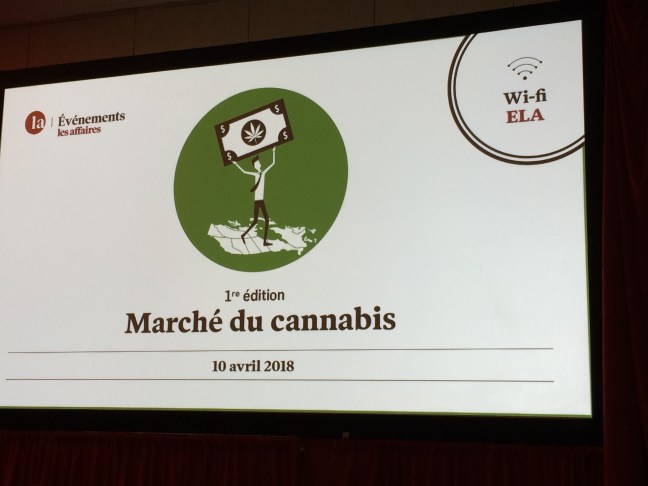
What’s happening with the Liberal promise to legalize the recreational use of marijuana by this July? When will edibles be legal? What’s the story on pot-impaired driving? To find the answers and to see where this budding industry is at, I attended the April 10 Marché du cannabis, a day-long Les Affaires symposium on Canada’s weed industry.
Speakers and panels covered the horizon, ranging from regulatory issues and public health concerns to branding, marketing, packaging and consumables. Some 300 participants included Canada’s three largest growers and an expert on the exploding market in consumables — edibles and other alternatives to smoking.
Quebec municipalities are concerned with three laws: the federal C-45 and C-46, plus Quebec’s Projet de loi 157, now undergoing article-by-article study by the Commission de la santé et des services sociaux. No dates are set for the second or third readings.
Quebec has adopted an incremental approach to legalization that will not include many of the freedoms found elsewhere in Canada.
C-45 and C-46 are before the Senate Committee on Social Affairs, Science and Technology, last stop in the approval process that began last July. The committee’s vice-chair Sen. Pierre Hughes Boisvenu told a recent Conservative party gathering he doesn’t see recreational cannabis made legal until January, 2019.
C-45 gives Ottawa exclusive right to licence growers, processors, exporters and all aspects of branding, labelling and distribution. Medical and recreational pot will be delivered in similar packaging; advertising and promotion will be subject to tobacco rules. The fast-growing markets in edibles and alternative-delivery systems (nebulizers, etc.) will have to wait a year while the feds and provinces work through problems.
C-46 sets out testing procedures, impairment levels and penalties for drug-impaired driving. Canadian police forces will be required to equip their patrols with “spit kits” as well as roadside alcohol breathalyzers. The kits test for THC, cocaine, and methamphetamine. As with alcohol, those who fail roadside spit tests are subject to further testing, with one level for summary conviction and a higher level leading to a criminal conviction.
There was general agreement court challenges are a near-certainty, especially in Quebec where PL157 mandates a zero-tolerance level for THC, whereas the rest of Canada is proposing a 25-nanogram roadside test threshold to separate seriously impaired drivers from someone who might have consumed within in the past 24 hours.
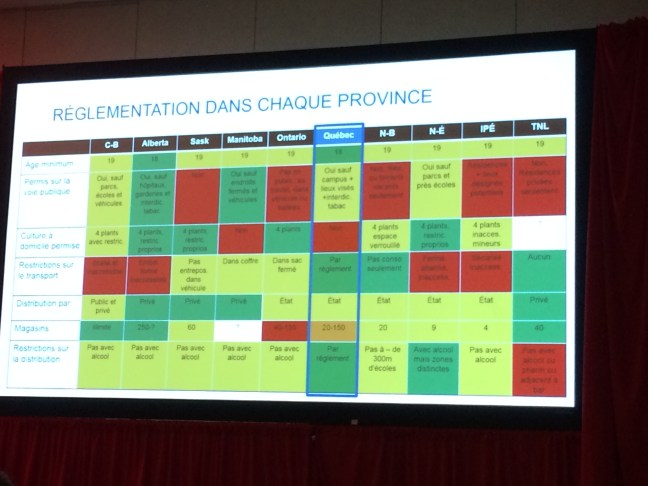
Quebec and Manitoba are the only two provinces to ban all unlicenced grow ops, even those with the federally allowed four-plant limit. Ottawa says federal law will apply; Quebec doesn’t agree.
Ottawa and the provinces generally agree on the need to control the black market by keeping the market price as low as possible. Under federal law, individuals would be allowed to grow up to four plants. However, Quebec and Manitoba have chosen to prohibit home cultivation altogether, despite the four-plant limit allowed under the proposed federal law. If their prohibition is challenged in court, Justice Minister Jody Wilson-Raybould has said the federal law will prevail.
The feds are giving the provinces wide latitude in deciding how recreational cannabis should be distributed. Quebec and Alberta propose to make 18 the legal consumption age; the other provinces are all 19. Five provinces, Quebec included, will control distribution and sale through their own retail networks.
Under PL 157, Quebec has created a distribution arm of the SAQ, the Société québécois du cannabis (SQC), to oversee the purchase of 62 tonnes of bulk weed annually from federally licenced growers. It will be sold in 20-150 stores, but as with all of Quebec’s initiatives under PL 157, timing is up to an oversight committee mandated to advise the government on every step of the legalization process.
Under the terms of a $5 billion contract announced this past week, Quebec’s sole licenced grower, Gatineau-based Hydropothecary will supply the SQC 200,000 kilos over five years. By then, Hydropothecary is hoping to have 63 products — cannabis and its derivatives in every delivery form — ready for the legal consumables market.
Aurora’s Envoy is a self-contained miniature greenhouse, complete with grow lights.
Gadgets and consumables were the big draw on the convention floor. Aurora was showing off Envoy, a self-contained miniature greenhouse. Hydropothecary showed off Elixir, a sublingual nebulizer delivering a minty THC/cannabidiol blend and Decarb, an edible THC/CBD capsule or mixable powder. Benefits are never spelled out; federal law prohibits unsubstantiated medical claims and the medical profession is generally wary of the hype surrounding cannabis’s real and/or imagined medical uses.
Marijuana contains more than 100 cannabinoids, but is grown for two principal ingredients — tetrahydrocannabinol, or THC, and cannabidiol, or CBD. THC is psychoactive — it gets you high by binding to certain receptors in the brain. CBD binds to different brain receptors and is medically available in Canada (Sativex) for the treatment of multiple sclerosis symptoms. Research is attempting to determine CBD’s efficacy in the treatment of other conditions ranging from multiple sclerosis to epilepsy.
Producers and transformers have lined up an array of products to coincide with both legalization deadlines: smokable weed and cannabis-based consumables.
Panels:
Effects on Quebec cities and towns
— Alexandre Cusson, president of the Union des Municipalités du Québec and mayor of Drummondville
— Robert Beaudry, Montreal executive committee member
Major concerns: One-law-fits-all edict, SQC big-footing local government on traffic, zoning, permit and derogation issues. Every municipality is different, with different policies based on what its citizens want.
$60M: Estimated up-front cost to Quebec municipalities for first two years of legalization. Represents police training/equipment, job site (HR) training/enforcement.
$1.25/resident: Recurring enforcement and social costs that should be borne by Ottawa. Municipal/regional police forces will be saddled with costs of enforcing ban on unlicensed cultivation and public cannabis use. Municipal/provincial courts will bear cost of prosecuting offenders. Instead of grow-op ban, UMQ, Mtl. propose $250 four-plant licence.
Scientific research into cannabis
— Dr. Mark Ware, doctor in family medicine, McGill professor and DG of Canadian Consortium for the Investigation of Cannabinoids
— Dr. Serge Marchand, doctor/researcher, Université de Sherbrooke and research director, Fonds de Recherche du Québec — Santé
— Dr. Bruno Battistini, cardiologist and PDG New Brunswick Health Research Foundation
Major concerns: Legalization will turn Canada into a huge social and medical experiment before the medical profession is set up to measure the effects on individuals and the healthcare system. Doctors reluctant to refer patients for clinical studies and trials, especially in Quebec where the College des medicins discourages its members from writing medical pot prescriptions. Ware: The problem isn’t in recruiting patients, it’s recruiting doctors to participate in a study.
Studies underway: Is CBD a medical magic bullet? Which markers determine whether someone will respond well to the molecule and who might be genetically predisposed to psychotic or allergic reactions to cannabis? Why do men and women respond to molecule differently? Canada needs to invest in research now, before the U.S. jumps in.
Risk vs. potential
— Adam Greenblatt, Canopy Growth
— Pierre Killeen, Hydropothecary
— Andrea Paine, Aurora Cannabis Inc.
Reps for Canada’s Big Three commercial growers talked about the regulatory logistics and cultural challenges. Greenblatt, co-founder of Santé Cannabis, the first medical pot dispensary in Montreal, complained about the stifling regulatory atmosphere in Quebec. Hydropothecary’s Killeen was far more conciliatory, understandable in light of the SQC’s huge buy from his company later in the week.
Takeaway: They’re all happy to be pioneers in an emerging industry where publicly listed corporations are already trading at valuation levels untethered to real market value. Whatever happens, they’ll each make millions.
Individual speakers:
The market for consumables
— Sylvain Charlebois, Dean of of the Faculty of Management, Dalhousie University
Central message: The market for consumables will dwarf the demand for legal pot. Ottawa and the provinces have agreed to delay legalization of consumables for one year after the recreational use of cannabis is legalized. Health Canada’s central message: ingest, don’t smoke. 81% of Canadians are ready to try edibles. Charlebois predicts a $5 billion market, especially in Quebec where surveys show people demonstrate a more evolved understanding of edibles.
Charlebois, an acknowledged food marketing expert, noted that cannabis combines well with a wide variety of foodstuffs and can be processed into a wide range of products — butter, spices, oils and baked goods.
Quebec’s policy in response to the emerging consumables market is unclear. Quebec’s minister responsible for PL157 has expressed concern over the marketing of THC concentrates known by their street names — shatter, wax, honeycomb, dab, hash oil. While cannabis THC levels are below 30% because of the plant’s own inherent limitations, transformers can produce concentrates of up to 90% THC.
Health Canada status report
— Benoît Séguin, manager, national compliance and enforcement section, Office of Medical Cannabis, Health Canada
As the result of public hearings into C-45, Ottawa will now allow the licensing of microfarms (200 sq. metres). Microproducers will be required to sell output to licensed producers or transform their output (up to 600 kilos, representing the average output from 200 square metres) themselves.
Untapped market potential
— Barinder Rasode, National Institute for Cannabis Health and Education
Main point: Cannabis marketing is missing an huge target — women and minorities. This 49-year-old former Surrey, B.C. two-term city councillor was the only speaker to discuss why she uses cannabis — to enable her to sleep. Women aren’t interested in recreational use and place more importance on word-of-mouth than any other form of marketing. They favour edibles and other consumption alternatives over smoking and vaping.
Rasode noted the role of cannabis in traditional Chinese and ayurvedic (southeast Asian) medicine and the need to explain in those terms why Canada is proceeding with legalization. This market is more concerned with how and where the product was produced. They’re uncertain, confused and seeking a more evolved message.
Others I spoke with:
— An actuary for Intact Insurance. He has major concerns with the federal legislation and appreciates Quebec’s incremental approach. He echoed Montreal executive committee member Robert Beaudry, who noted during his panel that Montreal is Quebec’s largest employer and has to develop a policy covering marijuana in the workplace that doesn’t conflict with collective agreements.
Intact anticipates a conflict between impairment levels permitted in the Criminal Code and levels being proposed in Quebec’s Highway Code.
C-46, the federal legislation, proposes a roadside saliva test level of 25 nanograms for THC and 50 nanograms for cocaine or methamphetamine. Roadside test levels were set deliberately high to reduce the inevitable lawsuits. Once at the station, however, a 2-nano reading is sufficient for a summary conviction and 5 nanos a Criminal Code violation, with sanctions similar to those for blood alcohol levels in excess of .08.
Quebec’s proposed changes are far more draconian, with zero tolerance for drug impairment and an automatic 90-day licence suspension on the spot.
— James McMillan, Hydropothecary VP of business development. He said Hypothecary will be signing production agreements with micro producers to deliver the volume of cannabis the company anticipates requiring once consumables are legal. Any Quebec municipality with unused farmland would have an inside track at meeting the demand. He invited members of council to visit the company’s facility in Gatineau.
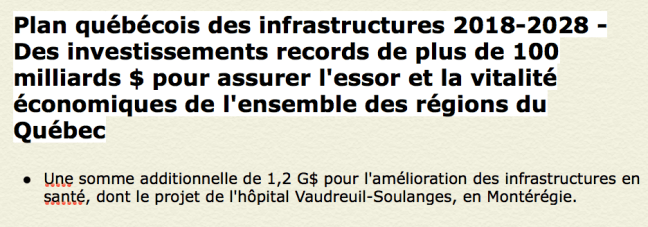
Above is a screen shot taken from Quebec Finance Minister Carlos Letaio’s 2018-2019 budget tabled this afternoon. Where was the Vaudreuil-Soulanges hospital project for the past 10 years before it entered the planning stage?
I don’t know about you, but I’m not getting a good feeling about last week’s Vaudreuil-Soulanges hospital announcement made by Premier Philippe Couillard, Health Minister Gaètan Barrette and our region’s two Liberal MNAs Lucie Charlebois and Marie-Claude Nichols. According to today’s Liberal 2018-19 budget, the hospital is ‘now in the “planning stage” in the 2018-2028 capital investment plan. Where was it prior to last Thursday’s announcement? What went on during those 10 years since former health minister Yves Bolduc made the initial promise?
Four months as a municipal councillor have taught me the tricks governments use to kick an election-promise can down the road. Posting them in a capital investment wish list is a sure-fire can-kicker.
Maybe I’m using the wrong metaphor. Instead of kicking the can, what about badminton with the bureaucracy? We’re the bird being whacked back and forth.
My last blog Political Improv was written following last Thursday’s announcement, described above on the website of the SQI, the government’s real estate development arm. Since then, I’ve come to reflect on why I concluded the event was improvised. It was the absence of documentation.
Whenever the provincial government has a significant announcement to make, there’s a snowstorm of releases beginning with the invite to a news conference. Journalists attending tare greeted with media kits. Usually there’s a page on the announcement and a page or two of briefing notes. If more than one elected official is present, one also gets copies of speeches to be checked against delivery.
These media kits are assembled by the press attachés for the porteur du dossier, the ministry or agency under whose authority the announcement is being made, with input from their colleagues in the political sphere. In this case, the media kit should have included a statement from Couillard’s office, an explainer from Barrette’s people and comments from both MNAs, one of whom is also a cabinet minister.
The invite came from Yves Masse, president-director-general of the Centre intégré de santé et de services social de la Montérégie-Ouest. I received mine on my town email March 20. It was headed Annonce importante concernant les soins et les services de santé offerts sur le territoire de Vaudreuil-Soulanges but gave no details about who would be making it. The lack of paper says to me Masse and his people have as much enthusiasm for building this hospital as Vaudreuil-Soulanges residents have for voting Liberal. Quebec’s health and social services bureaucracy doesn’t take kindly to being ordered to work at anything more than a snail’s pace; 2028 may be optimistic.
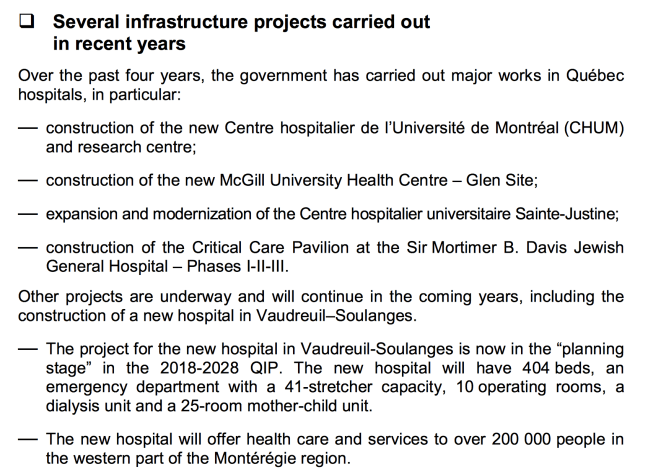
So here we are on budget day evening, attempting to parse what, exactly, the government has announced in regard to a Vaudreuil-Soulanges hospital. Above is what we THINK is the envelope for the purchase of the site on which the hospital will be built. Is it?
I’m one of those who feels Finance Minister Letaio and the Couillard Liberals have done an exemplary job of cleaning up Quebec’s finances and putting this province back on the road to prosperity. Ex-Quebeckers visiting from outside the province can’t believe the number of public and private construction projects in Quebec’s major cities. But for whatever reason, the Couillard Liberals have neglected the Montérégie-Ouest, the tail on the Montérégie donkey with its head in Longueuil.
It makes no sense to me that the Liberals would deliberately turn their backs on Vaudreuil-Soulanges, a district which contains two ridings that have consistently voted Liberal for decades. But the lack of efficient public transit, no replacement date for the crumbling Île aux Tourtes bridge and a list of other deferred promises speak for themselves.
The Liberals could pull off a win in October’s election, but it won’t be with weasel words and bureaucratic code for “let’s kick this sucker down the road for another 10 years and see if those rubes in Vaudreuil-Soulanges are as stupid as they seem.”
Fool us once — shame on you. Fool us twice — shame on us.
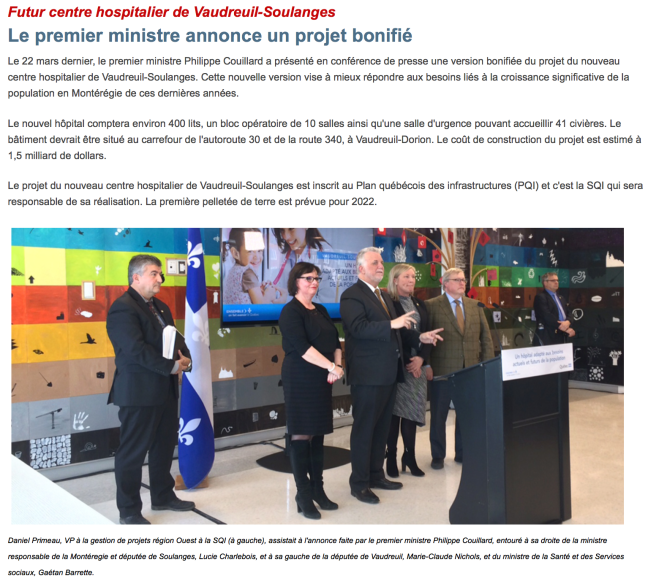
From left, Vaudreuil-Dorion mayor Guy Pilon, Vaudreuil MNA Marie-Claude Nichols, ealth Minister Gaètan Barrette, Premier Philippe Couillard, Soulanges MNA and Treasury Board vice-chair Lucie Charlebois, Vaudreuil-Soulanges prefect Patrick Bousez, Yves Masse (standing).
Improv theatre has its place, but at the announcement of a $1.5 billion hospital for Vaudreuil-Soulanges? I’m referring to Tuesday’s (March 22) reveal by Quebec premier Philippe Couillard that his government would finally be getting around to build a 404-bed facility to serve the county’s 150,000 residents.
This should be a vote-getter in Vaudreuil-Soulanges. Back in August 2008, then Liberal health minister Yves Bolduc gratified the region’s healthcare structure with an unscripted promise of a 250-bed hospital by 2018. Shortly after the Liberals retook power, Couillard walked Bolduc’s blurt back with his own vague non-promise at a February 2014 appearance. Couillard’s health minister Gaètan Barrette tried to play it both ways with an April 2016 announcement that $16M had been earmarked for acquisition of a site. The money was never appropriated and the site, still agriculturally zoned, was somehow removed from the regional master plan.
Those following this file have become cynical, inured, jaded, fatigued disbelievers after a decade of blabla, especially whenever they’re forced to seek emergency services. Valleyfield? Eastern Ontario? Lakeshore? Downtown? My Louise calls it Loto ER. As I write this, Valleyfield’s Hôpital du Suroît, the ER for more 200,000 Vaudreuil-Soulanges residents, is at 268% capacity. Thirty patients have been lying on gurneys in the corridors for up to 24 hours. Another 19 have been there for up to 48 hours. It’s the hands-down winner of Quebec’s palmares de débordement, our imaginary award for the most overcrowded ER in the province.
Whenever I feel a pang of pity for our local MNAs I remind myself of family and friends wasting hours waiting for to be seen by overworked caregivers while this government chose to ignore our plight.
Thursday’s news conference was called in haste, I suspect because the committee which has been lobbying for the hospital for close to a decade ramped up the pressure by making it an issue in this October’s provincial election. Polls show François Legault and the Coalition Avenir Québec leading the Liberals in voter intentions by as much as 20 points. Premature, yes, but Liberal support is trending the wrong way. The Liberals don’t share their internal polling but the storm of comments on social media suggest Vaudreuil-Soulanges voters are royally pissed — in both languages.
Whatever, Couillard began on the defensive. “Your deputies fought for this project…cost is immaterial because of the need in the region…we’ll prioritize every step.” A site, currently zoned agricultural, has been identified at the junction of blvds. Harwood and Cité des Jeunes and $16M squirrelled away for its acquisition. (Look for it in Tuesday’s budget.) Quebec will call for tenders in 2019. Construction will begin in 2022, with a late 2026 completion date. The hospital will have 10 operating rooms and 94 surgical beds, 44 psychiatric beds, 24 paediatric beds. A 25-bed obstetrics ward will be able to handle 2,000-plus births a year. More than half the beds would be earmarked for general medicine.
Couillard and Barrette skated hard in explaining the rationale for the 10-year delay. Forget that 250-bed hospital, they said. It was wrong from the start. What happened at Pierre Legardeur, a 250-bed hospital that should have started with 400 beds, won’t happen to you. We took the time we needed to give you the right hospital, adapted to your needs. Barrette: “We can dig a hole tomorrow, but it’s for a hospital, not a quarry.”
Later, Barrette would claim the delay was entirely his fault and reportedly said that if he loses, he’ll return here to work for the new hospital. That, together with Couillard’s explanation of how the government can decree the rezoning of the site from green to white and place the approval process beyond the reach of whichever government succeeds his, suggests to me the Liberals are hearing CAQ footsteps.
The most emotional intervention was that of Soulanges MNA Lucie Charlebois, whose portfolios include the Montérégie, Rehabilitation, Youth Protection, Public Health and Healthy Living. Charlebois, whose riding now includes the Town of Hudson as the result of the latest electoral redistribution, is also vice-chair of the Treasury Board and a member of the Cabinet Committee for Social, Educational and Cultural Development. In other words, Charlebois, one of the highest ranking women in Couillard’s cabinet, can count on an historically Liberal vote from Hudson and St. Lazare. I would have thought a Vaudreuil-Soulanges hospital would have been a cabinet priority, if only to sweeten Charlebois’s and Nichols’s re-election chances in two ridings the Liberals can win.
Instead, Charlebois appeared to lash out at those who questioned her government’s handling of the hospital file. “Are you happy now?” she asked Louise Craig, the English-language spokesperson for the Comité tripartite pour la construction de l’hôpital de Vaudreuil-Soulanges lobbying for the hospital. She and Nichols called for a ‘grand collaboration’ to get everyone working together for the common good. “Too little, too late,” I thought to myself.
The invite for the news conference was sent out over the signature of Yves Masse, president-director-general of the Centre intégré de santé et de services social de la Montérégie-Ouest. Quebec’s bureaucracy does its utmost to remain apolitical. We could debate whether this was a political announcement but the message I got was that Masse would have preferred being stuck behind an accident on the Ile aux Tourtes bridge with no gas and a full bladder. It falls on his CISSSM-O to cover the ER shortfall in Vaudreuil-Soulanges for the next eight, nine or 10 years.
My advice to all: do whatever it takes to remain healthy — and thank your lucky stars if you live in a community with First Responders. If not, pray the ambulance gets there in time.
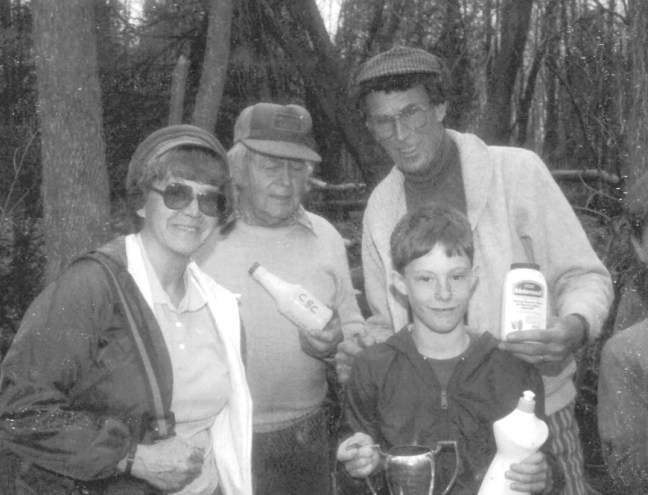
Hudson’s distinct culture: The annual Viviry Bottle Race was one of those events that made Hudson a special place for families. If Hudsonites don’t believe Hudson is special, who will?
There’s a FB discussion underway, sparked by a post asking people which of Hudson’s neighbours we should amalgamate with if we had to. The three choices were Vaudreuil-Dorion, St. Lazare or Rigaud.
Even having this discussion disturbs me. I see amalgamation as an admission of failure on Hudson’s part. Sure, we could merge with V-D, St. Lazare or Rigaud. V-D is out of developable land, always short on water. St. Lazare needs water, thinks a merger will confer bilingual status and is ready to discuss cost-sharing services. Rigaud needs water and likewise would be open to sharing costs.
Whoever, their residents would be asked to vote to assume our long-term debt and other obligations. An absolute majority of Hudson residents eligible to vote would have to approve the deal. It would be as ugly and divisive as Hudson’s original 1968 merger of the Three Villages.
Maybe people are past caring whether Hudson would be able to retain its bilingual status, but I can’t help wondering how that would work if we became part of one of our officially unilingual neighbours. Vaudreuil-Dorion got whacked by the OLF for offering online services in English. St. Lazare can’t even post the word “Welcome” without someone filing an anonymous complaint. Earlier this year I had a conversation with a St. Lazare official who told me a merger would bring them close to the 50% English mother tongue designation required for bilingual status. They pointed out the social ties that already bind the two communities as sufficient reason to talk. One can hear the touche-pas-a-la-loi-101 wagons circling as I write this.
I see Hudson’s bilingualism as a huge asset, especially with a new hospital coming to our region some day. Francophone families move to Hudson because they know their kids will grow up bilingual even if they aren’t allowed to attend English schools. The only other town in our region where you’ll find that is Pincourt, the second of three officially bilingual towns in the MRC (the other is L’Île-Cadieux).
Instead of fantasizing about our next relationship, let’s make a vow to work at the one we’re in. By all means, let’s talk about an inter-municipal water board and how we can obtain federal and provincial funding for a treatment facility drawing drinking water from the Ottawa River. Let’s explore how we can share administrative services and work together for regional arts funding.
Hudson has marched to its own drum for as long as I remember. It’s time Hudson started walking in step with our neighbours. But I see no point in discussing the terms of our surrender.
Just because there’s no cash exchanged doesn’t mean it’s not a conflict of interest.
If you’re following national politics, you’ll know why Finance Minister Bill Morneau and the Trudeau Liberals are being accused of ethics breaches. There’s a perception out there that Morneau’s family firm will benefit from proposed changes to how Canadians are taxed.
It’s the latest twist to a Canadian cliché: a principled businessman is ensnared in an ethics trap of his own making because he trusted those around him to advise him on what the Big Book of Rules says.
It’s no different in Quebec politics. Liberal MNA Guy Ouellette and his associate Annie Trudel, arrested by Quebec’s crime-busting UPAC, are claiming it’s because they were closing in on a conspiracy between UPAC’s top brass and the Autorité des marchés financiers to shake down corporations hoping to bid on government contracts. If UPAC wins this one it’s because they have the rules on their side.
We come to local municipal politics. Hudson has a reputation for playing fast and loose with the rules that has earned the town unfavourable audits year after year. Last year’s Quebec Municipal Commission hearings exonerated the mayor and elected officials — but hammered the former DG for not explaining the rules to a naive council with no prior experience in municipal governance.
We don’t want to pass that way again.
Politics is all about perception. One of the candidates for mayor in the last municipal election did business with the town. He was rejected by the voters regardless of his other qualities.
This election, ask yourself this: does this candidate have any financial ties to the town? Does that candidate stand to gain as the result of his or her position?
Quebec’s rules governing fiduciary interests are strict and straightforward. The mayor and councillors must declare their holdings and allegiances, including contracts with the town. When the caucus begins a discussion involving a file in which the mayor or councillor has a real or potential conflict of interest, he or she has to leave the room and it must be so noted in the caucus minutes.
If the file generates a resolution, the mayor or councillor must abstain from the vote at the public council meeting and explain to the assembly he or she is in a potential conflict of interest.
What constitutes a conflict of interest? It could be as innocent as the desire to see a municipal building converted from one use to another to benefit one’s colleagues. It could be lobbying fellow council members to approve a project of benefit to one’s clients.
One of the first things awaiting Hudson’s next council is an intensive seminar in the role of elected officials and the rules governing every discussion, deliberation and decision. Anyone who hasn’t attended council meetings regularly will be at an automatic disadvantage.
Words don’t count, especially fatuous generalizations and vague promises uttered in the course of an election campaign. Actions — and conflicts of interest — do.
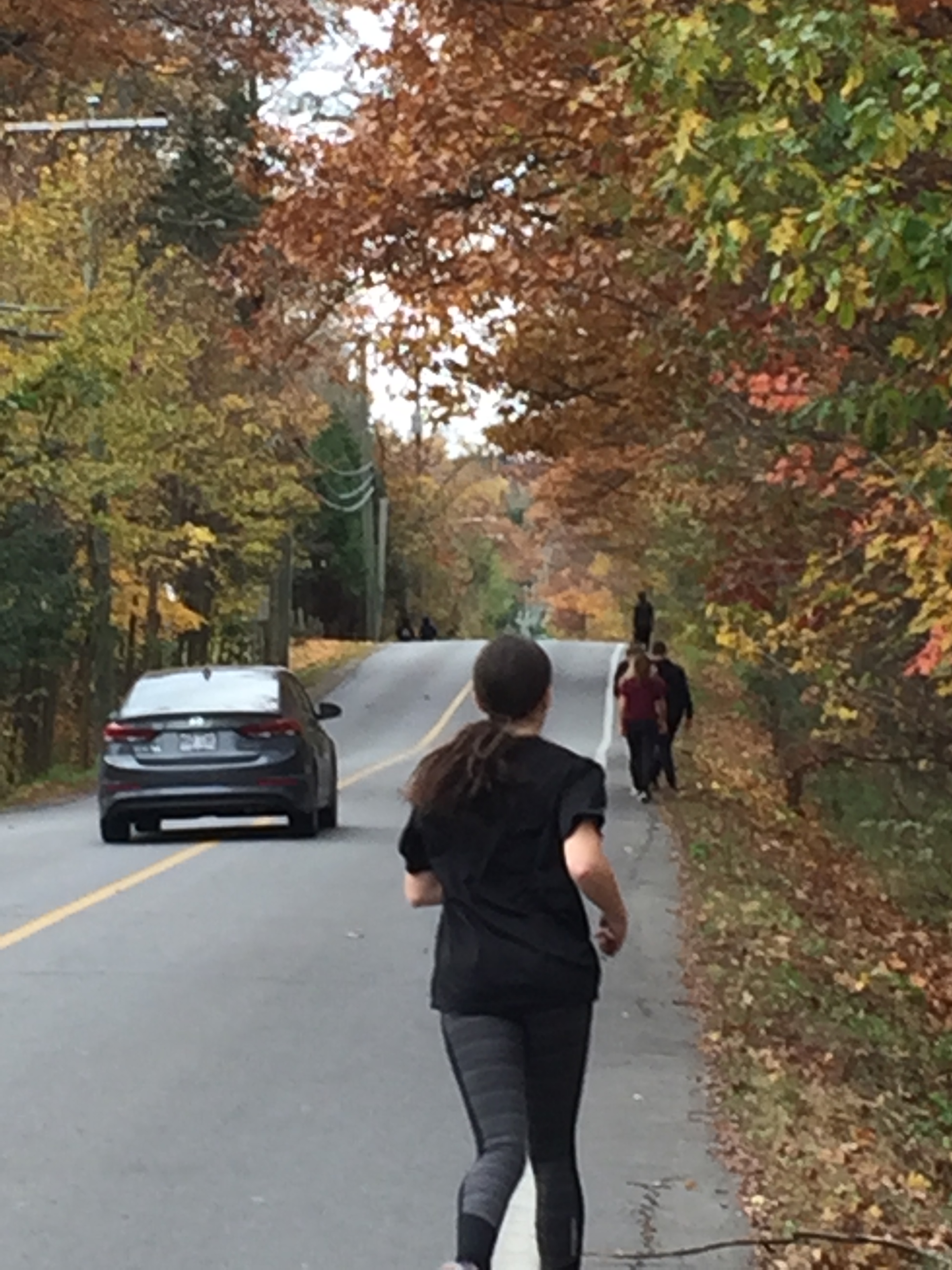
WSHS students out for a morning run on Côte St. Charles. What will it take to change public thinking on Hudson’s need for secure pedestrian/cycling corridors?
You’re looking at one of the biggest public security risks in Hudson, the absence of sidewalks and/or cycling paths on the town’s main streets. Here, a pack of Westwood Senior runners heads south on the two-foot-wide security strip along Côte St. Charles. A driver pulls wide around them near the crest of the hill. The driver won’t be able to see oncoming traffic until the last possible moment.
There have been a number of near-death experiences on Côte St. Charles. One involved a hit-and-run transport rig, another a school bus. Miraculously, nobody has been seriously hurt.
Cameron is equally dangerous, but for different reasons. The intersection with Harwood/342 routinely sees near misses as westbound vehicles in the Hudson turning lane conceal vehicles continuing west. Drivers waiting to turn left or right on Harwood sometimes don’t see the second vehicle until after they’ve begun their turn. Accidents are routine.
Cyclists and pedestrians avoid Cameron’s so-called bike/pedestrian path like the plague because they risk being trapped between traffic and the curb. Vehicles heading up the hill are often forced all the way over to the curb by oncoming traffic at the sharp downhill turn.
Over the past month I’ve spoken to scores of residents who resent having to risk their lives to go for a walk that includes being exposed on Cameron, Côte St. Charles and many parts of Main Road. They can’t let their kids walk to school. They can’t bike together as a family. They look with envy at the pedestrian-friendly, bike-friendly streets of St. Lazare and Vaudreuil-Dorion.
The one thing the town has always had in abundance are excuses for why residents can’t enjoy safe cycling and walking. The first conversation I remember took place when Elizabeth Corker was mayor. There’s no room for a right of way. We’d have to expropriate. We don’t want to take setbacks from residents. I remember hearing those same excuses at St. Lazare town hall meetings. The people who gave them were kicked out of office, but it took the tragedy of Patricia Jolicoeur’s grievous injury and a life-changing criminal record for a reckless young driver to change public thinking.
Safer streets can be incorporated in the promised repaving initiative, but it requires planning to do it as cheaply as possible. Ditches need to be excavated, storm drains and culverts installed, then backfilled and paved. Once wands or other removable separation devices are added, Hudson’s pedestrians and cyclists can walk and ride safely.
None of this happens by wishful thinking. The $1.5M road repaving loan bylaw presented last week is a drop in the bucket. But if we don’t get serious about making our streets safer, nothing will happen until something tragic does.
Earlier this week, a resident sent me this question on FB Messenger:
I live in the area formerly known as “Como” even though when I bought my house, it is Hudson. I notice in writings, such as your recent interesting article on WordPress people who have lived in Hudson a long time always have to refer to an address here as “in Como” ex: Thursday’s council candidates round table, 7:30 at St. Mary’s Parish Hall in Como”. When I meet my kids’ friends parents at Mount Pleasant and I mention where I live, many who are from here say “oh, you are in Como”. Why does that happen? Was there a cultural or economical divide between “Como” and “Hudson” that people who have lived here a long time need to make a comment? As a “newcomer” of 15 years, I am hoping you can shed some light on something that has always puzzled me. I pay Hudson taxes and will vote in the Hudson election. Just curious.
Here’s my response:
Prior to 1969 Hudson, Hudson Heights and Como were separate villages. Each had its own mayor and council and sent out its own tax bills. Each had its own post office and railway station (Hudson Heights also had Alstonvale and Choisy stations).
With the completion of the Trans-Canada Highway n the early ‘60s, the Three Villages saw an influx of new residents and developments such as Fairhaven. Their respective councils came to realize they shared a number of common concerns, the biggest being water.
In those days the residents either had their own wells or were supplied by a private company, Suburban Water. Suburban’s wells, reservoirs and aqueducts were old (pipes were a mix of lead, iron, steel, asbestos, even wood and dead animals occasionally tainted the open reservoirs). House fires were frequent in those days and there were no hydrants. Volunteer firefighters had to draft water from the lake.
Talk of merging the Three Villages was not new, nor was resistance. Heights residents saw little benefit other than water. Fiercely independent, Como had its own business sector and no interest in amalgamation.
Hudson had the most to gain because it had most of the region’s businesses.
In 1965, Hudson was a thriving regional shopping destination, with three grocery stores, four hardware outlets and dozens of businesses, even a sock factory. St. Lazare was a small agricultural community featuring some of Canada’s best-known riding stables and not much else. Vaudreuil was a summer community; Dorion, a separate municipality, was a truck stop.
We lived in Hudson Heights. My father and like-minded residents believed the three villages stood to gain from a merger. In 1961 my dad bought the only local newspaper, the Hudson Gazette, to campaign for amalgamation. It was a long, bitter battle. The Yes side won the 1968 referendum by a narrow majority. My father was seen by many Heights old-timers as a traitor because he challenged the discrimination that still prevailed throughout Quebec. (Irony: those social distinctions live on in the names of Hudson’s six electoral districts half a century later.)
Once the merger was law, negotiations began to buy the waterworks from Suburban Water and to install new water lines and fire hydrants. The town acquired new fire trucks and built the firehall that parks and recreation now uses.
The merger debate created grudges that remain to this day. If you have the opportunity to talk about this with old Como residents, you’ll occasionally get an earful on a bad day, when something triggers old memories.
There’s a longer version of the merger history. Back in 1999, when millennium projects were all the rage, I began my own, a recent history of Hudson, Hudson Heights and Como written from the Hudson Gazette’s archives, beginning in 1950. The Gazette Vaudreuil-Soulanges Millennium Project ran as 50 weekly instalments. Here are my Millennium Project columns covering 1966-1969:
1966
1966 blew in with astounding news – Ron Alloway, the nice guy who bought a place from Perry Bedbrooke in Mountain Ranches, turned out to be Charles Wilson, one of the members of the gang that stole close to $20 million from a British mail train carrying bags of worn-out currency for eventual destruction. The train’s engineer was beaten into a bloody pulp by the thugs during the robbery.
Arrested, tried and convicted on the word of informers, the gang split up and fled to different corners of the world after escaping from a Birmingham prison in 1964, a year into 30-year sentences.
Wilson, his ‘pretty blonde wife Pat ‘ and kids made their way to Canada via separate routes and settled in the Heights in the Pyke cottage before moving to Mountain Ranches.
He was a real charmer, read the Feb 1. Lake of Two Mountains Gazette. He paid his bills promptly, had a friendly wave for even his most casual of acquaintances, was a welcome member of Whitlock Golf and Country Club and was never known to have anything but a cheery smile on his face.
The only suspicion was how Alloway made enough money to support the house in Mountain Ranches, a wife and three kids. Locals were miffed that Alloway had conned them, but that didn’t stop them from hiding Mrs. Alloway and the kids from the hordes of British tabloid journalists that descended on the area like a pack of baying hounds.
In fact, Gazette publisher Ron Jones ended up removing a rifle and shotgun lying on the bed in the master bedroom – as if Wilson had been contemplating a last stand. Jones phoned various police departments, but nobody was interested in safeguarding the guns, let alone guarding the Alloway home from curious intruders.
At first, locals wanted the kids to be allowed to stay in Hudson. But as Ron wrote in an editorial, what about the children growing up in a community where everyone knows what and where their father is? We can’t curb the tongues of everyone, we can’t shield the children from the jibes of ‘jailbird kids’ they will inevitably receive.
That brought Ron a righteous blast at the next council meeting from both Heights Mayor David Aird and Chief Charlie Pooley, both who counted Alloway among their acquaintances. Their biggest beef – Ron’s characterization of Pat Alloway’s cockney accent and his suggestion that local kids might be bullied.
Amalgamation inched its way a step closer with a massive report that discovered that there would be (a) no major financial effects from a merger; (b) better services and (c) easier zoning. In fact the biggest debate was over what to call the new beast.
1968 marked the beginning of a Canadian motoring era – the first Toyotas went up for sale at the Village Pump and immediately were adopted by the rally crowd….meanwhile, Dolly, the old red Volks towed onto the ice off the government wharf, finally broke through and plunged into the lake. You could buy into a pool at the local Legion – before it was decided Dolly was an affront to Quebec’s environmental protection and gambling laws. Another Hudson tradition died.
What was to have been a gala Friday-night dance at St. Thomas School to mark the rebirth of Hudson’s Club des Jeunes turned into tragedy October 7 when 19 young people died in a bus-train crash in Dorion; Hudson police were bombarded with calls from anxious parents as news of the horror became known.
Meanwhile, the town was buzzing with the discovery of the body of an 18-year-old Roxboro girl just off Cote St. Charles. Heights’ cop Charlie Pooley turned the case over to the QPP, who refused to confirm reports Linda Blanchette had been strangled.
The Blenkinship homestead, one of the oldest buildings in Hudson, was heavily damaged by fire that October. Built in August, 1844, the house was so badly damaged, it was torn down.
Feelings ran high that fall in the editorials of the Lake of Two Mountains Gazette: The local blood donor clinic attracted 124 donors, far fewer than organizers expected. The Gaz railed on about community apathy.
Meanwhile, local youth including the young Jack Layton were trying to sell the idea of a youth centre as a worthwhile Centennial project for the three communities. The Gaz ran one of their letters on the front page and several more inside; essentially, the kids wanted a hall large enough for an average dance with a stage, snack bar, sound system, tables, chairs and maybe a juke box.
The kids’ demonstrations, letter-writing, even a 600-name petition – fell on deaf ears. The fix was already in; the Centennial Projects board for the Three Villages voted $30,000 to improve Benson Park, complete with wading pool, basketball court and better parking facilities. (One has to wonder what happened to the wading pool, basketball court and parking.)
But local outrage was reserved for a far more hypocritical decision. After coming down hard on Rigaud and the Three Villages for dumping raw sewage into the Ottawa, the Quebec Fish, Game and Tourism Ministry approved a sewage line into the Lake of Two Mountains to get rid of raw waste from Oka Provincial Park – immediately across the river from Ile Cadieux’s water intake.
The Heights had water woes of its own. Local resident John Vipond, whose property sat between Harwood Road and the lake, wrote to the Gaz after being told by Heights councillor Art Grubert to stop whining about a town ditch that was sending torrents of water into Vipond’s basement every time it rained.
Vipond’s beef: He didn’t see how Grubert had the right to tell him it wasn’t Town business. That prompted a flurry of letters suggesting it was okay for councillors to be rude because they weren’t being paid enough to be nice.
Blind pigs: Back in ‘66, locals would have had to drive to Dorion or Hawkesbury to buy booze. There’s no wonder, then, that enterprising locals would open blind pigs where locals could pick up a fifth of their favourite at any hour. Delivery was extra, but business was brisk; the Hudson Gazette reported at least four plying their trade right under the noses of the local constabulary and elected officials.
Amalgamation: The 20-year-old debate to merge Hudson, Hudson Heights and Como was heating up in Three Villages council chambers. But not for long – in December, 1966, someone from the Quebec Municipal Affairs Ministry produced a report showing the cost of running one merged municipality would be less than the bills for the Three Villages. After that, it was just a matter of time.
1967
Hudson Heights rang in Canada’s centennial year with an ugly political battle. At issue was the council’s new master plan that would have called for major changes to the community’s road network. • Ridge Road would be extended westward across Whitlock Golf Club to intersect Birch Hill, Brisbane and eventually Harwood Road; • An area on Harwood Road (now Lower Alstonvale) midway between Main Road and Highway 17 was designated a Civic Centre; • Main Road would be rerouted south of the CPR tracks to connect with Harwood Road, with the current Main Road terminating at a dead end just west of the tracks; • The area between Harwood and Choisy Station Road was to be zoned industrial and for multiple-family dwellings.
Outraged Heights residents banded together. Calling themselves the Citizen’s Committee for a Better Hudson Heights, they descended on the council meeting and forced the council to abandon the master plan – but not without being themselves accused of dirty politics.
The inevitable showdown came when the Citizens’ Committee ran a slate in the municipal elections, the first time the Heights mayoralty had ever been contested. Mayor David Aird faced former Gazette publisher Don Duff in a bitterly-fought election. At issue: Council’s insistence that Hudson Heights needed an industrial park to keep taxes down.
When the votes were counted, the council-backed slate was elected and the Citizens’ Committee gang frozen out – but they won in the end. The Heights master plan was scrapped.
The Three Villages desperately needed another doctor, but eyebrows shot up when Dr. Gilbert Croteau opened the area’s first chiropractic clinic, claiming to cure ’Headache, Bronchitis, Liver, Paralysis, Nervousness, Asthma, Backache, Hemorrhoids, Respiration, Digestion, Lombago and Menstruation’
But nobody could cure what ailed the local Centennial Committee. With barely five months to go to Canada’s Centennial, the local project to revamp the park on Yacht Club Road hit a brick wall in March when Como refused to pay maintenance fees for the proposed fancy new playing fields and chalets. Never mind that a third of the kids who used the existing park were from Como. Never mind that it would cost $6.50 per year per family, raged the editorial in the Gaz.
When July 1 finally rolled around, the Three Villages had done nothing permanent, but it was a fine summer for picnics and plenty of cross-Canada canoeists ended up spending time here.
Another local tradition ended in the Spring of ‘67 – the annual Viviry Creek Bottle Race. Alan Blenkinship, owner of the property bounding the creek, announced that due to the increase in the number of homes, the area was ‘too private’ for a bottle race. He urged organizers to take the race to another local stream, but interest faded. One happy note: Marg Gardner managed to uphold her personal tradition of falling in during the race – 14 of the 15 times she entered.
Insect infestation was a huge problem that hot, humid spring. Tent caterpillars and mosquitoes had locals demanding that Hudson spray the Fairhaven area with DDT and the heck with the birds.
Not so fast, said council – we’re not spraying until residents deal with leaky cesspools – a suspected source of regular outbreaks of infectious hepatitis.
1967 was also the summer that the local constabulary decided to crack down on free-running dogs and unlicenced bicycles. In the case of the hounds, too many kids were having to get rabies shots after having been bitten.
Expo ’67 brought plenty of house guests to the Three Villages, but nary a single lasting Centennial project, thanks to ongoing squabbling about the cost of maintaining an upgraded athletic facility on Yacht Club Road.
But the end of summer was just the beginning for the local horsey set as riders from across Eastern Canada converged on St. Lazare for various equestrian events. It was an open secret that George Jacobsen and other guiding lights behind the Montreal and Lake of Two Mountains Hunt Clubs felt they had the inside track for the upcoming 1976 Olympic Games equestrian events. (They eventually went to Bromont, thanks to the Desourdy family’s courting of Olympic officials.)
There were plenty of complaints about the local car rally enthusiasts. Volvos, Triumphs, Coopers, MGBs – and Steve Thom’s eclectic Mercedes collection – spent weekends hammering along the back roads in St. Lazare and Vaudreuil, kicking up rooster tails of gravel and dust. Whatever the complaints, the Lake of Two Mountains Car Club had enthusiastic members and a column in the LTM Gazette.
There was plenty of new construction off Cameron Avenue, but the best deals in 1967 were in the Heights. Four bedrooms on a big lot with old trees overlooking the lake: $27,500. Mortgages were being offered at 5 1/2 per cent.
Canada’s Centennial Summer did have one local effect – the plaquing of historic properties in the community. First to be plaqued was the rambling white home on Mount Victoria once owned by George Matthews, after whose wife Elizabeth Hudson the town was named. Then came Mullan’s General Store, built in 1824 as a schoolhouse, courthouse and church – on different days of the week, of course.
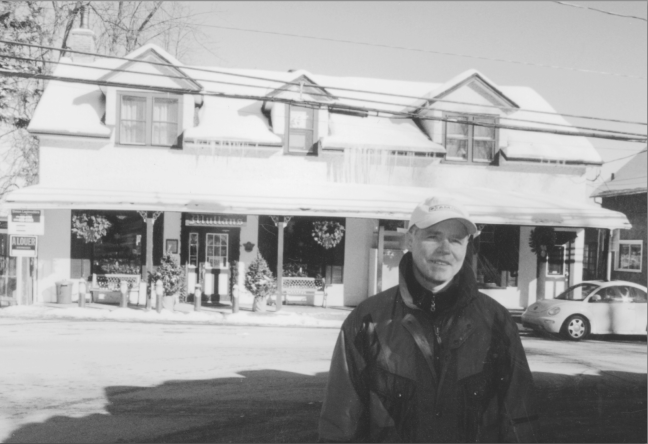
Marcel Patry, the last owner of Mullan’s General Store before its transformation into a private residence.
The plaquing frenzy climaxed early in October, with a plaque-a-thon organized by the Hudson Historical Society and the Women’s Canadian Club. All three mayors and scores of history-minded locals spent an entire weekend unveiling plaques on 17 buildings. At least half of them have since been renovated, destroyed by fire – or torn down to make room for new homes without architectural merit.
The 20-year-old debate over whether the Three Villages should get married continued to drag on. Quebec was pushing these shotgun weddings in order to save money, but Gaz publisher Ron Jones wasn’t impressed with their tactics. One example: The three local councils were invited to a closed-door meeting at Whitlock – and barred Ron. Bad move. His double-barrelled counterblast came in a heavily-slanted article entitled A Nothing Story and in an editorial headed Fusion Confusion.
No wonder Quebec wanted to keep it a secret. Figures released just before Christmas, 1967 showed Hudson Heights would be the biggest tax-bill winner after amalgamation – from $60 per capita, to $46. Como would jump from $35.
That was the fall the Hudson High senior football team won the Greater Montreal Football Championship. Steve Doty’s team, led by team captain Larry Smith’s pass reception, became an HHS sports legend.
But interest in local athletics was dying. Residents resisted any attempt to use any part of their taxes to pay for upkeep of the town rink and playing fields at Benson Park. Not only that – an emergency meeting discovered that although the Athletic Association paid a dollar’s rent on the land, nobody knew who owned it.
1968
After 50 years of endless debate, the Three Villages voted in 1968 to merge into the municipality of Hudson. It took all year.
All three councils held public meetings in April to allow residents to vent their concerns; attendance was poor. In Como, the farmers wanted to keep taxes down but others wanted the roads paved; Hudson was concerned it would have to pay for services in the other two communities. Hudson Heights couldn’t afford to clean its ditches and big landowners were facing enormous tax evaluations.
But when the issue went to a three-village referendum on Wednesday, May 15, Como voted against. Turnout was poor; of the 1220 eligible voters in the Three Villages, only 583 voted. But this was not to be Como’s last word; in September, the town mailed out ballots to its 295 ratepayers. Of the 212 returned, 184 voted yes to amalgamation.
From then on, things happened quickly. In December, 1968, Hudson Mayor George Runnells declined the job heading the new provisional council; Doc Runnells was about to turn 90. Heights Mayor David Aird also declined, making Como mayor George Armstrong Hudson’s provisional mayor.
The Three Villages already had a combined police force by then. Vandalism was on the increase and hardly a week went by that somebody’s car didn’t get taken for a joyride, thanks to the trusting local habit of leaving keys in the ignition. Problem #1 was the cost of full-time policing. So in August, Hudson Heights agreed to merge its police force with that of Hudson-Como. Heights Chief Charlie Pooley promptly retired.
Spring 1968 brought the usual demand that something be done to ‘get rid of’ mosquitoes; some locals still thought the best treatment was DDT. That brought a torrent of angry letters from birdwatchers and one from zoology student Randi Olson, who pointed out that any pesticide is concentrated as it moves up the food chain, affecting birds, fish and other beneficial species.
In the end, it was only Alastair Grant, real estate agent, mining promoter and noted local eccentric, who spoke out in favour of a massive aerial DDT bombardment of the local mosquito population.
Real estate in ‘68 was still a bargain. A nine-room, five-bedroom house on half an acre of mature pine in Hudson was going for $25,000. In Como, Royal Trust agent Donella Darling was selling 20 lots in Hawthorne Park, just west of the Willow, for $3,500 apiece, 10 per cent down. Hawthorne Park? It’s now Leger Lane. Also renamed: Como Station Road became Bellevue Drive after CP tore down the old station.
The summer of ‘68 saw a lot of roadwork – like the widening and repaving of Macaulay Hill, the disappearance of the hump on Cameron at Lakeview and the straightening of Como’s deadly Parsons Corner. It also saw the startup of an employment agency for local teens.Teens Unlimited was given office space at Hudson Heights Town Hall, where residents could connect with local teens looking for odd jobs.
The fall of ‘68 saw another debate pit Hudsonite against Hudsonite. Some locals, including Hudson’s sizeable population of pilots, wanted the federal and provincial governments to build a proposed mega-airport in St. Polycarpe.
Others were aghast at all that noise and traffic.
Don’t worry, Air Canada pilot Alan Mills wrote in the Letters section. The new generation of aircraft is much quieter. Besides, look at all those new jobs we’ll be getting, Mills wrote.
In the end, Mirabel got the nod.
— Millennium Project, by Jim Duff, from Gazette Vaudreuil-Soulanges archives
This bird was cooked slow and low under foil and needed a last-minute browning blast. Thanksgiving’s power failure altered dinner plans for thousands of households.
Four weeks into the official municipal election campaign and I’m hearing about issues that never get mentioned in public discussions. Here’s one we can all relate to.
A Whitlock West couple whose Thanksgiving turkey dinner was disrupted by that Sunday power failure wondered what could be done other than installing a generator. Although their neighbourhood boasts underground power lines, residents are hit by the same power outages that all too often darken the triangle between Harwood Blvd., Alstonvale Road and Côte St. Charles.
Could the Town of Hudson intervene with Hydro Quebec to limit power failures? Hydro Quebec says its crews are in the midst of its ongoing preventive pruning program, but interventions are limited to ensuring a minimum clearance for transmission lines. Hydro pruning crews don’t attempt to identify and fell every tree with the potential to cause outages because they don’t have the resources.
Do Quebec municipalities have a legal responsibility to limit the risk from downed trees? Jurisprudence is scarce. A St. Lazare resident took the city to small claims court after trees along a town-owned Hydro servitude destroyed appliances and knocked out his power for several days. He lost. There was talk of a class action lawsuit but lawyers couldn’t agree on who to sue.
After a town-owned rotten poplar fell on Gabriel Rossy’s car, killing him in 2006, his family fought all the way to the Supreme Court for the right to sue the City of Westmount instead of accepting a Quebec Automobile Insurance Board settlement. They lost, but only because he was in his car. If he had been walking or cycling, would the courts have decided otherwise?
Quebec law holds the property owner responsible for damage if it can be proven a tree was unhealthy or otherwise presented a risk, but who is prepared to waste time and money to track the root cause of a power failure that delayed Thanksgiving dinner?
Property owners have a legal responsibility to manage any of their trees posing a risk to their neighbours. I think the town should set an example by tending to trees on public land with a potential for risk. Right now I’m looking at an otherwise healthy shagbark hickory on the town setback with a crack starting at a bole 25 feet above the pavement. If that branch was to break off, it would take out the neighbourhood power lines and could easily kill someone happening by at that moment.
Hudson is lucky to have a number of tree-care professionals with the experience to judge whether a tree poses a risk and the expertise and equipment to deal with it. A permit is needed to fell a tree more than four inches in diameter, but Hudson’s technical services division is quick to inspect and issue a permit.
Back to the core question: what if anything can the town do to reduce blackouts? Anyone who lived through the ’98 Ice Storm and Hudson’s all-too-frequent blackouts would be curious to know the answer. I know I am.











 thousandlashesdotca