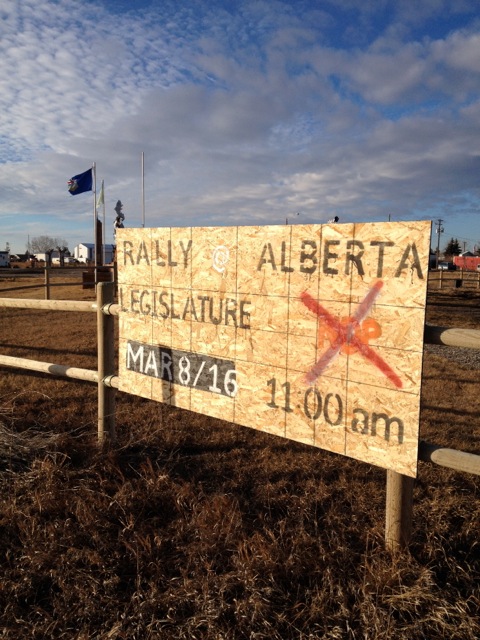
For Albertans like Garth Pritchard, it’s simple math.
In 2016-17, Ottawa will transfer $21 billion to Quebec, including $10 billion in equalization payments “due to the limited relative strength of its economy when compared to other provinces.”* The $21 billion works out to $2,521 per Quebecker.
Despite the collapse in oil prices, despite having cut crude production from 3.4 to 2.2 million barrels a day (and much of that produced at a net loss), despite a 7.4% unemployment rate (topping the national rate for the first time since the ‘80s), despite the loss of upwards of 100,000 full-time jobs since September 2014, “Alberta does not qualify for equalization due to the strength of its economy relative to the other provinces.”* Federal transfer payments in 2016-17 per Albertan: $1,366.
Alberta isn’t the only have province; Saskatchewan, B.C. and Newfoundland/Labrador likewise receive $1,366 per citizen because of the relative strength of their economies.
*(You’ll find all this and more on the Ministry of Finance website, http://www.fin.gc.ca/access/fedprov-eng.asp)
Even Ontario gets more per capita — $1,532 — beginning in 2009-10 “due to the limited relative strength of its economy when compared to other provinces.”
What was once a financial tool to overcome regional disparities has become a political boondoggle and a reflection of rural Canada’s impoverishment. New Brunswick will get $3,626 per citizen; Nova Scotia $3,240, the Yukon $24,333, NWT $28,351 and Canada’s transfer-payment winner, Nunavut – $40,364.
Late last week, Trudeau’s damage control team assigned the publicity-hungry PM to pay a visit to Alberta’s NDP premier Rachel Notley. In his pocket was a $250 million EI topup so that laid-off Albertans will get the same benefits and be governed by the same eligibility periods as EI recipients in most of Canada. Nary a word about the transfer-payment structure which created the double standard in the first place, because that would have called into question Alberta’s status as one of Canada’s three remaining ‘have’ provinces.
“Jimmy, $250 million would not start a hundred half-tons!,” Garth roared. “Peanuts! This man is out here embarrassing us!”
Pritchard, a former Montreal Gazette photographer who went on to become one of this country’s greatest battlefield documentarists, blames PostMedia mergers for the demise of journalism. The Calgary Herald and Sun are operating out of Sun offices, leaving the city-block-sized Herald building to the ghosts of Calgary’s outspoken past, like Robert Chambers Edwards and Ralph Klein. “The same in Edmonton…we have no media.
“Today we have the prime minister of Canada standing beside the premier of the province and it’s quite obvious the media has no idea what’s going on and they’re asking childish questions. The question needed to be asked today while they were both there: “Is it a fact that Quebec got $9.8 billion in transfer payments last year?” Because the real people, not in the political bubble and certainly not in the journalistic bubble, they’re all looking at each other because it’s so obvious.”
Pritchard credits the CBC’s Rick Mercer with making Albertans aware of the double standard. “A week ago on his program…spoke harshly about Quebec’s greed. And he’s the one who put out the $9.8 billion transfer payment from Alberta to Quebec.”
Technically, Quebec’s equalization payout doesn’t come directly from Albertan pockets, but it may as well as far as Albertans are concerned. “In rural Alberta that’s all they’re talking about…thousands and thousands of laid-off Albertans. And these were good-paying jobs. When an oil rig is decommissioned, 14 people directly involved with that rig are out of work. The lowest-paid guy is probably making $200 a day. The top-paying guy on that rig, the rig manager, is probably making $1,000-$1,200 a day, plus per diem plus expenses.”
Another harsh realization: U.S. companies, once bullish on the Alberta oil patch when crude was topping $100 a barrel, are treating Canada as a Third-World country, another dispensable link in their supply chain. Year after year, the Americans have been buying up Canada with the complete support of our government. Now that oil is down to $30 a barrel, they’re firing. “Anyway, Alberta’s not getting $32 or $30 a barrel,” Pritch adds. “We’re getting $17. Who made this deal?”
The deaths of the Keystone XL and Northern Gateway projects and the Liberal government’s vow to raise the bar for approval of the Energy East project are triggering a tsunami of pessimism sweeping a province with a history of booms and busts. Many of the thousands who moved to Alberta’s’s streets of gold for the oil boom are either headed back home or trying to get out from under a mountain of debt now that their properties are underwater. A piece in last week’s Globe and Mail included a number that even the math-challenged can grasp: for every U-Haul driving into Alberta, seven are heading out.
“If you’re an oil man in management, you’re gone,” Pritchard says. “ If you’re on an oil rig your job is gone. And the PM shows up with peanuts in his pocket. And our premier, you should have seen her. This pretty boy beside me, isn’t he beautiful, love was in her eyes. No hard questions, nothing from the Alberta government about what we want.”
Albertans are seeing themselves being reduced to beggars and it’s not going down well. “The question on everybody’s lips: what is this transfer payment all about?” Garth tried to put the question to his MP for Bow River, without success. “He has had the Nepean lobotomy,” a repeat of how how quickly Preston Manning’s Reform MPs ignored Western concerns once they’d stormed the gates of Babylon.
Invariably, Alberta’s anger is focused eastward. Rick Mercer’s retort to Montreal mayor Denis Coderre’s outright rejection of TransCanada’s million-barrel-a-day pipeline to St. John, N.B. was what it took to remind Albertans of the unfairness of the Canadian equalization payment deal. Trudeau’s Liberals will doubtless try to sweeten the pot but the damage has been done. Petitions are circulating demanding Notley’s impeachment. The mayors of Calgary and Edmonton are suddenly silent, caught between their constituents and federal politicians warning them to stay out of interprovincial squabbles. Everywhere, Albertans are talking about betrayal, humiliation and separation – an eerie echo of 1995 Quebec.
Whatever happens, Canadians can be sure of one thing — in Alberta, the discussion of transfer payments is no longer confined to politicians. That and the folly of looking at Justin Trudeau with love in your eyes.