Hudson side street hours after the season’s first major dump. Throughout this past winter, the only clearing was done by the private driveway contractors concerned about their clients.
If the disbursements for the first two months of 2017 are any indication, Hudson’s spendthrift ways will continue up to November’s municipal election.
And residents who voice their concerns may as well save their breath.
To nobody’s surprise, the big payouts to the town’s legalists Dunton Rainville continued into the New Year. The town cut a cheque for $30,296.73 to cover Drain-the-ville’s representation on 11 files. No indication of whether these are continuations of the golden oldies of the last three years or whether these are new fights that will continue to milk the repaving budget.
I also see the town lost its grudge match against defeated mayoral aspirant Jacques Bourgeois in Small Claims Court, being ordered to pay Bourgeois’s Raris Communications $15,000 and costs. (Echoes of Trump’s ‘see you in court.’) Now, that’s small-town cheap.
Take road salt. In February, supplier Cargill’s bill had topped $155,000. As of the end of February, the town had blown another $46,000.
The record of disbursements tabled at the March council meeting also revealed that the town paid snow clearing contractor Transport André Leroux $87,000 for sand. This was over and above the cost of the base contract, which pays Leroux $399,500 plus taxes in four instalments of $103,348.15.
Worse, the documents show the price was based on a three-year contract with these incompetents with an option to renew for another two years.
More simply, the town leaves it to Leroux to decide how much salt and sand to use and when to use it.
Residents who attended the February meeting will recall councillor Rob Goldenberg and town manager Jean-Pierre Roy vowing to more closely monitor Leroux with regard to its use of salt.
Here’s my two-part question to Goldenberg and Roy:
Given this winter’s atrociously poor snow clearing, what is this administration proposing to do to correct the situation for the next two winters?
What was the average total cost of snow removal, salt and sand over the previous three winters? If my suspicions are correct, this administration has managed to stick Hudson residents with two more winters of botched snow removal at greater cost than if they had renewed with Gruenwald.
Long after November’s municipal election, this administration’s legacy of bad decisions will live on. In that respect, they’re no different that the bunch they replaced. What a surprise.
Big shout of thanks to Peter Ratcliffe for keeping the pot boiling during my absence. He gives this blog site a sense of decorum and balance, something I tend to forget. Thanks as well to Rod Birrell for sharing the high points(?) and documentation from last week’s March council meeting.
Upon our return from a whirlwind two weeks in Japan (I’ll be posting on our incredible trip later this week) the town’s response to my latest access to information request was in my inbox.
Back in mid-February I had asked for the most recent employment statistics and the new collective agreement. In return I received this all-in-one document:
To summarize, Hudson employs 121 people, including part-time permanent, temporary/seasonal and occasional. This includes posts which have yet to be filled, such as that of treasurer. Fifteen are management positions. Another 38 are full-time positions, bringing the town’s full-time staff to 53. Hudson’s neighbours all have larger municipal payrolls but it’s difficult to compare. Regardless of size, every municipality has to have a bare-bones staff which includes a town manager, treasurer, clerk, urban planning and inspection department, public works department and a secretariat to move all that paper.
Those proposing to slash Hudson’s budget (revised downward to $12,456,000 for 2017) may be tempted to single out two high-cost services.
Communication, Parks and Recreation, Culture and Tourism, with a 2017 budget of $1.545 million and a staff of 51, makes no economic sense to me. We take the excellent Pilates courses offered at the Community Centre and find ourselves wondering why it takes four people to run the office when we sign in. During last month’s Shiver Fest, Phil Prince struggled to get everything done for the various events because he had no help. Why all the chiefs, why so few Indians? Jean Chevalier had more help on two-thirds the budget.
Then there’s the matter of the draft loan bylaw for a $555,000 renovation of the Community Centre. We’re told Canada 150 will pick up some of the bill. Some? Half? The question that comes to my mind is why the Community Centre needs two upgrades in five years. To give CPRCT’s empire-building bureaucracy more offices? To improve the shitty accoustics and execreble sound system in the main hall so citizens can hear the disinformational mumbling emanating from the folks up front? This administration needs to make a better case for adding a quarter million or more to the long-term debt load.
Moreover, the CPRCT budget does not include funding to Hudson’s arts, culture and tourism organizations. Here’s a partial list of who got funding and how much they received:
Hudson Parade Committee (2017 St. Patrick’s Day Parade and Festivities): $11,500
Hudson Music Festival: $15,000
Hudson Auto Show: $3,000
Hudson Village Theatre: $15,000
Greenwood Centre for Living History (2017 StoryFest) $5,000
Hudson Historical Society: $5,000
Arts Hudson: $200
That’s close to $55,000 that should be added to the CPRCT budget.
No other municipality in the MRC spends as much per capita on these services.
Hudson’s Public Security director Philippe Baron at the 2014 St. Patrick’s Day Parade. Hudson’s $2.5M public security budget is the largest single 2017 expenditure, but it’s justified in the number of lives it saves. Can the same be said for Communication, Parks and Recreation, Tourism and Culture’s $1.6M budget?
Public security, with a budget of $2.5 million and a total roster of some 40, has just two full-time employees – the public security director and a captain. The 33-person fire department roster includes an assistant director, co-ordinator, three other captains, four lieutenants and 24 firefighters, all part-time.
This is consistent with the costs and staffing levels in other Vaudreuil-Soulanges municipalities offering 24/7 first responder services.
“Yes, (first response) costs money, but it saves lives in a town with an aging population,” a senior officer with another MRC fire department told me. Quebec subsidizes first responder services because ER statistics consistently show a 20-30% difference in heart attack and stroke survival rates in municipalities with first responders compared to those who depend on 9-1-1 ambulance service.
Firefighting services also benefit from having first responders, especially when the two are integrated, as in Hudson. “The tools and the training go hand in hand.”
The biggest issue facing volunteer fire departments throughout Quebec is having enough manpower to satisfy the minimum requirements of the notorious “schema” – the fire risk management plans required of every MRC in the province. “Because they have to work elsewhere to earn a living, fewer firefighters are available during the day.”
The answer, adds this officer, is to integrate services so that medically equipped pumpers are dispatched to all calls. In smaller towns such as Hudson, integration means fewer responders and vehicles are needed. “If responders get a fire call, they can head straight to that call, rather than having to return to the firehall to trade vehicles.”
By creating a shared response protocol among neighbouring municipalities, Vaudreuil-Soulanges MRC’s schema has proven to be effective in ensuring a minimum of 10 firefighters within 15 minutes, a minimum volume of water and the availability of specialized equipment, such as aerial ladders. But it’s nowhere near enough to ensure the manpower or equipment needed in the event of a major disaster or fire in a high-risk structure such as Westwood Senior or Manoir Cavagnal.
Full disclosure: I survived a heart attack in 2012 because Hudson has a well-staffed, competent medical centre and first responders. I wouldn’t be alive today if I had depended on 9-1-1 ambulance response times.
The proposed rezoning on Mayfair received enough (91 versus 83 required) signatures to force a referendum to pass the bylaw, or the bylaw is basically dead. Unless the town doesn’t listen and decides to fund a referendum to test the will of those who signed the register against the desire to build. I see both sides and agree in part with both views.
It’s not my style or taste, frankly I like eclectic diverse villages and am generally an anti-enclave. I own 18,000 square feet of grass, hedges and trees in the village and frankly it’s a lot of work and cost, so I was never fond of the 30,000 square foot minimum set at that time it was zoned for Alstonvale and Hudson’s Valleys.
Nor am I fond of perpetual binding community development agreements with strict limits to what can be built including surfaces and exterior. That said, both developments are great assets to Hudson and I’m glad they have filled up and added to our population and taxation rolls. Hudson never really welcomed and included that area in our collective thinking to match the value that has been added to our town.
All that said, those current owners who built and bought those beautiful brick and stone homes with uni-stone driveways have a clear right to protect their investment by resisting change as they see fit. Essentially the current community are able to hoist the developer on his own petard and prevent the changes that could make selling and building that short vacant section of Mayfair easier in today’s marketplace. I do wonder how much the proposed changes could have actually shifted the marketplace or value of the existing homes.
I think on this round one that we’ve missed a good opportunity for some smaller high end homes with lower operating costs. I’ve lived in a fine old Montreal downtown row house and semi-detached street two blocks from the old Montreal forum. Well built multi-story brick homes with slate roofs, lane for garage and services access. A great place to live, populated by average people through captains of industry as I might have expected the semi-detached homes on Mayfair would be great places to live.
I’ll anxiously await the decision of the town as well as any revisions they developer might try to make to resurrect this project. Frankly I’d rather see homes than vacant lots, a completed community rather than an unfinished one.
I’ll state clearly that I’m against the cost and divisive process of a referendum. I believe that it’s really all in the hands of the developer now, perhaps he can revise and persuade through something that will be different enough to be acceptable to the affected community.
I really do hope they try again and eventually succeed, the marketplace and market pricing for large brick mansions is shrinking as quickly as our town spending is rising and we don’t really need more huge homes.
Like Johnny Carson as Karnak, I’m holding the sealed envelope to my turban and looking into the future. I see:
I can’t shake the feeling that Hudson Council will simply table a rezoning of Sandy Beach exactly as per the developers Pine Beach proposal. This may even happen Monday night at March council.
Hudson should, in my opinion, but likely won’t charge the developer either a per connection or blanket contribution for the infrastructure of Hudson’s Brick Shithouse Sewage Treatment Plant. The explanation will be that we have the capacity and need the development, so the developer will benefit at the expense of Annex A ratepayers who won’t be consulted about the future use of excess capacity that we have funded. If and when future developments, or Birch Hill for example require sewage treatment, the cost will be much higher. Nicanco, if they don’t pay a reasonable cost for sewage treatment infrastructure, will have a gift that drops right to their bottom line and limits the opportunity to better allocate those resources. Simply put, I believe that we should end the Pine Beach development with exactly the same excess capacity we had before it was developed and that until the whole town has sewage developers must replace what they will consume.
Same thing on water. Hudson doesn’t yet have a costed future plan for water capacity, so we’re not yet in a position to actually name a price for the water required by the 316 doors to be approved. Well or Lake? If we don’t know yet, how can we name a price that matches what we need to spend. If we agree to a deal for shared costs on water, we’ll simply have no idea if it’s a good one or not. Elsewhere on this blog the unlistened to have debated and logically concluded that we should should consider a lake supply around Thompson Park treated in a new plant just across Main Road and connected to our existing network. Solve both future capacity and West End water issues as well as offer water for sale to parts of Vaudreuil Dorion and St. Lazare.
The Pine Beach plan could be significantly improved for the protection of Sandy Beach while still allowing an exceptional development. For example wider buffers have been well proposed by competent citizens, but we’ll probably find that the community will have no leadership or will to stall the development by requesting such changes. We could hold to the original zoning numbers, but won’t.
Don’t get me wrong, I am a very pro-development person. We can’t buy Sandy Beach at market value, it will be developed. I have suggested many times over the years, to successive councils, that Hudson needs to develop Sandy Beach, Ellerbeck’s and R-55 as high priorities.
In spite of what the idealists and dreamers say or think, we have long passed the fiscal turning point where we could survive without significant numbers of new taxable properties to help pay for the irrational excesses of decades of growth in bureaucracy and spending that has resulted in a tripling of our expenses over the past 15 years with stagnant population.
We have filled this swamp with debt and spending, we must have development soon. But if we rush we’ll do it badly and divide a community.
Development usually pits the wants of our citizens against the needs of a developer for profit. Both sides are wrong at first. A delicate balance must be struck between the idealists and the capitalists, and into the chasm separating the two is only Town Council or possibly a referendum.
We will see a new Council elected in November, and that Council will have to live with and resolve all of the good and the bad results from this Council. Hell, in some world it may even be the same Council, but I’m just not getting those vibes.
The responsible thing on Sandy Beach would to hold public consultations and have a committee including a balanced group of citizens to negotiate with the developer quickly towards a better compromise. Instead, I think we’ll see weakness, a quick acquiescence and acceptance without demands for better and a simple decree that we need to do this without adequate reasons that we really need to do it.
I really want to be wrong about this. This is not simply a political or fiscal issue. It sits at the root of our community soul. I believe that this issue contains everything Hudson needs to either heal itself, or to finish destroying itself. In these beautiful wetlands we can find ourselves again as a cohesive community or finally finish losing ourselves.
You want proud, so do I.
I am the eternal optimist: I hope to one day soon walk from Jack Layton Park to Sandy Beach, proudly in close proximity to an exceptional new showcase development embraced by the majority of our community and welcoming those who have chosen Hudson’s best new development as a new place to live or a way to stay.
In life we find exceptional not by simple acceptance of average, by being demanding of excellence.
So, watch closely for what our leaders are demanding from the developer. If we demand nothing but simply accept what they’ve offered, we’ll get exactly the mediocrity proposed.
I believe we must, as a community, at least try to do better.
Vivry Creek that is. Without sufficient water supply or sewer capacity, this project is literally up the creek. We need to address those issues and negotiate a fair and balanced cost to add the capacity needed to sewer and water so that a new development doesn’t cost existing taxpayers more money.
Nicanco’s Pine Beach proposal is, in my opinion, a great opportunity for Hudson and an necessary part of our future. It’s been in the works since 2001, much has changed and so needs to be adapted to today’s reality.
When it was first conceived and zoned, there was no sewer system in Hudson and we thought we had lots of water capacity. The original project approved was based on a shared septic plan. Without a connection to our treatment facility, I’d argue against this current planned expansion of the original zoning. I think it would be a bad choice to accept 200+ units on shared septic in such land at water’s edge.
The capital structures of sewer and water are very different in Hudson, so by necessity we need to treat them separately. Today I’ll opine on the sewers and what they should cost the project and not the taxpayers.
The debt for the sewer network and our Brick Shithouse Treatment plant are currently funded by only those who can be connected to the sewer network, approximately 900 ratepayers listed in something called Annex A. It is my opinion that those Annex A taxpayers need to have a say in approving the connection of a proposed 316 new units to the network and treatment.
We were told we had 20-25% overcapacity in the design of the treatment plant, and this Pine Beach development would be approximately a 35% increase in connections when fully built.So clearly, approving Pine Beach will, at some point in the planned seven year completion, require a significant and expensive expansion of our sewage treatment facility.
I don’t have the exact numbers, but I believe the Brick Shithouse Treatment plant cost approximately $8,000,000 to build and commission, divide by 900 connections and you get approximately $8,900.00 capital cost per home served. I believe expansion will be less costly than a new build, so I’ll call that 60% to add capacity and round it to $5,250 per connection.
In my opinion, we need to ensure that Hudson’s Sewage Treatment Network gets funded for an average of $5,250 per unit so we can expand it and maintain some overcapacity. These are hypothetical numbers and smarter people than me need to review and adjust them. I would propose to divide that average per connection cost into a habitable per square foot permitted to build cost, so if the average unit on Pine beach would be 1,600 square feet of habitable living space, the cost to fund sewage treatment would be $ 3.28/ Square foot.
I chose to propose a per square foot cost on the builder when the building is approved for several reasons:
To ensure that we’re funded early and progressively, without asking for a pile of money from the developer up front.
We get paid up front from the builder when a permit is issued to build, based on actual plans. If they didn’t have sewage treatment they’d have to pay to install septic and couldn’t build as many units.
To impact larger homes with larger costs and allow smaller condos with fewer bathrooms and occupants to have a smaller impact.
The funds so generated can be clearly segregated and allocated to a fund for Sewage Treatment expansion.
I’m betting that these units will sell for in the range of $300/square foot and a town willing to extend their existing sewage treatment plant for approximately 1% of a unit’s cost is not going to kill a sale.
Please note that it will remain the responsibility of the developer to provide collection, piping and pumping to get the sewage from Pine Beach to the pumping station by the community center. I’d like to see a twinned system, so that if a pump or pipe on the way to our system fails we have enough capacity to avoid overflows into the Ottawa River.
This is just one idea, but it’s simple and clear. We need to stop the post development financial bleeding we’ve had in the past where we’ve had to pave roads that developers should have paved and absorbed other costs.
Keep it simple, recognize that development might be necessary, but development should not cost existing users to spend more so we can add a development. I believe that we need to name the price for sewage treatment capacity up front as a condition of approving the project requiring connection. Not just on this project, but any future projects that wish to connect to our existing sewage treatment capacity.
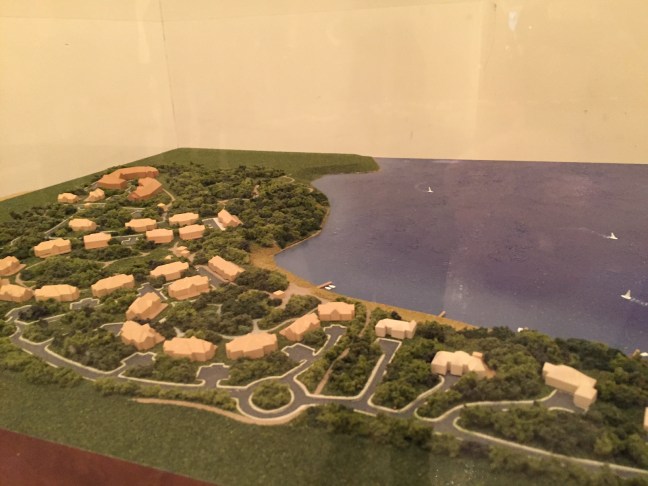
Pine Beach: Nicanco’s name for its latest Sandy Beach development proposal. The key difference between the proposal presented Thursday and the zoning approved by referendum in 2001 is a third storey added to the two multi-unit structures at rear left.
A new name, 89 more doors, higher buildings, narrower streets and a PAE instead of a PIIA. That’s the crux of what urbanist Marc Perreault presented to a full house at last Thursday’s information meeting on Nicanco’s revised Sandy Beach development.
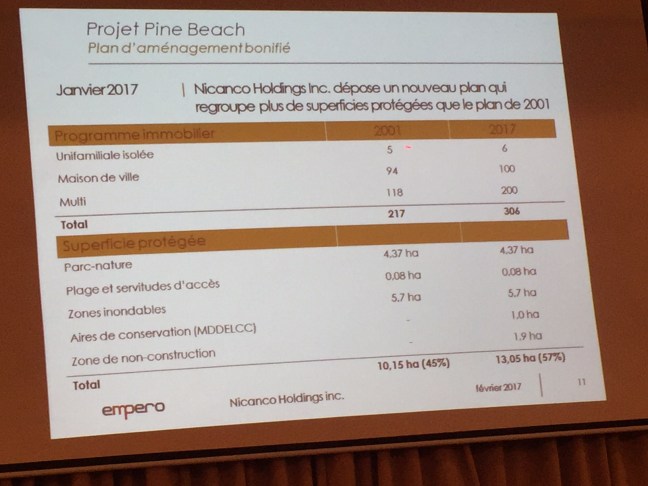
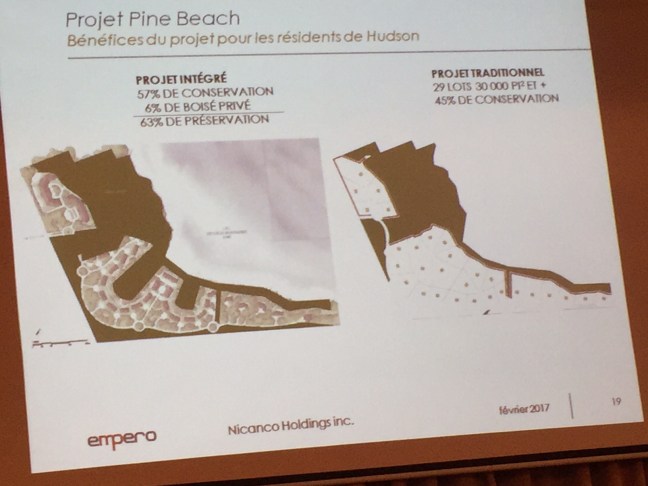
Renamed the Pine Beach Project, Version II would/will allow 41% greater density to compensate for 28.5% more protected space, the result of stricter development requirements imposed since 2001 by the provincial environment ministry. This slide from last Thursday’s presentation quantifies the differences:
Although the town council and administrative staff were present, they played no part in Perreault’s presentation other than the mayor urging questioners not to hog the mic. The tone of the three-hour session was was generally courteous. To judge from the crowd’s reaction to the points made, opinion on the merits of the project was fairly evenly split.
Perreault’s questioners raised a range of valid issues. Many wondered whether the town has the potable water and sewer capacity to accommodate possibly 1,000 additional residents. Others questioned the integrity of the Technika HBA flora and fauna study on which the environment ministry issued certificates of authorization. A consensus emerged that the beach servitude isn’t wide enough and there would/will be friction between residents of the new development and the beachgoing public because Nicanco is making no allowance for public parking.
You may have noticed my use of the words would/will. This is because it’s still not clear whether any part of Nicanco’s proposal is subject to referendum. I was told the Sandy Beach project was recognized as a Plan d’implementation et d’intégration architecturale, or PIIA. According to town urban planning director Natalie Lavoie, Hudson’s Town Planning Advisory Committee (TPAC) recommended the project’s PIIA status sometime around 2004. According to the municipal affairs ministry’s (MAMOT’s) PIIA guidelines, integrated projects must conform to the town’s master plan.
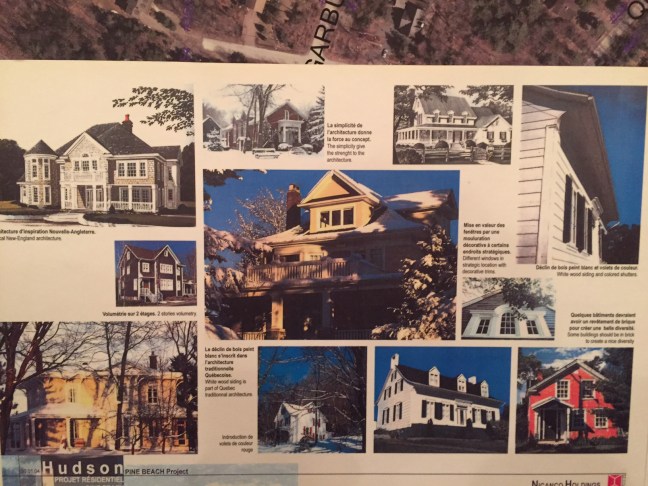
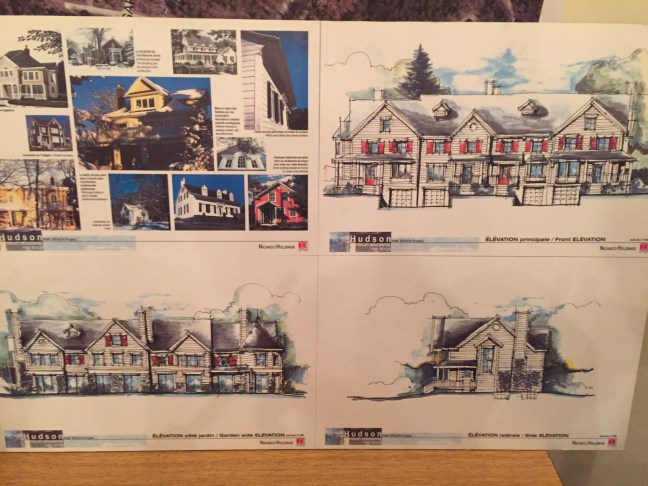
Top: Nicanco’s presentation included this sampling of typical Hudson architectural elements it proposes to integrate into the Pine Beach project’s townhouses and single-family units, bottom.
Between then and now, the project was transformed into a Plan d’aménagement d’ensemble, or PAE, a characterization which leaves the details to a municipality’s TPAC and urban planning department working in concert with the developer. The concern here, according to MAMOT, is that details tend to be overlooked. Perreault’s stock response last Thursday was that these things are difficult to foresee and must be worked out during the development process.
Asked what would happen if the project wasn’t approved, Perreault at first claimed it would revert back to the pre-2001 zoning allowing 29 single family homes (slide below). He corrected himself to say it would revert to the 2001 zoning, minus the additional wetland Nicanco has had to give up since, but including the beach servitude, now a notarized legal document. What I found interesting is that the view to the right still presents a beach servitude, suggesting that (a) this revision requires some form of approval, and (b) that they’re ready for a fight if it does. Does this mean Nicanco doesn’t want to revert to the 2001 zoning and densities provided in Bylaws 408 and 409? My understanding is that the 2001 referendum replaced the original single-family zoning, so it’s no longer an option. If not, then why pretend it is?
Here’s the core problem: Over the next seven years, Nicanco proposes to sell the right to develop to a number of different builders, specializing in the type of construction permitted in that sector. Perreault skimmed over that part of his presentation because it’s clear Nicanco wants to be out of this as soon as possible, leaving the municipality the task of policing contractors.
Given taxpayer aversion to hiring more permanent staff, this will be a problem.
There is a solution.
Much of the increased density will be restricted to the western edge of the 60-acre site, immediately opposite the Hudson Legion curling rink, Manoir Cavagnal and the public daycare. The quadrilateral is enclaved by Beach Road, AMT’s right of way and Viviry Creek flood zone. Even those petitioning for the town to explore possibilities for the outright purchase of all or part of Sandy Beach have said they have no issue with densification in this sector.
We’re behind the Manoir Cavagnal, looking north toward the river from the tracks. This is where Nicanco proposes to build two 100-unit three-storey condominiums. Beach Road is to our right; Wharf Road and the town’s sewage treatment plant is to our left. The fence was installed by Nicanco in 1998 to prevent access to the beach. Behind the gate is the Manoir’s former sewage treatment facility, abandoned since the Manoir connected to the town sewer system.
One suggestion to have emerged from last week’s information meeting: why not allow Nicanco to build high-rise towers in this western sector in exchange for public ownership of a much wider swath of land, including the beach? This fits with earlier suggestions to Nicanco that they densify upwards, generating more saleable water views while concentrating townhouse development in a ribbon along Royalview, thereby protecting those wetlands Nicanco is proposing to backfill.
Nicanco is proposing to build twin 100-unit condos behind the Manoir Cavagnal. Would Nicanco be prepared to sign over the beach and eco-sensitive woodland and wetland in exchange for high-rise blocks with more river views to sell?
This might be the only compromise that will satisfy the need for public parking and access to the existing public roads. The loudest, most concentrated opposition to Nicanco’s proposal comes from those who fear the developer’s beach servitude could easily be revoked in the event that residents of the townhouses are unhappy about unauthorized parking and people traipsing across their common properties. The save-the-beach lobby makes a good point.
My response to Peter Ratcliffe’s post and comments in the Off-Island Gazette is in the form of an MP4. It’s a recording of the emergency council meeting at the firehall where Mayor Ed Prévost announced town manager Catherine Haulard’s firing.
It’s just under 80 minutes long, a stunning example of an improvised, ill-considered decision that cost the town in excess of $200,000. It’s too large a file to post on WordPress or email but I’ll be happy to copy it onto anybody’s thumb drive if they stop by.
The Haulard file is just one of many.
For the two years Louise Craig and I have attempted to obtain a detailed list of the legal files this administration has shopped out to external legal counsel. We were assured repeatedly by members of this council basic information regarding each mandate would be posted on the town website. This was never done.
Here’s a comment I received from one of the people targeted by the town’s legal pit bulls. “Ratcliffe…keeps stating the town is defending itself. HE IS SO WRONG. IN MOST CASES THe TERMINATED /SUSPENDED PEOPLE WERE ATTACKED by the TOWN (and forced to defend themselves- with their OWN MONEY. The town playing victim here is totally totally off.”
Anyone who has had dealings with lawyers quickly realizes they’re a last resort. This administration has made it a policy to consult with lawyers instead of using basic common sense. We could have repaved most of town for the cost of what I see as fiscal abuse. Unlike my colleague, I will continue to hold this administration accountable for what I see as a dereliction of fiscal stewardship.
I was quoted on how I feel about Hudson’s big legal bills in the Off Island section of the Montreal Gazette this morning, article by Albert Kramberger, Here’s the full text of my response to his emailed question last week, because they cut and paste and use what they want.
For openness and clarity and no one surprised I had openly copied Council and Mayor Prevost when I responded as well.
My reactions to Hudson’s legal bills:
Qualified anger and significant concern would be my simplistic response at the huge legal costs, but directed at the underlying reasons and the few people not on current Council who have taken actions that resulted in these inflated costs in both time and distraction.
There may have been some very minor errors in exact procedures by a new Council, but I believe that there has been absolutely no bad faith or inappropriate action by any of the currently sitting Council and Mayor. We citizens are correctly kept blind of details in most cases by confidentiality required in some of these issues, but from my view the bulk of the causes have seemed like an organized multi-pronged predation by a limited number of sources. Mayor Prevost and Council have been forced to protect the Town interests and their own reputations aggressively because of these outside actions, so I fully understand the reasons for the number of files and costs. Clearly our Town’s lawyers are both cautious and expensive, we need to manage those points into the future.
Perhaps you should be asking those who would have most benefitted had Council not defended themselves adequately? And questioning the myriad of legal protections of municipal employees who are rightly or wrongly terminated or leave their position.
A municipal government seems an easy target of frivolous claims likely to pay out rather than fight. I am proud that we’ve defended not just our Town but the honour of those elected to serve us, but am disgusted by the legal system that allows this type of expensive process to reduce the resources we can allocate to important things.
Thursday evening, Hudson residents will have the opportunity to closely question developer Nicanco Holdings on the visual, environmental and fiscal impact of their revised Sandy Beach development.
This week produced a flood of documents relating to the Sandy Beach development. I’ve distilled them into a dozen questions looking for clear answers at Thursday evening’s public consultation on Nicanco Holdings Inc.’s request to revise the 2001 zoning and density bylaws. Thanks to all who shared this information.
The deeper I dig into what has gone on since Hudson residents approved the development of Sandy Beach in 2001, the more concerned I am that we’re not asking the right questions.
This isn’t about whether Sandy Beach should be developed. That has already been decided by referendum, followed by regulatory approvals by provincial, regional and local governments. This is about how Sandy Beach will be developed and the impact it will have on the natural beauty of this place. It’s about whether Hudson’s taxpayers will be saddled with the collateral costs of development.
Density and visual impact
– What is the proposed residential density being sought? How does it compare with the density approved in 2001? What will the result look like?
According to Quebec’s lobbying register, Nicanco’s urban planning consultant Marc Perreault is mandated to lobby the Town of Hudson for approval of a residential development including single-family homes and multi-family units of two to four storeys and a density of at least 40 units per hectare.
I’ve been told Nicanco’s development footprint has been reduced to 12.5 hectares as a result of wetland trades authorized by the Ministry of Sustainable Development, Environment, and Action against Climate Change (MDDELCC) to bring this project into conformity with the town’s yet-to-be-approved conservation plan. Pro-mayor Deborah Woodhead confirmed at last week’s council meeting the revision would allow 210 doors.
Three storeys are the height of the Chateau du Lac, Westwood Senior and the new condos at 450 Main. Hudson currently has no four-storey structures. Now picture yourself in a kayak 500 feet offshore and imagine what that would look like. Pierrefonds. Laval.
Drinking water and wastewater
– What is the estimated potable water budget for 210 residential units? How is the town proposing to guarantee the additional volume?
During summer peak usage periods, Hudson consumes 300 cubic feet more per minute than its wells produce, drawing down the town’s water reserves. Recent fires have shown the town is vulnerable to serious pressure drops even in winter.
– How is Nicanco proposing to connect its project to the municipal sewer system? Does the system have the capacity to handle in excess of 200 new doors? If not, how much will the upgrade cost? Who will pay for it?
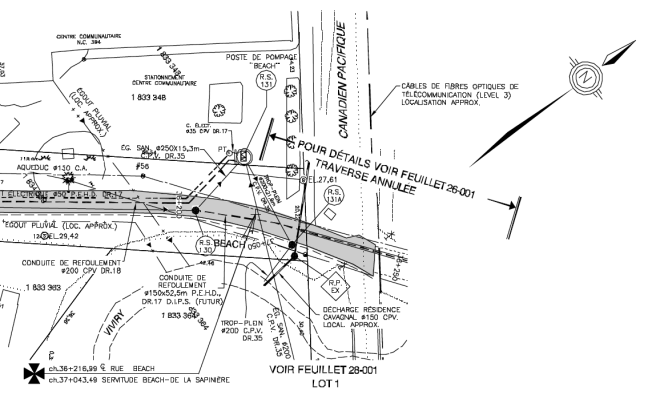
Nicanco proposes to run a collector the full length of Royalview and westward to include proposed multi-unit development on R-22. The above document confirms Nicanco withdrew its request for a sewer line running under the AMT right-of-way to the existing town pumping station in the Legion Curling Club parking lot. We believe Nicanco now proposes to save time by using an existing line under the tracks which had connected Manoir Cavagnal to its pre-sewer septic system.
– Is the former Manoir Cavagnal sewer line and existing pumping station capable of handling peak sewage flow from 210 doors? (The Manoir has fewer than 100). Can it be upgraded without a new certificate of authorization? What impact will it have on the tax bills of sewered property owners?
– Will raw sewage from Nicanco’s project be allowed to dump into the Viviry? Under what conditions? What constitutes an emergency?
What’s important in this diagram is how the emergency overflow from the Beach pumping station flows directly into the Viviry opposite the Legion. I’ve been told this pumping station has been problematic from Day 1. The existing certificate of authorization (CA) from the MDDELCC allows emergency-only discharge into the Viviry – but this is without the addition of Nicanco’s 210 doors.
Conservation
– What has been and will be done to protect wetlands, woodlands and rare, at-risk and endangered species they contain?
In October 2010 Nicanco Holdings Inc. applied to MDDELCC for permission to backfill a 1.58-hectare (3.9 acre) wetland. In March 2014 MDDELCC approved an internal wetland trade which allows the developer the right to backfill 1.58 hectares (3.9 acres) in exchange for moving 2.33 hectares (5.75 acres) into the conservation zone. This trade was largely based on data collected for the 2008 Technika-HBA flora/fauna audit. The audit team’s findings regarding the presence of rare, at-risk and endangered species have since been challenged. I doubt this will have much of an impact on development plans, but it does nothing to reassure environmentalists the town and the MDDELCC are on the case.
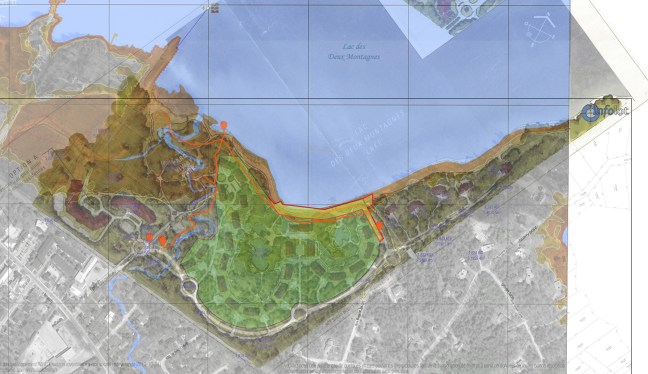
If you can pull the above map up to 300% magnification, follow the thin T-profile red line along the lake. I think this is the 25-year flood line. Now compare this with the map below:
Nicanco’s developable footprint has been reduced to 56% of the total land area, making beach access a major bargaining chip.
None of the documents I’ve seen so far indicate whether the beach servitude is taken from the mean high water line, chart datum line or to 25-year flood line.
The best scenario for beach users would be the 25-year line because it extends well past the road into the woods.
This reinforces my point that whoever is negotiating this for the town needs to know the file backwards.
Here’s an example of how the town could lose control: In March 2015, Nicanco signed a notarized Restriction of Use agreement transferring approximately one hectare to the existing conservation zone. Under this agreement, Nicanco retains ownership. This restriction of use agreement prohibits lawns, landscaping, pruning or cutting of underbrush, pesticide use, recreational facilities, garden furniture and sheds or storage but allows walking, skiing, snowshoeing, berry picking and pest control. It also allows the cutting of dead and dangerous trees with a permit from the town up to 15% of the total canopy over 15 years.
However, it gives special tree-cutting status to the owners of two lots.
– Explain the location and significance of this and other restriction-of-use agreements in plain language.
The only existing house on Royalview, one of five single-family dwellings authorized, is currently connected to a septic tank even though it is located in the 100-year flood zone.
– Will these five doors be connected to the sewer system?
Nicanco has the option of running an access road connecting Royalview with Quarry Point Road opposite Green Lane.
– Will the town approve a road connection to Royalview via Quarry Point Road?
Until a rezoning bylaw is presented, everything is on the table. The current administration has a narrow window of opportunity to cut a better deal than the 2001 agreement. The worst that could happen is a reversion to Bylaws 408 and 409. The worst? A referendum approving a much worse arrangement that will end up costing the town money it doesn’t have to deal with infrastructure issues I’ve raised.
Unconfirmed: Nicanco’s proposed development according to one version of its rezoning proposal. The five single-family units on 40,000-square-foot lots are to the right. In the centre, 25 multi-unit structures, most likely with four townhouses per building. At left, on the far side of the Viviry conservation zone, two 50-unit structures would densify the project’s western sector.
The following is what I expect will happen at next Thursday’s public meeting regarding Hudson’s Sandy Beach. This comes from a variety of sources, none of whom is authorized to speak on the record.
Nicanco Holdings Inc., owner of the 60-acre Sandy Beach parcel delineated in the map above, wants a zoning change to permit a greater density. Bylaws 408 and 409, adopted by referendum in September 2001, gave Nicanco the right to build up to 150 units.
Nicanco’s requested zoning change would allow 210 units, well short of MRC/PMAD densification guidelines.
Quebec requires all zoning bylaws to be subject to approval by referendum unless a municipality seeks provincial approval for a Plan particular d’urbanism, or PPU. There is no indication the town has made such a request.
However, even if citizens reject Nicanco’s bid for greater density, the municipal affairs ministry and other sources have confirmed that zoning reverts to the previous zoning, in this case Bylaws 408-409.
Bylaws 408-409 created three zones. R-6 (11.6 acres), the closest to Quarry Point, would allow five single-family residences on 40,000-square-foot waterfront lots. R-7 (23.65 acres), the largest sector, would permit four units per hectare, equivalent to 25 single-family units or 95 townhouses. R-8 (10.6 acres), across the tracks from Manoir Cavagnal and to the west of the Viviry footpath, would allow 12 single-family dwellings, 40 multi-family units or a 50-door seniors residence with a maximum height of three storeys, or 42 feet.
Back to Thursday’s meeting, where I’m told citizens will hear presentations from Nicanco and the Town of Hudson. As I write this, the meeting serves no legal purpose. Quebec’s rezoning protocols stipulate that any public consultation on a zoning proposal be preceded by a Notice of Motion and adoption of a draft bylaw. The administration could do both at a special public meeting prior to the meeting but would have to do so with 24 hours notice and post the time, place and date on the bulletin board at Hudson town hall. Such a meeting would be open to questions from residents.
I’m keeping an eye on the town hall bulletin board for a change in status. I’m also mindful that anything said at a public meeting (other than a council meeting) is subject to libel.
Nicanco’s presentation, likely given by urban planner Marc Perreault, will concentrate on aspects of the project such as architecture, construction standards, average density, structure footprints, parking, security and pedestrian walkways.
Perreault was Nicanco’s representative at the June 2001 public information meeting and has worked on the Sandy Beach development for most of his working life. He knows every detail, including how the 2008 Technika-HBA woodland/wetland audit overlays the 60-acre site. (Sandy Beach: the core problem, http://www.thousandlashes.ca)
We know Nicanco’s development plans hit an environmental barrier following the adoption of stricter environment ministry guidelines sometime after 2001. Nicanco’s problem was a 1.5-hectare wetland in R-7, the zone where it had hoped to build townhouses. The project was blocked until 2012, when a new provincial law (Bill 73) permitted wetland trades to unblock development of environmentally sensitive areas. As a result, developers could buy the right to backfill a wetland by preserving in perpetuity a wetland of equal or superior environmental value in the same watershed.
Nicanco moved quickly to take advantage of the new law, pressuring the municipal administration of the time to provide a wetland that would satisfy the ministry’s requirements.
The town, sensitive to the optics of spending tax dollars on land to satisfy a developer, tried everything short of buying wetland. It offered a wetland it had just acquired opposite the new sewage treatment plant. The ministry told the town it couldn’t protect what it already owned. Then the town offered a parcel of the Viviry Valley Conservation Area acquired as a result of the Whitlock West deal. The ministry told the town it couldn’t protect what it had already protected. In desperation the town offered a parcel in Como it would acquire in exchange for a tax credit. I don’t know what happened to that deal, which went down during Hudson’s darkest days between April and November 2013.
In the end, Nicanco came up with its own solution, reconfiguring its Sandy Beach development plan to guarantee 3.5 hectares of R-7 near the beach in exchange for the right to backfill 1.5 hectares of wetland closer to Royalview.
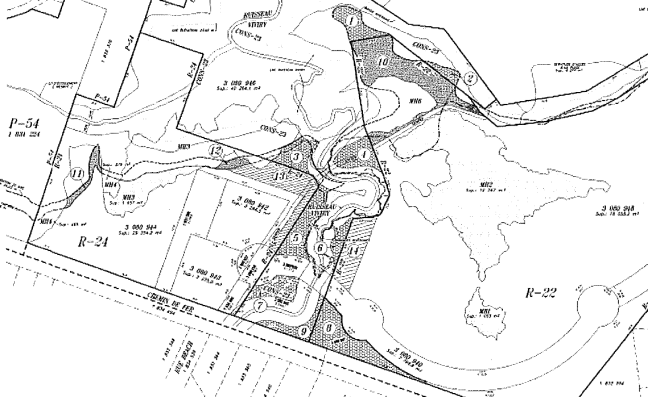
Unconfirmed: Wetland trades in the town’s favour appear to be the darker hatched areas, while the trades in Nicanco’s favour appear as the lighter hatched areas.
I suspect this exchange is why Nicanco is rolling the dice in the hope of getting greater densification.
I’m told Nicanco’s latest proposal would limit its construction footprint to 12.5 hectares, or 31 acres, representing 56% of the total land area of Sandy Beach. I don’t know if the 56% includes roads, setbacks, footpaths and public space, but it may be less than the 2001 deal.
Bylaws 408-409 gave the town 20% of the total greenspace and preserved 75% of the pine forest and 50% of the total forest canopy. The town got the use of, and legal access to, 1,186 feet of beachfront and 11 acres of greenspace. Nobody can tell me whether those numbers have changed in the latest proposal.
So the big challenge at Thursday’s meeting will be to determine how this latest proposal compares with the 2001 status quo.
Meanwhile, the town will present details of its plan to ensure greater security and control access to Jack Layton Park, Sandy Beach Nature Park and the beach area. This will include fencing, public parking, lifeguards and regular water quality testing. The town intends to enforce curfews,, leash laws and nuisance bylaws targeting loud music, fires, alcohol and drug consumption. It will also ban watercraft from the beach area.
I expect the town to announce tariffs for non-residents. I don’t know how this will play, but it might be popular with residents who resent the wave of humanity descending on the beach every summer weekend.
“Oka Provincial Park charges $25 for daily access,” I was told. “People come [to Sandy Beach] from all over and don’t pay. Hudson residents tell me they’re afraid to use the beach because of the broken glass, open alcohol consumption and dogs running in the water.”
Council has budgeted $250,000 in its 2017 triennial capital works (PTI) budget to cover the cost of securing the beach.
I’ve been following endless Facebook threads regarding the project, including those pushing the town to buy the site outright. Organizers of an online petition claim to have gathered 1,000+ signatures to pressure the Prévost administration to negotiate an outright purchase of Sandy Beach.
With respect to those who have expended their time and energy on this, we’ve been this way before (A Short History of Sandy Beach, http://www.thousandlashes.ca) and the path goes nowhere. As we saw in 1998, the public gets enthusiastic when someone proposes a simple solution to a complex problem, then quickly loses interest when there’s no immediate gratification.
We can rule out expropriation because of the legal costs and the risk of losing. It cost Hudson $575,000 to purchase from Graeme Nesbitt the wetland opposite the sewage treatment plant on Wharf Road. Nesbitt took the town to court because a storm sewer discharging onto Nesbitt’s land had killed all the trees. Nesbitt proposed to sell it to the town for less than $200,000 but the administration at that time wouldn’t hear of it and moved to expropriate. The town ended up paying Nesbitt $500,000. Another $75,000 disappeared into thin air, allegedly because former town manager and clerk Louise Villandré cut her phantom suppliers three $25,000 cheques.
Even without the fraud surtax, the expropriation attempt was a disaster because one never knows what the expropriation tribunal will decide. No sane administration would roll the dice for parkland its citizens already enjoy access to.
Others posting on Facebook would have us believe there’s a Hail Mary solution, like the cost of an overpass on the Beach Road crossing. The AMT owns the right of way (the AMT’s contribution in lieu of taxes forms part of the $113,430 the town will receive in 2017) and oversees roughly 100 of what the Canadian Transportation Safety Board characterizes as low-speed level crossings throughout its network. (Hudson alone accounts for Beach, Main, Bellevue plus a number of unsignalled crossings, such as the one on Montée Manson.)
At this point, the Save-the-Beach lobby is reduced to praying for rare and endangered species and hoping for a First Nations intervention.
One possible issue might be legal lapses but I have yet to find any. Nicanco and the Town of Hudson have already concluded a number of enabling agreements. One is the beach servitude, posted here.
Another is a March 2009 certificate of authorization signed by the environment ministry’s regional director Pierre Paquin, allowing Nicanco to connect to the town sewage system via the pumping station next to the Legion curling club. This agreement also stipulates exactly how Nicanco must run a sewer line across the Viviry next to the road bridge and decrees the protocol to be followed in the event of a sewage overflow.
Without a cadastral map and access to the Registre immobilier du Québec, it’s next to impossible to determine whether the full and legal transfer of greenspace and servitudes described here has taken place.
An outright purchase by the town, heritage protection body or other agency is wishful thinking, especially when its proponents argue that the selling price for Sandy Beach should be its municipal evaluation, roughly $1.5 million. Anyone familiar with real estate knows valuation has no bearing on asking or selling price.
Nicanco has already told the town it will claim a real ‘manque a gagner’ of $2 million as well as all costs incurred to date and the potential value under current zoning. I’ve been told it’s in excess of $23M. I’ve seen the letter exchange between Perreault and members of the group exploring outright purchase. It’s clear from Perreault’s dismissive tone he doesn’t propose to waste time on further discussions.
Here’s the bottom line: Nicanco is gambling that residents opposed to this latest rezoning request will force it to a referendum, just as they did in 2001. And just as they did in 2001 – with 862 of 3,418 eligible voters voting 72% in favour of the project – a majority of residents will support the rezoning. Nicanco will get the greater density it needs to attract builders and repay stakeholders for the loss of income and interest incurred over the past 16 years.
If Nicanco loses, the zoning reverts to Bylaws 408-409.
Either way, Hudson residents will continue to enjoy the beach and trail network in perpetuity while Nicanco pays taxes on it.
It’s a purely financial equation that has nothing to do with saving Sandy Beach. The part of Sandy Beach we love and use has already been saved. The only question is how much more Nicanco can wring from the deal.







 thousandlashesdotca