
As I predicted they would, Hudson’s Prévost administration has discovered a way out of holding referendums on zoning projects the town perceives as beneficial. How this council did it — and how it justified removing the right to subject zoning changes to approval by referendum at the May 30 public consult on the proposed assisted-care seniors’ residence in the Wyman United Church parking lot— is an interesting exercise in bureaucratic manipulation.
(NOTE: Revised draft bylaw 692.1 tabled at the outset of the June 5 council meeting rezones lot #5 970 081 exclusively for a seniors’ residence and makes it subject to a public consultation June 20. The designation is therefore subject to citizen approval by referendum. Bylaw 691 removing Wyman Memorial United Church from Zone P-57 and adding it to Zone C-27 is a change to the town’s master plan and is therefore not subject to approval by referendum.
Before we get into that, something equally interesting emerged at the meeting. This was Daren Legault’s impassioned plea on behalf of the project. Legault’s argument: we’ve all seen how NIMBYism has blocked progress in Hudson. The town needs an assisted-living facility for seniors, so we should hold our noses and get it built.
It’s a tempting argument and I’ve been worrying at it since Tuesday evening’s consultation. Does the end justify the means? Or is this the Trojan Horse that will be used to re-engineer Hudson without the need to consult residents? It may be the right thing to do in this case, but is it ethical to place potentially disruptive projects like Sandy Beach (250 doors) two Cameron residential developments (36 doors) and a possible 40-unit densification east of Mount Pleasant beyond approval by referendum?
And the corollary: what projects should go to referendum and which should be exempt? Why should Daniel Rodrigue’s Mayfair townhouse project have gone to register (where the rezoning was pulled) while this project won’t?
Both consultations on May 23 and May 30 fulfilled the municipal affairs ministry’s legal requirements but left residents feeling cheated of a voice in the process. Worse, the administration failed to explain clearly what they were proposing to do and why. The way the truth emerged left residents feeling they were being hoodwinked.
There’s general agreement Hudson desperately needs an assisted care facility. If Hudson’s churches see fit to make eldercare part of their social mission, good. St. Thomas and St. James both own excellent sites. But Wyman’s site is far from ideal. Even its proponents agree it’s small for a three-storey structure 144 by 100 feet where parking and traffic will be an issue. Neighbours fear there won’t be enough trees left to provide a screen, especially in light of the town’s failure to deliver on past promises. They’re urging the promoters to move the project to the east side of Wyman, at the corner of Main and Selkirk.
Christine Redfern, whose house will be next door to the proposed facility, lived through this before when the town built the new firehall and extended the public works yard to her property line. She’s still giving me grief for failing to follow up on the town’s promises to mitigate the effects by building something similar to the big wooden noise barrier off Chemin St-Louis in St. Lazare.
“Blocks the view, blocks noise + has lovely plants growing up around it — about 10 different local varieties of shrubs, vines and trees have been planted,” she wrote me. “Then did you ever look at the fence you pushed for at the public works yard? The nice side facing inwards, not one tree planted and all winter long big trucks parked 6 feet from the neighbouring property where the town promised 21 feet of green space?”
Redfern says she’s had multiple meetings since with the town, with landscapers, with councillors and has sent some two dozen follow-up emails. “I always get a positive response, no action.”
Without the possibility of a referendum to leverage negotiations, Villa Wyman’s neighbours have one option. Once bylaws 691/692 are adopted at next Monday’s monthly council meeting, citizens have 30 days to collect five signatures and file a request with the Municipal Affairs Commission to determine whether the bylaws conform with the town’s planning program.
Then there’s the trust issue. The zoning change (call it what it is) moves Wyman and its parking lot, including the proposed site from P-57, the zone currently occupied by the church, firehall, public works and the town-owned 539 and 541 Main and into C-27, a commercial/residential zone with fewer restrictions. Why move the site into a commercial zone? Twice before, Hudson has been screwed by developers who promised to build assisted-care facilities if the town agreed to zoning changes. Kilteevan and R-55 are legacies of those broken promises. If the Villa Wyman project falls through, nothing prevents the owner from selling it to a developer for any multi-unit residential project.
Or for that matter, the United Church from selling Wyman Memorial.
…which brings us to the compliance loophole. Residents got a sneak peek at the May 23 public consultation for Bylaws 688, 689 and 690, the land use and density resolutions bringing the town’s planning process in line with those of the Montreal Metropolitan Community (CMM) and Vaudreuil-Soulanges MRC. Many of those attending that first meeting were still under the illusion that Hudson could dodge the MMC/MRC densification bullet on the basis of a municipal resolution asking to be excluded.
They were to learn this administration had no such intention.
“One thing you all must remember,” pro-mayor Deborah Woodhead said as she called the consultation to order, once the town brings its planning program into compliance with Vaudreuil-Soulanges MRC’s revised land use plan, “we will be in a much better position…we’re on the outside now. Once we’re on the inside we can discuss things like the TOD.”
Over the next two hours, the council and administrators attempted to convince residents transport-oriented development (TOD) is just a pretext. By agreeing to TOD-level densities in Hudson’s downtown core, the administration claims it will be able to exempt the rest of the community from MMC/MRC densification guidelines.
“They told us it would be possible after we were in compliance […] after the compliance, we will be able to regress [to lower average densities],” Hudson’s director-general Jean-Pierre Roy told residents.
Confusion continued into the May 30 meeting, where town clerk Cassandra Comin Bergonzi explained how the town could enact zoning changes without going through the usual procedures. Council, she said with a straight face, has the discretion to proceed in this way because it is in the midst of amending the planning program. It can make changes to a zoning bylaw because to not do so would create zoning which would no longer conform to the planning program. “If we don’t amend our zoning bylaw, our zoning bylaw won’t be conforming to our planning program.”
Hudson’s three compliance bylaws are based on the work of Jean-François Viens, an urban planning consultant for L’Atelier Urbain, the firm contracted last year to prepare Hudson’s compliance file. As Viens walked residents through the compliance process, it became clear that densification without consultation had been this administration’s goal from the outset of the process.
Following the meeting, Viens told me that Hudson doesn’t fit the TOD concept, a one-size-fits-all densification tool designed for suburban dormitory communities stretching from Boisbriand to Boucherville. The aim of the TODs was to encourage development like we see along Vaudreuil-Dorion’s de la Gare, with dozens of commuter trains and express buses to and from downtown Montreal and scores of shuttle buses between West Island and off-island destinations.
The core belief driving the CMM’s PMAD and these TODs is that urban sprawl is something to be avoided. New developments mean new services – roads, public transportation, water, sewage treatment, waste management, schools and other municipal infrastructure. Densification makes better use of existing infrastructure and helps local economies remain sustainable.
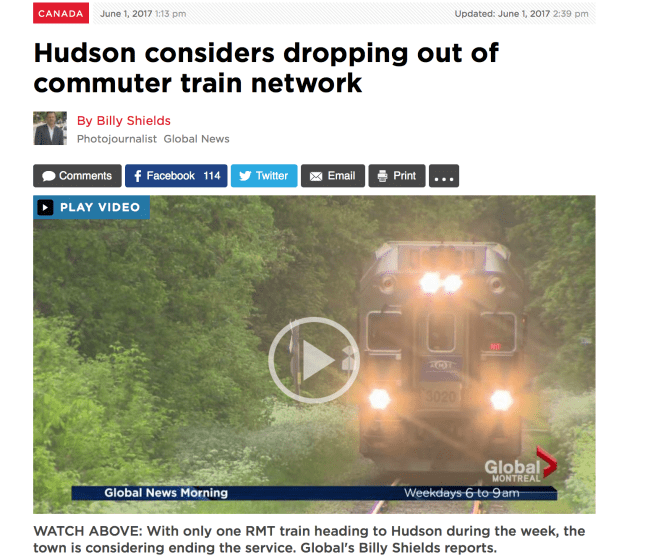
Hudson, with its two trains a day weekdays, ageing population, infrastructure issues and small-town heritage, isn’t what TOD’s originators had in mind, Viens said.
I asked him whether residents should fight the TOD designation. “It’s too late for that,” he told me. “Now is not the time for a great reflection…maybe in one or two years, with a strategic vision…”
Viens said any appeal for another delay would have to be directed to the municipal affairs minister. The concordance process in Hudson is clearly politicized with the approaching elections and it’s unlikely another delay would be granted.
Those who attended that first consultation were surprised at town hall’s haste in ramrodding concordance past residents, especially since it is not subject to approval by referendum. DG Jean-Pierre Roy said it would be adopted at the June 5 council meeting without further discussion or debate. His rationale – Hudson has already been granted two extensions (six and nine months) and is the last MRC holdout.
As we were to learn, that last statement wasn’t true.
The following night at the monthly MRC council meeting, residents Jamie Nicholls, Marcus Owen and Austin Rickley-Krindle were told Hudson is one of six of the 11 MRC municipalities in the CMM which have yet to harmonize their master plans with those of the CMM and MRC. Councillor Nicole Durand, who has been attending MRC council meetings in the mayor’s stead, said nothing. The next day, MRC spokesman Simon Richard confirmed that number to me.
Since then, we’ve learned that just 44% of the MMC’s 82 municipalities have passed concordance resolutions.
Nor is there any evidence the Prévost administration has attempted to change the CMM’s mind on density requirements in non-TOD sectors of Hudson’s urban perimeter (http://cmm.qc.ca/fileadmin/user_upload/fiche/TOD/FicheTod_11.pdf).
The facts suggest the town is willing to densify wherever it can. At the May 23 consult, a contingent of residents from the Hillside/Charleswood (non-TOD) sector demanded that the town un-tick a box in 689’s Appendix C which would have allowed multi-family dwellings as well as a seniors’ residence in R-55, a five-hectare lot that lies between Côte St. Charles, Oakland, Charleswood and Ridge.
The group’s spokesman, Keith Heller, noted that residents approved zoning in 2007 for a continuing-care seniors’ campus with fewer than 150 doors — but not for a development that would allow double that number of multi-family units.
Heller was especially incensed that two lots he owns at the site’s southern extremity linking the main body to Charleswood had been rezoned without his knowledge or consultation. Town planner Natalie Lavoie told him she did it to satisfy a potential developer.
The knowledge of the audience and the quality of questions at both meetings has been, and continues to be, the high point of this process. Those who stood in line at the mic represented three generations and included a former mayor (Elizabeth Corker), both declared candidates in November’s mayoral race (Bill Nash, Jamie Nicholls) and several potential council candidates. I counted half a dozen former Town Planning Advisory Committee members and probably missed some.
Most of the questions were focused and informed. Most who asked them succeeded in keeping their tempers. Some of the sharpest observations (“What sidewalks?”) came from young residents who will be voting in their first municipal elections this fall. It was tremendously heartening to see the youth and experience working in tandem. One result: the creation of a group tentatively calling itself the Hudson Group for Smart Development (that may end up being a working name, with an official shingle and structure to follow a June 19 gathering.
A lot still isn’t clear. We know there’s a draft bylaw in the works to bring Greenwood Centre for Living History into compliance. We can assume the town would like to make similar concessions for the Auberge Willow Place Inn, Como ferry and a list of grandfathered businesses operating in residential and agricultural zones. From what I’ve learned about Bill 122, the province’s draft legislation handing more power to municipalities, referendums will become the exception in zoning and land use.
Is this good or bad? Like all powers, this one depends on whose hands in which we place it.
This story was edited June 5/17 to make it clear the town is proposing to transfer both Wyman United and its parking lot from P-57 to C-27. It was further modified June 6/17 to reflect a land use bylaw revision making Bylaw 692.1 subject to approval by referendum.







 thousandlashesdotca