Sandy Beach Nature Trail, with the bridge and boardwalk financed in part by developer Hans Muhlegg. Would we be having this discussion if Hudson had made a conservation plan a priority?
The core problem in the latest Sandy Beach debate is Hudson’s lack of a conservation plan which presents developers with a set of ‘facts on the ground’ before they submit subdivision plans to town hall. One can’t but help wonder whether this soap opera would have played out differently if successive administrations had made it a priority instead of a tedious bureaucratic chore.
A conservation plan consists of two elements: a detailed flora/fauna inventory of wetlands and woodlots, and an administrative framework to ensure the protection of the municipality’s most environmentally sensitive areas.
The first element, the Technika-HBA wetland/greenspace audit was presented to a handful of residents at a special meeting in June 2008. Nicanco Holdings Inc. president Hans Muhlegg was among those present. You’ll find it posted at the bottom of this page.
The CIMA+ Conservation Plan, which you’ll find on the town’s website, was presented to residents last August. It can’t be adopted by council and married with the MRC’s master development plan until approved by the Ministry of Sustainable Development, Environment, and Action against Climate Change, then subjected to a second public consultation. As I write this it still sits with Quebec.
The Technika audit was carried out by a team of biologists between April 25 and September 3, 2007. A followup visit took place in May 2008 to confirm findings. The team visited 63 wetlands and woodlands found throughout Hudson’s 2,185 hectares, leaving out only those which are already zoned as parkland or too small to characterize. They narrowed their list to 15 woodlands and 26 wetlands.
Two of those woodlands (Bi-11, Bi-15) and one wetland (MH-10) are part of Nicanco’s Sandy Beach Holdings. Among the threatened, vulnerable or at-risk species either present or possibly present: Climbing Fumitory (adlumia fungosa), Maidenhair Fern (adiantum pedatum), Putty-root Orchid (aplectrum hyemale).
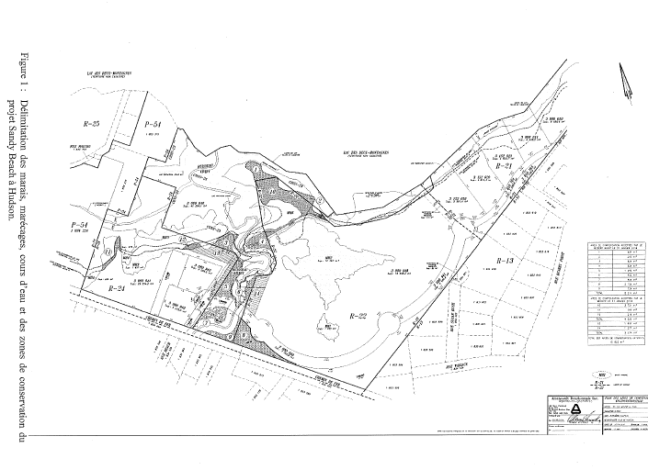
All or parts of all three appear to lie within the 20% greenspace allocation Nicanco undertook to deed to the town as a result of the adoption by referendum of Bylaws 408 and 409 on Sept. 30, 2001. Apart from this surveyor’s map, I can find no record of a cadastral transfer. (I was given a photo of the beach servitude surveyor’s document, but this isn’t a transfer of property.)
The following paragraphs are taken verbatim from the Technika-HBA audit. (I highly recommend that anyone wishing to understand this file takes the time to read the audit I’m posting. You’ll need it to crack the map code, which includes references to threatened, vulnerable and at-risk species.)
Wooded areas
Parmi les 15 boisés d’intérêt sélectionnés pour la classification écologique, deux boisés se
distinguent des autres avec des pointages nettement supérieurs; il s’agit du Bi-3 (97 points) et du Bi-8 (82 points). Les autres boisés d’intérêt présentent des pointages allant de 34 à 64. Le pointage attribué à chacun des 8 critères en fonction de chaque milieu est présenté au tableau 13.
Le boisé d’intérêt Bi-3, notamment de par sa grande superficie (contient deux secteurs), la
présence de trois espèces floristiques à statut précaire, la présence de milieux hydriques et le caractère majoritairement naturel du milieu environnant, a obtenu la plus forte valeur
écologique. Le boisé d’intérêt Bi-8 vient en deuxième place et est caractérisé par un vieux
peuplement inéquienne d’une grande superficie contenant une grande biodiversité d’espèces floristiques ainsi que deux espèces floristiques à statut précaire. En troisième place, le boisé d’intérêt Bi-11 est caractérisé par son niveau de rareté, sa biodiversité floristique, la présence d’un cours d’eau permanent qui font de ce peuplement un milieu à forte valeur écologique.
Wetlands
Des trente-cinq milieux humides présents sur l’ensemble du territoire, 26 ont servi à la
classification écologique. Le milieu humide MH-25 se distingue des autres avec un pointage de 87. Il est suivi par les milieux humides MH-8 et MH-10 qui ont un pointage similaire de 82. Le pointage pour les autres milieux se situe entre 74 et 29. Le pointage attribué à chacun des 8 critères en fonction de chaque milieu est présenté au tableau 14.
Le milieu humide MH-25 est une tourbière boisée qui, notamment par sa rareté, sa grande
superficie, sa biodiversité élevée et son hydroconnectivité avec un cours d’eau permanent et un autre intermittent, a obtenu la plus forte valeur écologique.
Juxtaposé au boisé d’intérêt Bi-6, le milieu humide MH-8 est un complexe de milieux humides composé d’un marais à quenouilles et roseau commun ainsi que d’un marécage riverain. Présentant la plus grande superficie, ce milieu humide contient une grande diversité d’espèces floristiques, de même qu’une espèce floristique à statut précaire. Il est en lien hydrologique avec la rivière Viviry et présente un bon potentiel de mise en valeur.
Le milieu humide MH-10 est lui aussi un complexe de milieux humides, situé aux abords de la rivière des Outaouais. Composé d’un marais riverain et d’un marécage arborescent riverain, une partie de ce milieu est comprise dans l’ensemble des parcs et espaces verts de la ville d’Hudson.
Most of Hudson’s most environmentally sensitive and biodiverse wetlands and woodland lie outside the urban core and fall under the protection of the Commission de protection des terres agricoles (CPTAQ). For example, Bi-3 and Bi-8 are both in the west end to the south of developed areas. MH-8 is part of the Viviry Valley Conservation Area. But, as you’ll discover trekking through these documents, a number of others are in the direct path of a developing urban core.
The Technika-HBA audit’s conclusion doesn’t mince words.
Les 63 milieux naturels cartographiés et caractérisés présentés dans ce rapport possèdent une valeur significative due à leur rôle écologique important et aux services rendus à la
collectivité. De plus, la caractérisation effectuée permet de mieux connaître la valeur
exceptionnelle de certains milieux et présente ainsi un bon outil pour l’élaboration d’un plan de conservation et de gestion des milieux humides et naturels du territoire de la ville d’Hudson.
The following is the Technika-HBA audit: rap-s88002
What’s the connection between poison ivy, ragweed and road salt?Note: I’ll be posting separately on Monday’s night’s discussion concerning the Sandy Beach development.
The Town of Hudson adopted a revised 2017 budget at a special meeting Monday evening, cutting more than $800,000 from its $13,185,890 fiscal exercise approved in December.
The revision was the result of a complaint during the Dec. 21 budget meeting from Como resident Marcus Owen, who noted that the projected increase in the general tax rate was closer to 9.4% than the less than 5% claimed. The town labelled it an honest mistake and announced it would table a revised budget.
The revision drops all four property tax rates an average of four cents per $100 evaluation. The total debt service tax remains unchanged at just under nine cents per $100. (I’m posting my three-budget comparison comparing tax rates and tariffs.)
As for tariffs, the big change is a $44 reduction in the bill to properties located on the sewer system. The town was apprised of a provincial regulation that everyone capable of connecting to a service is legally obligated to pay for it even if they opt not to connect. Approximately 90 properties are thus added to the sewer tariff roll, reducing the cost per address.
Residential green and blue bin collection will increase by $1.50 per household and drop by $2 for large commercial property owners.
Council had hoped to placate residents by emphasizing the minimal increase ($325,630) between the 2017 revision and the 2016 budget. Instead, questioners homed in on why the town chose to defer repayment of long-term debt rather than cutting operating costs.
Under treasurers Sylvain Bernard and Serge Raymond, the town had concentrated on paying down more than $30 million in long-term debt. In 2015, the town directed nearly $1M to debt reimbursement and succeeded in reducing the total to $28.9M. In 2016, council earmarked $877,610 for debt reduction; this, together with fuel tax rebates and government grant obligations reduced the total to $25.4M.
This year’s revised budget, with just $131,100 earmarked for debt reimbursement and capital expenditures, still shows the town’s long-term debt reduced to $23.4M.
The budget adoption meeting was followed by the scheduled February council meeting, where the town’s escalating overhead was the major topic during opening and closing question periods.
The town’s legal bills were an obvious question period target. Elm resident Bill Driver sought confirmation the town has spent $917,000 over the past two years, leading others to speculate on how that sum would have covered the $746,510 cut in long-term debt service or rebuilding Hudson’s crumbing infrastructure.
So was the skyrocketing general administration budget, which has grown from $1.7 million in the 2016 budget to $2.25 actual, to just under $2.5 million in 2017, leading Melrose resident Jim McDermott to urge the town to start cutting and Charleswood resident Louise Craig to question the 28% increase in the parks, recreation and culture budget. The department will receive $1.5 million in 2017, up from $1.2 million in 2016.
Residents concerned about the town’s growing full-time payroll questioned council’s approval of a resolution hiring a full-time employee on a 12-month contract to seek out and file applications for grants and subsidies for various construction projects. He’ll receive a salary of $58,500 and bonuses totalling $3,000 if he meets the town’s objectives, explained director-general Jean-Pierre Roy. The grant writer’s duties will include compiling an intervention plan, Roy said, adding “we really need an intervention plan…it should have been done 10 years ago. This is one of our challenges – catching up with the past 10 years.” (See Buy a ticket, http://www.thousandlashes.ca)
Even snow removal and the contractor’s liberal use of the town’s salt stockpile came under attack. This year’s contract went to low bidder Transport André Leroux, whose $450,000 bid came in well under last winter’s $625,000 contract. Quarry Point resident Helen Kurgansky told the meeting numbers show the town has spent $148,000 on salt so far and asked who decides when to spread it. Earlier, a Fairhaven resident noted the town spent $100,000 on salt in one month, adding that twice in the past week the contractor has needlessly spread salt on his street.
Roy confirmed the contractor decides when to spread salt and said he’ll monitor its use.
In response to a question from Blenkinship resident Jamie Nicholls about a salt management plan, councillor Ron Goldenberg followed up with the news the town is looking into the comparative costs of in-house snow removal and salting versus contracting it out.
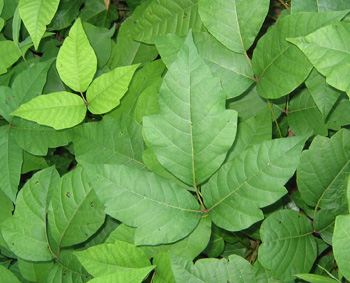
Previous administrations have been pressured by the town’s environment committee to reduce salt use because it encourages the roadside proliferation of noxious weeds, such as poison ivy and ragweed. The environment committee is no more but ragweed and poison ivy are thriving.
Comparison of 2016/2017/2017 revised taxes and tariffs
Tax rates
2016 budget: $12,053,290
2016 residential/agricultural tax rate: 69 cents per $100
2016 non-residential tax rate: 74.73 cents per $100
2016 vacant land tax rate: 83.67 cents per $100
2016 debt service tax rate: 11 cents per $100
2017 budget: $13,185,890
2017 residential/agricultural tax rate: 76 cents per $100
2017 non-residential tax rate: 81.47 cents per $100
2017 vacant land tax rate: 91.22 cents per $100
2017 debt service tax rate: 8.85 cents per $100
2017 revised budget: $12,378,920
2017 revised residential/agricultural tax rate: 71.97 cents per $100 (reduction)
2017 revised non-residential tax rate: 77.13 cents per $100 (reduction)
2017 revised vacant land tax rate: 86.36 cents per $100 (reduction)
2017 revised debt service tax: 8.85 cents per $100 (unchanged)
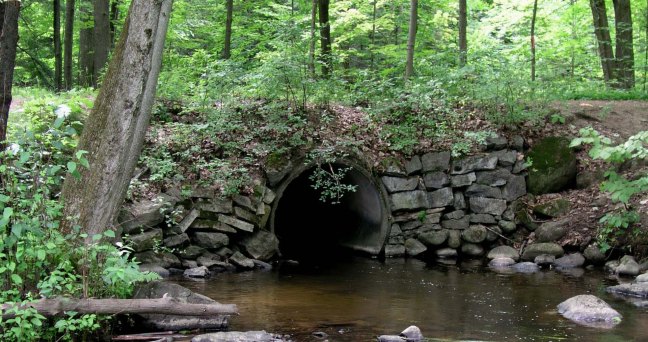
Allen Blenkinship’s stone and steel causeway across the lower Viviry was built with square-hewn boulders from the gristmill dam built by Marcellin Farand dit Vivarais, the creek’s namesake. The span was replaced with a wooden trestle bridge in December 2009.
From the Dec. 16 2009 Hudson Gazette
Story and photo by Jim Duff
Sandy Beach Nature Trail regulars are in shock over seeing the stone-filled culvert installed by Allen Blenkinship in the late 1950s replaced by a temporary wooden bridge some 20 feet upstream.
Last summer’s torrential rains caused the Viviry to back up behind the culvert, prompting concerns of a washout similar to that on McNaughten. So the former council contracted with Arcade Inc., the company building the new boardwalk over the mouth of the Viviry, to dig out the half-century-old culvert. The work was completed last week.
Hudson town inspector Natalie Lavoie said the temporary bridge will be replaced after Christmas by a permanent wooden structure where Blenkinship’s bridge once conveyed paying customers traffic down to the beach for a day’s outing or to stay in the rental cottages along the shore.
The plans to replace the culvert with a wooden span required approval from the provincial environment ministry and Hans Muhlegg, owner of most of Sandy Beach, she added.
By design or by chance, Arcade’s construction crew positioned the temporary wooden span atop two rows of massive flat stones on each bank — exactly where McGill historian and Hudson Historical Society consultant Maben Poirier believes Marcellin Farand dit Vivarais anchored the dam that powered his gristmill at the turn of the 18th century.
If so, the bridge is sitting on the last vestiges of Hudson’s pre-conquest New France heritage.
Poirier anchors his belief in oral history and admittedly incomplete seignieurial documents. “I well remember when I first heard Marcellin Farand’s name in connection with this piece of land,” he writes in a brief history on the HHS website. Blenkinship was straightening out the gravel road leading down to the waterfront and replacing the old bridge that crossed the Viviry.
“As the old bridge was being dismantled, Allen observed, ‘See those rocks that are just below the abutment for the old bridge? They were placed there by Marcellin Farand, when he operated a small mill at this precise location.’”
Poirier continues: “…the well positioned flat stones situated on the very edge of the stream…were certainly not the product of happenstance, nor were they needed as support by the old bridge, which was resting at least six inches above the stones. As Allen spoke, some amongst us had visions of a small lake backing up behind a low dam. We could see that it all made sense, given the lay of the land. It was the perfect place for a small mill and a low-lying dam that would have been capable of backing up the waters of the Viviry for about 150 feet or more in what was a natural basin.”
Standing on the bank of the river bearing the name of that first settler, Poirier theorized what would have brought Vivarais to the region. The 1689 Lachine Massacre, in which scores of settlers were slaughtered by the Iroquois, was still fresh enough in everyone’s minds that they lived in stockades for part of the year. Vivarais may have moved into the general area some time after the signing of the Great Peace of 1701, initially as a summer resident who spent his winters at the fort at Oka.
Poirier’s thumbnail history on the HHS website traces the land through a succession of owners to the Blenkinships, part of the wave of Cumberland settlers who settled here in the first half of the 19th century and whose family names endure to this day.
He admitted to being less concerned once he had seen the site. “I don’t suppose they’ll have done much damage if they stick to where Blenkinship’s bridge was,” Poirier added. “But I wish they’d consult with us before they start digging.”
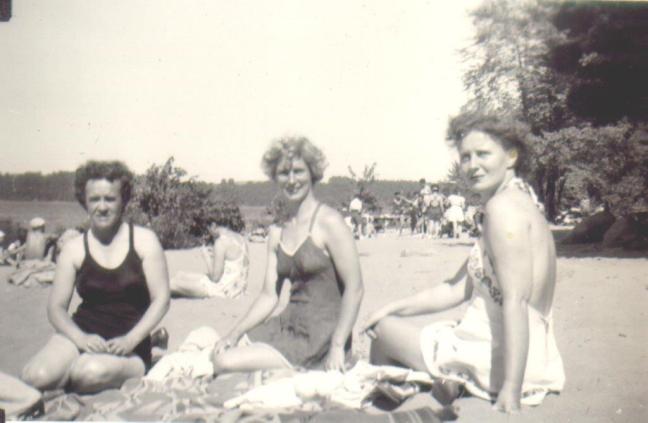
Sandy Beach, circa 1936. Trainloads of overheated Montrealers streamed to Hudson’s clear, cool waterfront resort.
Note: This was the front-page story in the Hudson Gazette, March 25, 1998. It serves to remind Hudsonites what has changed and what remains the same. In 2000, Hudson had a population of 5,408, an annual budget of $3,595,183 and was running a surplus.
The fate of one of Hudson’s last remaining pieces of waterfront greenspace depends on whether there’s a market for single-family homes on the 60-acre site – or whether the owners will be permitted to rezone the area for multi-family dwellings.
The Hudson Gazette has learned that representatives of the owners of Sandy Beach met two weeks ago with Hudson Mayor Steve Shaar and others to discuss the possibility of zoning changes for the environmentally sensitive area.
Marc Hiligua, project manager for Nicanco Holdings Inc. confirmed his company is in the process of conducting a marketing study. “We are working on different schemes for the property,” said Hiligua.
Until the analysis is complete, he added, there won’t be a decision on how the land may be developed.
Any development will take into account the many trees on the property, said Hiligua. As we reported in our February 25th issue, an inventory of trees on the Sandy Beach site is being conducted as required by the zoning bylaw for the area which includes Sandy Beach.
Nicanco owns the tract at the foot of Beach Road, evaluated at $2,377,000, and the lot at 397 Halcro, evaluated at $423,000.
Once zoned for single-family dwellings on 40,000-square-foot lots, the town’s 1994 master plan made Nicanco’s holdings part of a new zone which would permit condominiums, semi-detached homes and townhouses.
Planning Committee chair Elizabeth Corker believes a development of single-family homes on the property would not be economically viable.
“At least 10 per cent of it is in the flood zone,” she said. “The developer has to give the town 10 per cent in greenspace.” Another 15 per cent would be required for roads and other infrastructures, meaning there would probably be room for about 30 homes. Septic systems could also be a problem that close to the Lake of Two Mountains.
“The only way they can make it pay is to go up,” commented former Hudson Mayor Taylor Bradbury. “Then they could have a common septic system.”
Multi-family homes would require a zoning change, said Corker. That would mean a public notice, a public information meeting and registration on the bylaw amendment. “Citizens would have their day in court…if citizens voted against it, it would not fly.”
Speculation about the future of the Sandy Beach property has raged ever since Blenkinship Farm was sold by the original owner’s heirs in the early sixties. The 60 acres at the foot of Beach Road is evaluated at $2.8 million, down from a high of $4.25 million a decade ago.
Over the years, Hudson residents have pressured the Town to purchase the property for public use. The last occasion was in 1994, when the site was suggested for the new Community Centre. The response has always been the same: it’s too expensive.
The Town came closest to acquiring Sandy Beach in the early 60s, ex-mayor Taylor Bradbury told the Hudson Gazette.
Council turned down a chance to buy the beach for $200,000. “For what?” asked Bradbury. An engineering study concluded that it was not worth purchasing just for the beach, he said. “We had Thompson Park and the Marina. We had water outlets. What good is it in wintertime?” he asked.
The property was eventually sold for $450,000. The latest registered owner is a Mr. Muhlegg, who originally purchased it through a company called Circo Craft. The land is still owned by Muhlegg through Nicanco Holdings Inc.
Ex-mayor Bradbury has a warning for anyone who thinks rezoning Sandy Beach will be easy. He gives as an example the Alstonvale Project, forced to a referendum before the zoning changes were approved in 1989. In that case, 574 acres were zoned for a golf course and single-family homes.
Ten years and a real-estate recession later, the Alstonvale development is on the verge of proceeding – but only after its owners agreed to the original zoning parameters.
Beachgoers today include Vaudreuil-Soulanges residents. Sandy Beach Nature Park, which includes Jack Layton Park and bridge over the Viviry, cost $235,000 in 2007, of which $165,000 came from the Town of Hudson. The Montreal Metropolitan Community and the Fonds Bleu split the other $70,000.
Speculation about the future of the Sandy Beach property has been on and off ever since Blenkinship Farm was sold by the son and daughter of the original owner in the early sixties. The 60 acres of land lies along the waterfront off Beach Road. The current evaluation is $2.8 million, down from a high of $4.25 million.
The early sixties were probably the only time that the Town could have bought the land. The opportunity was turned down. “We could have got it for $200,000,” former mayor Taylor Bradbury admitted. “For what?” he asked. A study was done by a local engineer and the conclusion was that it was not worth purchasing it just for the beach. “We had Thompson Park and the Marina. We had water outlets,” said Bradbury. “What good is it in wintertime?” he asked.
The property was eventually sold for $450,000 to Claudette Boyer. About 12 years ago it was purchased by Hans Muhlegg, originally through Circo Craft, Muhlegg’s circuit-board manufacturing business. The land is still owned by Muhlegg through his company Nicanco Holdings Inc.
There are signs that the status quo may change. Recently, a study was done of the trees on the property. Then there was a meeting with the mayor of Hudson a couple of weeks ago. Project Manager Marc Hiligua told the Hudson Gazette that the the company is now in the process of conducting a marketing study. ‘We are working on different schemes for the property,” he said. Until the analysis is complete, he added, there won’t be a decisions on how the land may be developed.
The company owns two pieces of land. The larger piece off Beach Road is evaluated at $2,377,000. The smaller piece, at 397 Halcro, is evaluated at $423,000.
Hiligua stressed that the company will take into account the many trees on the property. “We want to see what we have there,” he said. He also said that the company’s intention was to make any development the “best possible” for Hudson. “It is a very beautiful property,” he commented.
The speculation continues. The land now is zoned for single family dwellings on 40,000 square foot lots. when the Town’s Master Plan was completed in 1994. It now is also part of a new PAE zone, a comprehensive development area (area for future development) which could be considered for other types of housing eg. condominiums, semi-detached homes, townhouses, among other things.
The chairman of Hudson’s Consultative Town Planning Committee, Elizabeth Corker, points out that a development of single-family homes on the property would not be economically viable. “Probably at least 10% of it is in the flood zone,” she said. “The developer has to give 10% in green space.” Adding to that another 15% which has to be set aside for roads and other infrastructures, there would probably only be room possibly for only about 30 homes. Septic systems could also be a problem.
“The only way they can make it pay, is to go up,” commented Bradbury.
“Then they could have a common septic system.”
To have multi-family homes would, however, require a zoning change. That would mean a public notice, a public information meeting and registration on the by-law amendment. “Citizens would have their day in court,” said Corker. “If citizens voted against it, it would not fly.”
There are echoes of another development project at the west end of Town, the Alstonvale, project which had to go to a referendum before the zoning changes were approved in 1989. In that case 574 acres were zoned for a golf course and single-family homes. That project , the brainchild of a group of mainly local residents, then stalled, but is now on the verge of going ahead after two thirds of the land were purchased last year by local developer, Daniel Rodrigue (Constructions de Luxe Contemporaine). By keeping within the framework of the original project, no by-law amendment is required for that development.
Bradbury, who remembers well the divisiveness of the Alstonvale referendum, warns that the town” may have trouble with the citizens” if there is a by-law amendment for the Sandy Beach property.
A number of citizens over the years have asked the Town to purchase the property for public use. The response has always been the same: it’s too expensive. The site was also suggested as a possible location for the Town’s new Community Centre when the Town decided to apply for a Federal/Provincial infrastructure grant in 1994, but again rejected it as too costly.
The Sandy Beach area is now used by residents to walk their dogs and has become a popular spot for teens to hang out during the summer.
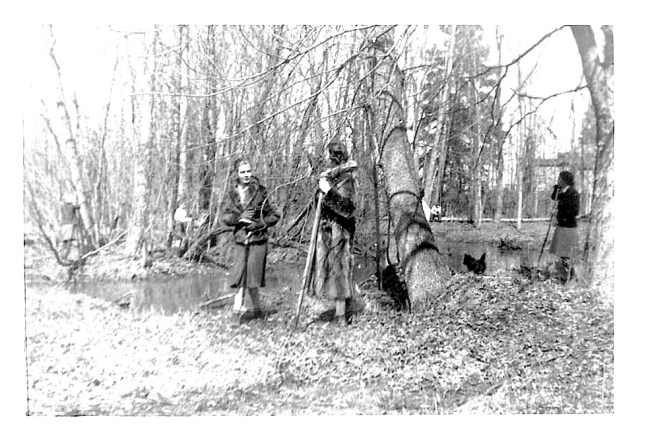
Viviry River Spring Bottle Race, circa 1940
Rumours abound with respect to looming development at Sandy Beach, especially among the nature mavens and dog lovers who stroll the locale’s peaceful walking paths. They worry whether they will soon be losing their favourite doggie exercise arena to a stretch of new condos, some semi-detached structures, or maybe even a nursing home. The privately-owned but easily accessible slice of waterfront property tucked away in town feels like a public park to many of these Hudsonites.
“This is all speculation,” stated Liz Corker, Chairperson of our Town’s planning committee, when the query was put to her by phone.
“There was a meeting between the owners and the mayor, but that’s all it was. Nothing formal was presented.”
Corker, who often takes her Bernese Mountain dogs to Sandy Beach, stressed that Sandy Beach’s owners have every right to develop should they want to. “It’s private property after all.” Corker said the area is currently zoned for single family dwellings but Council will consider plans for an alternative, whether it be condos, semi-detached housing, or even a nursing home.
“But, it’s such a shame,” remarked Judy Dobbie one sunny morning last week. Dobbie is one of the dozens of dog-walkers who enjoys daily sojourns along Sandy Beach. “They’ll probably put up expensive and gaudy condos that no average aging Hudsonite can afford. Hudson is losing all its pockets of charm. And that’s why I live in Hudson! I need these nature walks to lift my spirits.”
Other dog-owners have echoed her sentiments. They wonder where they will go should both areas, Alstonvale and Sandy Beach, be developed. Behind Mount Pleasant? Down Maple?
Sylvia Nelham, real-estate agent at Remax Realties, doesn’t see any problem with lack of local recreational greenspace. “There are still many areas for dog-lovers to enjoy,” she countered. What Nelham does see is a definite need for alternative housing in Hudson to accommodate our aging population. “A development along the Hudson Club model would be a terrific idea for seniors. The problem with Hudson Club is that it is too far away from Town for seniors who want to be able to walk everywhere.” Nelham thinks Sandy Beach, with its lovely waterfront, might be just the location to build a good mix of affordable and/or prestige housing.
Jasmine Ellemo, agent at Sutton, agrees. “I can see a need for more facilities for the elderly. The Boomers are aging, you know.” Ellemo would not comment on the viability of such a facility at Sandy Beach, however.
When reached at home, Gordon Drewett, chair of the Town’s environment committee, did express reservations about building homes at Sandy Beach.
“It’s not the best place to develop,” he said. “I’d be very concerned with the water down there, the water going out, I mean. They’d have to be on their own system. One would hope the owners will think very seriously about this problem.”
Drewett chuckled over the idea of development happening any time soon at Sandy Beach. “Look at how long it has taken Alstonvale to get going – and it’s not a sure thing yet. There are still some T’s to be crossed and I’s to be dotted. “I would be amazed if two major developments like this got the go-ahead at once.”
Counselor Corker’s take was slightly more cautious. “I imagine that if plans were submitted for development at Sandy Beach while development was in progress at Alstonvale, Council and Hudson citizens would be less inclined to approve anything.”
Both Corker and Drewett agree that if any development were to happen, at either site, it would likely only be take place in stages, extending over years.
When asked to comment on the potentially adverse environmental effects of such widespread development, Corker reminded the Gazette that the owners of Sandy Beach and Alstonvale have to turn over 10 percent of the land to the town should they decide to develop. “This is greenspace for the Town. The developers have to give it up.”
“But, this is all speculation, anyway,” Corker repeated. “We’ll will have to wait and see.”
It seems the dog-lovers of Hudson might have earned a reprieve for the moment.
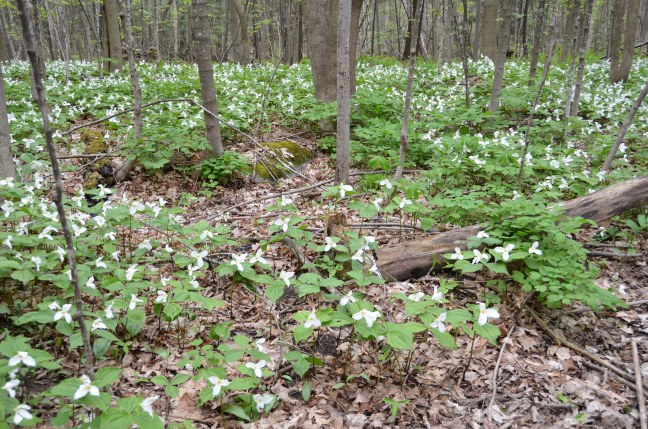
Trilliums in bloom in a Sandy Beach wetland. For 60 years, Hudson has been debating the merits of buying versus developing the 60-acre site. (Jim Duff photo)
On Thursday, Feb. 16, Hudson residents will learn how Mayor Ed Prévost’s administration proposes to allow Hans Muhlegg to develop Sandy Beach and what it will mean for the thousands who take advantage of Hudson’s public window on the Ottawa River.
This latest public consultation will be Muhlegg’s fourth kick at the Sandy Beach can, each under a different mayor. Steve Shaar cut a rezoning deal approved by 72% of the vote in an October 2001 referendum. Elizabeth Corker’s administration adopted the attitude that environment ministry hurdles would stall the project until Muhlegg gave up and agreed to a sewered project of 70 single-family dwellings. Michael Elliott did his utmost to move the project forward but couldn’t get the pieces in place before his time ran out.
Hudson’s current administration appears to be in a hurry to submit a revised development plan I suspect may not be subject to approval by referendum. I’ll get into that later on.
This is an old, old game, this dance between the town and a succession of Sandy Beach owners. In the ‘60s the Blenkinship family was ready to sell the 60 acres to the town for $235,000. A dozen years later, Claudette Boyer offered it to the town for the taxes owed before selling it to Muhlegg’s company for $450,000. Muhlegg himself has expressed his ambivalence at seeing Sandy Beach developed. I’ve come to believe the people most interested in seeing it developed and the least interested in seeing it remain greenspace are the past 60 years of mayors and councillors.
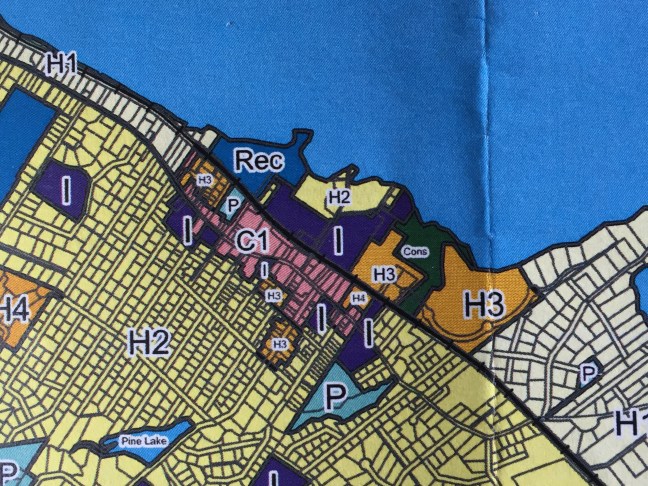
Sandy Beach development according to 2001 rezoning. The two orange sectors marked H3 would see a mix of single and multi-family units. The smaller of the two would also permit a three-storey 50-door seniors’ residence. The green section marked CONS represents the 20% greenspace. Although it doesn’t show on this town map, the town also gets a 100-foot-wide strip along the beach. This may no longer represent the agreement between the town and the developer.
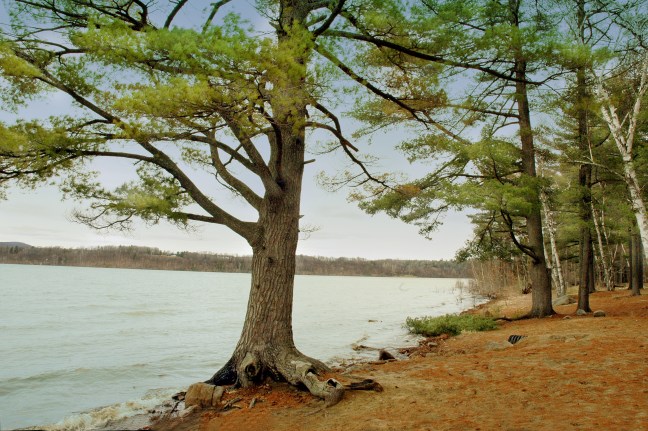
Sandy Beach hasn’t changed much since the retreat of the glaciers. Algonquin tribes fished salmon, muskie, perch and walleye in its shallows and sheltered among its ancient pines and hemlocks along the same shoreline where toddlers splash.
New France brought the fur trade to Sandy Beach in the form of a trading post and gristmill. Historian Maben Poirier once showed me the massive square-cut stones and remnants of the millpond where pre-Conquest entrepreneur Marcellin Farand dit Vivarais built his mill on the creek that bears his name. I’ll post an interesting sidebar on Maben’s musings.
The Viviry River and Parsons Point created Sandy Beach. Swift-flowing and clear, the Viviry drains a 114-square-kilometre watershed with its origins in the spring-fed bogs at the top of Côte St. Charles. In its rush to join the Ottawa, the Viviry transports tonnes of fine sand from St. Lazare, only to drop its load as it runs into the slow-moving river. Over the centuries the sand from the Viviry has mixed with the sand from the Ottawa’s long fetch to form a perfect half-moon alluvial delta all the way to Quarry Point.
Sandy Beach is Hudson’s last remaining window on the Ottawa River, the last reminder of Canada’s steamboat era. During the Depression, Canadian Pacific ran trains directly to Sandy Beach, filled with inner-city dwellers yearning for escape from Montreal’s heat. The Blenkinships, who owned it back then, charged a quarter per car to cross the culvert bridge where Vivaris’s dam once stood. Old timers recall the beach, snack bar and store with the excitement of teenagers. It sounds like a magic place, which of course it still is.
Development was always an option. The 60-acre parcel was zoned for roughly 40 single-family dwellings on 40,000-square-foot lots, but the cost of subdividing and servicing that part of Hudson made it financially unattractive until Hudson adopted a new master plan in 1994. Nicanco’s holdings were included in PAE 1-C, a new zone which would permit condominiums, semi-detached homes and townhouses.
The current discussion had its beginnings almost 20 years ago and as you’ll see, has been shaped by unintended consequences.
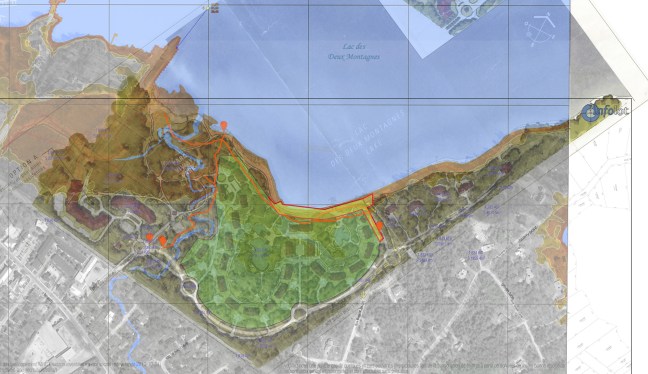
Revised Sandy Beach development shows beach access cut off just to the east of the access servitude (red lines, right centre) as well as alterations to the original conservation zone along Viviry Creek.
In a March 25/98 front-page story, the Hudson Gazette reports:
The fate of one of Hudson’s last remaining pieces of waterfront greenspace depends on whether there’s a market for single-family homes on the 60-acre site – or whether the owners will be permitted to rezone the area for multi-family dwellings.
The Hudson Gazette has learned that representatives of the owners of Sandy Beach met two weeks ago with Hudson Mayor Steve Shaar and others to discuss the possibility of zoning changes for the environmentally sensitive area.
[…] Planning Committee chair Elizabeth Corker believes a development of single-family homes on the property would not be economically viable.
“At least 10 per cent of it is in the flood zone,” she said. “The developer has to give the town 10 per cent in greenspace.” Another 15 per cent would be required for roads and other infrastructures, meaning there would probably be room for about 30 homes.
April 8/98: Citizens petition for unfettered access to beach. Organizers Shawn Murphy and Heather Cockburn point out the town has the right under PAE 1-C to claim as greenspace any 10% it chooses and notes that 10% of the 60 acre total lies in a flood zone.
April 15/98: There’s no rush to buy Sandy Beach, Mayor Shaar tells residents at the monthly council meeting. He accepts a 250-name petition demanding that the 10% greenspace allocation be in the form of beachfront stretching from the tip of Quarry Point to what is now Jack Layton Park.
May 13/98: Shaar tells the monthly council meeting he’s to meet with Nicanco May 26 to discuss buying all or part of Sandy Beach. Asked about Muhlegg’s offer to help find funding to purchase the property, Shaar said Nicanco’s offers were vague and the letter disjointed, as was a followup letter. Shaar reads Muhlegg’s latest letter to the meeting expressing dissatisfaction with the lack of an offer from the town and asking for a meeting to discuss the company’s proposals. The mayor concludes by saying negotiations won’t go far with a $6 million floor price.
The story quotes Muhlegg saying formal and informal meetings on the future of Sandy Beach have been going on for seven or eight years, leading some residents to wonder whether promises had been made when the 1994 master plan was adopted.
May 27/98: Corker challenges Nicanco’s asking price, wondering how a 60-acre property with a municipal evaluation of $2.37 million can be worth $6 million when half will be required for infrastructure or undevelopable.
July 6/98: Nicanco bars public access to Sandy Beach and posts a security guard at the Beach Road entrance. Nicanco’s Robert Sabbah says the fence is necessary to prevent vandalism. Shaar calls it a pressure tactic. The town, he says, is not prepared to make wholesale changes to the PAE, which poses no barriers to development.
2001 Sandy Beach development plan
July 29/98: Tempers flare at Nicanco’s Sandy Beach information meeting as residents shout down Muhlegg’s presentation of his proposed Pine Beach Village. The development would include a restaurant-inn, 60-suite seniors residential complex, 22 villas, 12 semi-detached units, 60 townhouses and a fitness centre with an indoor pool. Nicanco claims the development will generate $400,000 a year in taxes.
Residents zero in on the lack of public beach access. Although the proposal includes 9,000 square metres of greenspace, public beach makes up 125 square metres and is located in a wetland. Muhlegg claims wetland can be transformed into beach. Not everyone is opposed; resident Peter Johnston calls it a well-thought-out project that should nt be condemned because people want to walk their dogs.
Aug. 5/98: Mayor Shaar later says Nicanco’s plan was rejected because the comprehensive development program (PAE), doesn’t permit commercial development. Nor is the town happy with the greenspace being offered. The beach property offered isn’t a beach. At $6 million, the town isn’t buying and Hudson historically doesn’t expropriate, he adds – so the ball is in Muhlegg’s court. Nicanco complains the town is asking for 42% of the 60-acre total. Not true, says Shaar. “They’re including roads, flood zone, greenspace – things that are not part of the calculation.”
Sept. 23/98: Nicanco to present new proposal for Sandy Beach. The story quotes Robert Sabbah, director of business development for Nicanco Holdings, Hans Muhlegg’s brother-in-law. It’s the first sign of a break in the impasse that began with the beach closure.
Oct. 13/98: Discussions between Nicanco and the town continue. The new proposal would include an integrated project with a large building with full services.
The rest of 1998 and all of 1999 passes without public announcement. Then, on Feb. 16, 2000, Hudson residents learn that PAE 1-C is being rewritten to allow a mix of housing. In April, the town planning advisory committee recommends council approve Nicanco’s latest proposal. On May 24, the Gazette reports Nicanco’s fence has been removed in a number of places to allow free access to Sandy Beach.
Meanwhile, events were quickly overtaking Nicanco’s development that would change Hudson forever.
In June 2000, the town awards a contract to the consulting engineering firm LBCD for a feasibility study for a sewage collection and treatment system for Hudson’s downtown core. No fees are payable unless the town receives federal and provincial grants. (In February 2001, LBCD’s mandate is extended to Como’s Bellevue-Sanderson sector.)
Oct. 11/00: Town, Nicanco close to deal. Beach access is the major sticking point.
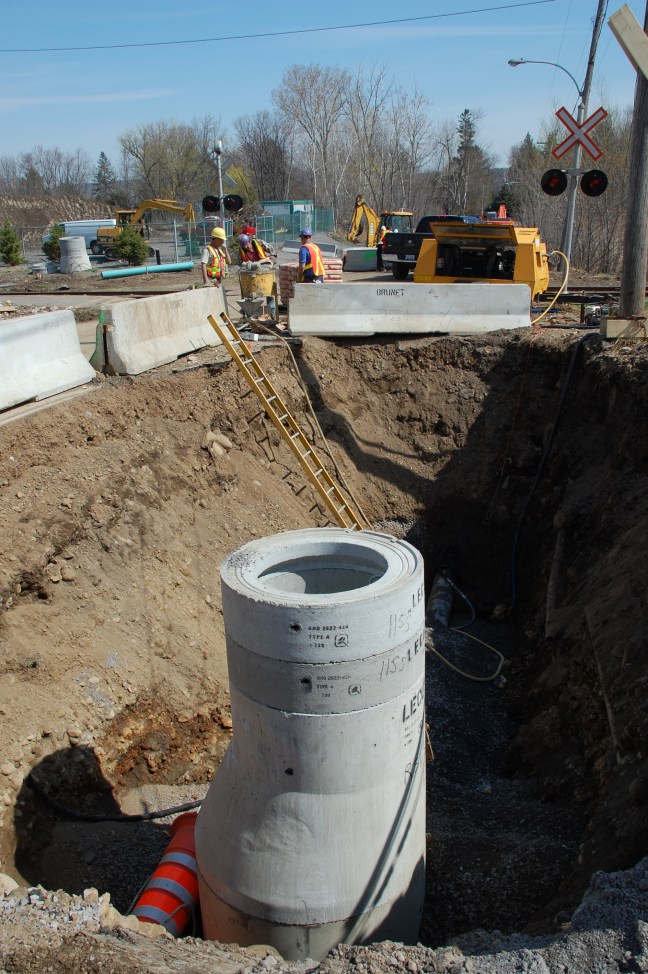
Hudson’s main sewer interceptor under construction on Wharf Rd. The town’s aim has always been to add doors to the system while getting developers to assume the cost.
Feb. 14/01: Town, Nicanco reach agreement in principle. The developer will give up 20 per cent greenspace, or 12 acres – twice the required allotment.
March 12/01: Town holds public consultation on two rezoning bylaws that will allow mixed-density residential development on Sandy Beach. Fifty residents attend. Bylaws create three zones. R-6 (11.6 acres), the closest to Quarry Point, would allow five single-family residences on 40,000-square-foot waterfront lots. R-7 (23.65 acres), the largest sector, would permit four units per hectare, equivalent to 25 single-family units or 95 townhouses. R-8 (10.6 acres), across the tracks from Manoir Cavagnal and to the west of the Viviry footpath, would allow any combination of 12 single-family dwellings, 40 multi-family units and 50-door seniors residence with a maximum height of 42 feet – three storeys.
May 16/01: Town, Nicanco agree on larger setbacks to create wider buffer zone between the new development and residents on Wallace and Sugarbush.
The estimated cost of LBCD’s sewage project rises to $9.4 million, 85% covered by grants.
May 24/01: Two dozen people attend public consultation on bylaws 408 and 409, modifying zoning bylaw 321 and subdivision bylaw 323.
The 54-acre development would preserve 75% of the pine forest and 50% of all trees.
In exchange, the town gets a right of way (ROW) to 1,186 feet of beach, beach access and 11 acres of greenspace.
Most of those in the room oppose the zoning change. They argue that most of Nicanco’s 20% greenspace allocation is already protected wetland or flood zone. Quarry Point environmentalist Kathy Conway asks what happens to the deal if the environment ministry doesn’t approve the project.
That’s our problem, Nicanco’s urban planner Marc Perreault tells her. It proves to be prescient.
Mayor Shaar tells the crowd the project would add a maximum of 150 residential units to the town and reminded everyone the town is facing a $9.4 million sewage system bill. The project is unrelated to the sewage system, Shaar adds – but provision should be made for connecting the Sandy Beach development.
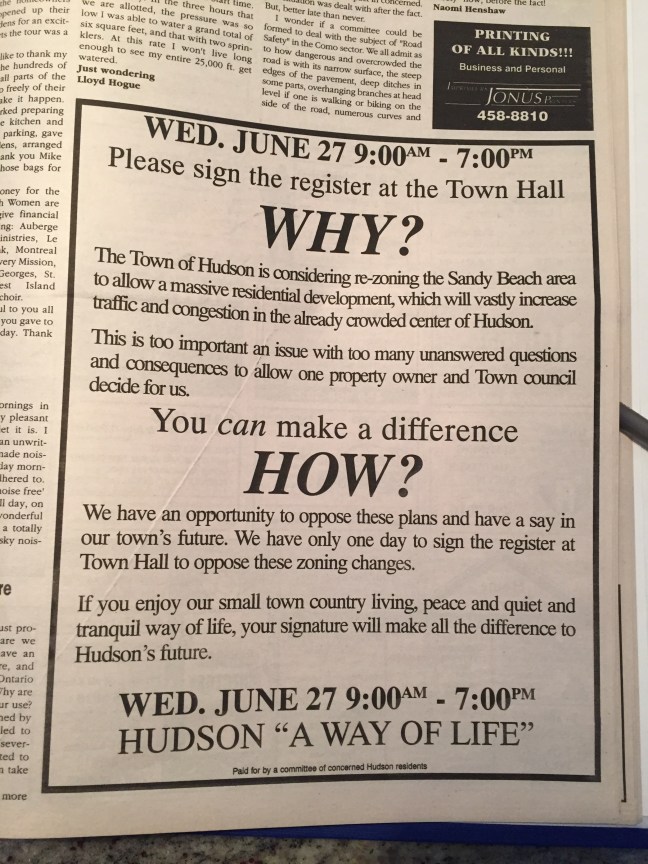
May 30/01: Council tables notices of motion of both zoning bylaws. Residents of contiguous sectors R-1, R-2, C-2, Y-1 (comprising most of Hudson) are eligible to sign a day-long register. 374 signatures are required to force a referendum.
June 27/01: Nicanco’s Marc Perreault warns there will be no further public access to Sandy Beach if the proposed rezoning is rejected.
July 4/01: 444 residents sign the register, 70 more than required to force a referendum.
July 11/01: Council indicates it will withdraw the proposed zoning rather than forcing a referendum. Nicanco is said to be ready to proceed with single-family dwellings.
Aug. 8/01: Council reconsiders, schedules referendum for Sunday, Sept. 30.
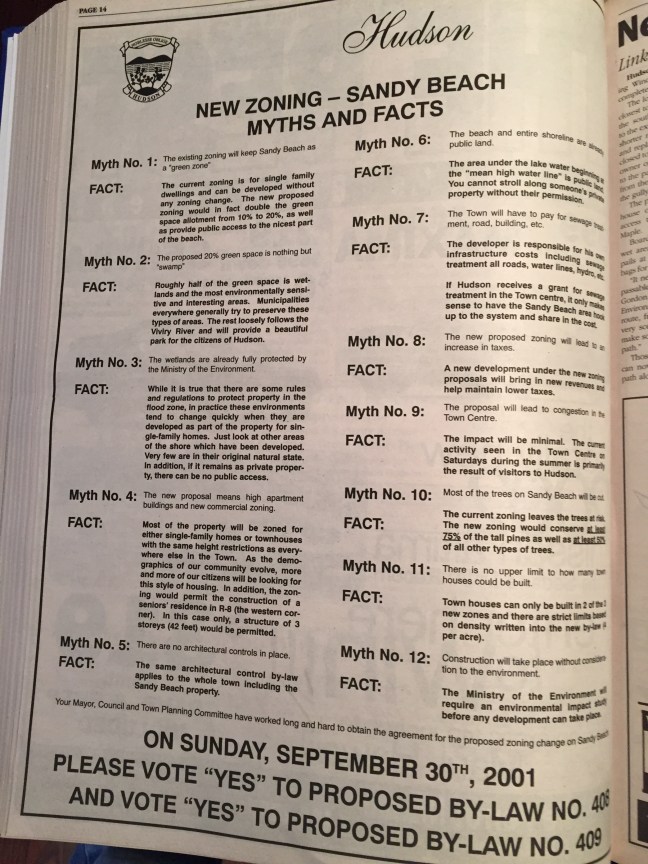
Town administration scrapped any pretense of neutrality in the leadup to the Sept. 30/01 rezoning referendum.
Sept. 5/01: Town, Nicanco hold open house to explain the project. The open house launches a massive ad blitz extolling the virtues of Nicanco’s project and downplaying the negatives. Opposition is divided and has difficulty getting its message out. Other projects, like Whitlock West and a proposal to run an access road between Highway 342 and the Oka ferry, fragment those who might otherwise oppose Sandy Beach development. A powerful argument in support of the project is the need to widen the user base for the coming sewer project.
Sept. 30/01: Both rezoning bylaws pass easily. Just 862 of 3,418 eligible voters vote 72% in favour of the project.
Citizens opposed to the 2001 rezoning bylaws never had a chance of swaying public opinion.
From that day on, nothing goes according to plan for Nicanco. Four years after residents approved the rezoning, the 150-door development has seen construction of a single home on one of the five R-6 lots.
Under Quebec’s Loi sur l’environnement, regional environment ministry inspectors make the determination whether a proposed subdivision requires further study. Their decision is based on acquired data, such as satellite mapping and a basic knowledge of the local topography. Sandy Beach, with a checkerboard of sensitive wetlands, flood zones and ticked all their boxes.
Two more years will pass before Nicanco provides the ministry with multi-season flora and fauna studies needed for authorization to extend Beach Road to the far end of the proposed development. More time is spent fighting the town for the right to service the five lots on Royalview via Sugarbush. At one point, it looked like the only house in the entire project would not be issued a certificate of location because it was located on a private road. Normally, a municipality takes over ownership of a subdivision but Hudson balked until Nicanco agrees to foot the bill for sewering the entire project. To this day, Beach is a private road, while at the far end, Royalview is public.
Dec. 7/05: Hans Muhlegg blames delays on “unplanned and unexpected development constraints.” Asked how a third party would interpret this, he responds: “It’s disguised expropriation.”
Worse, the environment ministry determines that a 1.5-hectare wetland in the middle of R-7 could not be filled in, leaving Nicanco’s largest sector with a money-losing hole in the middle. (It wasn’t until the 2012 passage of a Quebec law allowing developers to backfill a sensitive wetland by trading it for a protected wetland of equal or superior quality in the same watershed that Nicanco could proceed.)
March 30, 2011:Hudson mulls wetland swap to revive Sandy Beach project
How far should the Town of Hudson go in helping developer Nicanco revive the moribund Sandy Beach subdivision to add users to the new municipal sewer system?
Nicanco president Hans Muhlegg is asking the town to sign off on a deal that would protect a parcel of wetland the town already owns in exchange for allowing development of a five-acre wetland in the heart of his 56 acres.
Regional environment ministry officials confirmed last week they’re studying the proposed land switch to determine whether it falls within their land-trade parameters. Under controversial Ministry of Sustainable Development, Environment and Parks (MDDEP) guidelines, developers can ‘buy’ the right to develop wetland by acquiring wetland of equal value in the same watershed.
But Muhlegg isn’t interested in putting more money into the project, says Hudson mayor Michael Elliott.
“His request has simply been ‘will the town help me by freezing a piece of land you already own’?” Elliott explained prior to meeting with Muhlegg and his team last Tuesday. “In other words, to take a similar wet zone which we [already] own opposite the treatment plant, that we already have a court order telling us we can’t do anything with, and rezone [it] to be a sensitive ecological area.”
Nicanco already has the right to develop Sandy Beach, thanks to a 2001 zoning bylaw approved by a majority of residents. The plans call for a mix of single-family, semi-detached and seniors’ residences — all connected to the municipal sewer system.
But by the time he was ready to develop, MDDEP had changed the rules. “Part of the problem is he didn’t move quick enough,” Elliott said. “He should have moved eight or nine years ago for him to get his dispensation.”
Development means an end to unlimited public access to Sandy Beach, but that was already established in the 2001 zoning bylaw. The public will have access to roughly 11 acres, including 720 feet of shoreline — twice the mandatory 10 percent greenspace allowance Nicanco had to give the town.
Last week’s meeting with Muhlegg and his lawyer and biologists was to establish whether the five acres in the middle of the proposed development is as environmentally sensitive as MDDEP’s biologists say it is. The town has asked McGill biologist Martin Lechowitz to go over the data from both sides and advise the town’s environment committee, which will make a recommendation.
The mayor admits he’s torn between seeing more users on the sewer system and protecting every possible inch of Sandy Beach.
“I don’t particularity want to make that decision whether the town should help him,” says Elliott. “As far as I’m concerned the town lost the beach 25 years ago when we could have had it for $235 000.”
Even if the wetland swap is refused, it’s not going to halt development, Elliott points out, “but it will change his drawings where buildings are going to be.”
Both the mayor and town planning committee chairman Rob Spencer see it as an chance to revive an $80 million project while widening the town’s tax base. “The sewage treatment plant was designed to take it,” says Elliott. “I think it’s a win win for the town.
He pointed out that Muhlegg has already given the town more than twice the amount of greenspace required by law. “The decision has already been made to develop the bloody place, it was zoned for development we agreed to that years ago. so all we would be redoing is rezoning a piece of land we can’t do anything with anyway and we own.”
Since that was written, Muhlegg has satisfied the ministry’s wetland trading requirements by renegotiating the conservation zone with the town. The latest map shows alterations to the green corridor cutting across R-7. It also indicates a reduction of beachfront to the east of the access servitude from the end of Beach Road.
None of these revisions have come before public council meetings although they have been discussed by members of TPAC. At worst, say concerned residents, the Prévost administration will present residents at the Feb. 16 meeting with a revised Sandy Beach development proposal limiting beach access while dramatically increasing the number and density of residential units.
Why would council be in a rush to get this done? One theory suggests it’s because neither Nicanco nor the town want to find themselves on the wrong side of Bill 102, a top-to-bottom rewrite of Quebec’s 40-year-old environmental protection act. As of last week, the draft bill was in legislative committee undergoing a clause-by-clause study and could be ready for adoption before the June break.
For Nicanco and this administration, the major differences in the rewritten act are its new transparency and public consultation requirements. For that reason alone, I wonder whether the proposal being presented Feb. 16 will attempt to replace Sandy Beach’s PAE designation with a Plan particulier d’urbanisme, or PPU. Although the change would require ministry approval and consultation, it would no longer be subject to referendum.
For Hudson residents, the question we asked 60 years ago, 50 years ago, 20 years ago is the same question we’re asking today. Is Hudson better off owning Sandy Beach or seeing it developed according to a plan we can agree on?
If you were asked that question tomorrow in the form of a referendum, which way would you vote?
People ask me what Sandy Beach is worth. I have no idea. Once it was $235,000. Today, it’s $23.5 million. Muhlegg has come up with so many figures over the years I don’t think he knows what it’s worth to him.
Muhlegg and I have known one another for these 20 years but I can’t say I understand him.
We’ve sat through innumerable council meetings and public consultations together. I’ve spent hours in his Pointe Claire office and over lunch, listening to him obsessing on his favourite topic: Sandy Beach. He sees it as a jewel, a place of rare beauty that should be preserved in its natural state. He’s on record as having offered the town help in obtaining funding to buy Sandy Beach and suggested that his company might be able to help finance the acquisition. Yet he’s a shrewd businessman, making his fortune developing far-flung parts of the world and investing in highly speculative ventures – prize fighters. He’s a fighter himself, a lung cancer survivor.
If I was to venture a guess, I would say Hans Muhlegg’s perfect Sandy Beach deal would have all 60 acres declared a conservation zone, off-limits to the public. Forever.
Which will better protect Hudson’s Sandy Beach – development or popularity?
At a special meeting starting at 7 p.m. this Monday, Feb. 6, Hudson council will adopt a revised 2017 budget and triennial investment plan. Indications are this administration will slash $1 million from the $13M budget adopted in December. Expect across-the-board cuts, including reduced grants to local organizations and events. The regular February council meeting follows.
Food trucks don’t steal business from local eateries. They draw new customers to town and encourage everyone to up their game by innovating. Competition is good for everyone.
Amazing, how good ideas are so quickly snuffed out in Hudson. I liked Peter Ratcliffe’s post about taco trucks, chuck wagons, canteen-mobiles, whatever you want to call them. Sure, there’d be problems, but what can you expect in a town where thinking outside the box is grounds for suspicion?
Rod Hodgson notes that food trucks are illegal in Hudson. So are granny suites, glare-y floodlights, bikes without licences, dogs off the leash, solar panels, spitting in public and using shipping containers for storage. Feel free to add to my list of useless, unenforced bylaws. I see it as a citizen’s job to blow the whistle on stupidity.
Hudson’s SDC has a problem with food trucks. We won’t digress into a discussion of the legality of this organization’s right to exist, let alone spend taxpayer’s dollars without accountability or transparency. I’ll confine myself to saying Hudson’s beleaguered commercial sector has no need for self-appointed, unaccountable sheriffs and enforcers of who can do what.
Back to food trucks. Why is it that someone can sell prepared food at the Hudson Farmer’s Market or any number of other public events but not at Jack Layton Park? Because the town says so? As good a reason as any to challenge the status quo, I say.
Here’s a suggestion: Ask local restaurant owners what they think. That should take half an hour at most. Ask them if they’d be interested in going mobile and whether they have any suggestions.
By the way, I have one. Rather than blowing a pile on fireworks and all the other fake frivolity at this year’s Canada Day 150th, Hudson should think of co-hosting home-and-home street fairs with our First Nations brothers and sisters across the river. A lot of them have Hudson roots and it would be interesting and fun.
Trust me when I say the Mohawks will have no legal problems with food wagons on either side of their river.
A thirty-something friend posted mid-afternoon on Facebook : “Hudson needs a Taco Place” and a lively exchange ensued, allowing me to float one of my random ideas for Hudson. Someone in that conversation asked me to write about it and post on Jim Duff’s Blog, in reality he didn’t have to ask I was going to do it one day soon.
We were once a weekend day trip summer destination for shopping and food mostly. It’s part of our history perhaps we can build on.
Summer Food Truck Weekends at Jack Layton Park
For a waterfront community we have precious little accessible public waterfront, only one small public launch and dock at Jack Layton Park. My suggestion was to have spaces for between two and perhaps three gourmet food trucks open each summer weekend and set up and promote a schedule of changing food trucks and menus throughout the summer.
Open from late morning until evening, they would be a great draw for residents and out of town visitors to get outdoors, visit our waterfront area, share some great food and spend time at Sandy Beach, walk and shop the village, visit Greenwood, take in a matinee, head down to Finnegan’s Market.
If you’ve done any of the big festivals in Montreal, you may have experienced or at least seen high end food trucks. These are not your garden variety roadside chip wagons but a wide variety of higher end offerings often from talented chefs. Think a limited menu take-out Carambola wannabe on wheels. Watch the movie “Chef” on Netflix wherever it streams.
Better yet, perhaps we could encourage some of the fresh food supplied to come from the new Hudson Community Garden initiative: Eat locally grown, play locally and share good times with families and friends. We have a local Micro Brewery who might be able to license sale of their beer, just another random thought to benefit a local business. Perhaps we could host local musicians and artists as well.
Perfect Hudson Summer Days: wind, water, Sandy Beach, great food, craft beer, art and music with friends and neighbors.
A comment on Facebook suggested that such a proposal would be a good undertaking for the SDC of Hudson, who already have a promotion infrastructure on Facebook and work on behalf of local businesses want to bring more visitors and customers to Hudson. Such a weekly event for a whole summer could gain some traction and attract more potential new residents to our quaint village.
I’m not an expert on the logistics or economics of food trucks, but I’m sure many are owned by entrepreneur dreamers who need publicity and market. If you’re hosting a private event, I’m sure you need to pay them to come. I’m sure they pay big bucks for a spot at the Just For Laughs Festival or Grand Prix Weekend. I’d say we should offer them free space and whatever promotion we have and see if we can entice any high quality takers to come.
Sure there will be many defeatists who find reasons not to even consider this idea. First up was immediate skepticism that the town would make it difficult or over regulated.
I’ll remind everyone of the huge success, local benefits and national awareness of Hudson from Greenwood’s Storyfest. Run through the list of wonderful authors we’ve had, and those still to come and remember it started as a modest idea and grew each year. The vision of the Greenwood Board and their volunteer committee have yet another star studded line-up forming for Fall 2017. Authors come to Hudson, find it a truly special place and want to come back or even talk of moving here. We need more of that type of awareness of the good our town has to offer.
Hudson Summer Food Truck Weekends would need the interest and support of Hudson Council and SDC, perhaps some modest commitments to supporting infrastructure we should have anyway at Jack Layton Park, security and cleanup we should be doing anyway.
Not a lot to lose: Launch it, try it, and if it works try to grow it into an annual summer long event where we might be able to some day charge food trucks for spaces that are proven to deliver customers.
CBC’s The National has become an American news outlet, far more interested in Donald Trump and the American news cycle than anything happening in Canada.
They proved this beyond a doubt with last night’s deplorable coverage of the shootings in the mosque in Quebec City. The National’s newsroom obviously believed that Trump was the story of the day, as usual. Canadians were left in the dark as to what was happening in the horrific shooting in their own country.
The coverage from our national broadcaster was so bad that we turned to CNN – which was actually running live coverage from Quebec – while the Toronto faces rattled on about American news. Totally unacceptable.
As Albertans, we have known for a long time that CBC is the public relations department for the Liberal government. What’s more, over the last year, CBC has become just another bad American news channel, never missing an opportunity to showcase their anti-Trump opinions.
As a Canadian, I have no skin in the American game. I just want good journalism. Give me the two sides and let me, the public, make a decision. The Toronto newsroom has become a de facto propaganda machine.
CBC’s coverage of what happened in Quebec appeared to me as if people in the Toronto newsroom were actually annoyed that they might have to cover what was going on at home.
I could go on about CBC’s mandate and what this debacle of a news outlet costs us, but of course we’re all familiar with the numbers and appalled by the product.
The daily decisions to dispense with solid news reporting and showcase their own political opinions demonstrate the amateurish journalism skills of The National’s news editors. They should all be fired. Now.
Garth Pritchard is an award-winning Canadian documentary filmmaker living in rural Alberta.
Why did English Canada see none of this live on the CBC?
Globe and Mail TV critic John Doyle’s Tuesday column (Lack of TV news coverage of Quebec City shooting a huge broadcast failure) singles out CBC-TV News, the national network’s touted source for independent news and commentary.
Doyle’s takedown wasn’t strong enough. The CBC failed so utterly, so pathetically, I’m shocked the network hasn’t announced an internal inquiry into who made the call not to break away from regular Sunday night programming, including a pre-recorded The National – and why.
Quebeckers and subscribers watched Sunday evening’s horror unfold on LCN, Quebecor’s all-news channel, or on its Radio-Canada competitor RDI. Both provided the kind of nonstop coverage viewers desperately sought from the moment the first alerts began popping up. If I was forced to choose, I’d say LCN’s remote coverage was better, while RDI’s anchors did a more professional job co-ordinating. (LCN’s usually urbane Pierre Bruneau looked and sounded rumpled and I found myself yelling at ex-politician Mario Dumont, but these are nitpicks.) Both got the job done.
CBC Montreal’s online posts were slow in coming and read as if they were being transcribed by someone watching the Radio-Canada feed. I was the CBC-TV assignment editor the day in 1984 Denis Lortie stormed the Quebec National Assembly, killing three and injuring 13. We scrambled to round up cameras and reporters as Toronto ordered nonstop coverage and demanded why we couldn’t supply more. Now, 33 years later, the CBC’s top brass seems to see nothing wrong in its failure to deliver what its private competitors had no trouble supplying – professional live coverage of a fast-breaking news event of worldwide interest.
My suspicion is that CBC top brass made a political decision. Rather than risking getting it wrong in the news blur (three shooters became two, then one) and giving voice to politically incorrect utterances, the news bosses played it safe by waiting until the SQ and Premier Philippe Couillard had done talking. If I’m right, the CBC doesn’t deserve a dollar from taxpayers until those who made the call are replaced with professionals.
In 2016, the broadcaster got $34 per Canadian. It wants $46 per Canadian to go ad-free, which it claims will make it more independent and able to branch out into new technologies. My view: why should the CBC get more money if it fails to deliver on its existing promise of performance?
CTV and Global were no better, but they’re answerable to their shareholders and the CRTC, not the taxpayers. I feel for my colleagues who suffer in silence so they can keep their jobs. (As for the CRTC, it has outlived its usefulness, but it will take far more political courage than Ottawa has shown so far to make it relevant.)
Whenever I hear or read handwringing journalism profs and senior executives in Canada’s media monopolies moaning about the slow, sad death of print and broadcast journalism, I wonder whether I’m the one who’s crazy. Journalism isn’t dead. Its beating heart has been transplanted onto the internet, onto podcasts, onto live-streaming sites where inquisitive minds can work without the malevolent interference of corporate bosses. Media consumption has fragmented and as the boomers die, so will the mainstream media.
The CBC likes to pretend it’s a Canadian BBC, PBS or TV5. It is none of those things. It has excellent journalists, editors and producers but it ties their hands with a brain-dead bureaucracy which discourages initiative and enterprise. The sad part is that it could become the daring, disruptive voice of transformative journalism it claims to be.
What is the ultimate capacity of Hudson’s sewage treatment facility?
According to the people who built it, 25% more than what it was originally designed to handle, with future expansions possible. I have been told the system is currently operating at approximately 60 per cent capacity, but the only confirmation I’d accept from this administration would be in the form of flowmeter data.
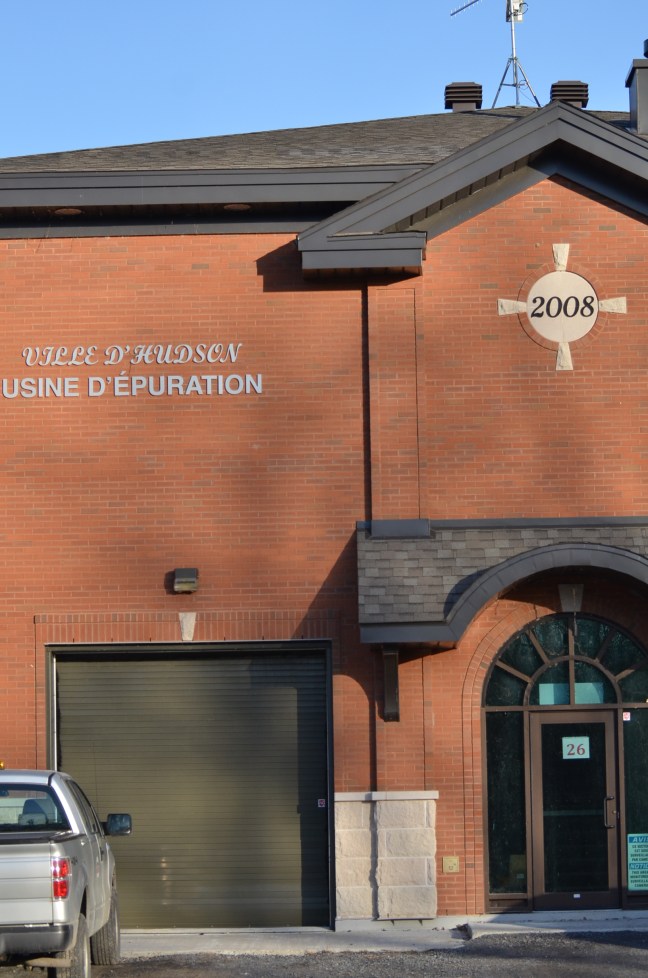
Above, the Town of Hudson’s sewage treatment facility as seen from Wharf Road. Below, the array of sequencing batch reactors at the back.
The 25% comes from former Hudson/St. Lazare Gazette reporter Matthew Brett’s sewer system notes from November 2007, which I post verbatim together with a big thanks to Matt for preserving them in digital form:
Whole system will be housed in a two-storey round building 28 metres in diameter according to town engineer Trail Grubert. Six-acre site off Wharf Road, next to the municipal snow dump.
Grubert said they’d looked at six other zones that weren’t suitable.
Space already belongs to town, so didn’t have to buy more property.
Discharge flows into the Lake of Two Mountains.
Denis Provencher of LBCD says it will use industrial processing tanks, called sequencing batch reactors (SBRs), to remove bacteria and solids from the water.
The first step in the treatment process involves what Provencher calls a “rotary screen,” where solids bigger than 6mm are filtered out. The liquid waste flows into an equalization tank to await transfer to one of the four SBRs. There, each load is pumped full of oxygen, which promotes the growth of aerobic bacteria that consume the particles found in the sewage.
Afterwards, the wastewater is left to settle before being separated from the leftover sludge. The water goes through a further ultraviolet disinfection process before flowing into the Lake of Two Mountains through a 300-metre pipe. The sludge is treated and dried, and periodically disposed of in a landfill.
According to Provencher, the water and sludge being returned into the environment must meet strict government requirements. One reason the town is installing the system is because municipalities downstream complained to the Ministry of Environment that Hudson is discharging raw sewage into the Lake of Two Mountains.
Building is equipped with a carbon filter that neutralizes odours.
Acoustic enclosure dampens noise.
For now, the sewer system will be available to businesses and residents in the town’s centre within the boundaries of Lakeview, Mount Pleasant, Côte St. Charles and Main Road, and all civic addresses on Bellevue, Sanderson, Seigneurie, Wilkinson and Parsons.
Provencher said the treatment facility has been designed to handle a larger service area in the future. “In the design, considerations have been given to future expansion. For example, by converting the equalization tank to a SBR, the capacity can be increased by 25 percent,” he said.







 thousandlashesdotca