Meanwhile, back at Town Hall…

I’ll continue writing this blog for the duration of the election campaign. I won’t burden my readers with lurid campaign details to date except to say I knocked over my ladder while putting up Jim Duff District 5 posters and had to koala-hug my way down a splintery staple-studded hydro pole.

We have to keep our eyes on the goings-on at Hudson town hall for the duration of the election, out of public view from this evening until the next mayor and council are sworn in more than a month from now.

Council will be dissolved after this evening’s special meeting (7 p.m., Community Centre) but town business will continue under the supervision of the acting mayor (pro-mayor Natalie Best) and town manager Jean-Pierre Roy. That includes loan bylaws for paving and a new well, a parking bylaw and approval of the new Coast Guard base.

I’m sure resolutions adopted at last week’s council meeting will reverberate during question period, especially the announcement of a deal with Sandy Beach developer Nicanco whereby the town takes over responsibility for Beach Road/ Royalview. In exchange, the developer adds a lot to the east to the existing servitude and agrees to install all infrastructure and pave the road. The developer will also cover the cost of two sewage pumping stations and extending a line west to the sewage treatment plant.

There is a long and growing list of work being done to comply with the Dec. 31 deadline for completion of projects receiving funding this year, including a new roof and mural for the curling club. Two local artists, Daniel Gautier and Kent Thomson, will be paid $10,000 each (they have both been cut $5,000 cheques to cover their setup costs) for designing and creating a We are Canada mural (citizens are promised some form of input at a later date). Roy, as DG, has been given authority by this council to sign cheques and approve contracts while  residents pick a council that will have to live with the results and approve the final tab.

Hmmm.

Posted this on FB yesterday:

Going through the auditor’s report on Hudson’s fiscal 2016. (It was presented at this council’s last regular Monday-night rubber-stamp event.) A $976,343 operating surplus, $4M in the bank, $400,000 more than budgeted to pay down the $26.7M long-term debt, lower than budgeted expenditures. Flip side: Hudson’s auditor can’t attest to the veracity of the data in their report because the town remains under a MAMOT dark cloud.

It’s hard to nail down, this dark cloud  but there’s no doubt it’s there, a conflation of Louise Villandré’s online gambling frauds and the litigious mess involving the town’s former DG, a human resources consultant and the outgoing mayor.  Here’s the introduction to an adverse opinion of the town’s financial situation (my translation and synopsis:

Our responsibility consists of offering an opinion on the consolidated financial statements on the basis of our audit. We carried out our audit according to generally recognized Canadian audit norms. These norms require that we adhere to [our profession’s] code of ethics and that we plan and conduct the audit so as to reasonably assure ourselves that the consolidated financial statements not contain significant anomalies.

An audit presupposes the carrying out of procedures designed to gather correct data concerning the sums and information contained in the consolidated financial statements. The choice of procedures is up to the auditor, and notably that his evaluation of risks the consolidated financial statements may contain significant anomalies and that these may result in frauds or errors. In the risk evaluation, the auditor takes into consideration [the Town of Hudson’s] internal controls on the preparation and accurate presentation of the consolidated financial statements so as to come up with audit procedures appropriate under the circumstances, and not with the goal of expressing an opinion on the effectiveness of the [town’s] internal controls. An audit also carries with it an appreciation of the appropriateness of the accounting methods used and how the consolidated financial statements are presented.

The audit evidence, Gaudreau, Poirier concluded in its report, is “sufficient and appropriate on which to base our adverse opinion (opinion d’audit défavorable)”

Wikipedia: In an audit report, an adverse opinion is one expressed by the professional accountant in which the auditor formulates a restriction on the basis that the financial statements do not fairly present the entity’s financial position and results in accordance with generally accepted accounting principles or a other applicable financial reporting framework.

Gaudreau Poirier continues: The town’s internal control deficiencies between 2004 and 2013 may have allowed some expenditures on town projects covered by [government] grants not in conformity with the loan bylaws that approved them. The auditors were unable to determine specific incidents.

In their view, the town’s consolidated financial statements do not give an accurate picture of the financial situation of the town and organizations under its control as of Dec. 31/16.

This post has been corrected to reduce the payout to the two We are Canada artists to $10,000 from $15,000. 

A FB message from Culture and Tourism director Laura McCaffrey on plans for public involvement: “Mr Duff – a quick correction regarding the mural info you posted on your latest blog. Each artist will be paid $10,000 for their work, which will have extended over 3 months. Input from residents has been solicited over the last 2 months via emails to our community and cultural organizations and their members, through social media, and through printed media with an article in YLJ and Arts Hudson. In addition to the submissions that we have received from the public, which have all been taken into account in the design of the mural, Hudson residents will have an opportunity to contribute to the actual painting of the mural once the painting process has begun. At the outset when determining timelines for the completion of this project, we concluded that November 11th would be a realistic and appropriate date to unveil the completed project. We continue to be on track to meet this deadline.” 

The alleged conversion of the beach servitude to outright public ownership was based on an unrecorded conversation and remains to be confirmed.


Fight like dogs and cats


DSC_5579.JPG
An unidentified Hudson resident shot this pitbull some years back because the owner was allowing it to run free. Hudson’s apathetic voters need electo-shock therapy with issues they can care about, like Hudson’s leash laws.
One of Hudson’s mayoral candidates waylaid me this week, wondering how to get people fired up about the upcoming election campaign. (Nominations open and the campaign officially begins Sept. 22. Nominations close Oct. 6 and the campaign finishes with the election Sunday, Nov. 5; so far, there’s next to no interest.)

Uppermost in both our minds: 53% of Hudson’s eligible voters didn’t vote in the last election.

I have the answer: trees, dogs and cats.

Before I get around to explaining, it’s too bad Hudson’s pontificaters and bloviators can’t be bothered to inform themselves on what’s been happening at the Quebec National Assembly this year — and how those happenings relate to Hudson.

If they did, Hudson residents could look forward to a more sophisticated, better-informed election campaign where those seeking election will have to do better than the usual yawners about transparency and commitment.

Trouble is, there’s no easy way to make administrative issues interesting  despite the profound effect they’ll have on our community. I’ll begin with Bill 122, ‘an Act mainly to recognize that municipalities are local governments and to increase their autonomy and powers.’

Bill 122 was adopted June 15, but only after the Couillard Liberals agreed to an amendment doing away with obligatory referendums on zoning changes. The amendment gives municipalities the choice of whether to adopt a public consultation policy to replace the ‘subject to approval by referendum’ process. Hudson’s Prévost administration chose the public consultation route without explaining the change to residents.

Back in January, I posted Waiting for Bill 122 (WordPress, Jan. 16/17) following a lengthy interview with Hudson’s director-general Jean-Pierre Roy. He explained in general terms how Bill 122 would allow Hudson to take control of development. But because 122 was not yet law, Roy didn’t explain the political mechanism whereby the town would be able to move past zoning bylaws subject to approval by referendum.

Nor did the current council, presumably because they thought it better to let sleeping dogs lie. It wasn’t until a May 23 public consultation that Hudson residents realized that by adopting three concordance bylaws (688,689,690) the town was giving itself the powers vested in it by Bill 122 to pre-approve a number of development projects, including Sandy Beach, Willowbrook and a townhouse scheme on Como Gardens.

Those three concordance bylaws also enabled transport-oriented development in sewered sectors of town. Two other zoning bylaws (690,691) cleared the way for Wyman Memorial United Church to sell a parcel of land for residential development. (A sixth modification to the town’s master plan, Bylaw 685.2 which I don’t believe was adopted, would have established Greenwood Centre for Living History’s right to non-conforming use.)

When we were done adding the potential numbers, Hudson found itself looking at close to 1,000 new doors in a town without enough water in its reservoirs to fight two fires simultaneously, let alone meet a 30% shortfall during peak demand periods.

The current administration made little effort to explain any of this to residents. Under Bill 122, municipalities are no longer required to post public notices in local newspapers. Instead, they face tougher transparency requirements, including an obligation to post every public document on their municipal website. Not only has this council failed to explain due process; it persists in obfuscation.

Hudson’s development future? Ellerbeck’s 98-door Willowbrook project is on track to become the town’s first development to be approved without recourse to a register or referendum.

And, as they say in the telemarketing ads, that’s not all. If Hudson Valleys developer Daniel Rodrigue had waited for the town to adopt bylaws 688, 689 and 690 before seeking a zoning change for his Mayfair semi-detached project, contractors would be pouring foundations this fall. Instead, the project was rejected in a register because Rodrigue failed to convince residents the project was to their benefit.

It could well prove to be NIMBYism’s last stand in a community notorious for its hostility to new development.

Because Rodrigue’s 24-door townhouse development isn’t toast. Bill 122 allows a municipality to identify requalification zones in its planning policy, where redevelopment such as densification or urban renewal won’t require a rezoning bylaw subject to referendum.

Screen Shot 2017-09-13 at 4.42.03 PM.png
Because of Bill 122, Ellerbecks’ Willowbrook development will be Hudson’s first to be approved without recourse to a register or referendum. It won’t be the last.
Then there’s draft Bill 132, an Act respecting the conservation of wetlands and bodies of water. It’s called a draft bill because it’s currently before the NatAss Committee on Transportation and the Environment undergoing clause-by-clause consideration. It’s a political hot potato because it delegates decision-making on wetlands and eco-corridors to Quebec’s regional municipalities, or MRCs.

Hudson’s draft conservation plan is being rushed to completion despite persistent questions about wetland swaps approved by the environment ministry. What’s the rush? Sandy Beach? Como Gardens?  The enabling legislation hasn’t been adopted — and won’t be until sometime next year.

Other issues loom, like fallout from the 17.5% salary increase to the Sûreté du Québec’s 5,400 members. The formula under which the Vaudreuil-Soulanges MRC is taxed for SQ policing is part of a Quebec-wide equalization scam. On average, Quebec municipalities pay 53% of the cost, Quebec the rest. But wealthy MRCs (we’re one) are assessed approximately 110%, with individual municipalities refunded half the excess. Quebec’s two municipal federations are fearful those rebates to their members will be slashed, possibly in excess of the 17.5% increase to cover the added cost to have-not MRCs.

Hudson, like most small municipalities where policing represents a sizeable chunk of their overhead, has come to depend on that rebate. But who’s going to get fired up over something they can’t change?

Now to the trees, cats and dogs.

Draft Bill 128, tabled in June, will dictate a province-wide law regarding dogs that bite people. Municipalities will have the power to adopt stricter regulations, but if they don’t the provincial law will prevail regardless of how Hudson’s dog lovers feel about it. Now, this is a hot-button issue in a town where many feel it’s unfair to leash their four-footed furry buddies, let alone muzzle them if they get rowdy with a neighbour’s toddler.

We’ve all seen horrific injuries inflicted by unmuzzled dogs, but like guns and climate change, we’re dealing with denial. Should Hudson ban specific breeds? Prosecute the owners of canine offenders? Aggressively enforce leash and poop laws?

While we’re at it, should people be allowed to trap cats trespassing on their property, eating songbirds and crapping in their garden?

…which brings me to trees. The new owners of a home on Ridge Road cut most of the trees surrounding the house to increase drainage on the perennially wet lot and to let some sun into their new abode. The neighbour, a house-proud couple for whom the illusion of country isolation was important, were outraged. Should the town consult with our neighbours before issuing tree-cutting permits? Now, there’s a fight worth having.

How about closing the town core to traffic on summer weekends? Or metered parking?

If it’s voter turnout we’re after, get people going. Forget the boring stuff, like governance and vision. Find those hot buttons and poke at them until Hudson’s sleeping dogs wake up.


Hudson tightens handout controls

Hudson Village Theatre has the town’s go-ahead to add an addition to the west end of their playhouse in Hudson’s former CP train station. Council’s conditions: it must be hooked up to municipal sewers and have two basement exits with old and new basements connected.

HVT executive director Kalina Skulska told me the addition will provide the theatre the space it needs for social events and theatre activities. She made a point of emphasizing the theatre isn’t looking for handouts from the town, adding HVT has gone it alone since its inception with the help of its sponsors and fans.

A coincidence? Council Monday night also approved a town policy for the recognition and support of non-profit organizations, allegedly in response to an embarrassing incident in which a cheque to a local organization was deposited into somebody’s private bank account.

In the preamble, the town links its financial support to an organization’s ‘recognition status’ and degree of accountability. Organizations requesting handouts from the taxpayers must be headquartered in Hudson, have 70% of their directors from Hudson, respond to a collective need, conduct all their activities in Hudson and not look to the town as a primary source of funding.

Institutional, political, religious, professional, philanthropic or any group “supporting or accompanying sick, addicted or incarcerated individuals” shouldn’t bother to apply.

The policy item that raised the biggest squawk was the requirement that any applicant with an annual budget of $20,000 or more, or having received a grant of $5,000 or more from the town is required to provide audited financial statements.

Hudson Music Festival co-organizer Lynda Clouette Mackay pointed out that an audited financial statement can cost as much as the grant is worth.
“There is flexibility, obviously,” said councillor Ron Goldenberg.
But you’ve passed it tonight, several in the audience pointed out.

Pro-mayor Natalie Best said at first there could be modifications to the resolution before it comes into effect, then persisted and signed. “It’s already passed but we’ll take it under advisement.”

Community Centre reno rush

The rush is on to spend as much of that $555,000 loan bylaw before Dec. 31. Council voted to approve a $22,460 contract with architect James Lalonde to prepare tender documents for the renovation of the Community Centre. Also announced was a notice of motion of delegation of powers to DG Jean-Pierre Roy so decisions regarding this and other town projects continue to be made in the period between the end of the current council’s mandate and the swearing in of their successors.

Following the council session Parks, Recreation, Culture and Tourism Director Nicolas Pedneault gave me a tour of the Community Centre with the emphasis on what renovations are needed. Roof leaks, crafty, leaky original low-grade windows and doors and worn flooring are obvious. Less obvious is the lack of a proper commercial stove ventilation hood and other shortcomings in the heavily used kitchen. The structure averages 100 visitors a day and has been designated as the town’s emergency shelter.

When the bylaw was adopted the town vowed not to spend any money unless it was matched dollar for dollar by the federal government’s Canada 150 and other community infrastructure programs. In other words, the taxpayer’s share of the total would be a maximum of $227,500.

Compost pickup coming

Organic waste pickup is coming as early as next year. Council voted for Hudson to join other Vaudreuil-Soulanges municipalities also part of the Montreal Metropolitan Commission in a project to collect compostables in 45-litre bins.

More new hires

Hudson’s next town planning services director was introduced. She’s Marie-Claude Besner and she’s been involved in urban planning since the early ‘80s. She replaces Natalie Lavoie, off to Two Mountains after 15 years in Hudson. Also hired is a new town clerk, two articling law students, a part-time employee for the finance department, facilities attendant and a mat leave replacement for Parks and Recreation.

$15G for snowclearing mayhem 

Transport André Leroux Inc. finally got the cheque for the last instalment of last year’s snow-clearing bill — $45,931.51, minus $15,000 representing the damage the town and Leroux agreed was caused to property by incompetent operators. Residents found the damage settlement to be ridiculously low and demanded whether Leroux will be tearing up Hudson streets again this coming winter. They were told it’s a three-year contract and the town will be working more closely with the contractor to ensure better service.

Water: Hudson looks to the Ottawa

Water filtration RGB.JPG
Hudson’s Woodland water filtration plant and reservoir: Peak demand exceeds well capacity by 30%. Treatment capacity at this facility will be exceeded when Hudson’s population hits 6,530. The town has no choice but to go to the river, according to a status report presented to residents.
Sooner or later, Hudson and its neighbours will be forced to draw their drinking water from the Lake of Two Mountains, residents were told at last night’s presentation of a status report on the town’s chronic water shortage.

Until a regional cost-sharing agreement is reached on the construction and operation of a $12-$15M filtration plant, Hudson has no other choice but to spend $1.3M to sink another well as quickly as possible to meet a 30% peak-demand shortfall.

The bleak assessment as well as immediate and long-term solutions were the work of the Citizens Action Group on Infrastructure, one of several advisory committees created by mayor Ed Prévost.

“We’re not looking for a divine solution,” chairman and District 2 councillor Ron Goldenberg said in his introduction to the briefing prior to the monthly council meeting. “We’re looking for a practical solution.”

Emphasizing the non-partisan urgency of Hudson’s looming water crisis was the presence on the committee of Jacques Bourgeois, the unsuccessful 2013 mayoral candidate. Bourgeois’s consulting group helped design and install Hudson’s aqueduct and sewage treatment systems and he has worked with municipalities in Quebec and Ontario in addressing potable-water issues.

In describing the situation he didn’t hold back. “The alarm bells are going off everywhere.”

Highlights of Bourgeois’s technical briefing:

– Only 10% of the precipitation falling on the region feeds the aquifers from which close to 100,000 Vaudreuil-Soulanges residents get their water. 70% is lost to evaporation. 20% is lost to runoff. Runoff is increasing due to development. Less retention means less water percolating, or making its way into the water table.

— Precipitation is less dependable. Precipitation maximums and minimums are less consistent. Example: the 100% swing in precipitation from 2015 to 2016.

— Hudson’s four main wells (Wellesley A, Bradbury, Hudson Valleys and Alstonvale) have a combined production capacity of 3,547 US gallons a minute. Demand peaks at 4,750, representing a 30% shortfall. The Bradbury, less than 10 years old, is producing at below rated capacity and requires remediation.

— Human water consumption averages a cubic metre a day, or 254 US gallons. The treatment and storage capacity of the Woodland waterworks will be exceeded once Hudson’s population hits 6,530 (current pop. 5,135.) New development already approved in the town’s draft conservation plan would raise the town’s population close to capacity.

The committee’s recommended short-term solution: a new well in the Viviry watershed. The aquifer will support a new well. The infrastructure and expertise are already in place, several potential sites have been identified, the expenditure is already planned in the town’s PTI and provincial approval would be expedient given the urgency.

The added capacity would allow replenishment of the reservoir at night, when demand is lower, thus retaining water levels adequate to meet peak daytime demand and firefighting requirements.

The long-term solution would be a new treatment plant allowing the town to draw water from the Ottawa River as do many other Quebec and Ontario municipalities, Bourgeois continued. The river provides stable quality, a reliable, easy-to-manage source. The main drawback is cost. A facility capable of providing 10-15,000 cubic metres/day would cost $12-$15M to build and $400,000 a year to operate. This explains why the capital and operating costs of waterfront treatment facilities are usually shared by three to seven municipalities.

Rigaud, St. Lazare and Vaudreuil-Dorion all have potable-water supply issues, Bourgeois noted. Rigaud has already expressed interest, he added. His proposed critical path for this and future councils:

– Proceed as soon as possible with the new well;
– Mandate a steering committee to oversee short and long-term solutions;
– Commission a detailed feasibility study on a lakeside treatment plant.

Questions ranged from whether it would be cheaper to cap Hudson’s population, to how much water is lost due to leaks (5%, said technical services director Paul Boudreau, while Austin Rikley-Krindle cited a paper suggesting it’s closer to 18%). Concern was expressed over drawing water from a river into which hundreds of municipalities dump treated and untreated sewage amid growing evidence that micro-contaminants such as excreted prescription drugs pose a potentially serious health risk.

The briefing marked a a turning point, both for this administration and for how the town is addressing a serious issue without delving into the rancorous partisanship hallmarking the last four years. Bourgeois prefaced his technical briefing by noting the group had consulted with former technical services director Trail Grubert, whose post-retirement severance and pension fight with the Prévost administration ended up in court.

The committee’s makeup (Goldenberg, Bourgeois, Bill Nash, Marcus Owen, Betsy Stewart, David Warne, with Boudreau and grant writer/waterworks technician Simon Corriveau) implies this isn’t going to be an issue that fades after the Nov. 5 elections. Nash is a mayoral candidate. Owen is attending MRC meetings.

Prior to the briefing I asked Goldenberg how he got along with Bourgeois. “I don’t get a warm and fuzzy feeling, but Jacques knows the water file like no one else and knows how to work,” he told me. Others told me there was council resistance to Bourgeois and Grubert, echoes of Prévost’s blanket rejection of anyone who had worked for the town prior to his election.

Twenty years ago, I wrote what would become the first of an endless series of articles and columns in the Hudson Gazette explaining why Hudson would be pulling water from the Ottawa some day. I was called a fool and worse by people who had no clue what they were talking about. How do I feel now? Vindicated — and awed by the enormity of the task of making it happen. Thanks to all who enabled this discussion to take a great leap forward last evening.

Malevolent neglect

IMG_1091.JPG
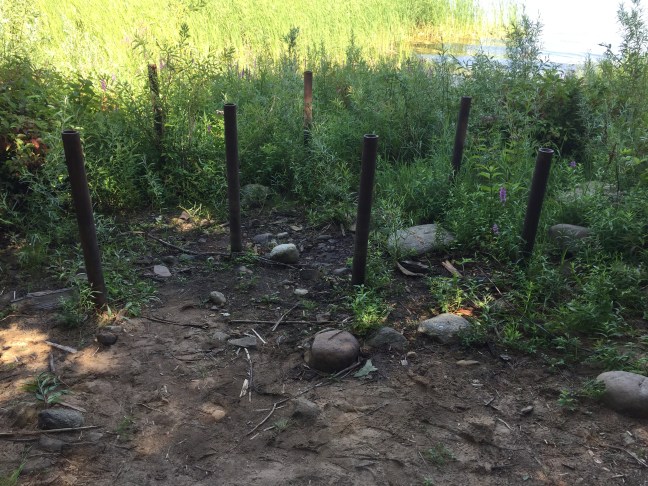
Remains of the observation deck at the west end of Sandy Beach. Why is the town of Hudson allowing the Sandy Beach Nature Trail to fall into ruin? Why is the town not collecting a parking fee from out-of-towners and using the revenues for maintenance?
Last Saturday we headed down to Jack Layton Park to launch our kayaks for a front-row seat on HYC’s Labour Day Regatta. There was a lineup of boats at the launching ramp and the parking lot was filled with cars, trucks and trailers. We saw nobody from Hudson. I suspect the vast majority were out-of-towners taking advantage of free services subsidized by Hudson taxpayers. Why, we wondered, is the town not charging for parking like just about any other popular nature destination I can think of?

Same story at Sandy Beach. Out-of-towners and their dogs, breaking Hudson’s leash laws with impunity. Locals tell me they don’t go near the beach on weekends because of out-of-control dogs. How many times in the past four years have council meetings heard these and other complaints?

I’ve been told the SQ won’t get out of their cruisers because the beach is privately owned. If the town’s development deal with Hans Muhlegg doesn’t insist on converting the existing servitude agreement to an outright transfer of ownership, how will this change?

IMG_0849.JPG

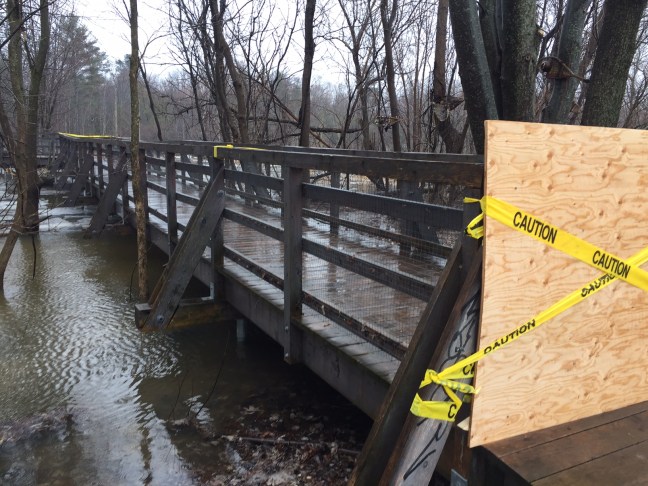
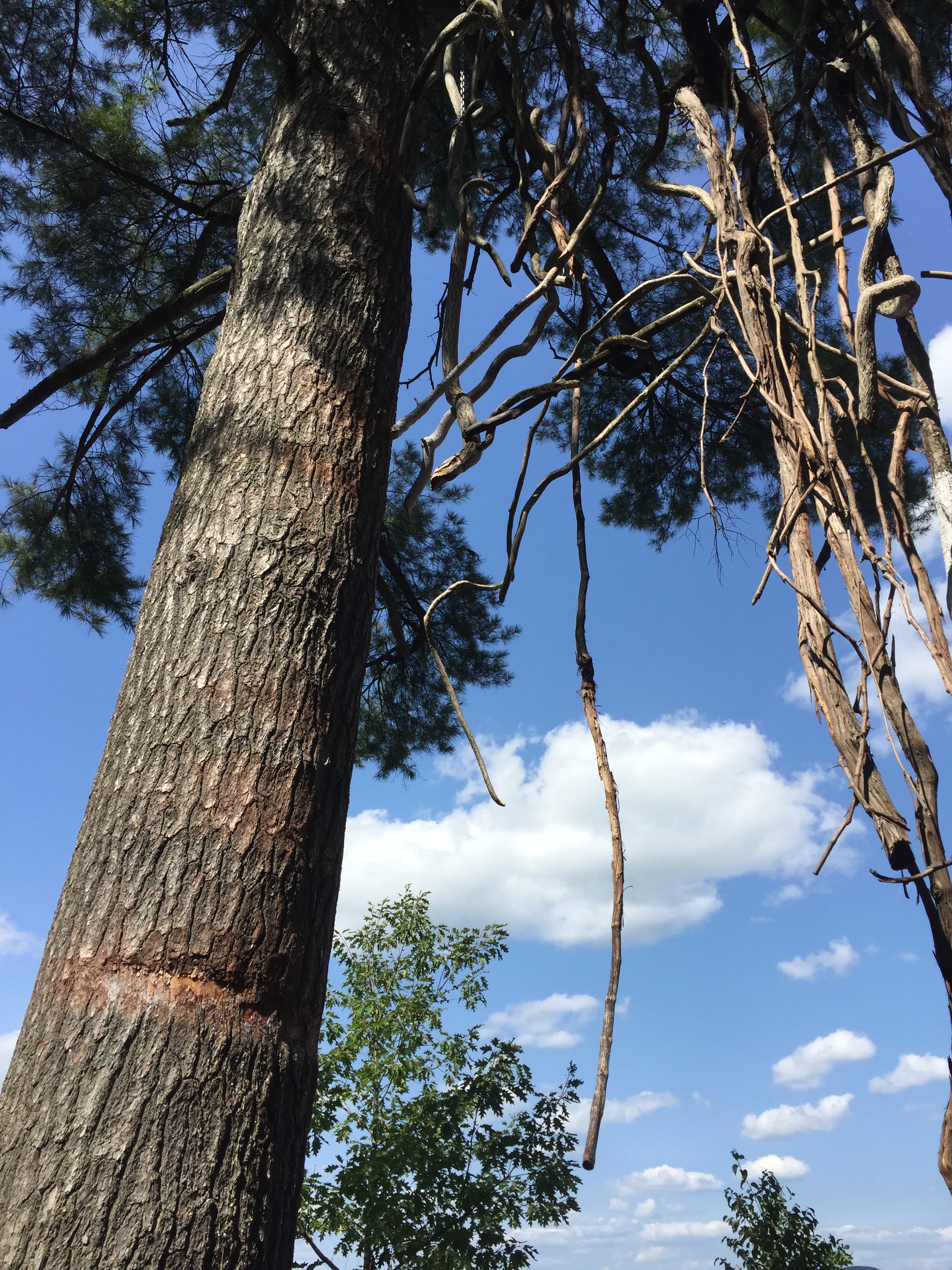
At least Jack Layton Park is being well maintained. The Sandy Beach Nature Trail isn’t. The bridge and boardwalk connecting the two remains closed. The observation deck on the lake is gone. Those ugly and expensive land art installations are disintegrating and carving chunks out of one of the majestic white pines. It’s depressing, seeing the neglect surrounding Hudson’s window on the water.

IMG_1092.JPG

Benign neglect would be one thing. This is malevolent neglect. Hudson’s Parks, Recreation, Culture and Tourism directorate, under whose purview these facilities fall, has had budget increases every year since the Prévost administration took power. So why is one of Hudson’s most important greenspaces being allowed to fall apart like this?

It’s simple. Charge for parking, as they do at Cap St. Jacques and most popular parks. Decide whether Hudson residents should get special treatment. Mandate public security to ticket those who don’t pay.  Use the revenue to maintain the space and fix what’s broken. It may be lost on some, but the culture file includes our natural environment.

Update: Following tonight’s council meeting, department director Nicolas Pedneault told me work has begun on the bridge and boardwalk. The steel structure was bent by the force of the floodwaters and needs replacement. Parts of the deck and handrails also require replacement. The lakeside observation deck will be replaced once the bridge reopens.


Why is this?


A race of eunuchs

DSC_9622.JPG
Janet and George Ellerbeck during a walk through their proposed residential development. Ellerbeck says he has permission to develop to an average density of 12.5 units per hectare.

Sunday, I ran into George Ellerbeck at Mike Lawrence’s 80th birthday bash and asked him whether there was any news on Willowbrook, his proposed residential development. Turns out he now has MRC approval for an average density of 12.5 units per hectare on his 16.7 hectares between the AMT right of way, Main Road, Léger and Parsons.

The agreement scales the project down to 98 doors, a mix of single-family and semi-detached units on 47% of the total acreage. A larger conservation zone (totalling almost a third of the total square footage) would serve to ease the shock of the number of new doors in Como. Two parks and three buffer zones together represent another 9%.

Fewer units will require less water during the 3-5 year construction period and ensure the sewer system won’t be overtaxed. Ellerbeck points out the Como system that would be serving Willowbrook is currently operating with the aid of chemicals to keep it flowing for lack of volume. “Our development would eliminate the need for the chemicals and new flow from the WillowBrook 98 is within the capacity of the system.”

He confirms previous administrations missed an opportunity to acquire an additional 90 arpents zoned agricultural as a conservation area between the tracks and Harwood Blvd.

“Janet and I offered to donate the 90 arpents to the town during the Corker years to an indifferent council, and were told to get it surveyed, which we did,” George recalls. “Our plan was to keep the southernmost 30 arpents towards Harwood for future development.”

In the 2008 Teknika HBA greenspace audit which forms the technical basis for Hudson’s new Conservation Plan for Wetlands and Natural Areas —Urbanization Perimeter, (CPWNA) the 30-arpent area was “magically anointed” a ‘woodland of interest’ B10. The area north of the tracks was designated B11.

All 90 arpents are now off the table, Ellerbeck told me, deposited in a family trust. “During the Elliott years the donation was interpreted as a condition for a development as no one thought that we had voluntarily wanted to give the town the land. Such is life in a small-minded town.”

How advanced is the project? Ellerbeck said it’s headed for Article 22 certification, which will determine the precise number of units based on environmental constraints. He already knows he’ll have to carve off 15,000-square-foot lots fronting on Main Road to satisfy the sector’s SPAIP designation, two parklands representing 17% of the total land area and a 15-metre buffer adjacent to the tracks, a requirement since the Lac Megantic disaster. There’s the unresolved issue regarding B10, the ‘woodland of interest’ based on the presence of a newly classified butternut species and shagbark hickories.

Here’s the takeaway for residents concerned about the loss of citizen input on future development projects:

The change in zoning allowing Ellerbeck’s Willowbrook project is no longer subject to approval by referendum since council adopted its three planning concordance bylaws earlier this year. Consultation will still be required but as Ellerbeck puts it, NIMBYs no longer have the power to stop or alter a project once it meets MDDELCC (the acronym for Quebec’s ministry of sustainable development, environment and the fight against climate change) and MRC regional government guidelines and satisfies Hudson’s new Conservation Plan for Wetlands and Natural Areas —Urbanization Perimeter.

A work in progress, the CPWNA includes Willowbrook in a list of six vacant sectors with a high development potential. The latest version was presented to citizens at a sparsely attended Aug. 23 public consultation. CIMA+ presenter Stephanie Besner described the presentation as a formality, another step in the long, convoluted road to determine Hudson’s development future. The process began with the 2008 Teknika HBA inventory and is on track to be completed next year.

Following the meeting, Besner confirmed the town’s goal in drafting the plan is to grandfather as many development projects as possible into the CPWNA  before it’s sent off to the MDDELCC for comment. The revised plan is then bounced back to Hudson council for adoption.

Under draft Bill 132, municipalities have five years to draft a conservation and development plan. Hudson’s delay isn’t entirely of its own making. Besner and Hudson DG Jean-Pierre Roy explained they’re still waiting on the ministry for “unusual analysis delays” pertaining to wetland swaps enabling developers to backfill low-lying parts of Sandy Beach and Como Gardens. (Roy explained this has no connection with a revised 100-year flood zone.)

Without development, the CPWNA paints a bleak picture of Hudson’s future. The urban perimeter accounts for roughly half of Hudson’s 2,162 hectares zoned white, or developable. The perimeter is 93% developed, with 62 hectares of unbuilt land (excluding Alsonvale/Hudson Valleys). “This surface area appears to be adequate with regards to the negative democratic growth forecasts […] for 2014-2024, consisting of a decrease in population assessed at 380 people [over] the next 20 years.”

Without development — especially development on the sewer system — taxes will inevitably increase as a factor of the valuation roll which determines how much municipalities are assessed for policing, public transit and regional government. The growth in Hudson’s valuation roll is almost entirely on account of real estate transactions.

Besides Ellerbeck’s development, the plan identifies Sandy Beach east and west sectors (11.34 hectares bounded by Main, Royalview and Wharf); R-55 (six hectares bounded by Ridge, Oakland, Hillside and Côte St. Charles); east central (2.37 hectares bounded by Main, Daoust and Mt. Pleasant); UK2 (3.4 hectares between the tracks, Como Gardens and Main) and four hectares between the tracks, Wilkinson and Parsons in Como.

As tedious as this process is, it will determine how Hudson develops, not whether it develops. I know it makes people sick to keep reading this, but Quebec’s shadow bureaucracy at Hudson town hall will function regardless of who is elected Nov. 5. Taxes will be collected, bills will be paid and services will continue. Council’s purview will be confined to discretionary spending, which represents less than a fifth of Hudson’s $12 million 2017 budget.

Thanks to concordance, development ceases to be a political issue; it’s now an administrative process with significant oversight from the province and two levels of regional government. (Ellerbeck told me he was one of a dozen Hudson developers or landowners investigated by the municipal affairs ministry in the wake of dissident councillor Rob Spencer’s influence-peddling allegations against mayor Ed Prévost. “We were all vindicated and were advised to become enterprise lobbyists,” Ellerbeck notes.  “As such, we can meet the town’s/MRC officials and then we are only permitted to discuss our own projects.”)

What’s it mean for Hudson? Less local input on development issues. When it comes to deciding where and how Hudson should be developed, we’re witnessing a mayoral race among eunuchs. Let’s hear Hudson’s mayoralty candidates speak to this new reality.

This post was edited to correct the number of units and other technical information and to clarify the impact of Hudson’s concordance bylaws on the development approval process.

Water on the table

waterfall.JPG
The old Macaulay Hill reservoir served Hudson Heights for years, but residential usage has skyrocketed with house size and endless thirsty lawns. The current administration continues to ignore its own evidence of the imbalance between residential and non-residential use.

Tomorrow (Tuesday, Sept. 5) evening at 6:30, Hudson residents will be updated on the drinking water situation, including a feasibility study on drawing water from the Lake of Two Mountains. The current administration has resorted to desperate measures, including consulting with former technical services director Trail Grubert. (Grubert had to sue the town to collect his severance following a nasty falling out shortly after the last election.)

Like so much in Hudson, there’s no agreement on the best course of action. Should the town go on sinking million-dollar artesian wells when there’s no guarantee of how long they’ll last? The town’s newest well off Côte St. Charles next to Viviry Creek showed signs of failing a year after coming online, mainly because we’re drawing more water than it can sustain. Subsequent to this post’s publication, councillor Nicole Durand pointed out the Bradbury well isn’t failing, but clogging with sand. My response: Clogging is a sign a well is beyond its production capacity. Citizens have grown to live with summer watering bans; the drop in the level of water in the Fairhaven reservoir during last winter’s house fire near Montée Manson revealed just how vulnerable Hudson would have been had there been another fire elsewhere in the municipality.

And yet, the administration insists it won’t meter residential water use even though the town’s own clear evidence is that the residential sector consumes far more per address than the commercial sector. Subsequent to publication, the town’s grant writer and waterworks technician Simon Corriveau said that without water meters in the commercial sector, Hudson won’t be eligible for water infrastructure grants.

Then there’s the replenishment issue. Hudson is one of a dozen Vaudreuil-Soulanges municipalities pulling drinking water out of the one aquifer. (Put water on the table, first posted in February 2016 and reposted Jan. 12/17) Our county is the largest region in Quebec so dependent on an underground aquifer, of which little is known about how it is replenished. Our MRC has long warned of the devastating consequences of a major environmental disaster such as a pipeline rupture or transport-related chemical spill.

The big argument against drawing river water is the cost and location of a water treatment plant and intake. The town-owned land opposite Thomson Park is the logical location, and would carry the added benefit of extending town water to the west end. The devil is in the details, such as whether and how the treatment plant would be connected to the town’s current waterworks at the top of Fairhaven.

Given Hudson’s current financial straits, the economics of a new waterworks depends on whether Hudson’s neighbours are interested in buying water. Before it was bigfooted by the PQ’s forced mergers in 2001, Pointe Claire subsidized its drinking water for decades by investing in a water treatment plant and selling water to five West Island neighbours. Rigaud, St. Lazare and Vaudreuil-Dorion all have water woes. If we haven’t had this conversation with them, what are we waiting for?

Legal weed: Quebec calls and raises

Joel Lightbourne, Peter Schiefke.JPG
Parliamentary secretaries Joel Lightbound (Health) and Peter Schiefke (Youth), members of the team the Trudeau PMO hopes can sell cannabis legalization. Their boss’s problem is getting provincial agreement, surely a Canadian oxymoron.
Two years into Justin Trudeau’s promise to legalize marijuana by next summer, the Prime Minister’s Office must sort out details like distribution and price. And the PMO needs the provinces to make it so.

It’ll be a tight race. Quebec has said it supports legalization in principle but Lucie Charlebois, Quebec’s minister for rehabilitation, youth protection and public health insists citizens and experts must be consulted. (Quebec’s public hearings — in Rimouski, Saguenay, Trois-Rivieres, Granby, Montreal and Gatineau — began in August and run to Sept. 12.)

Charlebois confirms she’s smoked pot but notes today’s cannabis is far stronger and more likely to lead to mental health issues, especially in young adults. Let’s hear what the experts have to say before rushing to a decision, she added in the June 17 LCN newsclip. (Details on the Quebec government hearings at https://encadrementcannabis.gouv.qc.ca)

So the PMO rejigged its year-old federal-provincial marijuana task force to deal with Charlebois and her provincial colleagues. The current head, Parliamentary secretary to the Justice minister and former Toronto police director Dave Blair is being joined by the rookie duo of Health minister Ginette Petitpas-Taylor and her Parliamentary secretary Joel Lightbound.

IMG-20160830-00023.jpg
Moncton’s monument to RCMP Csts. David Ross, Fabrice Georges Gevaudan and Douglas James Larche. Their killer Justin Bourque is serving 75 years without parole. There’s an open wound in Moncton that bleeds RCMP grievances, citizen frustration over lax firearm policies — and simmering resentment that Canada’s two largest provinces don’t pay for the RCMP.  Will social issues emerge in Parliamentary hearings on cannabis legalization due to begin next week?
Prior to her 2015 election, Petitpas-Taylor worked with crime victims. Her office was in the RCMP headquarters for Moncton’s detachment. (Moncton is the largest Canadian city policed by the RCMP; a monument to three Mounties murdered in June 2014 stands near the Petitcodiac River. Petitpas-Taylor spoke at the dedication.) A mutual acquaintance tells me she has an calm, logical common-sense approach in dealing with people in either official language.

Something I find significant: Access to mental health services was one of Petitpas-Taylor’s main concerns during her time advocating for crime victim compensation.

Louis-Hebert Liberal MP Joel Lightbound was the featured speaker at an Aug. 22 public briefing on the Liberal legislation organized by Vaudreuil-Soulanges MP Peter Schiefke. Lightbound is a Toronto-born 29-year-old McGill law grad who before being elected was practising immigration law in QC.

Lightbound and Schiefke spoke briefly about the federal legislation and the steps in the legalization process. Parliamentary hearings begin this week (Sept. 8). Bills C-45 and C-46, Lightbound explained, are “designed to keep cannabis out of the hands of youth, deprive criminals of the incentive to compete with legal producers and ensure commercial pot meets standards of efficacy and safety.” The federal legislation doesn’t deal with health or public security issues, he said, because they’re provincial concerns.

Trudeau’s problem is getting quick provincial agreement, surely a Canadian oxymoron. Quebec is leading the provinces in wanting Ottawa to take responsibility for the social fallout of legally available marijuana and its derivatives. Federal and provincial laws have to be harmonized, beginning with a standardized litigation-proof test for impairment similar to those for blood alcohol levels. (Lightbound conceded we’re not there yet, but predicted better tests will come with legalization. “Eight American states have given us an overview” on what does and doesn’t work, he said.)

Questioners included St. Lazare mayor Robert Grimaudo, the only municipal official to attend. (Grimaudo can’t believe other Vaudreuil-Soulanges municipalities aren’t participating in these discussions, given their proximity to social problems caused by drugs.) A budding businessman wanted to know whether the government was thinking of Amsterdam-style coffee houses or cigar lounges for indoor on-site consumption. The co-founder of a technical support firm for grow ops wanted to know whether the law would include restrictions on how it’s grown and quality is assured. (Organic weed?)

Concerned parents wanted reassurance the feds would take into effect the possible long-term effects on the brain, or whether marijuana would become a gateway drug.
“It’s not a gateway drug,” Lightbound assured the roughly 100 people in Vaudreuil-Dorion’s Opti-Centre. “The gateway is a dealer telling you what drug to use.”

At times Lightbound and Schiefke sounded more like salesmen than politicians tasked with allaying concerns about the side effects of a national experiment. Legalized cannabis is worth $7 billion annually, Lightbound told the crowd. The right price point is critical, Schiefke added. “The price point [walks the tightrope] between increased use and driving the market underground.”

Price will become the major issue in Western Canada, where friends recently sold their house and moved to Hudson. They spoke about the deterioration of B.C.’s Okanagan Valley city of Kelowna, where oil patch cash, the Vancouver underworld and biker gangs are creating a perfect storm of crime and drug-related medical problems. Price legal weed too low and more people will use. Price it too high, and the mob and the bikers will undercut the legal market.

Legalization’s rollout has been anything but smooth. Liberal bagmen have been sighted in the company of principals and lobbyists involved in legal and grey-area weed production. The Toronto Stock Exchange is trying to get the big players in the Canadian cannabis industry in line. Even through fewer than 60 growers are currently licenced with Health Canada, stories suggest the existence of a number of grey-area non-producing yet licenced growers across the country, including one in the centre of l’Ile Perrot.

As for the notion that Canada’s marijuana stance is Canada’s business, it took one U.S. border agent to impose a lifetime ban on one registered Canadian medical marijuana user to suggest it’s unwise to assume.

As a cub reporter, I covered the LeDain Commission hearings when they came to Montreal half a century ago. The Liberals under Trudeau the Elder commissioned Gerry Le Dain to determine whether the use of cannabis should be legalized or decriminalized. In their majority report, Le Dain, along with commissioners Heinz Lehmann and J. Peter Stein urged the government to begin by repealing the laws against the simple possession of cannabis and its cultivation for personal use. Only commissioner Marie-Andree Bertrand recommended a policy of legal distribution of cannabis, that cannabis be removed from the Narcotic Control Act (since replaced by the Controlled Drugs and Substances Act) and that the provinces implement controls on possession and cultivation, similar to those governing the use of alcohol.

The commission also recommended that the federal government conduct further research to monitor and evaluate changes in the extent and patterns of the use of cannabis and other drugs, and to explore possible consequences to health, and personal and social behaviour, resulting from the controlled legal distribution of cannabis — exactly what Lucie Charlebois is asking.

In the end, Pierre Elliott Trudeau ignored the commission’s recommendations. It’s entirely possible history could repeat itself as his son comes to realize the political cost of what seemed like such a slam dunk in the glow of victory. I’ll be surprised if the Trudeau Liberals can get legalization done by the end of their first term.

Previous blogs on this topic: Pay to Puff, Nov. 29/16; The Great Cannabis Bandwagon, Nov. 2/16; Are the Trudeau Libs downloading more corruption, May 2017

Does it matter who runs your town?

Screen Shot 2017-08-29 at 6.07.49 PM.png
A consultative committee of highly qualified local residents submitted these scenarios for Pine Lake. Mayoral candidate Bill Nash proposes to turn the project over to design school students.

Pine Lake Scenarios report

Those bothering to vote in the Nov. 5 municipal election will be choosing between clear choices for mayor. The Nash-Nicholls race presents two visions of how an affluent small town should operate as it faces an uncertain future. How should Hudson develop? Where should we invest? What should we subsidize? Do we need all those employees? Should taxes continue to increase? Are they equitable? How best to lower them?

What about merging with one of our neighbours to lower costs? It won’t happen tomorrow (it’s a long process and stakeholders are consulted throughout) but don’t think neighbouring municipalities are not eyeing Hudson. Rigaud, St. Lazare and Vaudreuil all have water issues; Hudson’s waterfront offers them the option of drawing lakewater while helping maintain a spectacular greenspace paid for by Hudsonites yet enjoyed by people from all over. In St. Lazare’s case there’s also a cultural fit. If it merged with Hudson, St. Lazare’s population would approach 55 per cent English-speaking. It’s in everyone’s interest to keep off-island English school populations healthy when a third of marriages confer English public school eligibility.

Hudson’s affluence hasn’t protected it from the democratic disease —  apathy. Fewer than half (1,912) of Hudson’s 4,121 eligible voters voted in the 2013 election. Mayor Ed Prévost was elected with nearly 76% of the vote to Jacques Bourgeois’s 24%, suggesting 52.6% of voters didn’t give a damn who ran the town. (The election took place prior to completion of the investigation into former manager and town clerk Louise Villandré’s 15-year crime spree but I question whether subsequent developments would have altered the outcome other than in Prevost’s favour.)

I’ve known Jamie Nicholls since we went hiking in a mutual friend’s woodlot in Eastern Ontario. Gary Dover and I helped found a non-profit advocacy group, Sentiers Vaudreuil-Soulanges. We needed someone to come up with a trail plan for the 32-acre Viviry Valley Conservation Area the town had received in exchange for the right to develop what is now Whitlock West. A landscape architect, Nicholls came up with such a plan. (Parts of his proposed trail network are included in the Parkinson Trail, our winter ski/snowshoe track to the foot of Hudson’s Valleys.)

Like his late boss Jack Layton, Nicholls is a Hudson native. One of 59 Quebec MPs elected in the May 2011 NDP Orange Crush, Nicholls was defeated in the October 2015 Liberal sweep. Since then he’s immersed himself in local, regional and national issues. He’s never without his social democratic values, which he brings to conversations ranging from First Nations land claims and oil pipelines to wetland conservation and protecting the source of our drinking water.

Nicholls is patient, reserved, careful in what he says. He’s a council regular whose question period interventions are polite and reasoned. His concerns tend to be environmental (he and his wife Amanda MacDonald have launched an outdoors day school) and decisions he feels are not in the public interest. On his website and in his campaign meetings thus far, Nicholls has emphasized collegiality, consultation and openness. Discussion, beginning with his proposed design workshops, would allow maximum community input on projected development. Nicholls has a following of like-minded residents of all ages, some of whom have either filed their nomination papers for council or are thinking of doing so.

I caught up with Bill Nash this past Sunday at a weekly neighbourhood gathering. He was there at the invitation of several local residents who see him as the logical successor to Ed Prévost.

Nash is from the same mould as Tom Mulcair, with an Irish wink and the gift of the blarney. (Nash says he’s known Mulcair since he was eight and still talks to him regularly.) They’re both from French-Irish families, both had Irish fathers, both fluently bilingual Outrement boys. (Nash claims his French is better.)

First question: Why do you want to be mayor? “The money.” That got a laugh from around the table. (Hudson’s mayor is paid $17,390 plus $8,695 in non-taxable expenses. The Union des Municipalités du Québec‘s 2015 Guide sur la rémuneration des elus municipaux noted that the salary (ex expenses) for mayors of the province’s 1,300-odd municipalities averaged $15,316.)

Nash and his wife Chantal moved to Hudson in November 2013, after the last election. He said he’s been to most council meetings since then and attended the Quebec Municipal Commission hearings into alleged wrongdoings attributed to the mayor and council members. (The first set of hearings were held over five days in October 2016 and heard from seven witnesses, including Prévost and Rob Spencer, the councillor who filed the complaint. In her ruling, administrative judge Sylvie Piérard held Prévost blameless but faulted the administration at the outset of the mandate for what she described as clear shortcomings at the administrative level. Most members of council were newly elected, Piérard noted, and may have placed excessive trust in director-general Catherine Haulard. Haulard was dismissed by Prévost in July 2015 and recently lost an unlawful-dismissal suit against the town.)

Well before this, Nash had called Prévost and suggested they meet. Nash says they talked about everything but local politics. They developed a friendship as he grew to appreciate Prévost’s tenacity in the face of illness and adversity. It’s clear he has Ed’s blessing, if not his endorsement.

People wanted to know about Nash’s management style. “I don’t micromanage, so don’t micromanage me,” he said. He agreed this administration is guilty of ‘analysis paralysis,’ deferring important decisions. Once he’s elected to take decisions, he says, he’ll start making them, just as he has throughout his working life.

He was asked about Pine Lake. Nash recalled how he and his wife decided to move to Hudson the moment they saw the lake. He proposes getting Montreal’s university design schools competing to come up with a proposal for the recreation of Hudson’s symbolic pond.

Asked about how he’d work with regional government, Nash made it crystal clear he has no intention of beginning at that level. “How do you get things done in Quebec? You start at the top.” He suggested he has the contacts.

I asked Nash why he seldom speaks at council meetings. He said he won’t speak until he has something to say. He’s careful. Members of his entourage argue for the elimination of the one AMT train a day as a waste of money with the added fault of giving downtown Hudson its unwelcome transport-oriented development (TOD) designation, thereby triggering MRC/MMC densification targets. I didn’t hear Nash take a position.

Unless they know something I don’t, neither mayoral candidate intends to run a slate. The official nomination period opens at 9 a.m. Friday, Sept. 22 and closes at 4:30 Friday, Oct. 6. Would-be candidates are being asked to call Mme. Claudia Ouellette, présidente d’élection, at 450-458-5347, ext. 204 to set up a meeting.

Both candidates are actively campaigning. Their websites:

billnashformayor.com                                     jamie4mayor.ca

Will Hudson miss the train again?


map_fr_161130.png
Schematic for the Réseau électrique métropolitain (REM), an integrated 67-km public transit network linking downtown Montréal, the South Shore, the West Island, the North Shore (Laval and Deux-Montagnes) and the airport through an automated electric light rail transit (LRT) system. Will Quebec extend the REM to include LRT service across the new Ile aux Tourtes Bridge to Vaudreuil and points west? They’d be stupid not to, says former Hudson councillor and Caisse de dépot VP Tom Birch. The existing Vaudreuil-Hudson line is in red.

When mayor Ed Prévost told a Global reporter Hudson was looking at ways to get out of the Montreal Metropolitan Community and its master development plan, Prévost showed he doesn’t know what he’s talking about. (Pythonesque, June 6)

For Hudson to secede from the MMC and its new public transit creation, the Réseau de transport métropolitain, Hudson would have to prove that fewer than 7% of Hudson’s total population work somewhere else in the MMC. The town would have to drop out of the CIT la Presqu-île, serve notice to the Agence Métropolitain de transport it no longer wanted train service and convince Transport Canada it’s in the community’s interest to force the AMT to lift the existing tracks and abandon the right of way.

What I find far more disturbing is Prévost’s lack of vision, a shortcoming shared by far too many Hudson residents.

Accompany me on this rail commute into the future to see what I’m seeing:

It’s 2025. The Réseau électrique métropolitain (REM), an integrated 67-km public transit network linking downtown Montréal, the South Shore, the West Island, the North Shore (Laval and Deux-Montagnes) and the airport through an automated electric light rail transit (LRT) system, has been running for five years. The old AMT trains de banlieu, which includes the Vaudreuil/Hudson line, are still running but ridership is dropping because the LRT is so much faster and more efficient. It’s easier to drive to the Ste. Anne LRT station.

Driving into town has become an ordeal not even the most dedicated motorist looks forward to. The average peak drive commute in and out of downtown Montreal takes over 100 minutes. Tolls on bridges and highways into the city, along with reserved lanes for taxis, buses and car-poolers discourage single-driver vehicles. If you’re driving into the city without a transponder and a downtown parking pass, be prepared to fork out $50.

The big news today is the grand opening of the double LRT line in the centre of the new Ile aux Tourtes bridge. This line is an extension of the original LRT system which opened in 2020. At Vaudreuil station it splits, with one branch continuing southwest to serve the booming southern tier municipalities of Les Cèdres, Côteau du lac and Les Coteaux. The other branch continues west to the new Hudson station. Eventually, it may continue on to Ottawa.

Yesterday was the last day riders caught the 7 a.m. diesel-powered train at the old Hudson station. Much fanfare and a few tears greeted the historic occasion. Hudson residents came close to giving up their train service until a visionary mayor and council realized they had the support of St. Lazare residents for a station closer and more convenient than Vaudreuil.

Plans for a central public transit hub in Hudson’s east end go back to the start of the millennium. While Liberal appointee Joël Gauthier headed the Agence métropolitain de transport, a map on his office wall showing a train/shuttlebus terminal located near where Montée Manson crosses the former Canadian Pacific right of way (ROW).

Vaudreuil-Dorion mayor Guy Pilon lobbied long and hard to make Vaudreuil the end of the off-island line, but the explosive population growth along the county’s southern tier and rush-hour congestion on Highway 20 convinced REM planners to extend the line southwest.

Here we are at Hudson’s new station. It’s on a beautiful road that runs through farmland from the foot of Bédard to the Como Ferry. The provincial transport ministry paid for it because the ferry has been declared an integral part of the highway network and someone had to put an end to the ridiculous traffic jams on Bellevue and Main Road. Benoît Laporte, on whose land the road is located, backed the project because Quebec allowed him to subdivide his farmland into 10 to 20-acre farmettes, a godsend for Hudson’s booming micro-agricultural industries.

Hudson has big plans for the original Canadian Pacific right of way between Montée Manson and the old station. Transport Canada and the RTM must approve the town’s request to abandon the line, lift the rails and ties and grant the town a lease or sell it outright. The big debate is whether to turn it into an aerobic corridor for cyclists, walkers, runners, skaters and skiers or create a new east-west route into the centre of town to take traffic off Main Road and Chemin de l’Anse.

Ahh, here’s the train now. It’ll take us less than an hour to downtown. The RTM offers recharging stations for electric cars, so let’s grab that parking spot, plug in and climb aboard.

This is fiction based on fact. The Caisse de dépot et de placement announced June 15 that the Trudeau government has committed to a 24.5% share of the $6.04B REM project. Quebec has already poneyed up its $1.283B share. The Caisse holds control with 51% of the project. It is to be a public-private partnership and the call for tenders to companies and consortia was issued in February. It is hoped to have trains running by the end of 2020.

The Ile aux Tourtes connection comes from the May 2, 2017 issue of Canadian Consulting Engineer which reported that a engineering consortium headed by consultants exp, Stantec and CIMA+ had been awarded the contract “to plan work on the existing [Ile aux Tourtes Bridge] structures over a five-year period to maintain traffic safety until the 50-year-old bridge is fully replaced over a 10-year horizon.”

The contract, awarded by the Ministère des Transports, Mobilité durable et Électrification des transports, will keep the crumbling structure open to some 85,000 vehicles a day while the new bridge is built alongside. Given the timelines, it appears the MTQ hopes to open the new bridge around 2025.

I asked former Hudson councillor Tom Birch whether he thought the MTQ would include an LRT line in the design for the new span. “They’d be stupid not to,” Birch said.

He comes at this from a unique position. Until 2008, he served as Mayor Elizabeth Corker’s councillor in charge of the infrastructure and public transport files. He’s now the vice-president for funds and technology with the Caisse’s Quebec Private Equity team, with net assets of $270B and a yield that averaged 10.2% over the last five years. [Birch has no connection with CDPQ Infra, the unit overseeing the REM project; the Caisse has stressed the information firewall separating the Infra project from its private and public equity, fixed income, real estate, infrastructure and Quebec investment teams.]

As councillor, Birch swung Hudson’s support behind the CIT La Presqu’île when the regional shuttle bus service was just getting going. He lobbied hard for a second weekday train to and from Hudson, noting it would have cost the town $14,000 a year compared to the $330,000 it would cost Vaudreuil-Dorion.

He worked with former St. Lazare mayor Pierre Kary to counter Vaudreuil-Dorion mayor Guy Pilon’s lobbying efforts to make Vaudreuil the last stop on the line with a proposal to build a new Hudson train station at the foot of Bédard, offering St. Lazare commuters a convenient alternative to having to drive to Vaudreuil or Hudson.

Birch says watching the town not being proactive on the public transportation file for the last eight years has driven him crazy. He predicts the LRT network is “seven or eight years out of the CIT” and will likely be extended south and west to Les Cèdres.

Birch doesn’t think current transit alternatives offer commuters sufficient convenience to abandon their cars. The A40 Express bus takes 40 minutes to deliver you to the Côte Vertu Metro, from where you’ll spend another half hour on the subway.

Birch’s parting shot: if Hudson had followed through with a plan for a new east-end station, there would have been a lot less incentive at the MMC and MRC levels to create a transport-oriented development in a densified downtown Hudson. The TOD would have been moved to a far more logical location along that stretch of Harwood between Bédard and the Galeries Hudson exit off the 40.

In Vaudreuil-Dorion.