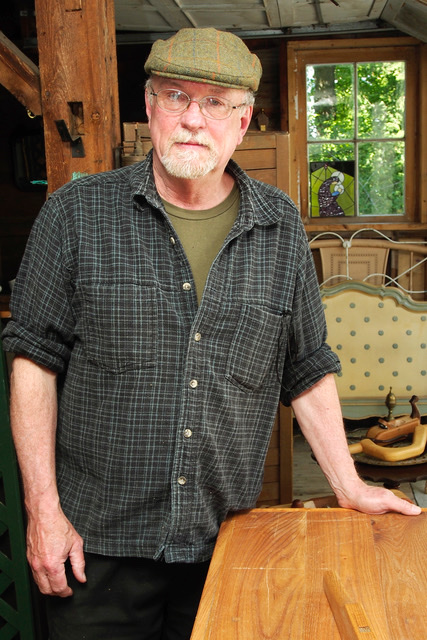
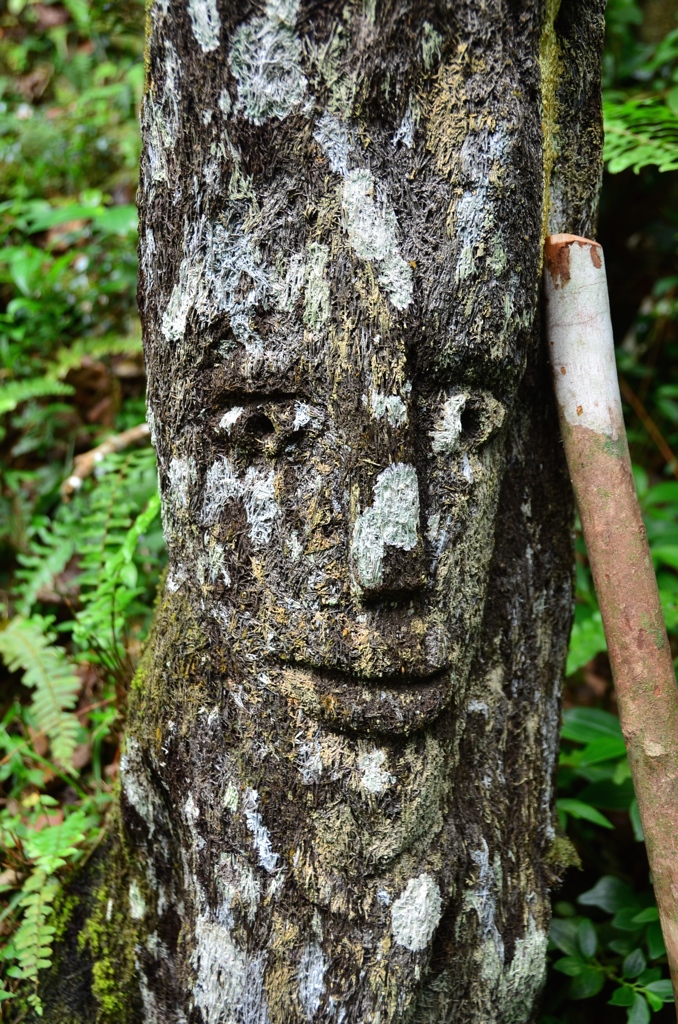
Gary Dover, ex military intelligence teacher, cabinetmaker, forester, historian, naturalist, friend.
It’s coming up on the anniversary of Gary Dover’s sudden death last September, a sad passing I just learned about from Gary’s wife Anita. There was no obit, no death notice, only a For Sale sign on their house that prompted me to call and Anita to text me the news from the UK.
Gary and I have been in and out of each other’s lives for years. He served in the Canadian Armed Forces with military liason and intelligence in the Middle East and Southeast Asia, taught at the Canadian War College and so happened to have been the intel dutyofficer the night of the’95 referendum. We’d talk for hours over beers or in the woods, where we’d bushwack on snowshoes or chop a route through the brush with Gary’s Gurkha kukri and my bush axe.
I never saw him get lost. Before we’d head out, he would study the relevant topographical map and carry a photographic image in his mind as we roamed the expanses of woodlands and wetlands that still cover most of northern Vaudreuil-Soulanges. Back at home, he would draw our route onto the topo map if he thought it warranted marking.
Back in the early 2000s, a bunch of us, alarmed at the rate of uncontrolled development and the loss of our region’s eco-corridors, banded together to create Sentiers Vaudreuil-Soulanges. The aim was to lobby the Vaudreuil-Soulanges regional municipality and our respective communities to integrate green corridors in their master plans. With Gary masterminding, volunteers rough-mapped a chain of local walking trails through Hudson, Vaudreuil, St. Lazare, Ste. Marthe, Trés-Saint-Redempteur to connect with Rigaud’s l’Escapade network.
At first, it all seemed to be coming together. The Hudson SVS contingent convinced the Corker administration to give our registered non-profit a mandate to add new trails and maintain Hudson’s trail network at no cost to taxpayers with funding from a national trail-network coalition and a mix of paid and volunteer labour—much as it is done throughout Canada and the U.S.
We hired landscape architect Jamie Nicholls (yes, Hudson’s last mayor) to come up with a trail plan for the 30-acre Viviry Valley Conservation Area. We hired a logger with a team of horses to clean up the existing trail network. We blazed every trail with approved markers, a few of which one can still see.
On Thanksgiving weekend in 2008, some 30 of us set out on the inaugural two-day Grand Trek, starting with a blessing from Father Roland Demers next to Hudson’s Mount Pleasant Elementary School and finishing at Rigaud’s Parc de Lotbinière and the Festival des Couleurs. Although some of it passed on public roads and unauthorized rights of way, it proved the concept of a contiguous trail network connecting our communities.
But the intensity didn’t last. In Hudson as in Quebec and Ottawa, every election brings changes in orientation. Throughout the county, municipal councils bowed to landowners who didn’t want strangers anywhere near their properties, let alone on their land. A few of our trails remain, like Hudson’s Parkinson walking and snowshoe trail behind Whitlock West, but the legacy of that first Grand Trek died from a combination of municipal indifference and landowners’legal threats.
Gary’s response was to go underground. We shut down the SVS website and other administrivia. The outing-club component broke away. Thus died the concept of a contiguous trail network.
Freed from the burden of a doomed mission, Gary threw himself into his many passions—gardening, woodworking, history and exploring nature. A skilled and innovative craftsman and cabinetmaker, he taught a generation of amateurs the rudiments of carpentry at his Merlinwood School. He led nature outings at Mount Pleasant Elementary. He experimented with mushroom production. Eventually, he closed his carpentry school and brought everything home to the cozy shop behind his and Anita’s Vaudreuil home, where he quickly branched out into yet another passion—researching ancient musical instruments and their reproduction.
My first inkling of this latest twist was the day he invited me to see his first try. It was a lyre, a stringed instrument right out of Homer’s Iliad. To set the table for its presentation, Gary had a basket of home-baked oatcakes and mead standing by. It would prove to be the first of many, many accurate reproductions of historic instruments, including the Irish harp featured on the Guinness beer label. Fittingly, he allowed me to write its story in time for St. Patrick’s Day.
The Dover homestead was furnished with beautifully crafted antique reproductions that began life in Gary’s workshop as recycled wood, mainly exotic hardwoods from Asian shipping pallets, but also salvaged timber from deadfalls closer to home. His abilities brought him to Hudson’s Greenwood Centre for Living History and the accurate restoration of pieces in their collection.
Gary still found time for hikes, especially when I was sniffing out a story for the Hudson Gazette. In the fall of 2011, he and I hiked into what was to have been the site of the new Vaudreuil-Soulanges regional hospital. (The site, vetoed by the Montreal Metropolitan Community, would have provided space for new schools and health-centred CEGEP as well as for housing for 3,500 hospital employees.) We were left speechless by the beauty and size of the old-growth forests we came across, a major reason why the site remains in its natural state.
One might ask why it took so long to learn of a friend’s passing. Gary and Anita would spend long periods travelling to the Middle East, Anita’s Mauritian homeland and the UK among other destinations. During and after the COVID lockdown, he and Anita would head off to a beautiful woodlot they owned in the Glengarry highlands.
Our last conversation was in February 2022. We worked together on a story about the failing aquifer along the height of land above the Viviry Creek’s headwaters. Gary and Anita’s well wasn’t producing as it had; his survey of the neighbourhood revealed that everyone was having similar concerns. The result wasHudson’s priceless wetlands(Feb. 11/22,www.thousandlashes.ca).
Gary and I aren’t quite finished our hike together. Before his death, he provided me with hours of information about his work as a military intelligence officer and historian. God wiling, I’ll have the opportunity to share his insight.
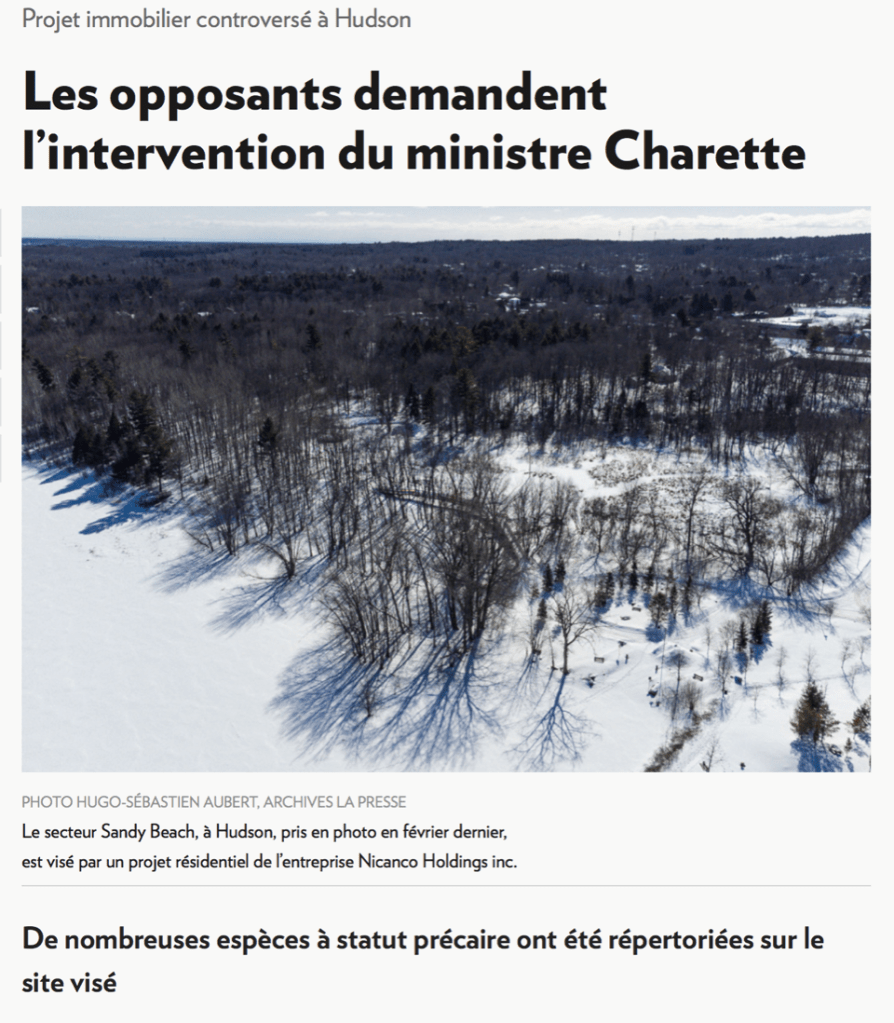
On again? Off again? The future of Hudson’s Sandy Beach residential development remains as murky as this summer’s skies following a June 7 Appeals Court ruling.
Quebec’s highest court confirmed a September 2022 lower court decision which found that the environment ministry didn’t have the power to cancel retroactively a developer’s right to backfill a wetland if the certificate of authorization (CA) had been issued prior to April 17, 2017.
Nicanco Holdings Inc.’s CA was issued in March 2014, giving it the right to backfill roughly 1.5 hectares of wetland in exchange for the transfer of 3.5 hectares to the area already signed over to the Town of Hudson.
The environment ministry annulled Nicanco’s CA in March 2020, based on a 2017 amendment to the Environmental Quality Act which allowed the ministry to cancel any CA if the developer failed to begin work within two years of the date it was issued.
Quebec’s argument in both hearings was that it had the authority to annul the CAs of Nicanco and two developers in similar circumstances because backfill operations hadn’t begun by March 2018, when the change took effect.
The three developers filed a common suit against the government last June on the basis that neither the amendment nor the act itself gave the environment ministry the power to apply a sunset clause retroactively because nowhere was it mentioned in the enabling legislation.
Appellate Court judges François Doyon, Simon Ruel and Benoît Moore upheld the earlier decision handed down late last fall by Superior Court judge David Collier. Both rulings found that the annulments decreed by the environment ministry did not respect the Environmental Quality Act, in part because it would force all parties to undo agreements already enacted, such as the transfer of greenspace to the municipalities concerned.
However, the appellate judges drew our attention to legislation already on the books which would allow the environment ministry to demand modifications to any CA based on incomplete or outdated information. The ruling cited Article 36 of Act M-11.6, “an Act respecting certain measures enabling the enforcement of environmental and dam safety legislation” adopted April 22/22. The crux of Article 36 is that the CAQ has already handed its bureaucracies the power to unilaterally modify or even cancel a CA, apparently at their own discretion:
36. The Government or the Minister may, for all or part of a project subject to an authorization under the Acts concerned, amend the authorization, refuse to amend or renew it, or suspend, revoke or cancel it in the following cases:
(1) if the authorization holder fails to comply with any of the authorization’s provisions or uses the authorization for purposes other than those specified in it;
(2) if the authorization holder fails to comply with a provision of the Act or the regulation under which the authorization was issued; or
(3) if the authorization holder fails to begin an activity within the time specified in the authorization or, if no time is specified, within two years after the authorization is issued.
______________________________________________
ANALYSIS
After reading the appeal judgment those familiar with the case were left with more questions than answers.
First, the appeal ruling rejected retroactivity. “Like it or not, the rule of law has to be fair. To have ruled otherwise would have confirmed a form of tyranny,” said one observer who spoke on the condition that they remain anonymous.
“I remain perplexed as to why the government wanted to appeal [the Superior Court ruling] in the first place. Best guess: the CAQ wanted to apear pro-environment, thereby protecting its Québec solidaire flank while while confident the courts would never allow retroactivity.”
It’s doubtful Quebec’s solicitor-general’s office will appeal the appeal ruling. “It does not play to their nationalist theme. The appeals court is in Quebec, not elsewhere.
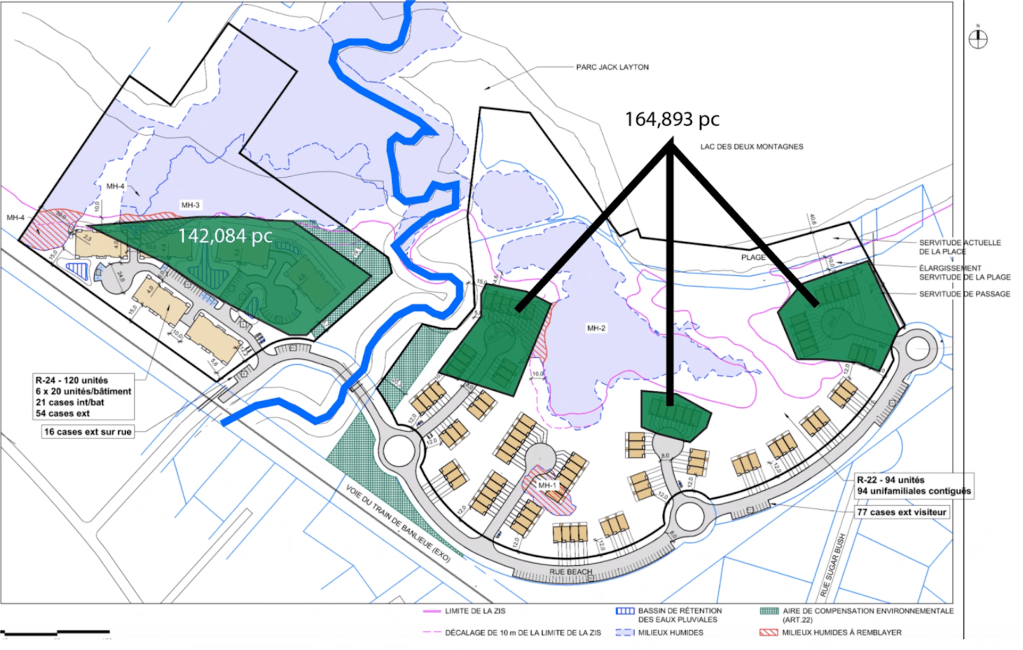
How will it impact Hudson’s Sandy Beach project for more than 200 residential units in a mix of semi-detached townhouses and multi-unit condominiums?
La Presse reporter Éric-Pierre Champagne noted in last week’s story on the ruling that at least 25 projects across Quebec have been frozen over the last two years as a result of the environment ministry’s 2017 sunset clause regarding wetland backfilling. It’s not clear yet whether those projects are dead for good, or awaiting updated CAs.
As reported in late February, Nature Hudson, the Legacy Fund for the Environment and the Centre québécois du droit de l’environnement (CQDE) contacted Quebec’s environment minister Benoît Charette, demanding a revision of Nicanco’s CA. They claimed that the area of the wetlands to be backfilled were far greater than what was characterized in the 2014 CA. Their claim was based on an unauthorized study by TerraHumana Solutions, a study Hudson’s current council declined to refer to the ministry because it was done without the landowner’s knowledge or consent.
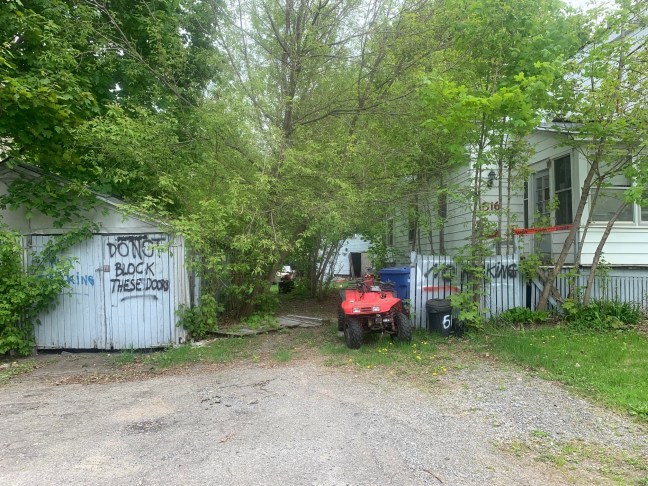
518 Main from the corner of Reid: demolition by attrition? A Hudson visitor recently asked me why the town allows what looks to be an abandoned crack house in the village centre. Council wants to preserve a century-old heritage structure, I explained. The timber-frame duplex at the corner of Main and Reid was sold by the family of the original owners to a developer, who flipped it to Groupe Lawlor, whose plans for a three-storey multi-unit condo were rejected by council in July 2022. Hudson’s demolition bylaw (652.2) states that nothing in town can be torn down or moved unless the owner has first obtained authorization to build a replacement, so nothing can move forward until the two sides agree on a compromise.
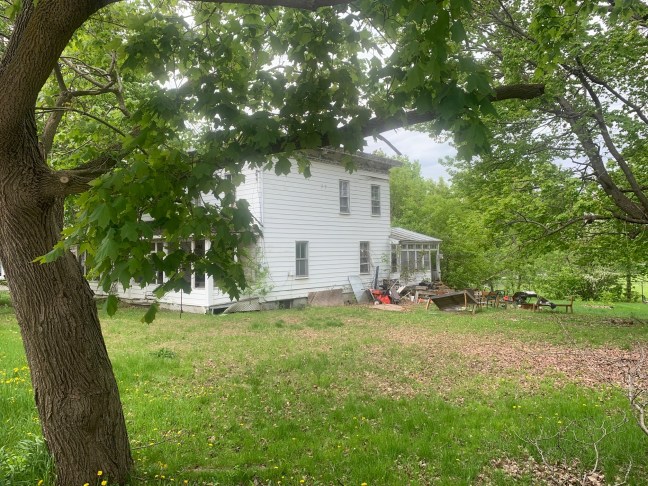
The once well-maintained duplex next to the now closed Vivery Restaurant is surrounded by a sea of junk.Ripe for a PPU?
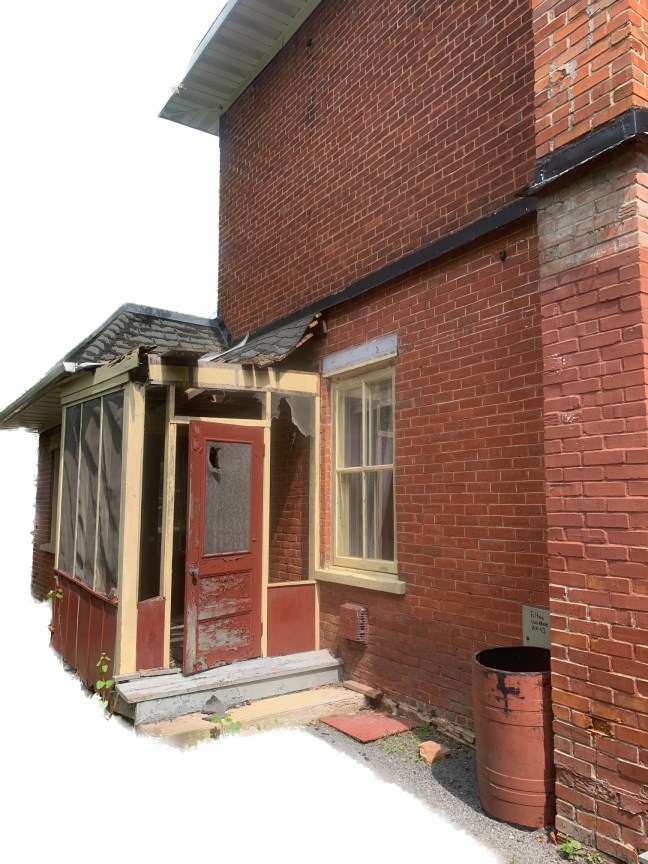
The town doesn’t have the legal tools to force the developer to maintain or restore the building, let alone incorporate it into plans for the replacement structure. The municipality has adopted legislation that would allow it to place a reserve on the the property, but the courts have established the seller has the right to fair market value. Lawlor paid just under $1.1 million, so the question becomes whether the property would be a worthwhile acquisition for the town. As long as this stalemate persists, the old Gaudreau house at 514 Main, once a well-kept testament to the skill of the inventive artisans who built much of the town’s French quarter, will remain a very public eyesore, the once well-manicured yard and outbuildings filled with junk, the once cozy sun porch running the length of the frontage a sorry spectacle of torn screens, sagging doors, clapped-out furniture and a tattered Canadian flag. Demolition by attrition they call it — and it’s not the only example in Hudson’s downtown heritage district.
The Hodgson house at 498 Main is another heritage structure caught in a legal labyrinth with no exit.
Hudson mayor Chloe Hutchison told the May council meeting she’s determined to preserve the town’s look and feel, which is why the town is also blocking demolition of an similarly deteriorating structure at 498 Main.
During the second question period, Hutchison was asked what she hopes to achieve by blocking 498’s teardown in light of the fact that the previous council adopted resolutions approving both the demolition and an 18-unit condominium project on the site, located between the IGA parking lot and the SAQ. The owner, Lotissement SM Inc., has filed a motion requesting a court order for the emergency demolition of the structure, parts of which date back to 1856. To back its case, the developer cites two engineering reports, both of which list potentially dangerous structural defects and salubrity concerns. Council’s basis for rejecting the demolition request: no estimate was filed on the cost of restoring and upgrading the building even though it was never an option. “The outcome I expect to achieve is that our local heritage is of value and there’s (sic) ways of repurposing lots and continuing to develop or redevelop in a respectful manner of our local quality and heritage,” the mayor replied. “And I think that is a prerogative that has been given to councils in the recent change in the law on cultural heritage and we are exercising that right.”
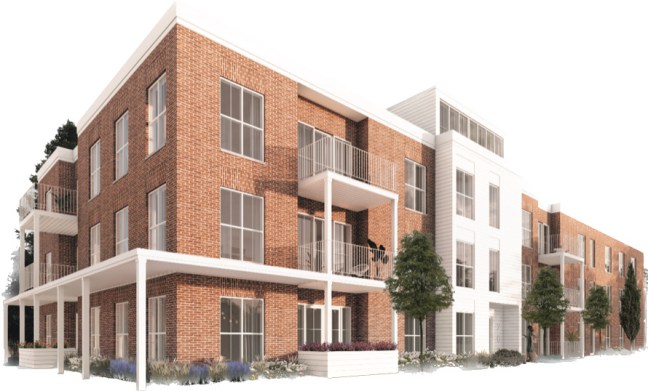
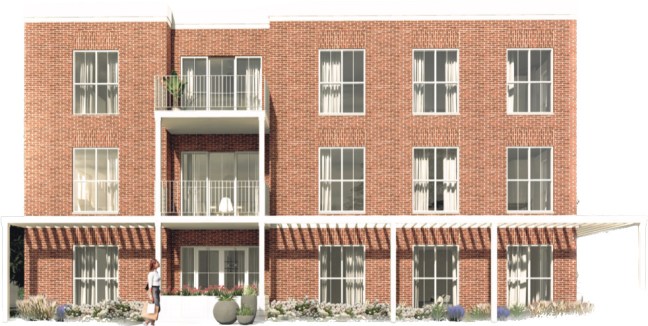
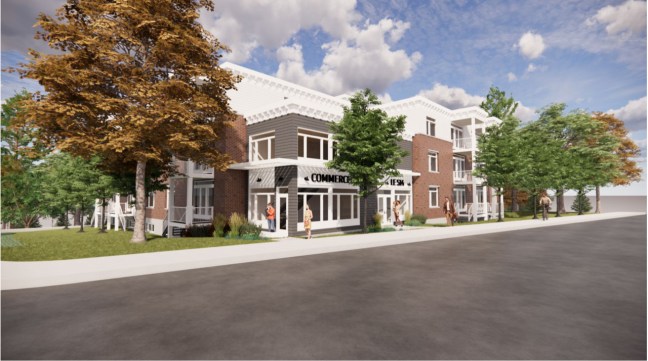
Renderings of the front and side of SM’s 18-unit project at 498 Main, approved together with the demolition of the existing structure by the previous council. The mayor had no estimate of legal costs fighting to preserve the existing building.
A followup question was how much is the town prepared to spend fighting this. Hutchison had no answer, but the the case history of 498 Main suggests it’s a legal money pit. SM had reached a deal in January 2020 with a family member mandated to represent its interests, but wasn’t able to take formal ownership until August 2022. In the meantime, the project was approved unanimously by the previous council at its June 1, 2020 meeting on the unanimous recommendation of the Town Planning Advisory Committee reached at its May 13, 2020 session. A month later, council revoked the demolition permit after learning of the involvement of Quebec’s Public Curator on behalf of the interests of the last surviving resident. Litigation will likely revolve around questions about which parts of what decision are still valid.
A cornerstone of Quebec municipal law used to be that every council’s hands were tied by the decisions reached by the previous council. Under Legault’s CAQ government, this has morphed into a quagmire of grey zones, leaving it to the courts to interpret the legislator’s intent and apply it to real-life situations. For that reason alone, one wonders whether any Quebec mayor can say with certainty the law is on their side. As we’ve seen from recent decisions, the law cuts both ways. Hudsonites tend to get emotional about demolition, but it’s a recent thing. The Wilderness, home to Hudson’s founding couple, was torn down with little fuss back in the ‘60s. That began to change with the destruction of a row of businesses on what is now the IGA parking lot. With the growing public concern at the loss of heritage buildings, successive administrations tightened Hudson’s demolition bylaws as it became clear that nothing was safe from demolition, not even the Christmas Shoppe on Cameron. (It and Val’s hair salon were demolished to make way for a structure that began construction only last year.) A draft revision produced in 2009 enshrined the principle that no main building on a lot could be torn down until its replacement had been approved. It wasn’t formally adopted until 2015, with five exceptions — accessory buildings; main buildings to be demolished for public safety reasons; main buildings whose condition is such as to endanger people or has lost half of its value by decay, fire or explosion; main buildings where there was a court order for demolition, and municipal buildings.
In 2019, the previous council removed the exception for main buildings whose condition is such as to endanger people or has lost half of its value by decay, fire or explosion. In other words, the owner of a building seeking a demolition permit for those reasons first would need to get a replacement structure approved.
The Torrance Cottage precedent
The former Hudson Gazette gave voice to the impassioned pleas by Hudson’s amateur historian Rob Hodgson on behalf of the Torrance Cottage, a Como summer residence best known for its connection to a Beaver Hall Group artist. The developer even offered to move the timber-frame structure to a town-owned lot. The town’s involvement was limited to refusing the owner permission to demolish. After years of litigation, the case found its way to the Quebec Court of Appeal, which ordered the structure’s demolition and saddled Hudson taxpayers with costs.
Groupe Lawlor’s proposed replacement for the Gaudreau house at 518 Main. Council and TPAC both rejected this plan and demolition, leaving the existing structure unprotected.
The 498 Main Hodgson house file has echoes of Torrance Cottage. Again, Rod Hodgson weighed in, this time with a possible personal interest in preserving the family home of three generations of Hodgsons. Support for preservation was by no means unanimous; at the January 2023 demolition committee hearing, nine residents requested to be heard. Of those, four were either vehemently in favour of demolition or saw little value in trying to save a white elephant when the town is in dire need of seniors’ housing. In the end, just 40 residents submitted written opposition to the demolition. As far as I can tell, none of the intervenors argued for the town acquiring the property.
Over the years, the town has acquired half a dozen properties of dubious long-term value. That’s over and above municipal buildings in need of serious upgrades or outright replacement. There’s the old town hall, built in 1909 and in critical need of everything from structural brickwork to new windows. McNaughten Hall is one of three officially designated heritage buildings in town (539 and 541 Main are the other two). The public works garage dates back to the ‘50s and can’t begin to house all the vehicles, tools and equipment needed for a town of 5,500. Even the firehall and the Community Centre, the town’s two newest structures, have proven to be relatively expensive to maintain.
Most are heated with oil and require regular cash infusions to keep them operational. The worst is 64 Cedar, originally acquired as a stopgap teardown. Now being used as the town’s administrative hub (where rodents, freezing temperatures and humidity threaten the servers and other electronics in the basement) the land it stands on would have provided municipal parking to replace the existing lot where a previous council proposed to build a modern town hall annex to house most of the town’s departments, now spread over eight buildings. In other words, the town needs more geriatric buildings like taxpayers need a 5% tax hike.
There’s no proof that Hudson’s no-demolition-without-replacement policy works. Six years after the fact, there’s still no replacement for the old cottage and former Medi-Centre torn down for a condo project on Cameron. This council finally approved a setback-to-setback replacement for a lakeside cottage at 570 Main despite blocking lake views supposedly protected by Hudson’s highly subjective architectural protection bylaws.
The previous council (I was District 5 councillor and one of two elected TPAC members) was sufficiently concerned about the precarity of Hudson’s heritage structures that, led by then-councillor Hutchison’s efforts, we met with UQAM architecture professor Luc Noppen, the founder of the Canadian research chair into urban heritage. Under Noppen’s guidance, a research assistant was hired to compile an inventory of Hudson’s architectural heritage.
Council’s aim was to incorporate Noppen’s heritage-property inventory and a companion catalogue of Hudson design elements into a guide available to developers and property owners so that they would have a starting point for their proposed projects. It never got past the idea stage.
One could pin the blame on a slew of villains, ranging from the Montreal Metropolitan Community’s density yardsticks, to Quebec’s opaque municipal legislation, to previous administrations, to developers whose aim was to build the most units possible on a given site, to Hudson’s master plan, to administrative shortcomings. As a witness to the process, I’d say it was all of the above and a lot more.
Given all this baggage, one might understand why Mayor Hutchison is frustrated at not being able to do what she promised in her election campaign. That frustration is increasingly evident in her question period replies. At the April meeting, she was asked when property owners might expect the lifting of the interim control measure (RCI) adopted in November 2021. She conceded that it might take until the end of this year, perhaps longer.
At the May meeting Hutchison told a questioner residents might expect yet another freeze, this one on new construction in the core, possibly as early as the June meeting. Asked later to elaborate, Hutchison fudged her response. “All options are open…it may or may not happen. At this point it is really a reflection on the next step…we haven’t had a chance to talk about this yet.”
She continued: “we know it’s time for Hudson to revamp the master plan and also its needed bylaws, so to do it properly depending on the schedule and the pressures we’re already hearing, something I’m considering is […] a strategy of bringing a second freeze.”
Hutchison’s bylaw overhaul is so far behind schedule that she’s toying with alternatives, including aprogramme particulier d’urbanisme, or PPU — a master planning tool that gives an administration the power to bypass most of the public consultation process and deal directly with one or more developers to redevelop a specific sector. (To get a better idea of what a PPU can achieve, consider Vaudreuil-Dorion’s de la Gare sector, where residents were told their opinions were irrelevant.)
Given the mayor’s meeting with several developers in April, I’m left wondering whether a PPU — “an interesting and valuable tool,” quoting the mayor, might be the shortcut she’s seeking. To whose benefit remains to be seen, but at this point, anything is better than those eyesores on Main.
March 30 La Presse: enviro activists aren’t counting on Quebec to kill Sandy Beach project. The question remains who will pay compensation to the landowner?
While Save Sandy Beach activists, the Town of Hudson and developer Nicanco Holdings are waiting for an Appeals Court ruling on Nicanco’s right to backfill, a lower court decision involving a proposed project in South-Shore St. Bruno is setting precedent for municipalities and developers alike.
In a nutshell, it says municipalities have the authority to remove the right to develop — but developers have an equal right to market-value compensation.
The St. Bruno case has its roots in a 2006 land deal. Sommet Prestige Canada, a consortium whose majority owner is Senator Paul Massicotte, purchased six hectares of forested land adjacent to Mont Saint-Bruno provincial park. Working with the city over the next six years, Sommet drew up and submitted subdivision and architectural plans for Le Boisé des Hirondelles, a high-end 31-home development on large lots and maximum 40% footprints. Sommet would pay for all infrastructure — including close to $500,000 to the city to cover connection costs.
In May 2012, St. Bruno’s council approved the project, conditional on issuance of an Article 32 certificate of authorization from the environment ministry and the removal of one lot where wild ginseng grows in abundance.
While awaiting the Art. 32 CA — which hasn’t been issued to this day — citizen opposition to the project grew. Most wanted the forest maintained in its natural state. One group filed an injunction request that would halt any development. It was refused, with the judge pointing out that the action was premature because the project lacked ministerial approval.
November 2013 saw the election of a new mayor and council whose platform adamantly opposed the project. The new administration adopted a conservation plan and a strategic vision that would include a rewritten master plan and a wholesale bylaw revision.
In July 2014, the agglomeration of Longueuil — St. Bruno’s regional government — adopted an interim control resolution (RCI) designating Sommet’s woodlot as an ‘ecosystem of interest,’ thus limiting tree cutting and freezing any development. Sommet, still without a CA, filed a memo with the regional government reminding them of the development agreement and demanding that the ecosystem-of-interest designation be retracted. Over St. Bruno’s objections, the agglomeration changed the designation to ‘area to be studied’ while maintaining a temporary freeze on development.
December 2017: St. Bruno designates the woodlot as a protected natural area and adopts revised zoning and tree cutting bylaws which, in Sommet’s opinion, blocks any development. The developer launches legal action with the aim of striking down the city’s bylaws and demanding $15 million in compensation for what it terms disguised expropriation.
Almost two years went by before the sides agreed to split Sommet’s action in two. The compensation question would wait while the courts decided whether St. Bruno’s actions constituted disguised expropriation.
In February 2020, MELCC finally delivered its decision on Sommet’s infrastructure CA: rejected on grounds the project couldn’t proceed with St. Bruno’s bylaw revisions. Sommet’s response was to take the ministry before the administrative tribunal (TAQ). TAQ’s ruling: action suspended while Sommet’s complaint is litigated.
August 2020: St. Bruno petitioned the court to include Quebec’s solicitor-general in further actions on the grounds that Quebec should be on the hook in further disguised-expropriation proceedings. Likewise suspended while Sommet’s complaint is litigated.
That same month, Sommet modified its filing to demand annulment of MELCC’s CA refusal and re-examination in light of the proceedings underway.
On April 28, 2022, the Montreal Metropolitan Community piled on, adopting its own RCI identifying large sections of the Boisé as a “milieu terrestre d’interêt metropolitain.” Sommet’s response was to file another legal challenge. This, too is suspended pending the outcome of the original action.
The long-awaited showdown played out before Quebec Superior Court Lukasz Granosik over seven days in late November and early December 2022. Lawyers for the developers opened with a surprise gambit — Sommet wanted the court to decide whether this was a case of disguised expropriation. The developer no longer wished to challenge St. Bruno’s right to regulate development or protect the environment. The essence of their argument was that the end result effectively removed their right to develop, allowing them to demand compensation for that loss.
St. Bruno’s legal team objected to making disguised expropriation the key issue. They argued it should be subordinate to the legality of the process, and therefore outside the case at hand.
Ruling: disguised expropriation will cost
In his March 7/23 judgment, Judge Granosik found for the plaintiff and rejected St. Bruno’s contention that the disguised-expropriation issue shouldn’t be part of the action. At the heart of his 35-page ruling: Article 952 of the Quebec Civil Code.
No owner may be compelled to transfer his ownership except by expropriation according to law for public utility and in return for a just and prior indemnity.
“Given the evidence, I conclude that despite having maintained the residential zoning for Boisé des Hirondelles, the standards for tree cutting and regulations imposed by the municipality not only block any development, but any reasonable usage for this property […] this reglementation represents excessively severe norms for preserved natural areas.”
Judge Granosik recognized the municipality’s right to regulate development, particularly in environmentally sensitive areas. “It’s undeniable that municipalities, notably through their zoning powers, play an ever greater role in environmental management, whether in the protection of wetlands, or in this case, forest cover.”
However, that evolving right isn’t balanced by recognition of the right to property enshrined in Quebec’s Civil Code. “It is equally uncontestable that protection of the environment in all its dimensions constitutes a publicly useful cause, that as our court has affirmed, may have the effect of imposing an extra burden on the landowner. It remains, subject to legislation which currently does not exist, that when the burden results in a disguised expropriation, the cost of this measure should not fall on a sole landowner.”
Likewise, Judge Granosik rejected St. Bruno’s argument that nothing blocks the developer from selling the land as a greenspace.
“From this perspective, is this an example of suppression of “all reasonable usages of the property”? Effectively, this becomes the only applicable test, not its taxable value. Even if St. Bruno eloquently demonstrated of the existence of a market dedicated to the protection of natural areas and its ecological inhabitants, that isn’t the issue. Whether the Boisé des Hirondelles could be sold to specific organizations for a sum doubtless much less than its evaluation or its fair market value, is irrelevant. Uses are what count. And the uses permitted by the current regulation are insufficient to constitute reasonable usage.”
Unchallenged evidence showed that even if this property could be used as a sugarbush or managed woodlot, annual revenues were estimated at less than $1,000 — far below the acquisition value ($2 million) or the annual tax bill ($30,000). Evidence presented at the hearing established that organizations buying land for conservation purposes won’t pay more than $30,000 per hectare. Likewise, Saint Bruno’s contention that the owners could defray their costs with biking or walking trails, a community garden or urban agriculture were unreasonable, given the proximity of a provincial park and the residential zoning.
The judge is sympathetic to Saint-Bruno’s environmental protection concerns. Everyone wants to live surrounded by protected spaces, in harmony with nature, in the midst of dynamic ecosystems capable of providing eco-corridors for flora and fauna at risk, he writes. The public’s concern for the woodlot’s wild ginseng colonies is well founded and the current administration was within its rights to enact bylaws in keeping with that and other concerns. (Among the jurisprudence cited in his ruling is the 2001 ruling upholding the Town of Hudson’s famous pesticide ban.)
Granosik was satisfied that the urban planning measures adopted in St. Bruno were the result of a process that included analyis, consultation and deliberations by a newly elected administration whose electoral platform included stricter environmental controls. Moreover, the planning measures being challenged by the plaintiffs were in line with regional orientations and within the competencies of the municipal council.
But, he goes on, the city is wrong in arguing that it has the power to expropriate without compensation. “…such an extraordinary shift in our judicial paradigm — the possibility of being dispossessed without compensation as the result of a decision by the collectivity when the right to property constitutes one of the three columns in our judicial system, requires the legislator’s explicit language, which I do not find in this case.”
What I find significant is that this legislative-shortcoming argument has similarities to that invoked by Sandy Beach developer Nicanco Holdings in its case against the provincial environment ministry (MELCC). Recall that Nicanco is one of three developers whose certificates of authorization were annulled on the pretext that they hadn’t started work within a prescribed delay. As I noted in Another legal twist in Sandy Beach saga(thousandlashes.ca, Oct. 1/22) Superior Court judge David Collier restored Nicanco’s right to backfill Sandy Beach wetlands because the environment ministry failed to include retroactivity in a 2017 modification to its environmental protection act.
As I wrote in Sandy Beach: leave to appeal, Quebec appealed Collier’s ruling, effectively nullifying the certificates of authorization for Sandy Beach and two other developments. The appellate court heard all three parties on March 22. No date has been given for rulings.
Meanwhile, there’s growing anxiety among those counting on Quebec’s appeal to quash the Sandy Beach project once and for all.
As La Presse reported this past Friday, the Centre québécois du droit de l’environnement (CQDE), Nature Hudson and the Fonds d’héritage pour l’environnement are asking Quebec environment minister Benoit Charette to exercise his powers to determine whether Nicanco supplied the ministry with false data on the presence of endangered species and additional wetlands in Sandy Beach.
Specifically, they want the ministry to consider the contents of a 2021 study by TerraHumana Solutions and field notes taken by an environment ministry analyst. Hudson Mayor Chloe Hutchison said during a council meeting last year that the TerraHumana study was not receivable by the municipality because it was conducted on private land without authorization.
Viviry Creek Bottle Race, circa? Whatever the outcome, Sandy Beach memories live on.
Quebec’s highest court has given the province permission to appeal a lower court ruling upholding Nicanco’s right to backfill wetland in the proposed Sandy Beach development, Hudson mayor Chloe Hutchison told Monday’s council meeting.
Appellate Court Judge Robert Mainville’s Nov. 3 decision suspends indefinitely further progress on Sandy Beach and two other residential developments covered by a Sept. 7 ruling by Superior Court Judge David Collier.
Judge Collier had been asked by the trio of Greater Montreal developers whether a 2017 change to Quebec’s Environmental Protection Act (EPA) could be applied retroactively. Article 46.0.9 stipulates that the holder of a certificate of authorization (CA) for work to be carried out in wetlands has to start work within two years, failing which the CA expires.
Nicanco’s CA, dated March 23, 2014, allowed the backfilling of approximately one hectare of wetland characterized as such in the 2006 Teknika inventory. In return, the ‘no net loss’ orientation in the 2017 EPA revisions transferred roughly 3.5 hectares of Viviry wetland to the town. Nowhere in the original C.A. was a start date mentioned.
BCF’s Simon Pelletier, representing the three plaintiffs, successfully argued that nowhere in the law or in jurisprudence is there anything in 46.0.9 that would allow the law to be applied to CAs issued prior to its April 7/17 adoption. Judge Collier agreed.
In granting leave to appeal, Judge Mainville takes pains to emphasize it’s not as much about the substance of his colleague’s decision as it is about Quebec’s wetland conservation legislation.
“The parties agree that the trial judgment is a decision of the trial court, the appeal of which is governed by Article 31 C.C.P. The parties also agree that this judgment decides in part the dispute.
“That being the case, the respondents challenge leave to appeal sought by the solicitor-general on the basis that the proposed appeal would not be in the interests of justice because it would not raise a matter worthy of the Court’s attention, It would have no reasonable chance of success and would not meet the guiding principles of the procedure, including proportionality.
“While the [solicitor-general’s] appeal presents challenges, particularly in light of sections 59, 63 and 65 of the Loi concernant la conservation des milieux humides et hydriques, it does not appear to me to be contrary to the interests of justice to allow it, since the issues it raises are complex and, in my opinion, merit consideration by the Court.
Judge Mainville’s ruling gives the province until Nov. 30 to file documentation supporting its case to the Court of Appeal. Legal counsel for the three developers has until Dec. 29 to do the same.
Analysis
Rare is the monthly Hudson council meeting without at least one question about Sandy Beach. Monday’s session didn’t disappoint, beginning with Adrian Burke’s query about why the town isn’t pushing for status in legal proceedings. It’s not our role, replied the mayor. Two more questioners wanted to know whether the town was proposing to buy the entire 60-acre site, already zoned and subdivided for 214 semi-detached and multifamily units. Mayor Hutchison’s response: there’s an equilibrium between conservation and protection. Interim director-general Martin Houde jumped to her defence. “We’re working to present council with alternatives […] this isn’t the place to comment.”
The takeaway? This council, like its predecessors, is in the process of realizing what can and can’t be done at the municipal level. The last council — with one unnamed exception — grasped the ultimate truth — buy it or negotiate the best compromise, because expropriation isn’t an affordable option and the longer a project is delayed, the worse the municipal bargaining position.
Given the added delay over the C.A. appeal, this is the time to approach Nicanco with a reasonable offer — sign over the hectare you wanted to backfill, agree on a price for not building the easternmost condo block and let’s find compromises on architecture and forest conservation — the only stages in the approval process where the town has jurisdiction.
Once those hurdles are off the table, Nicanco doesn’t require ministry approval to begin work. This project has taken 20 years and five councils to reach the stage it’s at; the pressure for housing and the tax revenues it generates will only increase. My advice to this administration: now’s your best shot at cutting a deal.
The Superior Court decision posted here may alter the exclusive right of Quebec’s environment ministry to regulate wetland protection. Appeals to this and another ruling will determine whether municipalities can still maintain some control of wetlands by way of the trees growing in them.
The 20-year Sandy Beach development saga has taken yet another twist.
A Quebec Superior Court ruling posted last week has restored the right of developer Nicanco Holdings Inc. to backfill a wetland on the 24-hectare (60-acre) Sandy Beach site, thus removing the basis for a November 2021 resolution withdrawing the Town of Hudson’s support for the project.
This latest twist has its roots in a certificate of authorization (CA) from the provincial environment ministry at a time when a developer could obtain permission to backfill a wetland in exchange for the donation of a wetland of equal or superior environmental value in the same watershed.
Nicanco applied for, and was granted a CA allowing the backfilling of one hectare in exchange for the conservation of 3.5 hectares of greenspace, which was transferred to the town in March 2014.
Four years later, the environment ministry — bowing to pressure from the municipalities and the public — adopted changes to Quebec’s cornerstone environmental protection act (EPA). The change at issue here was Clause 46.0.9, which gives the ministry the right to annul a CA if the developer hasn’t begun work within two years of it being issued.
On that basis, the environment ministry annulled Nicanco’s CA on March 23, 2020 — two years after the adoption of the EPA changes.
Nicanco was one of three developers to file a joint challenge to Clause 46.0.9. Representing the ministry was the office of Quebec’s procureur-general. Arguments were presented before Judge David Collier on June 15.
In his Sept. 7 decision, Judge Collier agreed with the plaintiffs that Article 46.0.9 of the revised EPA does not apply to CAs issued prior to April 7 2017 because the changes to the EPA didn’t specify that they could be applied retroactively. Collier reinforced his decision by awarding costs to the three plaintiffs.
Could Collier’s ruling be appealed? The province has 30 days from the receipt of notification letters to file a notice of appeal, leaving the outcome in limbo until mid-October. However a source familiar with the file thinks an appeal is doubtful.
“The court has confirmed that it takes clear instructions in the legislation to create retroactivity,” they told me. “Else the state of law would be permanently in flux (all it takes to apply retroactivity is for the thought to pop into an apparatchik’s head, à la Trump? Certainly not) Pretty much what is taught in first-year law school.”
Even if the judgment goes to appeal, the Town of Hudson’s current opposition to Nicanco’s 214-door project is on soggy legal ground.
The developer’s lawyers will certainly invoke the 20-year history of incremental approval by a succession of administrations, beginning with the original rezoning — from 49 single-family dwellings to a mixed multi-unit project — approved by referendum in September 2001.
Next in the chain of approvals was the March 2014 CA allowing Nicanco to backfill one hectare in exchange for the conservation of 3.5 hectares of greenspace. (The CA authorizes 15,800 square metres of backfill, but it turns out the project will use 4,128 square metres (26%) because backfilling isn’t authorized in the ZIS, the special intervention zone decreed in the aftermath of the 2017 and 2019 floods.)
Another key approval was the resolution approving a development agreement between Nicanco and the Town, adopted in October 2017. (Although neither side is particularly happy with the agreement, nobody wants to risk reopening it.)
Then there are the urban planning approvals. At its June, 2020 meeting, Hudson’s town planning advisory committee (TPAC) voted unanimously to recommend that council approve the Pine Beach subdivision plan, with two conditions — that the six townhouse units closest to the beach be relocated to minimize friction between residents and beachgoers, and that the developer agree to a perpetual servitude in favour of the town to existing and future pedestrian paths.
That same evening, TPAC also voted unanimously to reject the developer’s proposed design portfolio because the mix of townhouses and condo blocks didn’t satisfy Hudson’s architectural requirements for an integrated project.
At its July 2020 meeting, a council majority approved adoption of the subdivision plan with TPAC’s recommendations — plus council’s insistence that the sewer system be routed outside the floodplain as specified in the 2017 development agreement.
On TPAC’s recommendation, council also voted to reject Nicanco’s proposed architectural mix.
Finally, a resolution was adopted at the September 2020 council meeting authorizing the town clerk to issue a certificate of conformity with municipal bylaws to Nicanco, allowing the developer to apply for permission to begin infrastructure work on the condition that the developer submit revised architectural plans.
The outgoing council discussed acquiring all or parts of the 24-hectare Sandy Beach site. One proposal would have paid Nicanco market price for three environmentally sensitive wetlands characterized in the 2008 Teknika greenspace audit. There were never any talks between owner Nicanco Holdings Inc. and the town.
Prior to the November 2021 municipal election, the outgoing council discussed the possibility of acquiring all or part of Nicanco’s holdings. It quickly became clear that there would be no consensus. One councillor supported the Save Sandy Beach demand that council adopt a resolution petitioning the Montreal Metropolitan Community to acquire the entire site. Some proposed using the town’s accumulated surplus to acquire three wetlands characterized in the 2008 Teknika greenspace audit. The only point on which there was general agreement was that there was no appetite among Hudson residents for a tax hike to buy the site. The discussion died as soon as it was revealed that the environment ministry had annulled Nicanco’s 2014 CA.
Any further discussions of acquiring all or part of Sandy Beach ceased with the incoming council’s repeal of the previous council’s 2020 resolution authorizing the issuance of a certificate of conformity green-lighting Nicanco’s infrastructure operations. Despite the presence of two Save Sandy Beach activists on the current council, it has yet to adopt a resolution tapping the CMM for acquisition funding.
In theory, the restoration of Nicanco’s CA means the Pine Beach project is back on the books. But so far, there’s no indication of that from the key players. The development’s longtime spokesman, Empero’s Marc Perreault, did not respond to my inquiries. Calls to Nicanco’s Pointe Claire offices go unanswered following the death in July of CEO Hans-K. Muhlegg.
Meanwhile, similar challenges are working their way through the courts. One currently under appeal is the September 2021 decision rendered by Superior Court judge Florence Lucas involving a multi-unit development project in Saint-Bruno-de-Montarville. Her ruling, compared by one legalist to the pound-of-flesh-but-no-blood decision in Shakespeare’s Merchant of Venice, allowed the development as long as it preserves a forest of interest.
The logic behind this approach? While the environment ministry jealously guards its power to regulate wetland protection, municipalities have jurisdiction over the trees. Depending on this appeal, Hudson may be in a position to exercise some control over the Sandy Beach project.
Whatever the outcome, the only sure thing for Hudson’s taxpayers in the foreseeable future are lawyers’ and consultants’ bills. Hardly their gainful use.
Those who wish to read the Collier decision can find it at:
At Hudson’s September meeting, council approved eight studies and expert analyses for a total cost — including taxes and expenses — well in excess of $150,000. By my rough calculation, taxpayers will have ponied up more than $300,000 in the 10 months since this council was elected.
Some consulting fees are inevitable. Quebec requires third-party engineering analysis as the basis for loan bylaws and some infrastructure projects. Other consultancy costs were inevitable with this council’s shift in orientations regarding constraints on future development and wetland/woodland protection. Others reflect the difficulty in hiring and retaining administrative staff, such as council’s approval of $20,000 plus expenses for a white-collar contractor to clear the urban planning backlog.
Other fees appear to facilitate what the mayor used to call nice-to-haves, non-essentials — like the hiring of an architect to redesign Yacht Club Road between Main and the tracks. What’s the justification for this $17,500 expenditure?
Another $37,200 was earmarked for a strategic planning study. Didn’t we pay $60,000 plus for a strategic planning study in 2016, still gathering dust in the municipal archives? I can’t recall the last time an incoming Hudson council agreed with the orientations of its predecessors, so why squander tax dollars on a shopping list that isn’t legally binding on the next council?
The $12,200 commercial analysis appears to be yet another attempt to resurrect the moribund Hudson SDC, or local business association. The 2009 Archer Report — commissioned for triple the price — is still sitting on the same dusty shelf in the town archives. Has anyone on council cracked it open to see if it’s still useful?
What really burns my britches is the $28,000 for an updated Viviry Creek flow analysis and another $1,740 for a biologist to explain what it means. Is this the latest stall tactic to avoid replacing the Pine Lake dam (after having failed in the spring of 2014, Quebec insists the structure must be removed) in this mandate? Three ad-hoc citizens committees and two loan bylaws later, do councillors actually believe this latest kick at the can will produce different results than the 2014 AMEC report?
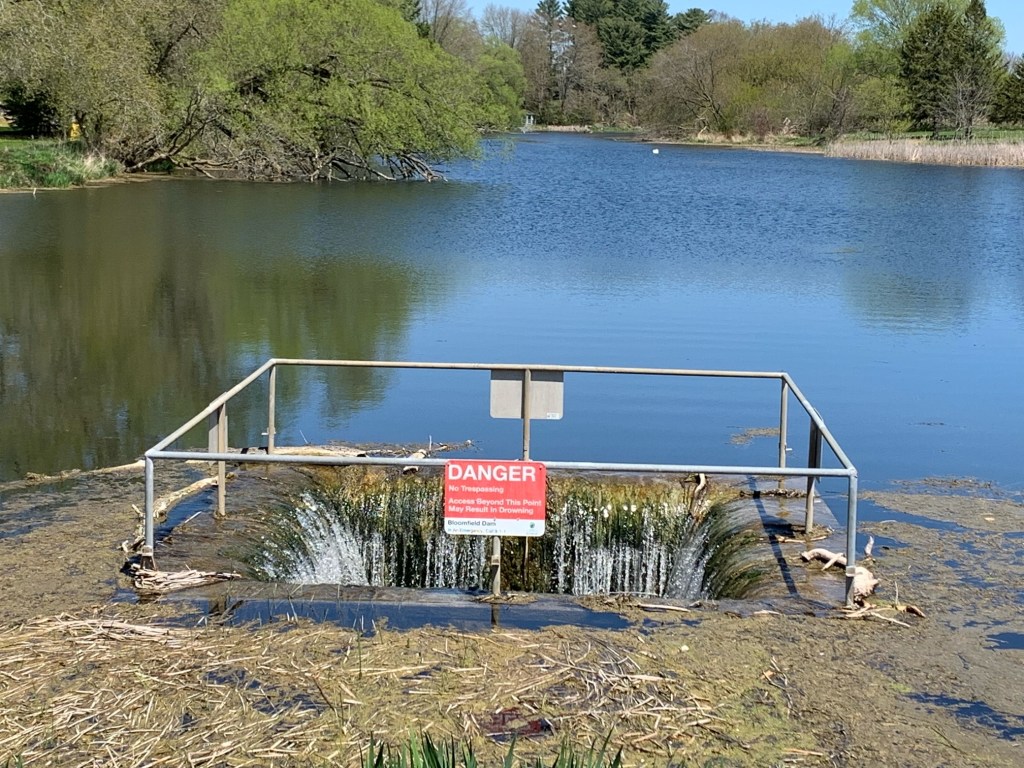
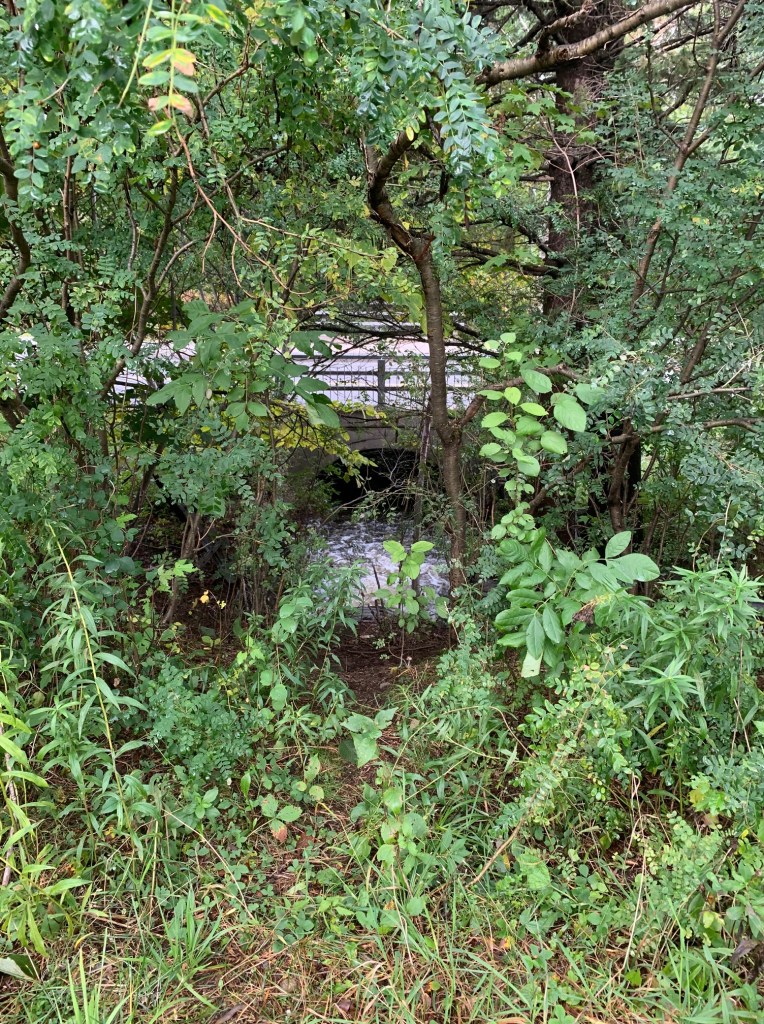
Louise Craig and I like to explore small towns like Hudson to observe how they deal with the same problems we have. This past summer, we spent a day walking around Bloomfield, a hamlet of about 600 people in Ontario’s Prince Edward County just west of Picton. There’s a creek the size of the Viviry running through town, with a dam and a millpond next to a main artery. Instead of a weir, there’s a square sluiceway which feeds into a six-foot culvert passing under the dam and the street to the other side. Last week we saw a similar layout in Mont-Tremblant Village, where a busy creek flows into a pond pretty close to the size of Pine Lake. At one end, a square sluiceway feeds into a culvert beneath the dam, below, and under the main drag into Lac Tremblant.I have no engineering credentials nor expertise in small dams, but I’ve been exploring, writing and talking about Pine lake since I was a kid. it strikes me that if other municipalities have been able to solve this problem with simple, elegant fixes, why is this such a struggle?
Finally, there’s a $27,790 update of the 2019 Maxxum intervention plan. Again, what has changed, other than the repaving of residential streets that never topped any list I saw as a councillor? Is this the pretext to rejig the list to satisfy some sectors at the expense of the majority?
Some analysis expenses may prove to be justified, like a study to determine the usefulness of the town’s various real estate assets and giving the town a yardstick to assess whether to relocate public works to the snow dump, thus making better use of the works yard in the town core. As the editor of the Hudson Gazette, then as a councillor, I saw the waste in having the administration split among half a dozen unsuitable, substandard structures. The last council pushed to have Hudson’s ‘look and feel’ codified so that prospective builders and buyers would know what design elements were mandatory in their proposals to urban planning.
But I don’t see any of this happening. Instead, I see money being spent on what the mayor used to characterize as non-essential consulting contracts — all paid for out of the apparently bottomless ($7 million plus) accumulated surplus.
Yes, Hudson is on track for yet another operating surplus in 2022, but what that says to me is we could just as easily cut taxes and tariffs when some residents are struggling. With this year’s final tax instalment due last week and the clerk’s office compiling the list of properties in arrears for eventual sheriff’s auction, a spending spree is bad optics.
One of Hudson’s remarkable trees, this stately American chestnut is on public land and deserves protection. What if it stood on private land and the owner was concerned about security?
By now Hudson residents will have received a disquieting note from the town in the mail announcing a “mandate to inventory remarkable public and private trees.” Between Sept. 18 and Sept. 30, people identifying themselves as Enracinart team members will be identifying and geolocating potentially significant trees on public and private property throughout town.
The mayor’s letter is vague about whether the tree people have the legal right to set foot on private property. “It is possible that a specimen located on your property could be recognized as a remarkable tree. I, and council, would therefore appreciate your permission to allow Ms. Hardy and her team to inspect, measure and photograph the tree(s).”
Background: Resolution 3.9, adopted at the Aug. 1 council meeting, approved the July 14 hiring of phytoculturalist Suzanne Hardy (for $7,200 ex taxes) “to assist the town in establishing an inventory of remarkable trees on its territory.” The goal: to develop and implement a new tree policy specific to Hudson.
Resolution 3.9 doesn’t provide details, but it’s my understanding that this tree inventory is part of the runup to the proposed overhaul of Hudson’s Planning Program, the collection of bylaws that regulate urban planning.
My first reaction was that there’s no harm in seeing what remarkable trees are out there. One of Hudson’s star attractions is the stately and spectacular American chestnut at the rear of 539/541 Main. I’ve come across awesome 120-foot hemlocks in several of Hudson’s deep ravines as well as monster-muscled blue hornbeams in the lower Viviry wetland.
Blue hornbeams in the Lower Viviry wetlands: ironwoods are understorey trees that seldom grow this big. You can see why they’re called musclewoods.
But these are on public land. What impact would this tree census have on private property?
The interim control bylaw adopted early this year includes a measure to geolocate remarkable trees as part of a strategy to map a protected canopy corridor with GPS coordinates. These corridors and adjacent buffer zones would become constraints on development in a revised master plan.
More simply, the revisions would appear to further limit the right to cut trees on private property.
I think a majority of residents would agree on the need to protect the forest canopy, which is why we adopted the revised tree bylaw in 2021. The problem lies in the process.
The folks doing this remarkable-tree inventory aren’t certified tree experts. Hardy’s bio says she’s a ‘phytotechnicienne’ and botanist. Their body of work includes a 2005 Hydro-Quebec subcontract to identify 1,000 remarkable trees (no word on what happened to unremarkable trees). In 2016, Enracinart published an inventory of remarkable trees for Laval’s regional environment council and in 2012 a similar census for a Quebec City heritage site. Their biggest job: an inventory of Mount Royal’s most remarkable trees, which identified a number of unique specimens.
Therein lies the crux of the problem. From what I know, only designated town inspectors can set foot on private property without the owner’s permission, and only in the course of enforcing municipal bylaws. Anyone else requires the owner’s permission, preferably written. Anything else is called trespassing.
Moreover, the information gathered likely will be shared with the Conservation Working Group, a body of unelected citizens tasked with creating a conservation corridor. This would be a clear violation of Quebec’s Privacy Act.
As we saw with the previous council’s disastrous effort to impose a 30-metre wetland buffer throughout the town, this isn’t the sort of thing a council can do without consultation with those whose property values will be impacted.
A friend owns a woodlot which includes several enormous trees that presented a real threat to his family’s security. As currently written, the tree bylaw allowed them to be felled because they represent a public security hazard. As we were chainsawing and splitting the tonnes of lumber, he asked me whether letting the tree people onto his land means he can get the town to pony up to take down a remarkable tree that threatens to kill people and destroy his house.
Even in this time of increasingly insignificant Canadian elections, Quebec’s Oct. 3 exercise may seem like a wallow in futility.
With 40% of the decided vote, François Legault’s CAQ is guaranteed a second majority. The most significant outcomes left to decide: the official opposition (likely Eric Duhaime’s Quebec Conservatives) and whether the PQ and Liberals will elect a sufficient number of MNAs to retain party status.
If Quebec was a true participatory democracy, Oct. 3 would be a plebiscite on Bill 96, the CAQ’s language law rewrite and Bill 21, Quebec’s emulation of France’s secular-state edicts. Sadly, the province’s legislators voted otherwise, leaving it to the courts to thrash out the human cost.
So much for principled stands on the sanctity of individual rights.
What I find more surprising is the voting public’s apparent surrender of their collective rights at the outset of this 36-day Marathon of Irrelevance.
I’m referring to the generalized apathy surrounding two files critical to millions — the failing Ile aux Tourtes highway bridge and the substandard emergency care system in southwestern Quebec.
Rendition of the 404-bed Vaudreuil-Soulanges hospital, promised for 2026: will construction really begin this fall, or is it another electoral gambit?
Most Vaudreuil-Soulanges residents find ways to work around the challenges. Rather than risking a multi-hour wait at overwhelmed ERs or packed walk-in clinics, many choose to drive to Ontario ERs. To escape the hell of the daily commute on and off the island, we negotiate flextime, co-working and work-from-home alternatives. Sometimes we joke about it. But why should we accept it?
Begin with the bridge and the lack of public-transit alternatives. When it was inaugurated in 1965, the existing structure had an estimated 50-year lifespan carrying 25,000 vehicles a day. Now it carries 90,000 vehicles a day, a third of them big rigs averaging 50,000 pounds. Decades of deferred maintenance, incompetent modifications and road salt have forced the regular closure of one or more lanes (and once the entire bridge). These closures are increasing in frequency and duration with every passing year.
In 2007, Transport Quebec boasted of keeping the bridge in operation for 70 years. A year ago, the ministry conceded the lane closures would have to continue until a new bridge was opened in 2031.
This past March 10, CAQ transport minister François Bonnardel announced the reopening of the new bridge would be moved forward 18 months, thanks to the government’s fast-tracking legislation for major infrastructure projects. No revised target date was given.
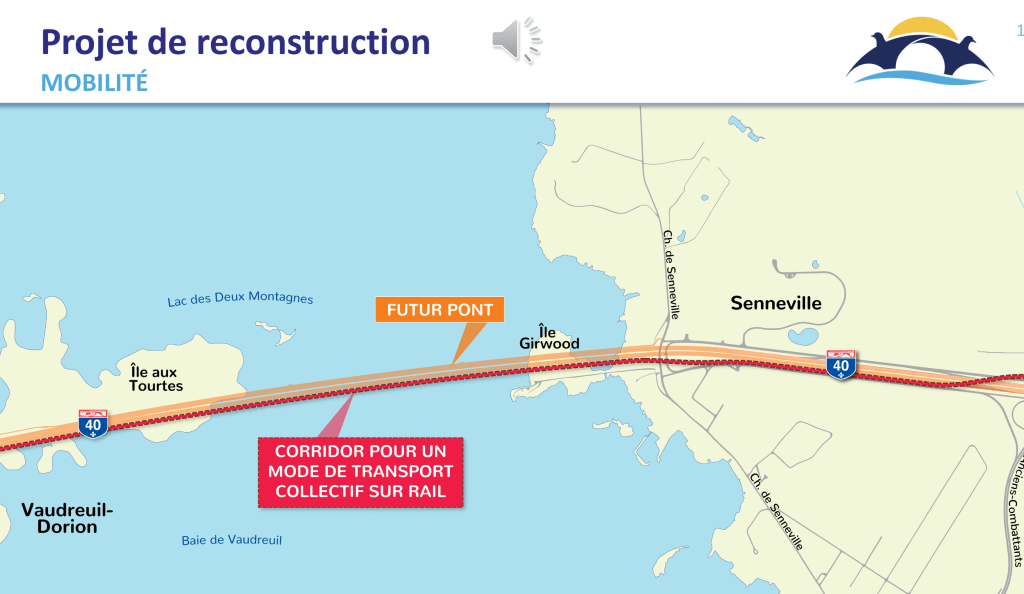
Castle in the air? Three years ago, a light rail transport system was integrated in plans for the new Île aux Tourtes bridge. Between then and now, the proposal dropped dedicated bus lanes and turned the REM extension into an imaginary corridor now occupied by the existing bridge.
Four years ago, the transport ministry and its CAQ overseers were talking about incorporating an off-island extension to the REM light rail system into the new bridge. Between then and now, the REM extension was dropped. So were dedicated bus lanes. Henceforth, buses could use the outside breakdown lanes, the only safety zones for two kilometres.
The one concession to an eventual REM extension was an imaginary corridor where the existing bridge now stands.
Hard targets remain equally elusive for the Vaudreuil-Soulanges regional hospital originally promised (by the premier himself) by late 2026. A prime contractor for the 404-bed hospital was to have been picked in the spring of 2022. Instead, a June 30 announcement by health minister Christian Dubé said construction will start “au début de l’automne prochain.” Taken literally, one might assume this to mean work will begin next week even though the prime contractor has yet to be named.
It’s hard to digest all this without getting the feeling that Vaudreuil-Soulanges voters don’t matter to the CAQ. The test of any government’s commitment to the democratic princlple is how quickly it abandons its promise to be a government for all citizens, not just those it was elected by. In Quebec’s bad old days, that manifested itself in whose roads were repaved and who got hired to do the job.
Maybe it’s just me, but François Legault’s 2022 Quebec is starting to feel like the 1936 Quebec of Maurice Duplessis, where faut voter à bon bord wasn’t an idle threat. All the more reason to raise our voices on the public forums open to us. Legault’s CAQ will persist in pandering to its base, but we all need to hear dissent and concerns from across the political spectrum.
This is the wetland Hudson should acquire: the Viviry watershed and catchment basin between Highway 40 and boul. Harwood, source of Hudson’s drinking water — and ever-increasing runoff from development in St. Lazare and Vaudreuil-Dorion.
I expect mail on this, but Hudson’s most valuable wetland isn’t Sandy Beach or Como Bog — and it isn’t even in Hudson. It’s the 100-hectare wilderness of forests, ravines, marshes and fens lying between Highway 40 to the south and Harwood Blvd. (Hwy 342) to the north. This is the Upper Viviry watershed and catchment basin, source of Hudson’s drinking water — and the recipient of ever-increasing runoff from new residential development in St. Lazare and Vaudreuil-Dorion.
The Upper Viviry is part of the Viviry/ Black Creek watershed, 14.5 square kilometres stretching through three municipalities. Its headwaters are three branches fed by springs and marshes in the forested wetlands reaching as far south as rue Ste. Angèlique in St. Lazare, from past Camping Daoust to the east and Montée Alstonvale in Vaudreuil-Dorion’s Fief sector.
The Viviry flows northeast under Hwy 342 into Hudson’s Viviry Conservation Area, past Whitlock’s links and under Cote St. Charles, through Bradbury Park into what was Pine Lake on its journey to the Sandy Beach estuary and the Lake of Two Mountains. Over that last mile, the Viviry’s flow is increased by drainage from ravines and wetlands extending along the escarpment between Montée Lavigne in Hudson’s west end and Bellevue in the east.
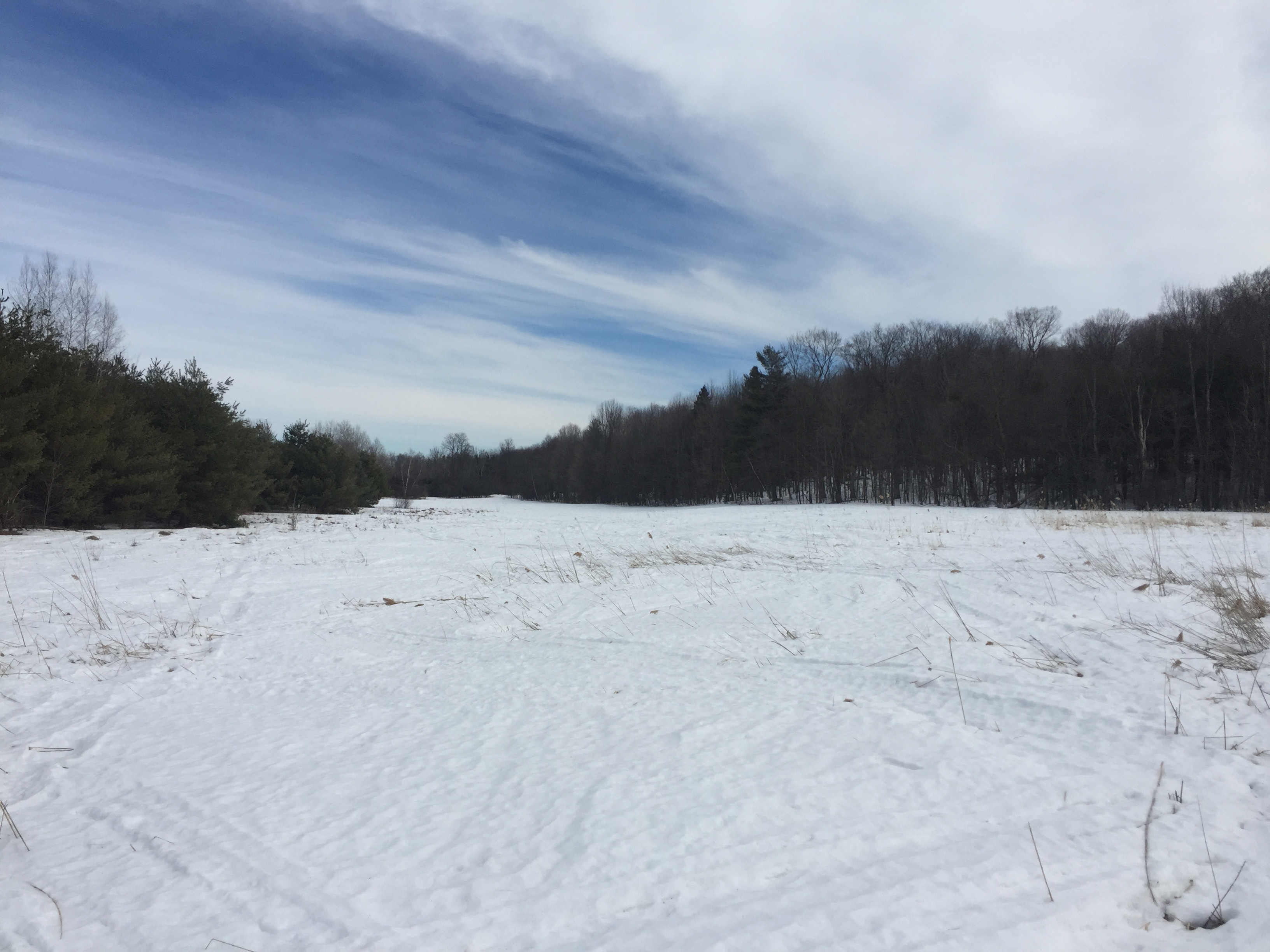
The Upper Viviry basin probably looks like it did when Cumberland settlers colonized the region in the first part of the 19th century. It’s accessible only in winter, and for the most part only on back-country skis or snowshoes. But civilization has encroached over the 60 or so years since I first explored its reaches. The tracks of unauthorized snowmobiles and ATVs stitch the the frozen marsh. To the northwest looms the sewage treatment plant where Habitations Robert is building the first 294 homes of the multiphase Ravin Boisé development on what was once a working farm and sugarbush. The southeastern corner, a mix of woodlots and grasslands behind Mon Village, is zoned for a major residential/commercial project with its own sewage treatment plant.
Crossing Highway 342 into Hudson, sections like the upper Viviry and Hudson’s Viviry Conservation Area remain relatively pristine. The stretch between the Bradbury Nature Trail and Cameron is in the process of re-wilding in the wake of the 2014 Pine Lake dam failure. Given the length of time since Pine Lake became Pine Flats and the ongoing political debate over what to do, it is increasingly unlikely that the lake will be rebuilt to its original dimensions.
Early Viviry Bottle Race, with The Wilson Company’s icehouse in the background. The lower Viviry appears to have been less forested half a century ago and residents were able to walk its banks.
Between Cameron and Main, the Viviry is in rough shape. Fallen trees, junk and generations of illegal dumping inpede its flow. Instead of the shoreline vegetation one finds on its upper reaches, erosion caused by unchecked high-water periods has turned the lower Viviry’s banks into mud flats. The growth of trash trees like Manitoba maples and willows cuts sunlight that bank-repairing, pollution-filtering species would need to thrive. Ecologically, the urbanized, canalized lower Viviry is a wasteland instead of an eco-corridor. This is being addressed in draft bylaws 525.3 and 750 but will depend on buy-in from property owners who will no longer be permitted to do whatever they want in their back yards.
I’ve already written extensively on the Viviry between Main and the Ottawa River, but to summarize, both banks are within the 60% placed under conservation as part of the development agreement with its owners. Ironically, the estuary, once home to flocks of shore-dwelling birds and mammals, has been trampled into desolate mud flats by hordes of day trippers looking for a place to camp and run their dogs. The adjacent wetlands are filled with garbage, scrapped appliances and junked industrial machinery from the former Wilson Company icehouse.
Exploring the Upper Viviry
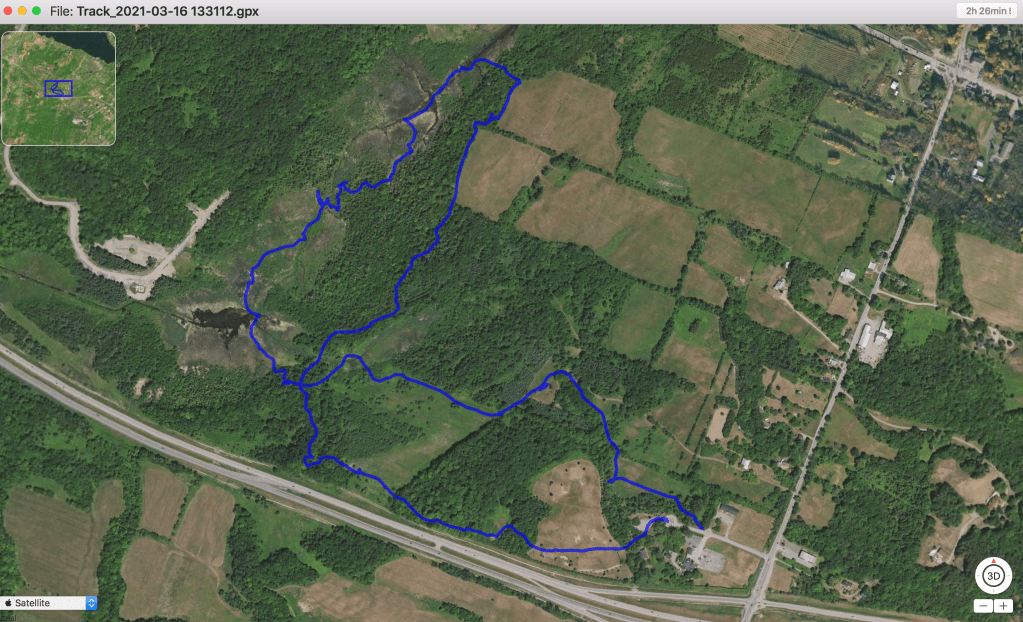
Our exploration of the Viviry Valley watershed in St. Lazare began at 10 a.m. Tuesday, March 16/21. In blue, the GPX tracking starts and ends beside Mon Village, at the northwest corner of the junction of Highway 40 and Côte St. Charles. Total distance covered: 5.4 km.
In mid-March 2021, our hiking friends Denis and Frances joined Louise and I for a trek through the Upper Viviry catchment basin. Between the start of mosquito season and the first frost, this square kilometre is unbearably buggy; late winter is the ideal time to explore.
I carried a Garmin GPSMap 78s to generate a GPX track of our hike I could overlay onto cadastral and zoning maps. It allows the user to compare what’s on the ground with municipal and agricultural zoning and land use maps, cadastral records, municipal boundaries and other information.
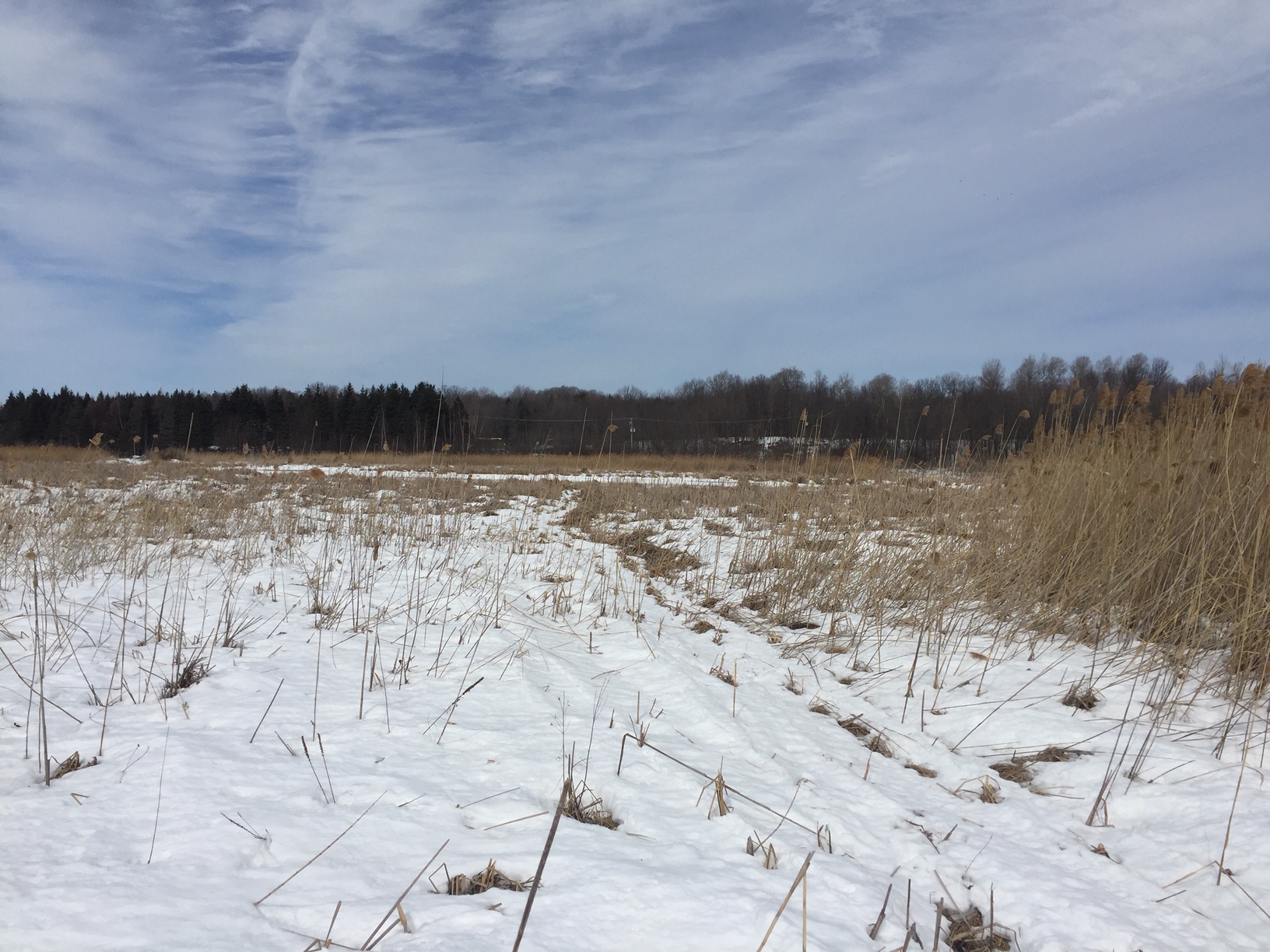
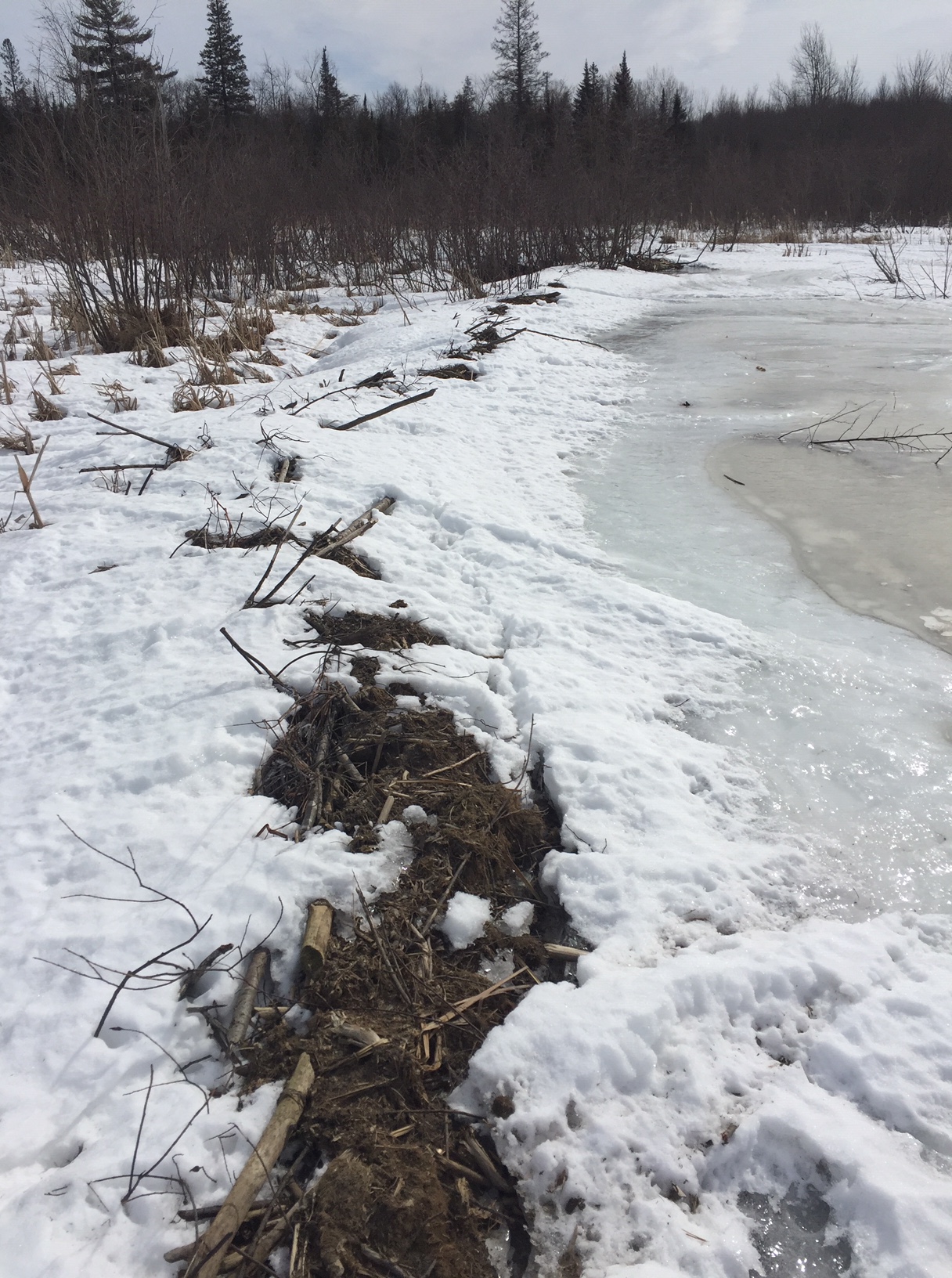
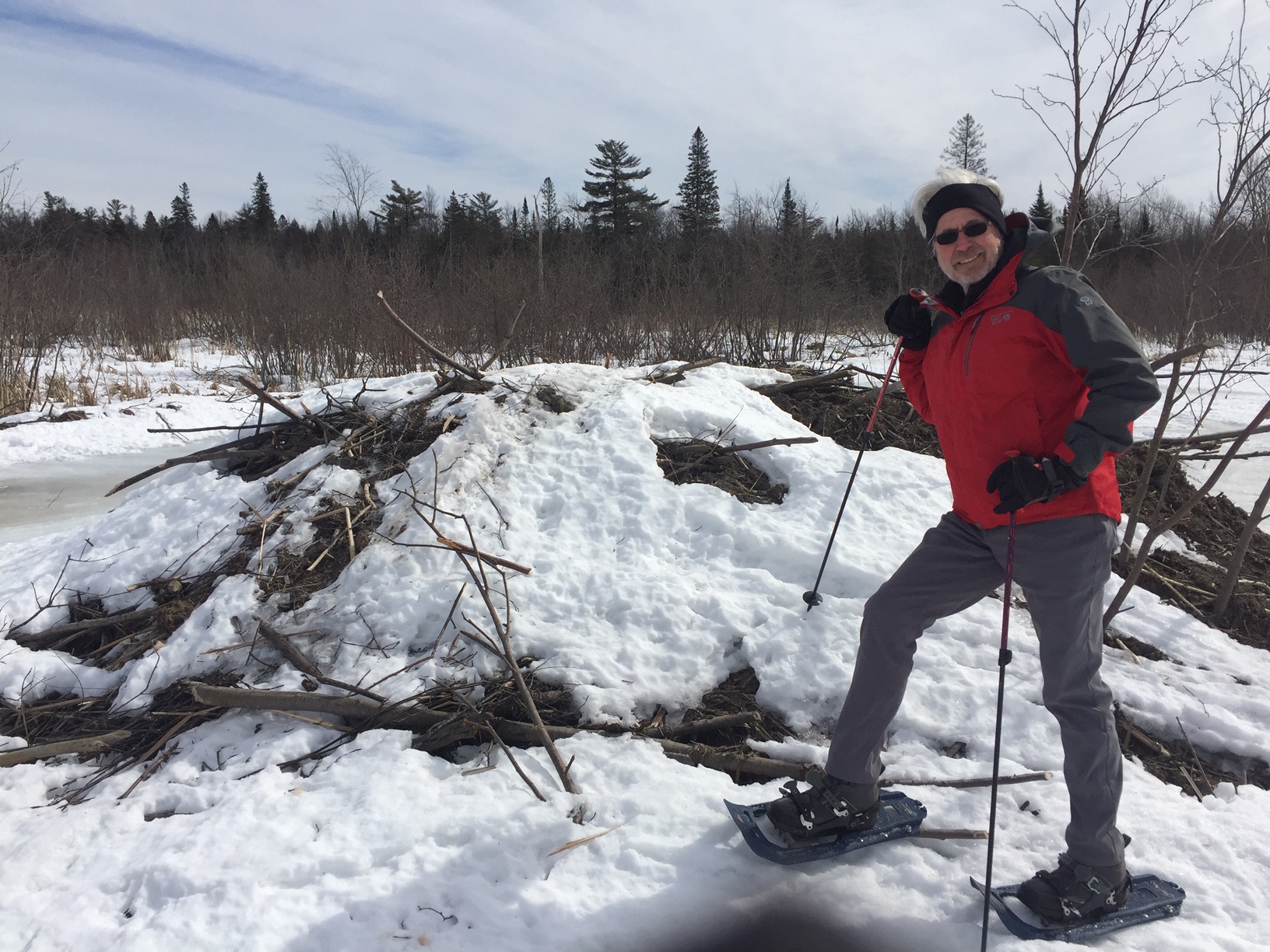
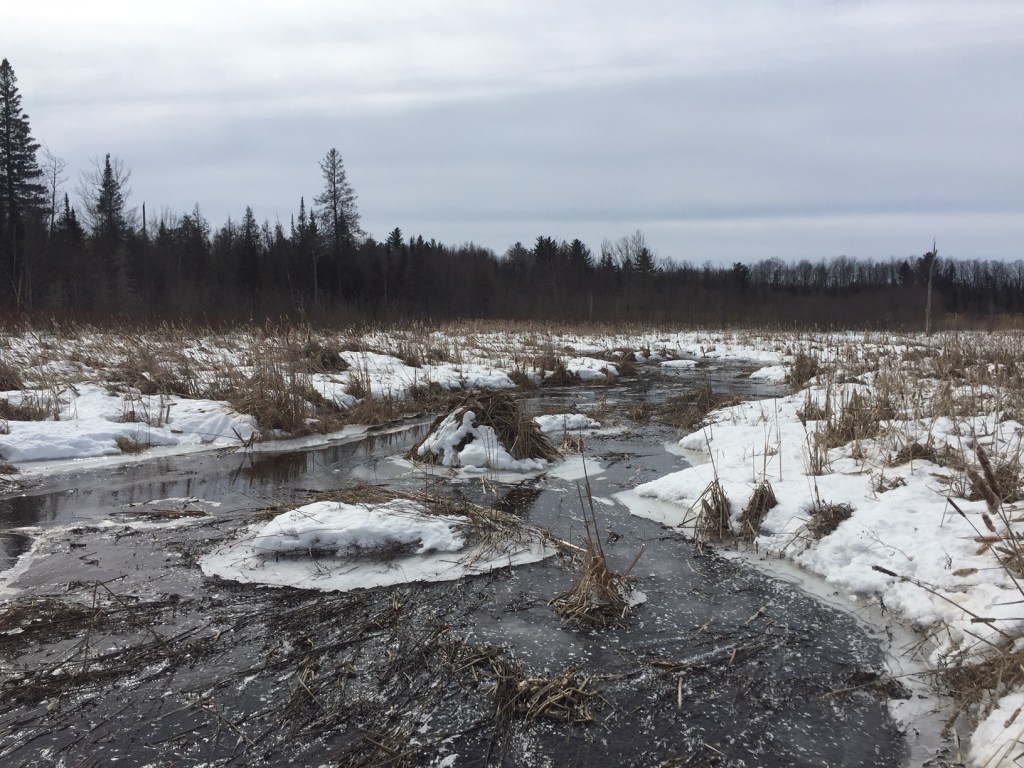
The four of us were awed by the vastness of the wetlands. We crossed beaver dikes hundreds of metres long and took selfies with condo-sized beaver lodges. We bushwacked through old-growth forests of maple, oak, hickory, hemlock, cedar, pine, fir and spruce where we identified tracks of coyote, lynx and fisher. We startled a sizeable herd of whitetail deer. Overhead, raptors circled.
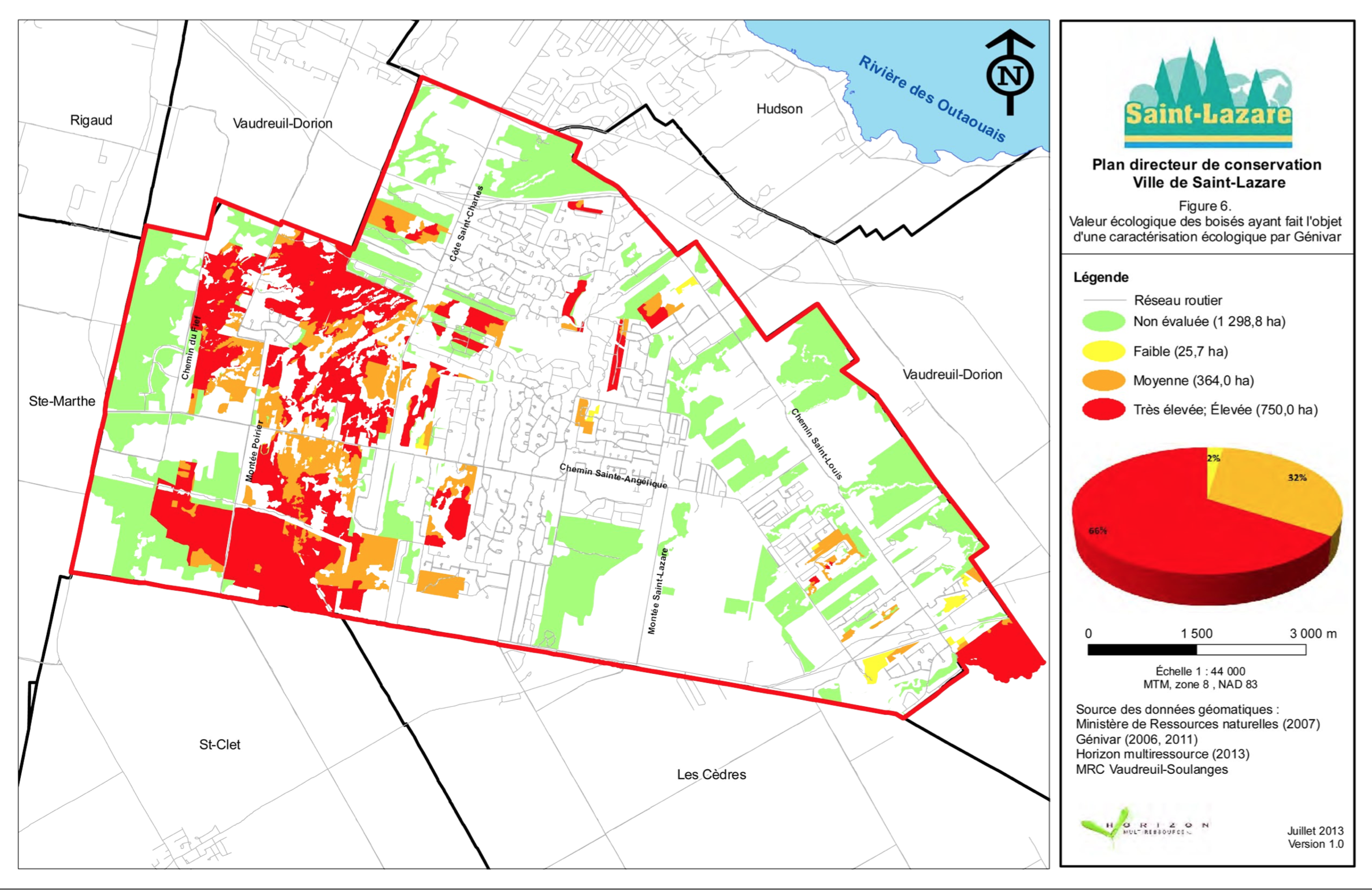
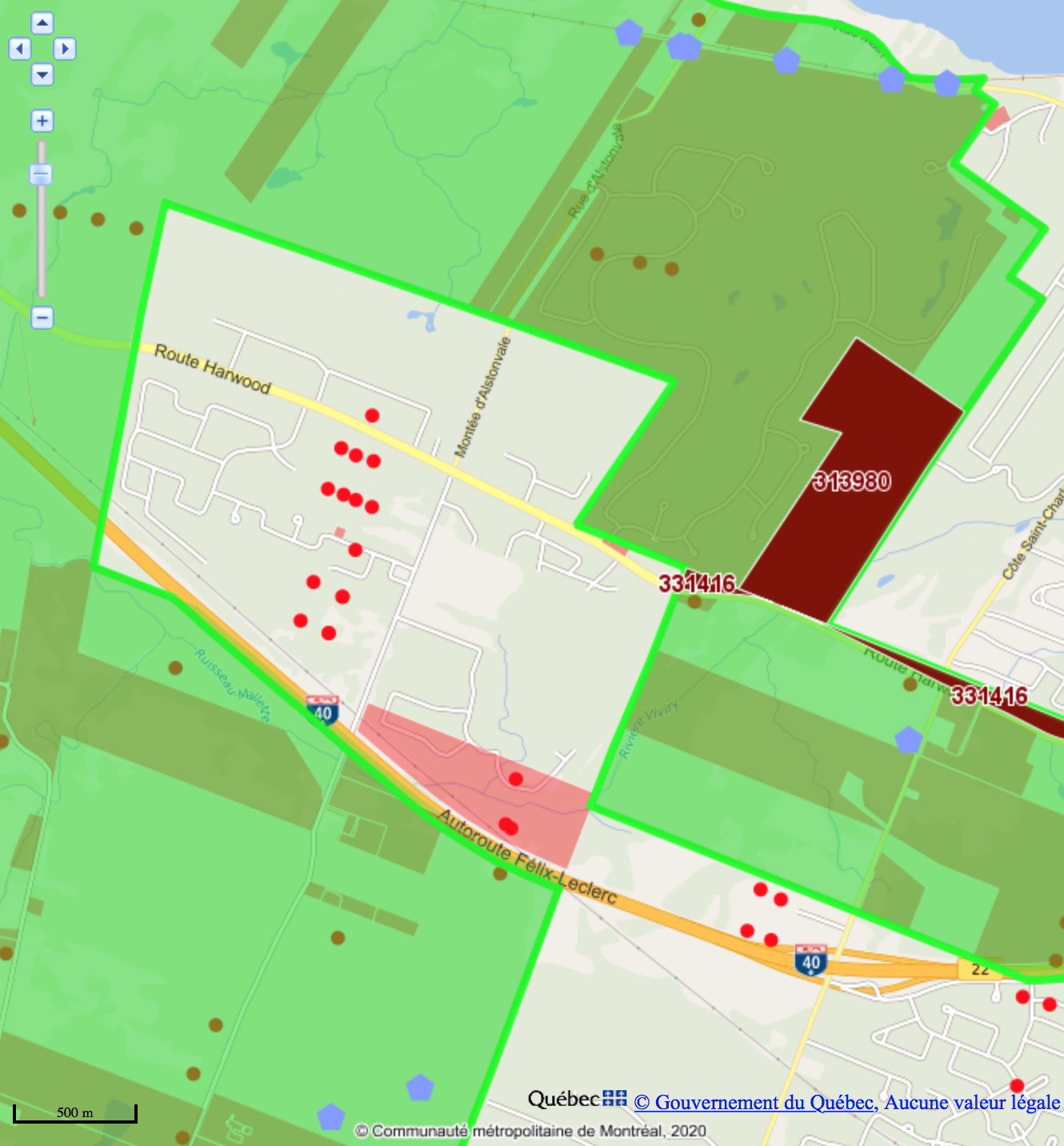
Later, I overlaid our track onto the aquifer map contained in the 2015 PACES analysis (more below). Much of where we walked lies within the replenishment area for the aquifer which supplies Hudson its water. Despite its size and importance to the aquifer, the wetland is not designated as protected in St. Lazare’s conservation plan, below left. At lower right, Commission de protection du territoire agricole (CPTAQ) zoning allows residential and commercial development on the par 3 golf course behind Mon Village you can see as the cluster of buildings just above the Exit 22 cloverleaf. This project, along with the pink Habitations Robert development to the west, would hug the southern edge of the Viviry watershed.
What we see of the Viviry and its tributaries is mirrored by another Viviry dozens or hundreds of feet below the surface, an invisible river flowing slowly through layers of silt, clay, sand and gravel laid down during the last glaciation 11,000 years ago. That underground Viviry — and aquifers like it — supply close to half of all the drinking water in Vaudreuil-Soulanges and its 150,000 residents, including all of Hudson, St. Lazare and Rigaud.
Ours is the largest region by population in Quebec dependent on underground aquifers for its drinking water, yet we know next to nothing about their capacity or recharge rates. The only numbers we have are for municipal consumption; figures for the volume of water drawn by private wells are guesstimates. Quebec’s 2008 regulation designed to monitor the quantity of water being drawn from a given aquifer is a pretense of control that fools nobody.
By 2010, Vaudreuil-Dorion, St. Lazare, Hudson and Rigaud were all dealing with chronic drinking-water issues — stressed or failing municipal wells, boil-water advisories, watering bans, even total exterior-use bans. (St. Lazare went to court to defend the right to keep water-consumption statistics secret so as not to slow the rate of development.)
It was at this point that retired hydrologist Gabriel Meunier and a group of concerned individuals created the Conseil des bassins versants de Vaudreuil-Soulanges (COBAVER-VS), a non-governmental organization with a mandate to study the region’s water sources with funding from the MRC and the environment ministry’s Programme d’acquisition de connaissance sur les eaux souterraines (PACES) and technical support from geomapping consultants Géomont. Over the next three years, an 20-person interdisciplinary team from the Université du Québec à Montréal (UQAM) gathered the data required to model our region’s aquifers.
From the 2015 PACES/UQAM study, aquifer replenishment areas for the region are concentrated in the wetlands and upland sand lenses with the Viviry centrally located.
Published in 2015, the PACES/UQAM study established that the plateaus in St. Lazare and Hudson are critical aquifer replenishment zones, vulnerable to pollution and hardscaping which reduce permeability. Their recommended protection measures: allowing only low-density (less than eight units per hectare) residential development and conserving the complex of wetland corridors.
Key points: — 54% of all drinking water consumed in Vaudreuil-Soulanges originates from the Mont Rigaud highlands (9%) and the Hudson and St. Lazare plateaus (41%). — Local aquifers (eg the Viviry watershed) are most vulnerable to depletion; public and private wells draw down 29% of their natural replenishment. — Hudson, Rigaud and St. Lazare depend entirely on underground water.
The report made special mention of a 2007 study by Gartner Lee Ltée. commissioned by concerned residents of St. Lazare’s west end. It found that wells on Ste. Angèlique and Fief need to be drilled progressively deeper to obtain sustainable water, raising the possibility that the aquifer in that part of St. Lazare is shrinking, either because of reduced replenishment or increased consumption. Fief residents have told me they had to drill up to 600 feet to ensure an adequate water supply.
PACES concluded with the recommendation that municipalities dependent on local aquifers must closely track consumption data before authorizing any new wells or allowing residential development based on water from the aquifer. It also warns that even if an aquifer appears to be productive, there is no way to measure long-term sustainability.
In the seven years since the PACES team published their report, emerging anecdotal evidence suggests that some aquifers in the region are stressed beyond their capacity by unregulated high-density residential development.
Earlier this month I got a call from Gary Dover, who lives on Harwood in Vaudreuil-Dorion west of the entrance to Hudson Valleys. Gary and Anita drink bottled water, but draw water for their household and garden from an 80-foot borehole well completed in 1990, the year before they purchased their house. With various modifications and a new pump, the system appeared to be working well until last year, when Gary’s seven-year-old pump showed signs of failure. The service technician identified the problem: their well was taking longer to replenish itself — a precursor to failure.
They learned neighbours were having similar problems with their wells regardless of depth or age. “Some of us have 80-foot artesian wells,” says Gary. “Others have 30-foot wells straight out of the 19th century.” Gary and neighbour Frank Delforge went door to door along Harwood and adjacent streets asking people whether they were having well issues. They found at least 40 others who were seeing signs of their wells failing over the past several months. When Gary told them that he and Anita were drinking and cooking with bottled water and boiling their well water for domestic uses, most said they were doing the same.
Dover contacted his district councillor Karine Lechasseur to discuss the problem and possible solutions. He said Lechasseur told him the city was aware of the problems residents were having with their wells and proposed a solution that would have Harwood households on private wells connect to a new west-end municipal water system fed by the city well at the corner of Harwood and Alstonvale. “She agreed it was a regional problem,” Dover told me, “and that the city would put it right, with consideration for the fact that this wasn’t our fault.”
I asked Lechasseur whether the city felt an official boil-water advisory was advisable for the sector. She told me she didn’t think the situation had reached the critical stage, but that Vaudreuil-Dorion’s director-general and staff were aware of the situation. One question she couldn’t answer is the sustainability of the aquifer, beginning with Vaudreuil-Dorion’s well at the corner of Harwood and Alstonvale that will supply Dover and his neighbours when and if they’re connected. Her understanding is that a municipality must apply for a certificate of authorization (CA) from the environment ministry to allow a sector to draw well water based on the number of homes and the working capacity of each well.
According to Dover, municipal employees have been working nonstop to ensure the well can supply increased demand from Ravin Boisé and adjacent developments. He finds it mind-boggling that the city would issue construction permits before ensuring it had a revised CA in hand, especially when the evidence suggests the aquifer may be showing early signs of stress.
While residents of the nearby Hudson Valleys and Alstonvale developments draw their water from municipal wells outside the affected area, some also have commissioned private wells to get around Hudson’s water-conservation regulations. Since the Environmental Quality Act was modified in 2008 to include the regulation of private wells, the Town of Hudson has issued 84 private-well permits for all sectors of town. I was told no numbers are available for the quantity of water extracted per well per day nor in which sector.
In principle, private wells require regulatory approval under a clause of the Environmental Quality Act, the Water Withdrawal and Protection Regulation, which sets standards for “water withdrawals, water withdrawal facilities and facilities or activities that may affect the quality of water withdrawn in the vicinity. It ensures, in particular, the protection of water withdrawn for human consumption or food processing purposes.”
The maximum daily amount of water that can be withdrawn by a private well is based on a 90-day average taken over a period of maximum water withdrawal (eg. a golf course well in summer) and the maximum number of users connected (20). Withdrawals cannot exceed 75 cubic metres (75,000 litres) per day.
My next call was to Vaudreuil-Dorion’s director-general, Olivier Van Nest, who shared his city’s long-term plan to connect all Harwood sectors currently on private or town wells (Hudson Acres, Domaine en haut, Normandie/Picardie/de la Concorde) to municipal water via a line up Montée Cadieux. The exception is Gary and Anita’s’s neighbourhood, separated from the rest of Vaudreuil-Dorion by the Viviry Valley. The solution there, Van Nest explained, is to connect them to the town’s Montée Alstonvale well — but only once data confirms the well is capable of supplying more water than the 600 cubic metres (600,000 litres) per day authorized by the current CA.
Can he be sure that aquifer can support a level of consumption required to supply several hundred new homes in the sector as well as hooking up those still on private wells? It’s up to the experts, Van Nest said. A similar process is underway to determine whether Vaudreuil-Dorion’s wells in southern St. Lazare have sufficient capacity to supply the network with the increased capacity required by the regional hospital scheduled to open in late 2026.
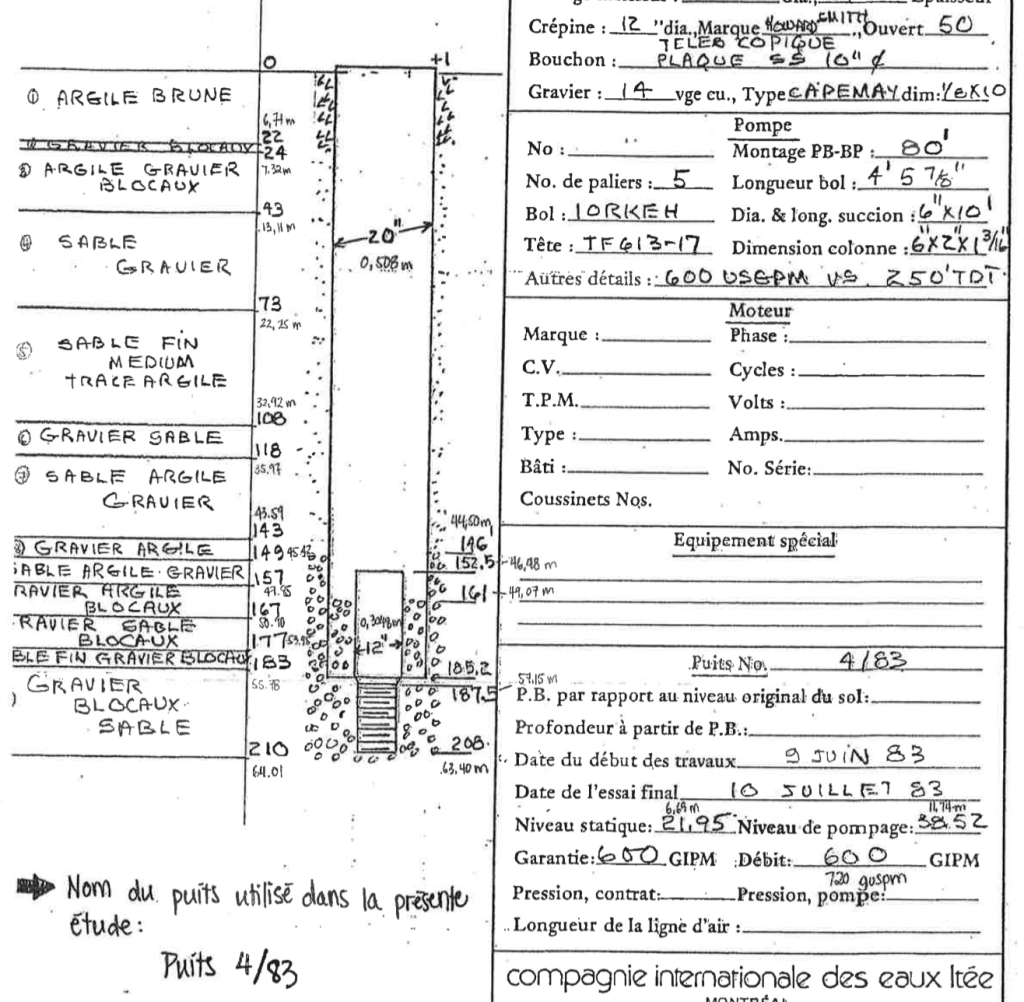
Above, a profile of 4/83, one of Hudson’s two most productive wells.
How does one determine the sustainability of Hudson’s aquifer? The latest attempt to answer this question was the 2018 Akifer study, one of the first contracts approved by the Nicholls council (residents will find the study posted on the town website). Below, the core paragraph (my translation):
In order to clarify whether the flow of the aquifer currently used by the Bradbury and 4/83 wells is capable of permitting the extraction of an additional flow, it will be necessary to provide, following the installation of new wells, an extended pumping period of one month during low-water periods to better document the behaviour of the pool under this constraint. It would also be preferable to have the shortfall period set during the summer to ensure that the Whitlock Golf Course well is also operated during the trial period, as the Whitlock Golf Course Golf Course Well uses the same aquifer as the Bradbury and 4/83 wells.
We know what is being produced and consumed from Hudson’s five operational wells (three in Bradbury Park, two in Hudsn Valleys/Alstonvale) because Quebec requires municipalities to monitor and post water consumption and test results. Hudson was negligent in doing so until 2017, when data first showed the municipality has a serious over-consumption problem. Over three days late last August, the main filtration plant on Woodland produced an average of more than 3,000 cubic metres of water a day — three million litres, or 596 litres a day for every one of the 5,033 residents on the two distribution networks it supplies.
Over that same period, the Mount Victoria filtration plant and reservoir serving Hudson’s Valleys and Alstonvale averaged 665 cubic metres (665,000 litres) a day for 263 residents — 2,528 litres per person. Losses due to leakage, arrived at by comparing daytime use with overnight baselines, was 70 cubic metres per day, or 10.5%. Quebec’s average usage is 385 litres per person per day. The provincial target for water loss due to leakage is 15%.
Brookside, circa 1950, by Hudson artist James Crockart. It’s hard to reconcile his peaceful pond with the detritus-clogged Black Creek of today. River cleanup and shoreline vegetation management should be priorities.
As kids, we swam in Pine Lake and explored the trails that ran along Black Creek. One of my goals, first as a newspaper editor, then as a councillor and now as an elder with a blog, has been to protect the Viviry, both as a natural area and as the source of Hudson’s water supply.
Sometimes those two missions have taken different paths. In 2017, the Citizens Action Group on Infrastructure, one of several advisory committees created by mayor Ed Prévost, produced the Source Report, a controversial analysis of Hudson’s chronic water shortages. (Water: Hudson looks to the Ottawa, http://www.thousandlashes.ca, September 6, 2017)
To summarize, the report urged incoming administrations to solve the town’s immediate water woes with a new well, but not to gamble on the aquifer being able to supply sustainable water in perpetuity. Instead, the town should be prepared to invest $12-$15 million in a new west-end filtration plant to treat water from the Ottawa and link it to the existing network as well as to Hudson’s thirsty neighbours.
The Nicholls administration went ahead with the new well roughly 100 metres west of 4/83, the town’s highest-producing well, but ignored the rest of the Source Report’s recommendations on the basis of the success of the new well.
Given Hudson’s dependency on three wells in a small area, Hudson’s former mayor Jamie Nicholls was mandated by council in 2018 to discuss ways to protect Hudson’s drinking-water source with former St. Lazare mayor Robert Grimaudo. There is no record of any discussion taking place and Nicholls was unsuccessful in his efforts to raise the issue at the regional level.
Council continued to push. Item 7.1 on the Dec. 10/18 council agenda was a resolution requesting an MRC intermunicipal meeting to discuss watershed management and the impact of increased runoff due to climate change and upstream development. In March 2019, council approved a request for financial support from the environment ministry to assemble data on what Hudson should be doing to protect its drinking water sources.
As far as I know, the result of those efforts was the installation of fences and generators around the Bradbury Park, Hudson Valleys and Alstonvale wells. We were told told there was no interest from neighbouring municipalities in the Source Report’s lakewater treatment plant alternative.
The only direct reference to the aquifer since the current council took over last November was in response to a question at the Dec. 6 council meeting from former Gazette publisher Louise Craig, who asked mayor Chloe Hutchison whether she was concerned about the impact of upstream development on the Viviry watershed and Hudson’s drinking water.
The mayor’s response: she believes that is part of the regional planning conducted by the MRC, which has already done a diagnostic of MRC watersheds. A working group would be starting in January, polling general public via online consults. The intent, she added, is to have a plan ready for June which they will send to MELCCC for approval, then integrated into Hudson’s bylaws along with wetland and forest canopy conservation. I have since been assured this council plans to prioritize potable-water protection.
Commercial and residential zoning on both sides of the 40 west of Côte St. Charles on St. Lazare’s zoning map. Until this is altered to reflect the sensitivity of the Upper Viviry, the watershed remains at the mercy of municipal conservation orientations.(A is agriculture, C is commercial, H is residential, E is equestrian)
Who owns the Upper Viviry watershed and how is it zoned? According to the Commission de protection du territoire agricole (CPTAQ) mapping app (https://geoegl.msp.gouv.qc.ca/igo/cptaq_demeter/?) and the St. Lazare and Vaudreuil-Dorion valuation rolls, the basin’s west-facing slope on the St. Lazare side is owned by a handful of longtime residents, some of whose families have lived there for generations. It is zoned green — agricultural — and taxed as farmland. One exception is a white (non-agricultural) slice to the west of Côte St. Charles along the 40, nearly 300,000 square metres zoned for a commercial-residential development from Cote St. Charles to the Vaudreuil-Dorion town line. Out of the roughly two dozen owners, perhaps half a dozen are holding companies and/or possible developers.
On the Vaudreuil-Dorion side, residential zoning extends outwards on both sides of Montée Alstonvale between Harwood and the 40. South of the 40, the zoning reverts to agricultural, with the exception of several enclaved lots giving on the Upper Viviry. Although they are currently unbuildable, they would become developable via Oakridge in St. Lazare. Their ownership says to me it’s a matter of time and opportunity.
These and other warnings prompted St. Lazare’s previous and current administrations to prioritize wetland protection. With input from a 10-member Comité consultatif sur l’environnement they have focussed on learning more about the sustainability of the aquifers and protection of recharge zones. They were unable to halt a number of developments either underway or already approved, some in clearly delineated aquifer replenishment zones, such as at the southern end of Côte St. Charles.
Like Hudson, St. Lazare is struggling to harmonize protection of ecosensitive lands with the rights of landowners. In municipal governance, you can’t repeal decisions already reached unless you’re prepared to spend a lot of money on legal battles and/or acquisition or engineer controversial land trades of 10% subdivision greenspace allotments for areas others want placed under conservation.
St. Lazare’s PDC had this to say about acquiring greenspace: We note that conservation zoning represents just 5% of St. Lazare’s total land area, a fraction of the zones targeted by the PDC. Acquisition is pricey, so we need to consider alternatives, eg. land use constraints and specific measures aimed at sustainable management to complement acquisition. In each case, the acquisition of lots by the city must be subject to an objective evaluation based on ecological value, including a series of explicit criteria currently being drawn up by the CCE. No acquisition policy, no acquisition.
Hudson’s new council should take the lead in adopting an acquisition policy which makes protecting the source of its drinking water its top priority. If they don’t, I fear the time isn’t far off that we’ll wish they had.