
Put water on the table

No discussions about development in Hudson, Rigaud and St. Lazare should exclude the impact on the water table supplying our drinking water.

A study released in June 2015 found that precipitation falling on Rigaud Mountain and the Hudson and St. Lazare plateaus represents 41% of the total replenishment of the Vaudreuil-Soulanges aquifer, the water table supplying drinking water to more than 100,000 Vaudreuil-Soulanges residents. (FYI, St. Lazare is the largest municipality in Quebec entirely dependent on well water.)

The chief concern expressed in the Programme d’acquisition de connaissances sur les eaux souterraines (PACES) report is that the zones with the highest replenishment rate — Mont Rigaud, Hudson and St. Lazare — also happen to be the most vulnerable to contamination.

The study was carried out over a two-year period by a multidisciplinary team from the Université du Québec à Montréal, École Polytechnique and GéoMont, the agency mandated to map the Montérégie using satellite data. Their methodology and models are well explained and accessible to anyone with a scientific bent.

Here’s the PACES final report (en français seulement): rapport_final_paces_vaudreuil-soulanges

My English summary:

– About 105,000 Vaudreuil-Soulanges residents living in 18 municipalities get their drinking water from artesian wells. (The other 35,000 get their water from the Ottawa or St. Lawrence rivers.)
– Those 18 municipalities suck 11.2 million cubic metres of water a year from the underground water table, equivalent to a sheet of water 14 millimetres deep covering the entire 814-square-kilometre Vaudreuil-Soulanges MRC.
– St. Lazare is far and away the biggest consumer, averaging 2.8 million cubic metres a year, followed by Vaudreuil-Dorion at 2.1 million (VD draws most of its drinking water from the Ottawa River) and Rigaud, at 1.7 million.
– Hudson’s 5,400 residents come a surprising fourth, consuming 1,123,024 cubic metres a year.
– Our region consumes 20% more water than the Quebec average, with 56% going to residential, 33% for industrial/institutional and 11% for agriculture, most of that to grow sweet corn, a notoriously thirsty crop. (That 33% residential/industrial usage is misleading; this sector draws only 58 percent of its total consumption from public water networks because many have their own wells pulling from the same aquifer.)
– The aquifer is replenished by precipitation averaging just under 1,000 millimetres a year.

Two aspects of the study should be of particular interest to those concerned about water quality and quantity:

The PACES team found total dissolved mineral content in samples from more than 50 testing sites throughout Vaudreuil-Soulanges to be far higher than provincial norms (58.5%). Calcium is 34.8% higher; iron, 31% and sodium, 25%. But it’s the manganese level (30% higher than approved levels) that causes the team the most concern, so much so that it rates a mention in the introduction. The report quotes a 2011 Quebec study which linked higher manganese levels with lower IQs among young children. This was the reason behind Quebec’s decision to approve Hudson’s water filtration plant as part of the 2008 waterworks upgrade — so that manganese could be precipitated out of the water supply. On a positive note, our water has nitrate levels well below provincial norms.

The second aspect of the study deals with the rate at which the aquifer is being replenished, and from where. The aquifer beneath the southern half of the county lies beneath a thick layer of impermeable clay, making it what is classified as captive or semi-captive, relatively protected from contamination but slow to replenish. They get a sizeable percentage of their replenishment from the Glengarry hills of southeastern Ontario.

The researchers discovered the marshes, bogs, swamps and fens found in Hudson, Rigaud and St. Lazare are far more efficient in replenishing the aquifer, with 41 square kilometres of wetland and forested areas supplying 41 per cent of the Vaudreuil-Soulanges aquifer’s total replenishment. But because they’re better connected to the water table, any contamination is also more likely to find its way into the aquifer.

The PACES study went unnoticed when it was released last year, because there is no agency in Quebec with a clear mandate to protect underground water sources. Vaudreuil-Soulanges, like most regions of Quebec, has its Conseil de bassins versants (Rigaud’s Mayor Gruenwald is a former COBAVER-VS president and currently sits on the board) but the COBAVERs have no teeth.

In 2014 the provincial government adopted its Reglement sur le prélevement des eaux et leur protection, setting threshold levels for the risks of contamination of underground water sources, but there’s no indication the Ministry of Sustainable Development, Environment and the Battle Against Climate Change (I kid you not) is making our most precious resource a protection priority.

Call me madcap, but I’m thinking the three municipalities in Vaudreuil-Soulanges with the most to lose from contaminated water should make it a factor.

$218,201.08

frais juridiques ville

The document I’ve posted here was generated by the Town of Hudson. It appears to be a spreadsheet of legal expenses incurred up until January 31, 2016, a total of $218,201.08 for approximately 18 months.

According to this, the town’s legal expenses fall into four main categories:

– grievance mediation and/or litigation with residents, former employees and subcontractors (Pine Lakers, ex-DG Catherine Haulard, former treasurer Sylvain Bernard, former technical services director Trail Grubert, former labor-relations advisor Judy Sheehan, former town auditors Bourassa Boyer);

– legal advice on governance and policy issues (Montreal Metropolitan Community, Vaudreuil-Soulanges MRC, etc.);

– representation at numerous criminal and civil proceedings (Louise Villandré’s trial on criminal charges, complaints from or regarding citizens, Quebec Municipal Commission hearings into alleged irregularies committed by elected officials);

– actions threatened and/or initiated as the result of alleged libels, defamations and assorted insults.

The first two categories are unavoidable in any municipality, but to this extent? According to this spreadsheet, proceedings against Haulard alone account for  $100,000. An ethical lawyer will advise the client to consider the cost of litigation versus the cost of reaching a settlement. Judges usually advise mediation in civil actions because they have a front-row seat on unreasonable plaintiffs, fee-grubbing lawyers, obstructionist defendents and jammed dockets. The worst-case hypothesis is a plaintiff with bottomless pockets. In Hudson’s case, one gets the impression this administration is prepared to push everything to the limit in the knowledge Hudson’s taxpayers will always pay the bill.

It’s the third and fourth categories that should concern us. In April 2015, District 1 councillor Rob Spencer filed a complaint with the municipal affairs ministry in regards to certain actions taken by a member of this administration. Municipal affairs, after analyzing the complaint, referred it to the Quebec Municipal Commission (CMQ). A hearing is imminent. Spencer says he’ll comment once the allegations are public.

In July, Spencer made a complaint to Quebec’s lobbying commissioner, the body which ensures people lobbying on behalf of business interests are duly registered. Again, details have not been made public and Spencer is declining comment.

Spencer continues to sit on council but has made it clear he will not take part in closed-door meetings with the mayor unless the proceedings are recorded. He confirms he has received three lawsuit threats, the latest  Nov. 24. Spencer’s name doesn’t appear on this spreadsheet, but if you look closely you’ll see some information has been whited out. This suggests to me the administration doesn’t want taxpayers to know the true cost of the town’s defence in the CMQ hearings.

You’ll also find a short list of names of residents whose crime appears to have been to question this administration’s actions in social media. None of those named complain of having received a lawyer’s letter or other communication so I presume the putative plaintiffs are banking on libel chill to silence dissent. Is this what passes for public discussion in Hudson? More to the point, the use of libel threats to silence dissent is on soft legal ground in Quebec as the result of the case of a Grenville dump owner’s efforts to silence opposition.

I have expressed concern this administration has juggled the 2016 budget to create a contingency fund that would allow them to write endless cheques to lawyers for whatever ill-advised legal adventure they decide to launch. Believe me when I say the people will be watching closely.


Coconut oil

As the result of swimming at the Pointe Claire pool, I’m learning the secret to ageing well is staying healthy and watching one’s diet closely. One of our discoveries: coconut oil. We use it as we would oil, margerine and butter and we’ve noticed a difference in our metabolisms. More lean muscle mass, less fat, fewer aches and pains.

We’re not alone in our respect for coconut oil. This column ran in the Gazette Vaudreuil-Soulanges back in June, 2012

Coconut oil and NOVA
Back in February, I read a piece by Dr. Joe Schwarcz in the Montreal Gazette about coconut oil and Alzheimer’s. Dr. Joe was cautiously optimistic there might be a scientific basis to the use of medium-chain fatty acids to overcome the inability of the Alzheimer brain to metabolize glucose.
I didn’t give it another thought until Maureen Young dropped by the office to get a copy of her mom’s obituary. We got to talking about Lorna, who taught many of us either in Grade 1, in music class or in the choir at Wyman.
The obituary said Lorna Bell Chadwick Young passed at home May 15, surrounded by her family and that all who knew her are invited to a celebration of her life Canada Day weekend. What it didn’t tell us was how coconut oil gave Lorna’s family their mother back for the last three months of her life.
Alzheimer’s has been described as a living hell from which death can be a merciful release for both victim and family. Lorna had been going steadily downhill for some time. There’s a family joke about how they’re all ‘forever Young,’ but the radiant woman with the incredible voice who gifted her family and so many others with music was being gradually robbed of everything in life.
Maureen’s story begins in a hospital ER, where her failing 87-year-old mother spent four days in a hallway last year. “Everyone that went to touch her, she thought she was defending herself and when she couldn’t anymore, she just checked out. It was just horrible…it took us six months to recover from that, so we knew we could never do that again.”
With the help of NOVA Hudson’s nurses, the family brought Lorna back to Maureen’s home to spend her last days. “Even so, she kept deteriorating,” Mareen recalls. Between Christmas and February, Lorna forgot how to eat out of a spoon or drink from a glass. “She’d bite the glass. Her eyes were vacant…it was really, really….sad. She was threatened by anybody who tried to change her, or anybody who came near her.”
Then Maureen got an e-mail from former Hudson resident Stevie Stephenson, whose dad Hugh was principal at Mount Pleasant Elementary. He’d been reading about Dr. Mary Newport, a neonatal pediatrician whose husband Steve had begun developing symptoms of Alzheimer’s in 2004. In 2008, Newport had an epiphany — certain fatty acids transformed by the liver into ketones might be able to replace the missing blood sugars. She fed Steve two tablespoons of coconut oil and saw a dramatic improvement.
The next day, Maureen began feeding Lorna coconut oil, a tablespoon in the morning and another in the evening. She swears the results were immediate, but within a week, there was absolutely no question. “She started to wake up. She was present in her eyes. She started moving, she started eating, she started co-operating, she started laughing and smiling and walking! I could walk her by holding her hand. It was a miracle and it kept getting better!”
Maureen said the NOVA Hudson nurses told her they’d never seen anything like it. “We had mom for three months. And it was her again. She would smile and say think you and ‘that’s delicious.’ It was absolutely remarkable. Little Lolobelle, Coral’s little daughter, could sit in her lap and watch cartoons with her.”
One day, while Maureen and Karen were changing their mother’s diaper, Karen started to sing a sacred choral piece. “Mom started to sing with her in harmony. It would just make us cry, it was so beautiful.”
Another milestone — Lorna was watching an old Abbott and Costello movie. “She was laughing, enjoying it, interacting with it, telling the girl to watch out for Dracula behind her.”
When Rosalie, Doug and Isobel’s youngest would come over and play the piano for her grandmother, Lorna would conduct her with her hands. “She’d put a little pressure on her hands to show the nuances… she was right there with her. She’d clap and clap afterwards…she so appreciated the music right to the end, when she hadn’t even been able to hear it before.”
When Lorna passed, it was beautiful and easy. “She was present and she knew she was loved, she wasn’t frightened, we sang to her right through her last breath, Dougie, Karen and I, and we just held her and sang her out. That was such a gift to us — the coconut oil and NOVA.”
Maureen tells Lorna’s story for others struggling with Alzheimer. “It’s terrible that we don’t have her now, but we did have her. That’s what I’m so grateful for. It made it possible for me, Karen and Dougie to keep her here, where she was happy, where the cats could sit on her lap, and be happy, rather than stuck somewhere all on her own.”

I followed up with this in September 2012:

A followup on my column a couple of months back about how several spoonfuls of coconut oil a day gave Lorna Young’s family their mother back: A Brown University Medical School research team has added compelling new evidence to support the theory that Alzheimer’s is a metabolic disease and unhealthy eating habits are a root cause.
The researchers found that insulin and its related proteins are produced by the brain as well as the pancreas. Their hypothesis is that a new form of diabetes (they labelled it type 3 diabetes) is the result of a drop in brain insulin levels. Unlike types 1 and 2, it doesn’t affect blood sugar, but the team found that many type 2 diabetics have protein deposits in their pancreas similar to those found in the brain tissue of Alzheimer sufferers.
The findings strengthen the evidence that people with diabetes have up to 65 percent more chance of being diagnosed with Alzheimer’s. A Sept. 10 article on the study in The Guardian notes: “About 35 million people suffer from Alzheimer’s disease worldwide; current projections, based on the rate at which the population ages, suggest that this will rise to 100 million by 2050. But if, as many scientists now believe, it is caused largely by the brain’s impaired response to insulin, the numbers could rise much further.”

Hudson’s trust problem

Are we too cynical? Not trusting enough? Unwilling to let the inherent goodness of humankind shine through?

That appears to be the message emerging in this latest debate over a proposed senior’s residence.

People who say we should be taking this on faith have short memories.

There’s a big piece of land zoned for a continuing care seniors campus at the corner of Côte St. Charles and Hillside. Hudson taxpayers on the hook for the sewer system will pay in perpetuity for the roughly $1 million it cost to extend the sewer line to R-55.

Last I heard, the owners were asking something like $3 million for the land.

What nobody mentions is why Hudson doesn’t already have a beautiful seniors’ campus on that site with apartments for autonomous and assisted living and an Alzheimer’s wing for 24/7 care of dementia patients.

The following was published as Duff’s Corner, Gazette Vaudreuil-Soulanges, March 29, 2011:

The Anbars have left the building
This past week has been a crash course in business ethics and no, that’s not necessarily an oxymoron. I’ve been delving into the transactions that somehow transferred ownership of the 15.5-acre site of the long-promised continuing-care seniors’ campus from a group of Hudson investors to the family foundation of one of Canada’s largest commercial landlords. Every twist and turn in this financial soap opera is fully documented on registrefoncier.gouv.qc.ca, Quebec’s online real estate transaction registry.
• February, 2005: A federally incorporated numbered company with Frank Royle as president pays $665,000 plus $100,000 in GST and PST for 15.5 acres at the corner of Côte St. Charles and Hillside.
• August 12, 2008: An Alberta incorporated company with Dan Anbar as president borrows $1.6 million from Montreal-based Rosenberg Family Foundation (RFF) for 13 months. Collateral: the $1.8 million assessed value of the land.
The 24-page deed of hypothec suggests this was never meant to be anything but a bridge loan which would allow Andev to find permanent financing for the Hudson seniors’ project. The interest rate was steep — 15 percent for the first 12 months, increasing to 18 percent as of August, 2009, with principal and interest due Sept. 12, 2009. That works out to almost $800 a day — hardly the kind of loan that a prudent business person would seek out.
• August 13, 2008: Royle’s company sells 14 lots to Anbar’s company for $975,000. The deed of sale includes a condition that Anbar begin construction of the first 20 units within a two-year period. It also includes a resolutory clause that says if Anbar fails to start the project by August 13, 2010, Royle and company have the right to repossess the land at no cost.
Summer, 2008: Work begins on Hudson’s sewer system, including a half-kilometre extension of the line up Oakland to service a 172-unit seniors’ campus. Cost: $600-$700 a metre, as much as $500,000 value added to R-55 courtesy of generous Hudson taxpayers. By November, the work is winding down.
• August 7, 2009: Anbar and RFF agree to extend the loan maturity date to Feb. 12, 2010. The interest rate is upped to 17.5%.
• April, 2010: Lawyers for RFF serve Anbar at his Highland Park, Illinois home with notice they’re about to seize the Hudson land. Anbar owes a month and a half of interest — $36, 295.84. He has 60 days to come up with $1,636,295.84.
• October 10, 2010: Anbar voluntarily signs the land over to RFF, ending any chance Royle’s group has of exercising their resolutory clause.
I had a lot of trouble trying to figure out why the Hudson group didn’t exercise their right to repo the land once they realized Anbar was a no-show. If the resolutory clause that forms part of the August 13, 2008 deed of sale didn’t carry enough legal weight, than why didn’t the sellers demand a lien on the land as a guarantee Anbar would deliver?
But when one re-reads the mortgage agreement between Anbar’s Alberta company and RFF, it becomes clear — Anbar wasn’t going to get the loan unless RFF had clear title to the land if he defaulted. A re-read of the deed of sale backs that up, explaining that in order to ensure Anbar gets the loan, “….Vendor does hereby grant priority of rank of all its rights stipulated in its favour in this Resolutory Clause, in favour of the Rosenberg Family Foundation.”
Frank Royle blames RFF for Anbar’s failure. If Anbar was the white knight who was going to ensure assisted care in perpetuity for Hudson’s seniors, why was he having trouble borrowing a paltry $1.6 million, and at such high interest? The Hudson group referred to the loan in their deed of sale, so they must have been aware of the terms. Wouldn’t it have been smarter to have fronted Anbar the land so that they could repo it if he crashed?
Looking back, I can recall an uneasy feeling. Here’s a paragraph from our August 29, 2007 story on the well-attended zoning consultation meeting:
“There were some probing questions, beginning with a query as to what insurance the Town had in place in the event of CRL’s bankruptcy. [Mayor Elizabeth] Corker, obviously somewhat taken aback, waited until the end of the meeting to note: “Council feels quite comfortable with CRL’s reputation and we should also feel comfortable, and go home and get a good night’s sleep.”
I’ve been leaving messages for the Anbars all over North America for the past two years. Last week, I was contacted by a developer who knows them. I asked him to relay a message to them. He called me back the next day to say the Anbars aren’t taking calls from Quebec, but their message was simplicity itself: “The Anbars are unable to build in Quebec.”

Call me cynical and negative, but that’s why we must accept nothing on faith. The Lord helps those who help themselves and that includes taking care of business.

This followup ran March 30, 2011:

Hudson’s R-55:
Owners heedful of community concerns
HUDSON — Paul Vincent just wants to get the facts straight.
Vincent is the industrial and commercial realtor who has been mandated to sell R-55, the 15.5-acre parcel of land originally zoned for a seniors’ residence off Côte St. Charles.
He represents the Rosenberg Family Foundation (RFF), the issuers of the $1.6 million bridge loan used by developer Dan Anbar to buy the land from a Hudson business group in 2008. In February, 2010, Anbar stopped making interest payments and voluntarily signed the land over to RFF last October.
RFF’s offering price is $3 million. That represents $4.45 a square foot for 675,000 square feet, “which is below the offering price for comparably zoned land anywhere in the area,” Vincent points out. “If I had the same piece of land — 675,000 square feet — in Vaudreuil-Dorion, I would be paying a minimum of $10 a foot.” He cited as proof two large residential projects on Blvd. de la Gare either under construction or recently finished.
“Who can say to me that this land, at $4.45 a square foot, is expensive? We’re in Hudson! What are they talking about? This should prove the Rosenberg Family Foundation is not trying to benefit from what the people [behind the seniors’ residence] tried to do.”
The owners of the land are fully aware of the importance of the seniors’ project to Hudsonites, Vincent explained. “[The RFF representative] wants me to find a developer that will have the interests of the Hudson community at heart. The Rosenberg Family Foundation reserves the right to accept or refuse the offer, depending on whether the project being proposed for this piece of land fits within and benefits the Hudson community.”
But he also points out that land is on the market precisely because of Andev’s difficulty in obtaining financing for the project as originally conceived — a three-building concept offering autonomous living, assisted care and Alzheimer/dementia care to seniors.
“We need a vision of this community for the next 10 years and we need the help of all citizens of Hudson to make that kind of decision. Rather than saying no, show me some ideas on how we can say yes.”
Bylaw 516 specifies that the structures be part of a ‘residential complex for senior citizens’ but nowhere does it stipulate the levels of care — or that there be an Alzheimer/dementia care unit.
“A development for seniors, with care — that can be done with the current zoning in concordance with the wishes of the community,” Vincent said. “Autonomous and semi-autonomous at the same time.”
Reading between the lines, a revised project could include assisted care features, but not the Alzheimer/dementia component. “You have to understand that Alzheimer and dementia is a care unit that requires specialized doctors and nurses 24 hours a day. It’s very costly to do and I suspect it’s one of the reasons this project didn’t fly.”
He also questions the original plans to have on-site facilities, such as banks, travel agencies, medical consultation offices, pharmacy, hairdressing salon, convenience store, catering, restaurant/cocktail lounge, laundromat and other commercial operations.
“They’ve got to move, they’ve got to be active, those people. We can have a shuttlebus for those who need it but those who can should be walking into town and using the services there. I want to see 55 plus up to people our parents’ age. Do we want to close the door on them and say that’s it?”
Vincent, himself a Hudson resident, understands why some may not want to depart from the original concept. “I’m not going to confront them. We’ll deal with what comes up. We’ll let the community judge. I want to get the community involved in this project. I need your help!”

So what should Hudson do? Forget about R-55? Rezone it for single-family residential? I can guarantee you’ll run into a wall of resistance from neighbours who like the unbuildable purgatory next door. Such is Hudson.


Signs of impeachment

Garth Pritchard snapped this photo of one of the signs popping up all over Alberta (they have no snow left because a chinook roared across the prairies earlier this week and melted everything). The signs summoning Albertans to a demonstration outside the Alberta legislature, a first as far as anybody can recall. They’re heading to the capital to demand NDP premier Rachel Notley’s impeachment under one of Alberta’s arcane laws.

And they say this isn’t a distinct society?

Everything’s going to hell here. If it hasn’t already. Someone in the know tells us 367 oilpatch enterprises have already declared bankruptcy with a lot more to follow. Those aren’t personal bankruptcies.

The stories are pouring in about Albertans wooed to the U.S. oil-producing states with the promise of a green card and a house. They’re all being fired because they’re more expendable that their U.S. counterparts. No green card, no house and nothing left to come home to. “They’re absolutely raping their Canadian employees,” Garth says.

Meanwhile, the Trudeau government remains hopelessly out of step with what’s happening in Alberta. A federal minister and his provincial NDP counterpart were in Manning, Alberta, way the hell and gone up in the Peace River.

“They tried to bamboozle locals into some kind of a carbon tax,” Pritchard says. “Carbon tax? There’s nothing left up here,” an oilman told them. Most of the oil companies are insolvent. They’ve gone through every penny they had put away for a rainy day and there’s nothing left and these guys are talking about a carbon tax?

The CBC is pretty well all people get out here and their national broadcaster, true to form, is wall to wall about Ghomeshi’s chaotic trial. “Who gives a good goddam whether he hit her or she gave him a hand job,” Garth bellows. “What people want to know out here is whether it’s true Montreal mayor Denis Coderre is demanding a billion bucks for Bombardier in exchange for his approval of the TransCanada pipeline.”

That and the $9.8 billion Quebec will get in transfer payments in 2016. Alberta gets nothing because Alberta is a have province, even with all these layoffs and bankruptcies and Ottawa’s projected deficit is now pegged at $50 billion.

When the roustabouts in their dirty, about-to-be-repo’d pickups hit Edmonton March 8, I wonder whether Notley and her former federal NDP staff will have the guts to tell them that.


Densify or bust

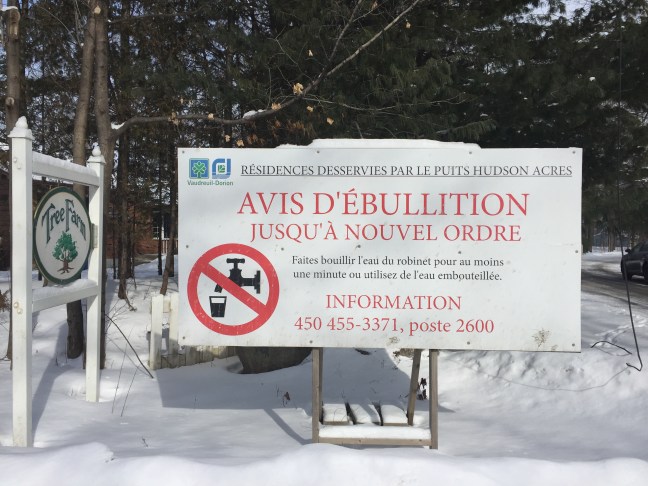
You may be wondering why I begin this with a photo of one of the boil-water advisory signs at the entrance to neighbourhoods along Highway 342 in Vaudreuil-Dorion.

So read on.

One of the reasons I launched this WordPress blog was to give area residents a soapbox, something I’m often told is sorely lacking since the Gazette Vaudreuil-Soulanges ceased publication in October 2014.

The way I see it, my job is to get people talking again, to get ideas flowing again. I don’t see that happening at the municipal level. People can’t be bothered when they conclude their ideas aren’t welcomed or treated with respect. Whether through arrogance or ignorance, this administration has made it clear the only ideas it welcomes are those which dovetail with its own agenda. This is a legitimate approach but it’s hardly participatory democracy.

So it’s humbling to see the depth and breadth of informed comment on the issues I’ve raised on thousandlashes.ca. Hudson may have many faults, but the intelligence, wisdom and collective life experience of its people is not one.

Via this blog, we’ve learned of the work done by previous administrations in key areas of discussion – Brian Grubert and his Agricultural Advisory Committee colleagues on how best to incubate small-scale sustainable agricultural operations, the role of the Town Planning Advisory Committee – an advisory body which recommends, but has no power to dictate to the mayor and council. It is a shame when elected officials can’t find the guts to own up to a decision, instead blaming it on TPAC. As former mayor Liz Corker once told me, “we can ignore TPAC’s recommendations, but if we do it all the time, they’ll get discouraged and quit.” Compared to its neighbours, Hudson is a better place for its activist TPAC and it will be a shame when Mayor Ed Prévost and his council replace it with a hand-picked herd of trained seals.

This is just one of the many changes to come in the days ahead. Some of them are for the better, such as the sale or long-term lease of the town-owned lot at 98 Cameron to a developer. We had long hoped for a multi-unit residential development on this site because it will set the stage for others. The Daousts have expressed interest in a residential development on their works yard across the street and I fervently hope the town can iron out its differences with Josie Pascoe so as to allow her three-storey condo unit to be built at the foot of Cameron. These are all high-quality projects with the ability to bring new consumers to a town sadly lacking in reasons for optimism.

Some readers may recall how I accompanied the MRC delegation to the PMAD hearings at the Canadian Railway Museum in St. Constant. At the time I wrote that we would lose because the greens were on the side of the PMAD’s five-year freeze on all agricultural dezoning off the island. I still think the PMAD is a four-letter word but I think we agree it’s best to densify where services allow. The MAMOT quibble with the town is why dezone more agricultural land when Hudson is making no effort to densify serviced sectors.

So I support densification in the sectors where densification makes sense. I hope the Ellerbecks will re-present their project just west of the ferry. As Brian Grubert and Peter Ratcliffe explain better than I can, this project would have the added benefit of protecting a 50-hectare greenspace in perpetuity. I know this greenspace well, a mix of wetland and old-growth mixed forest, a natural park for future generations.

The town would benefit in other ways. The Ellerbeck development always intended to connect to the Bellevue sewage interceptor, which passes through that greenspace on its way to the treatment plant.  Ellerbeck also undertook to extend a line to take in development on Leger/Oakfield as well as the Willow/Anchorage Inn and adjacent commercial zone. To address Diane Piacente’s concerns about the capacity of Hudson’s sewage and potable water treatment systems, I’m told the sewage treatment plant is operating at approximately half capacity (with 71 per cent of eligible users hooked up). The water treatment plant, as you probably know, was built to precipitate iron and manganese from the water supplied by the town’s three wells because of the impact on pipes and appliances and the propensity for certain bacteria to breed.

While the water filtration plant can handle considerably more volume than it is currently, ultimate capacity depends on backflush water storage and THAT depends on the levels of iron and manganese from the town’s wells. (The more we suck from Bradbury, Wellesley and Viviry wells, the more iron and manganese ions are pulled into the screen at the foot of the well and the more contaminated the water becomes. The water is safe to drink notwithstanding those levels (chlorine can be introduced during the precipitation/decantation process as well as directly at each wellhead) but it becomes an aesthetic issue with homeowners and businesses because of taste, odour and staining issues.

So, next summer and barring record precipitation (hardly a record this winter!) Hudson will once again institute a watering ban. Not because the treatment plant can’t handle it, but because the Town of Hudson needs a new well we can’t afford.

I’ve been writing and saying this again and again, but this time I’ll be making it personal. Mr. Prévost, we don’t need another well that will fail because the demand on it is too great.

We need to start drawing water from the Lake of Two Mountains.

St. Lazare, Rigaud and Vaudreuil-Dorion all have problems supplying adequate drinking water as well as water to fight fires. So ask them whether they’d go in on a project to draw lakewater to supply everyone. Nobody will have to drill another well. Or boil another kettle of water unless they’re making tea.

After journalism

The latest issue of Concordia’s alumni magazine carries a hand-wringing piece about the future of journalism as the university’s J school prepares to celebrate its 40th anniversary. Department chair Brian Gabrial gives us the usual hand jive about the loss of jobs (90 at PostMedia and as the CRTC warned last week, potentially hundreds more in TV newsrooms across the country) and the subsequent “damage to what a democratic society is supposed to be in terms of keeping the public informed.”

Nah. I don’t see a connection between layoffs in mainstream media and “damage to what a democratic society is supposed to be.” The thread of the piece — that there will always be a need for university-trained journalists in the newsrooms of the nation — strikes me as less than honest, albeit understandable in an upbeat vehicle designed to elicit donations.

PostMedia is going down because their apps and websites are obsolete, their content is generic and their weeklies can’t compete. The mountain of debt incurred during the Black, Asper and Godfrey iterations have have stripped value from local franchises; time will tell us whether the shotgun marriage of PostMedia’s broadsheets with the Sun’s lowbrow tabs is the kiss of death. Whether it’s 10 words or three, a boring headline is a boring headline.

What killed Canadian journalism?

– the CRTC, Canadian Association of Broadcasters and the Canadian Broadcast Standards Council. This cozy conclave of colluders has silenced Canada’s talk radio community and turned electronic journalists into whipped curs who dare not leave the pack for fear of breaking a story that might piss someone off. So we get news conferences, talking heads and millisecond bites.

– Industry Canada and the federal Competition Bureau. It began in the late ‘70s with the approval of a Southam/Thomson deal giving each a monopoly in Ottawa and Winnipeg. Ownership concentration and the convergence myth fell prey to waves of disruptive technologies — internet, cable, live streaming, tablets smartphones. Every daily in the country suffered the same agonies at approximately the same time — circulation churn, skyrocketing production and distribution costs and a shrinking wedge of the advertising budget. Newsroom cuts meant the end of zoned editions and hungry young reporters eager to accept the drudgery of municipal council meetings. Less local coverage meant fewer readers.

– Incompetent management. Franchises like La Presse and the Toronto Star will survive on their app platforms because they saw the writing on the wall before everyone else. Others are adjusting.The Globe and Mail has dropped its paywall on access to all but a restricted core of business stories and the New York Times (10 free stories/month) now appears to be offering its twice-daily digests free. Meanwhile, PostMedia squandered millions on apps that don’t offer substantially more than CBC, TVA, CTV and Global. Who failed to understand free access pays in eyeballs? Or have PostMedia web hits/visits dropped that far that nobody dares access the analytics?

We thought the weeklies were immune. That changed in November 2014, when Transcontinental and Quebecor reached agreement on a deal transferring 74 Quebecor weeklies to TC for $75 million. The Competition Bureau approved the deal on the condition that TC put roughly half those papers on the market before closing them and laying off their staff. By my own estimate, maybe a dozen survive, leaving communities throughout Quebec with a single weekly newspaper or none at all.

We were an independent, independently printed but distributed by Quebecor. TC refused to distribute us unless they printed us, something that would be prosecuted in the U.S. under federal racketeering laws. The Competition Bureau didn’t see it that way.

The consequences of Quebec’s weekly implosion? Municipal councils, never known for their democratic ideals, have become emboldened. Transparency, what there was of it, is a thing of the past. Weekly journalists know better than to report on anything that might anger the local power structure and cost their papers advertising or the threat of a boycott. Quebec’s freedom of information laws, the Fédération professionelle des journalistes du Québec and the Quebec Press Council are the only weapons we have. They have no teeth but censure and those they censure usually have no shame.

– Lazy, derivative, unproductive newsrooms. How many times when I was Montreal assignment editor did I hear a CBC reporter tell me ‘there’s no story there’ because it wasn’t a news conference? How many times did I see a reporter checking out a file from the Radio-Canada library and putting together the context for a story before heading out? How many radio/TV/online outlets credited the Globe and Mail’s Cathy Tomlinson for the B.C. shadow-flipping investigation? How many times did I read our stuff in other newspapers and see it on television and be told ‘Jim, it’s diffuse provenance’”?

I’ve worked in daily print as a reporter, editor and manager (Gazette, Star, Montreal Daily News), in television (CBC) and as a talk show barker (CBC, CFCF, Corus) before returning to weekly journalism from whence I sprang. To be be honest, I hired people even if they were J-school grads. As the editor of a small-town weekly, I was looking for the same qualities in my editorial staff that one finds in advertising salespeople — curiosity, inventiveness, perseverance and a refusal to take no for an answer.

Concordia’s journalism school vaunts a handful of successful grads. Here’s a better test of its relevance: how has Concordia’s journalism school evolved in its 40 years? Is it struggling to remain relevant surrounded by dying dinosaurs? Where it should be going from here? How can it redefine itself in terms that don’t include fat jobs in mainstream newsrooms?

Ethnic and cultural community newspapers, radio and television outlets are thriving. Online media — websites, online streaming and social media pages — are evolving as quickly as a Twitter feed. How are they dealing with AI-vs privacy issues? Libel and defamation? Balance and fairness? Sourcing? Political and societal pressure to remain silent or to spin a story? Are we courageous and dispassionate in our exploration of  journalistic integrity, bearing witness, point of view, context?
This is how Concordia’s journalism program should be reinventing itself. Either that or accept a slow death by irrelevance.

Canada to put the boots to ISIS?

We can now remove the question mark.

A week after I was first to post this, the Trudeau government announced it was committing 600 Canadian Special Forces troops to the ground war against ISIS.

According to the terse communiqué, Canada would be withdrawing its CF-18s but two Aurora surveillance planes, two transports and the ancient KC-135 refuelling tanker will remain in-theatre.

That would lead one to ask why would we keep our venerable midair refueller in the Middle East when the Americans have plenty?  I’m guessing when I say the Libs are preparing to back down on bringing the fighters home on the strength of Saturday’s Angus Reid poll.

It found nearly two-thirds of Canadians disagree with Trudeau’s plan to bring them home, with close to half fearing a recall would damage Canada’s international reputation if he follows through.

As for the commitment of boots on the ground, did I miss the debate in Parliament? Are the Trudeau Liberals flipping on yet another election vow? No and yes.


jimduff's avatarthousandlashesdotca

Produced by General Dynamics in Brampton, Ontario, Canada’s Coyote is widely considered to be the best desert fighting vehicle on the market, with the flexibility to serve as forward operating bases, surveillance platforms and airfield defence posts. Canadians worked out the bugs and perfected their use in Afghanistan. The Trudeau Liberals have yet to approve a 100-Coyote sale to the Saudi government. –Military Today photo

U.S. Secretary of State John Kerry, in Quebec City on Friday for a North American Foreign Ministers meeting, came close to confirming something I heard earlier in the week – that Justin Trudeau’s Liberal government is expected to announce it will be committing a significant ground force to the ISIS mission, most likely in northern Iraq.(http://www.cbc.ca/player/play/2682797614)

According to DND sources, 600 Special Forces members are training for the mission although to judge by vague government responses during Question Period, Parliament is being kept in the dark.

“The Government of Canada has…

View original post 460 more words

How the West was lost

For Albertans like Garth Pritchard, it’s simple math.

In 2016-17, Ottawa will transfer $21 billion to Quebec, including $10 billion in equalization payments “due to the limited relative strength of its economy when compared to other provinces.”* The $21 billion works out to $2,521 per Quebecker.

Despite the collapse in oil prices, despite having cut crude production from 3.4 to 2.2 million barrels a day (and much of that produced at a net loss), despite a 7.4% unemployment rate (topping the national rate for the first time since the ‘80s), despite the loss of upwards of 100,000 full-time jobs since September 2014, “Alberta does not qualify for equalization due to the strength of its economy relative to the other provinces.”* Federal transfer payments in 2016-17 per Albertan: $1,366.

Alberta isn’t the only have province; Saskatchewan, B.C. and Newfoundland/Labrador likewise receive $1,366 per citizen because of the relative strength of their economies.

*(You’ll find all this and more on the Ministry of Finance website, http://www.fin.gc.ca/access/fedprov-eng.asp)

Even Ontario gets more per capita — $1,532 — beginning in 2009-10 “due to the limited relative strength of its economy when compared to other provinces.”

What was once a financial tool to overcome regional disparities has become a political boondoggle and a reflection of rural Canada’s impoverishment. New Brunswick will get $3,626 per citizen; Nova Scotia $3,240, the Yukon $24,333, NWT $28,351 and Canada’s transfer-payment winner, Nunavut – $40,364.

Late last week, Trudeau’s damage control team assigned the publicity-hungry PM to pay a visit to Alberta’s NDP premier Rachel Notley. In his pocket was a $250 million EI topup so that laid-off Albertans will get the same benefits and be governed by the same eligibility periods as EI recipients in most of Canada. Nary a word about the transfer-payment structure which created the double standard in the first place, because that would have called into question Alberta’s status as one of Canada’s three remaining ‘have’ provinces.

“Jimmy, $250 million would not start a hundred half-tons!,” Garth roared. “Peanuts! This man is out here embarrassing us!”

Pritchard, a former Montreal Gazette photographer who went on to become one of this country’s greatest battlefield documentarists, blames PostMedia mergers for the demise of journalism. The Calgary Herald and Sun are operating out of Sun offices, leaving the city-block-sized Herald building to the ghosts of Calgary’s outspoken past, like Robert Chambers Edwards and Ralph Klein. “The same in Edmonton…we have no media.

“Today we have the prime minister of Canada standing beside the premier of the province and it’s quite obvious the media has no idea what’s going on and they’re asking childish questions. The question needed to be asked today while they were both there: “Is it a fact that Quebec got $9.8 billion in transfer payments last year?”  Because the real people, not in the political bubble and certainly not in the journalistic bubble, they’re all looking at each other because it’s so obvious.”

Pritchard credits the CBC’s Rick Mercer with making Albertans aware of the double standard. “A week ago on his program…spoke harshly about Quebec’s greed. And he’s the one who put out the $9.8 billion transfer payment from Alberta to Quebec.”

Technically, Quebec’s equalization payout doesn’t come directly from Albertan pockets, but it may as well as far as Albertans are concerned. “In rural Alberta that’s all they’re talking about…thousands and thousands of laid-off Albertans. And these were good-paying jobs. When an oil rig is decommissioned, 14 people directly involved with that rig are out of work. The lowest-paid guy is probably making $200 a day. The top-paying guy on that rig, the rig manager, is probably making $1,000-$1,200 a day, plus per diem plus expenses.”

Another harsh realization: U.S. companies, once bullish on the Alberta oil patch when crude was topping $100 a barrel, are treating Canada as a Third-World country, another dispensable link in their supply chain. Year after year, the Americans have been buying up Canada with the complete support of our government. Now that oil is down to $30 a barrel, they’re firing. “Anyway, Alberta’s not getting $32 or $30 a barrel,” Pritch adds.  “We’re getting $17. Who made this deal?”

The deaths of the Keystone XL and Northern Gateway projects and the Liberal government’s vow to raise the bar for approval of the Energy East project are triggering a tsunami of pessimism sweeping a province with a history of booms and busts. Many of the thousands who moved to Alberta’s’s streets of gold for the oil boom are either headed back home or trying to get out from under a mountain of debt now that their properties are underwater. A piece in last week’s Globe and Mail included a number that even the math-challenged can grasp: for every U-Haul driving into Alberta, seven are heading out.

“If you’re an oil man in management, you’re gone,” Pritchard says. “ If you’re on an oil rig your job is gone. And the PM shows up with peanuts in his pocket. And our premier, you should have seen her. This pretty boy beside me, isn’t he beautiful, love was in her eyes. No hard questions, nothing from the Alberta government about what we want.”

Albertans are seeing themselves being reduced to beggars and it’s not going down well. “The question on everybody’s lips: what is this transfer payment all about?” Garth tried to put the question to his MP for Bow River, without success. “He has had the Nepean lobotomy,” a repeat of how how quickly Preston Manning’s Reform MPs ignored Western concerns once they’d stormed the gates of Babylon.

Invariably, Alberta’s anger is focused eastward. Rick Mercer’s retort to Montreal mayor Denis Coderre’s outright rejection of TransCanada’s million-barrel-a-day pipeline to St. John, N.B. was what it took to remind Albertans of the unfairness of the Canadian equalization payment deal. Trudeau’s Liberals will doubtless try to sweeten the pot but the damage has been done. Petitions are circulating demanding Notley’s impeachment. The mayors of Calgary and Edmonton are suddenly silent, caught between their constituents and federal politicians warning them to stay out of interprovincial squabbles. Everywhere, Albertans are talking about betrayal, humiliation and separation – an eerie echo of 1995 Quebec.

Whatever happens, Canadians can be sure of one thing — in Alberta, the discussion of transfer payments is no longer confined to politicians. That and the folly of looking at Justin Trudeau with love in your eyes.

Quebec Inc.’s new reality

Whether it’s PKP coming clean on offshore tax havens or Rona’s inevitable takeover by Lowe’s, the myth once known as Québec Inc. is being debunked by market realities.

Take Bombardier, once the jewel in Quebec’s treasury of entrepreneurial successes. On Friday, shares closed at 80 cents after falling 8% on news the Trudeau Liberals are prepared to finance the struggling aircraft builder on the condition that the Bombardier-Beaudoin family agrees to a modification of its shareholder agreement.

It would end the family’s ability to control the firm without majority ownership by means of a class of shares conferring multiple votes.

Such a demand never would have been possible in the days of Jean Chrétien but times and allegiances have changed, so it falls to the family to decide whether they’ll risk everything by refusing or diluting their control by accepting Ottawa’s terms for a bailout loan.

On the one hand, the Couillard government set the precedent for an unconditional financial rescue last year. The Quebec Liberals came under withering criticism, especially in light of the Caisse de dépôt’s demands in taking an equity position in Bombardier Rail.


On the other hand, we’re beginning to see daylight for Bombardier’s CSeries single-corridor passenger jets, what with emerging markets looking to acquire new fleets. It would be a pity for Bombardier to collapse on that threshold.

One hopes the family will recognize this as an offer they can’t refuse. The old rules of governance are being replaced. One doesn’t need to see the writing on the wall to get that.