In search of wilderness

Approaching Carillon Island from the south: a late-season overnight camping cruise reveals the wetland wilderness half a day’s journey from Hudson’s Jack Layton Park boat launch.

Earlier this week I took my boat upriver on a late-season camping trip to the islands, bays and wild spaces below the Carillon hydro dam. I began these forays when I was in my teens, drawn by the pull of wetland wilderness. I would make camp on one of the sandbars and beaches.

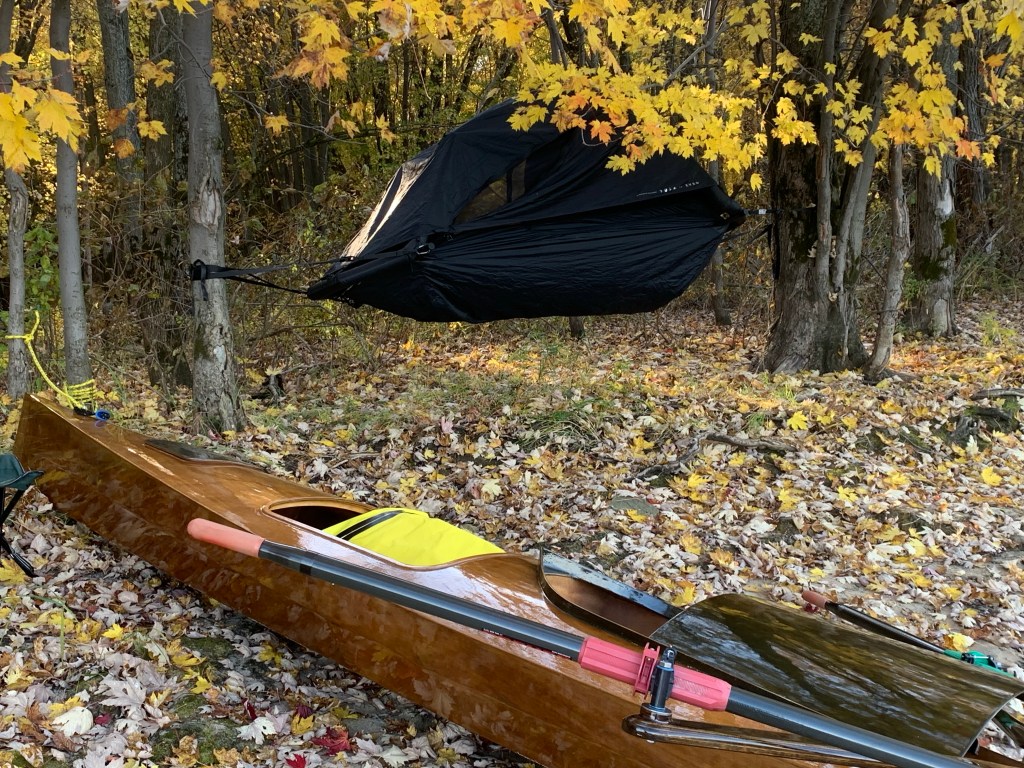
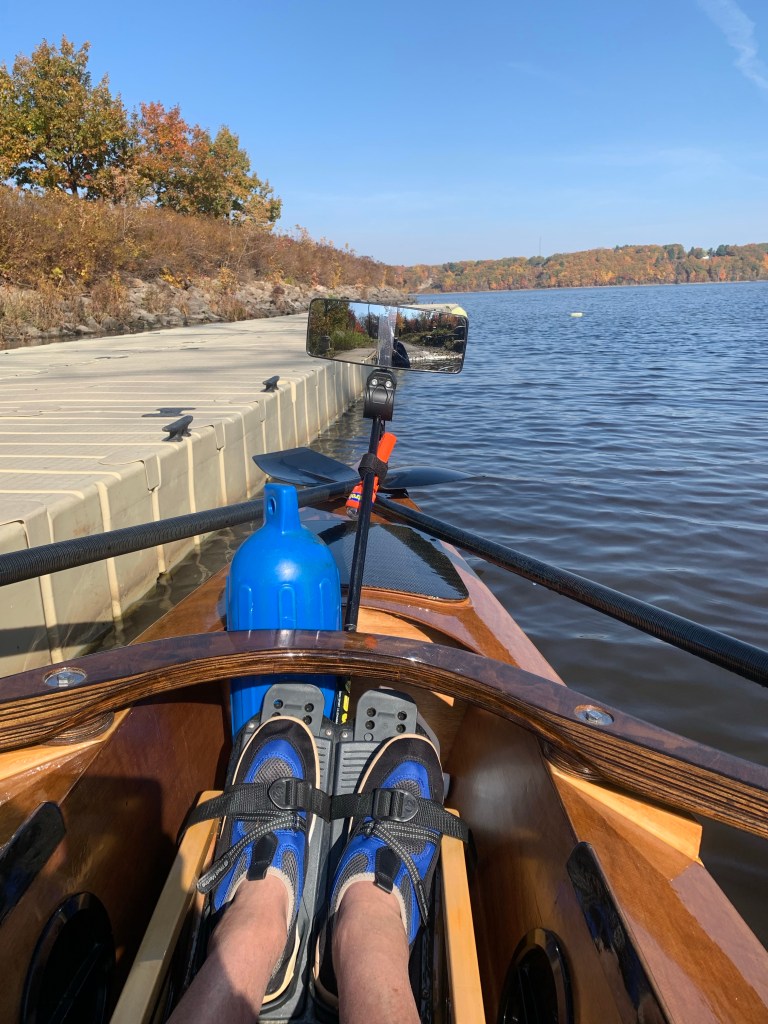
In late October, the only boats on the water are the fisherfolk and my 18-foot Angus Expedition, a rough-water sliding-seat rowboat designed by B.C.’s Colin and Julie Angus. In the hold are my tent hammock, sleeping bag, cooking gear, food and water, plus extra kit in case of a turn in the weather. In my lifejacket I carry a handheld VHF radio (the fisherfolk always have their ears on), strobe, cellphone (music!) and survival basics. As Coast Guard rescue jumpers put it, if you’re not wearing it you don’t have it.

Louise pushed me off from the Jack Layton Park dock before 8 a.m. The forecast was sunny and breezy, with winds from the southwest between 20 and 40 km/hr., so I hugged the Hudson and Rigaud shorelines to take advantage of the shelter they provided from the wind. Waterfront mansions gave way to modest cottages, many raised or on stilts after the epic 2017 and 2019 floods.

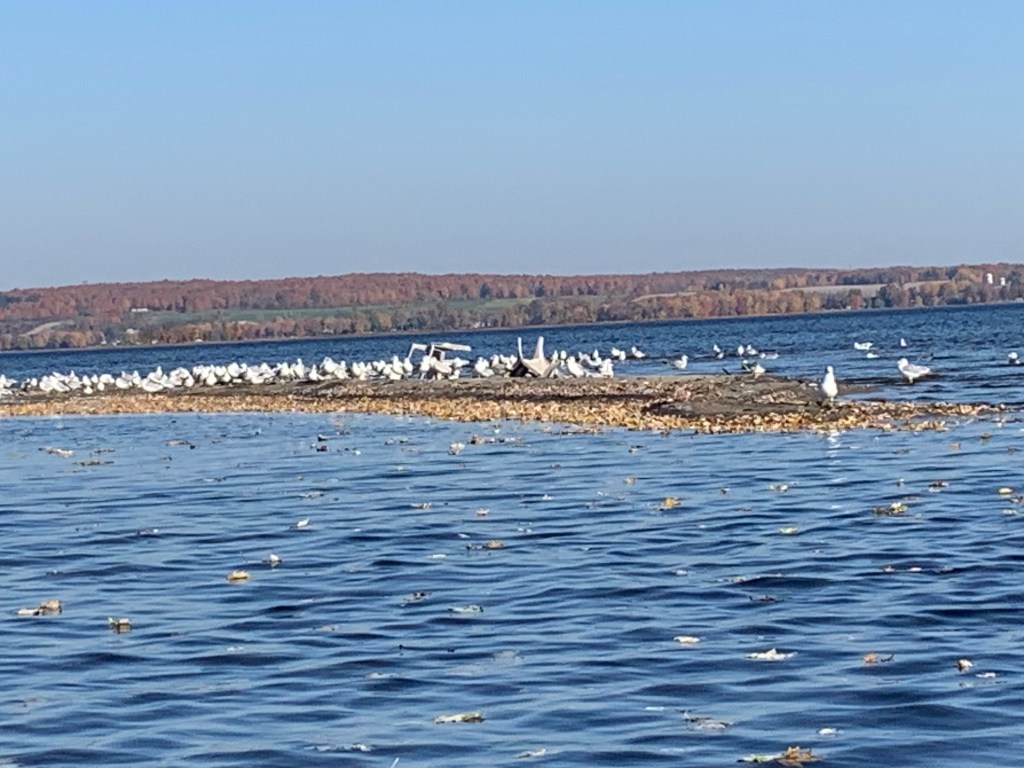
Gulls have taken over the sandbar at the mouth of the Raquette River. Four years ago, this was a shorebird hangout

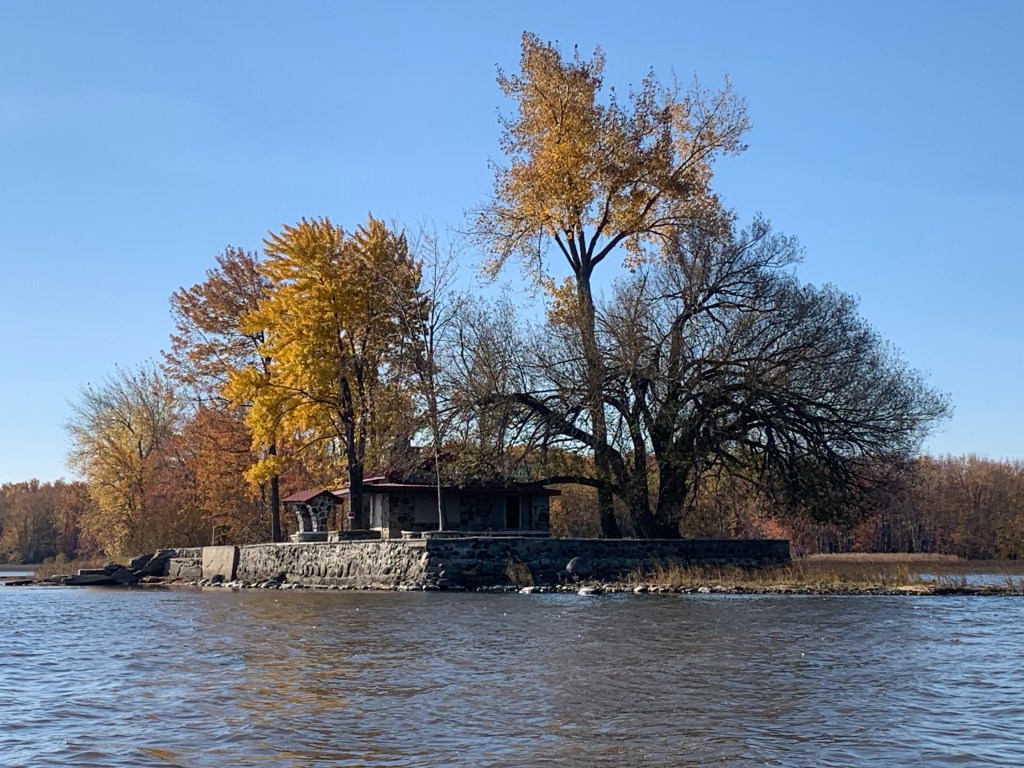
The Raquette estuary marks the division between civilization and wilderness. The gulls have now taken over the sandbar since my last visit in 2020; they sounded a raucous alarm as I rowed past. Around the next promentory was a surprise — a quiet bay, bisected by a manmade peninsula and at its end, a stone cottage, clearly predating environment ministry edicts about what one can and can’t do in a floodplain. It’s boarded up for the season but in good repair. I can understand why someone would want that view, across the Lake of Two Mountains to the westernmost mount the Mohawks believe is sacred.

Stone cottage on the Rigaud side evokes the golden age.

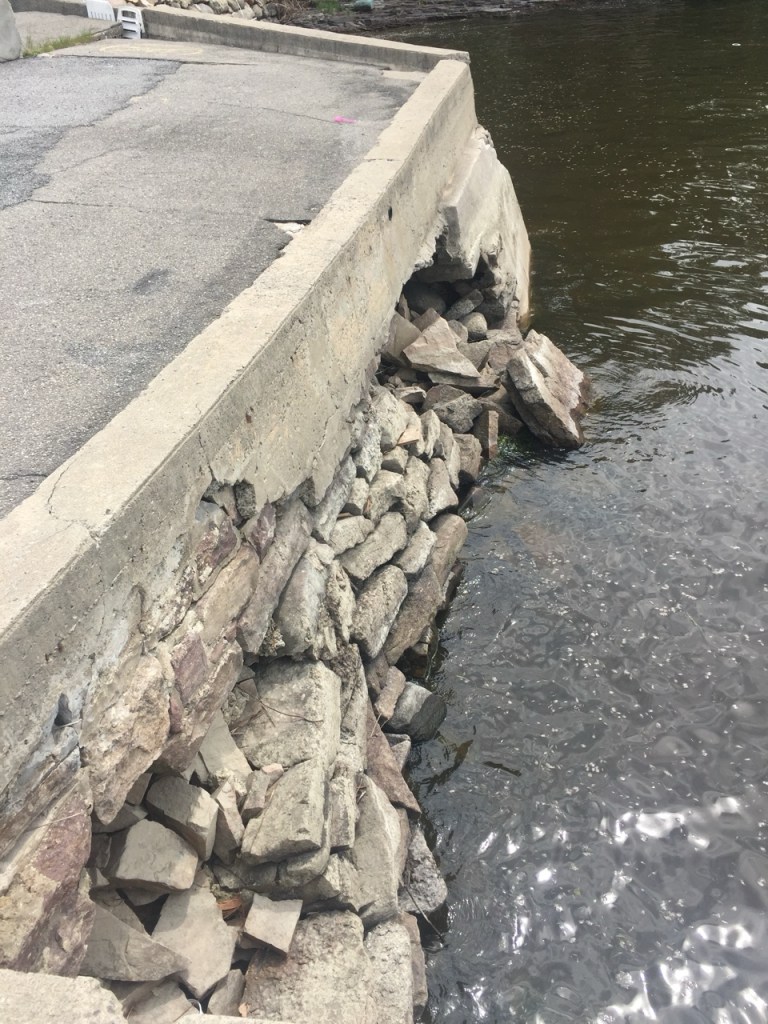
I continued upriver, past Rigaud’s Grand Quai, clusters of waterfront homes where residents continue their struggle against the river and the environment ministry’s latest floodplain map. Many are either raised or armoured against flood-borne ice with breakwaters. The goal is finding ways to prevent Quebec from justifying demolition of one’s home if it is seriously damaged in the next flood.

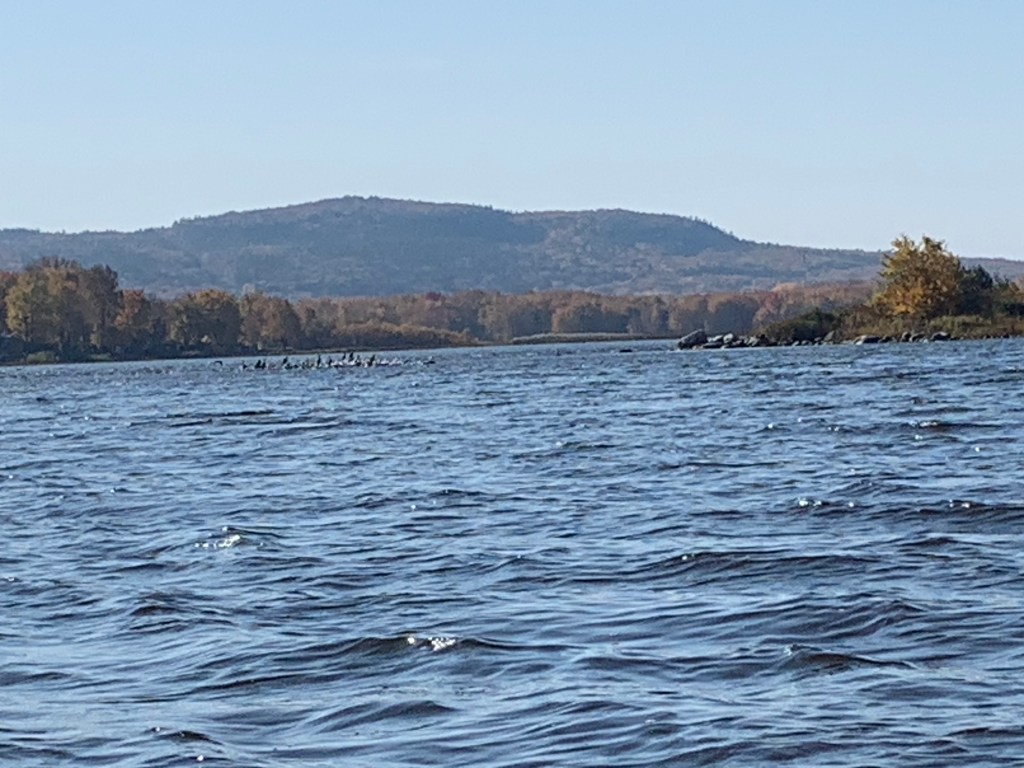
Four hours after pushing off from the JLP dock, I rounded the corner at the upper end of Carillon Island. This marks the junction of three rivers where the fluorescent yellow Rigaud and the polluted North River both discharge into the Ottawa, relatively clear after its trip through Hydro Quebec’s turbines.

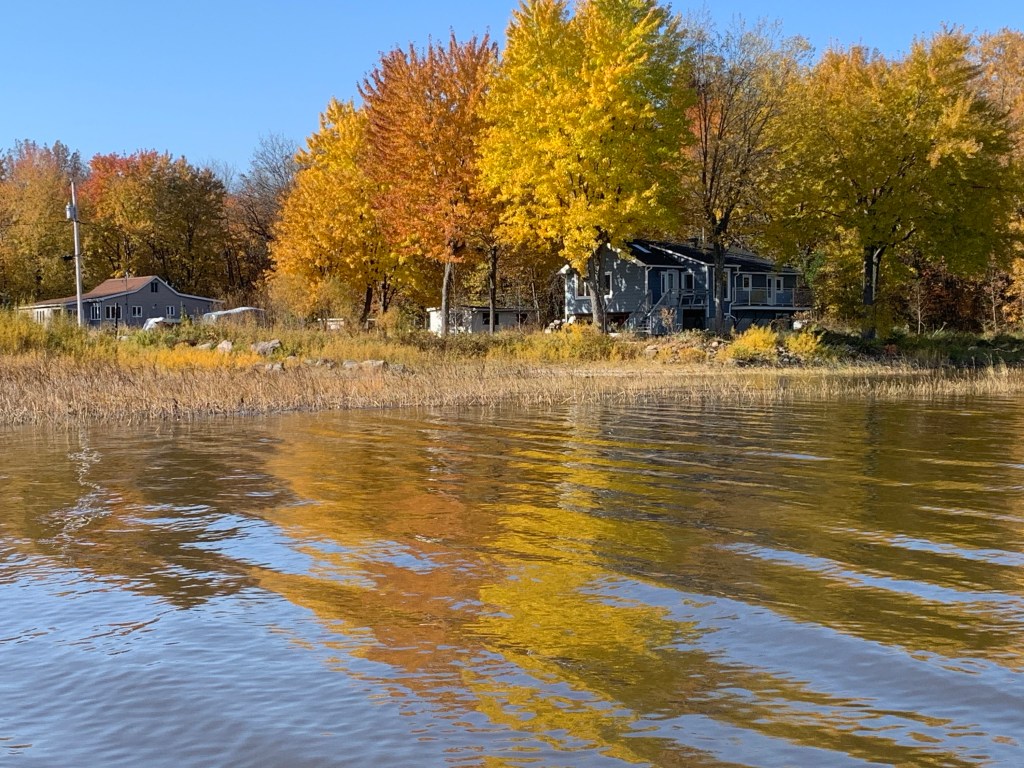
Waterfront homes: floodproofing measures are underway in earnest as Quebec looks to rewild vulnerable sectors.

Ten kilometres long, less than a kilometre at its widest, Carillon Island has three faces. The south side is a primal forest of trees in riotous fall colours. There’s no evidence of human habitation.It’s another story on the north side, where well-kept summer chalets are perched well above the highest floodline and rough-hewn shanties taking their chances. There’s an underwater electrical cable to the island, so I suppose one could live here year-round.

Mont Rigaud from the northeast: Rigaud and North rivers feed into the Ottawa from both sides.

Emergency access is the dealbreaker. There’s an old concrete dock, but no indication it’s still in use. In the four months between freezeup and thaw, access by water isn’t possible. In the 19th century, inhabitants risked their lives crossing the ice to Terrasse Robillard on the north side or to Rigaud Bay to the southwest. With the advent of warmer winters and thinner ice, I’m not sure it’s any different with snowmobiles and ATVs.

My destination for the night — Carillon Island’s migratory bird sanctuary at the eastern end of the island. It’s a kilometre from the closest habitation, with an ATV track to the main beach and a collection of broken chairs and fire rings where the summer folk party. I found a cozy cove a fair distance from partyville where I could pull Gus well up on the beach and pitch my tent hammock five feet away. Perfect — as long as one can live with the avian party going on.

Gus pulled well up on the beach 10 feet from my Exod Monolith tent hammock: minimizing impact on a sensitive wetland.

Every year at this time, massive flocks of Canada geese, ducks and other wildfowl home in on Horseshoe and Carillon bays. Late into the night, one is treated to the sound of excited birds welcoming their relatives at they fly in long past dark. After sunup, they spread out to fatten up on acres of ripe duck corn for the next leg of their migration.

Sundown was blessedly bug-free but the October chill brought out a puffer jacket as I heated up Louise’s chili. After 25 kilometres of rowing against a headwind, I was ready for my sleeping bag before 8 p.m.

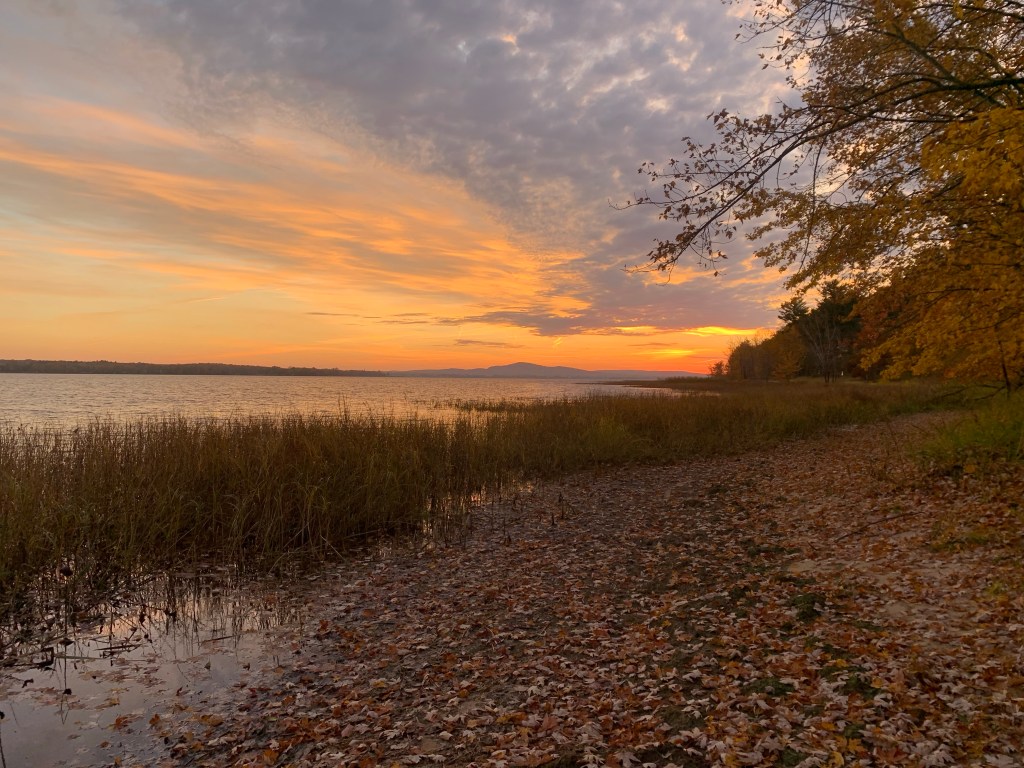
Predawn on Carillon Island looking east: a four-hour row back to JLP.

Morning brought another surprise. Overnight, the wind had shifted 180 degrees. Now it was out of the northeast, straight into my face on the row back to Hudson. Wind against current equals shorter, steeper waves. I girded for the pull with oatmeal, homemade beef jerky and a pot of strong coffee before loading everything into Gus and pushing off. 

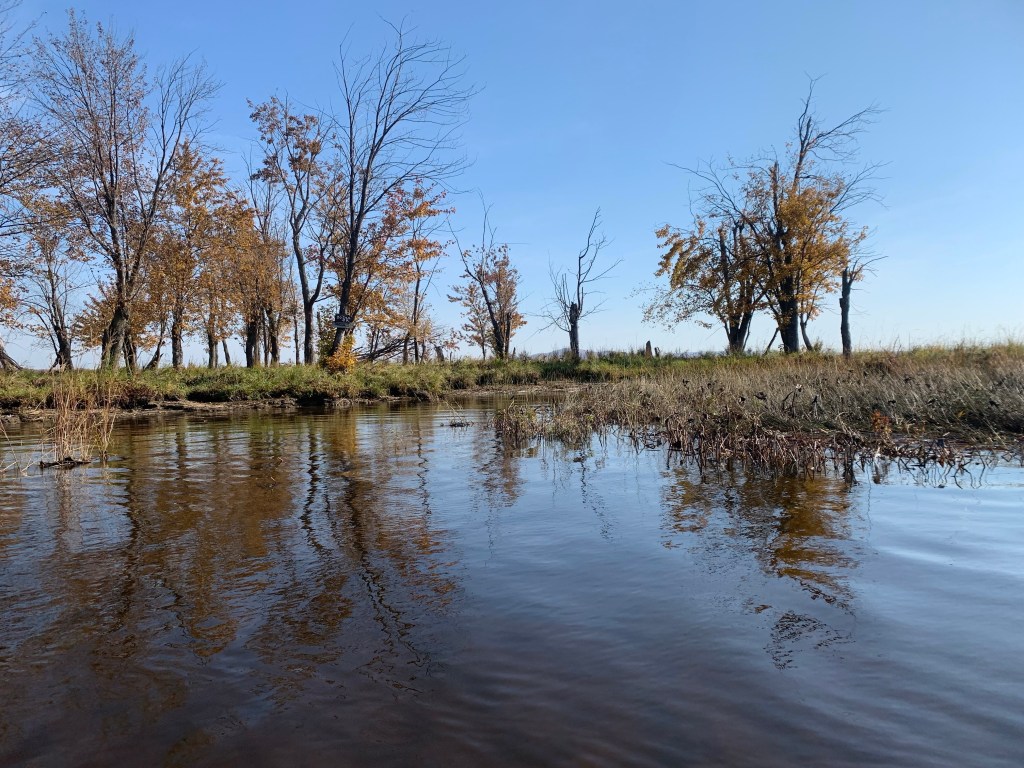
Pelley Island trees are pruned into grotesque shapes by spring ice buildup

In a small boat, one looks to minimize the effects of wind and wave, which meant following the line of weedy sandbars and islets stretching from the foot of Carillon Island through the Pelleys to Hay Island, then across the south channel to Graham Island, a rocky outcrop off Hudson’s Rousseau St. Four hours and 22 kilometres after starting out, I pulled up to the JLP dock where Louise was waiting to stand watch on Gus while I went home to get the trailer.

Back at the JLP dock at the end of a beautiful two days in a wetland wilderness.

°°°°°°

This isn’t everyone’s idea of a good time. A good boat and equipment are prerequisites, plus It’s a fair amount of work. The payback is a winter’s worth of memories — the sight of a massive orange hunter’s moon rising above the sacred mountain, the indescribable emotion of being far from civilization yet close to home. Even the sound of excited geese.

As this world grows crazier and less hospitable, short escapes to wild places will grow in importance. By all means, write and enforce rules needed to protect them from overcrowding and vandalism, but don’t put them beyond the reach of those without the means.

24 hours to react

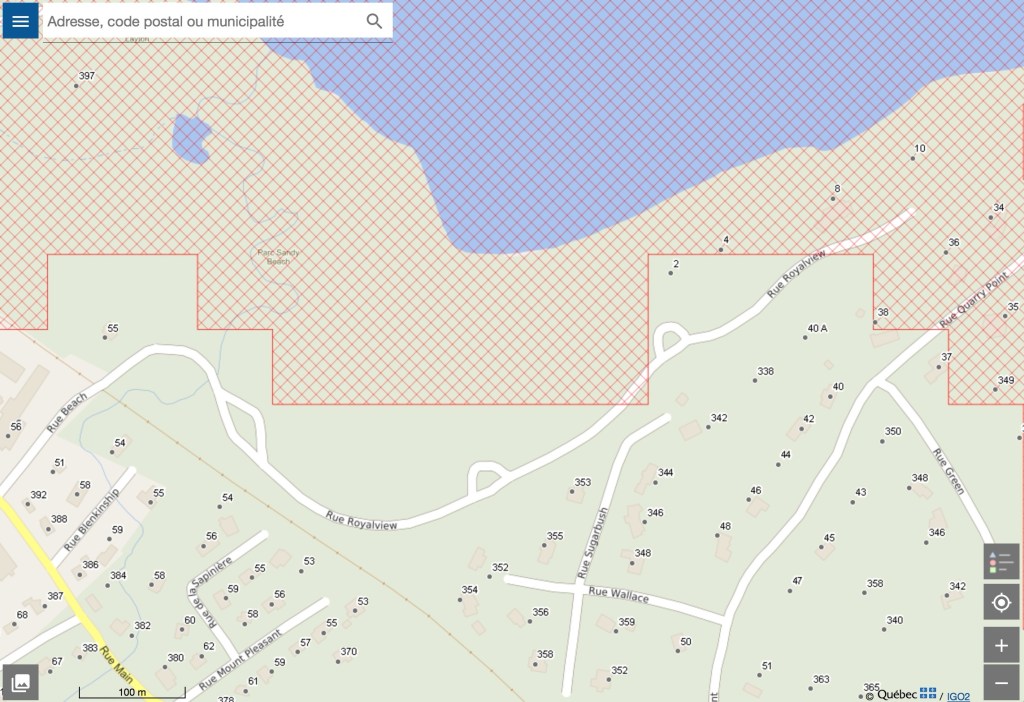
Irony of ironies: Quebec environment ministry’s revised floodplain map for Hudson will impact some 250 property owners whose homes may no
longer be rebuildable or insurable — but it does not include the slice of Sandy Beach adjacent to Beach Road.

Shocking news in this morning’s La Presse: thousands of Quebec residents have 24 hours to learn whether their homes are included in the government’s latest government floodplain maps.

“Their houses will be worth nothing,” a clearly perturbed Vaudreuil-Dorion mayor Guy Pilon tells La Presse’s team. Almost 2,000 homes in Pilon’s city are included in the environment ministry’s revised charts. Schools, seniors residences and the city’s water filtration and wastewater treatment facilities are included in Quebec’s new 350-year flood zones.

What’s especially disturbing is how Environment Minister Benoît Charette unveiled the changes in June without releasing the interactive website geoinondations.gouv.qc.ca which allows every municipality and residents to see for themselves who will be affected before the end of the public consultation process.

That process runs out on Thursday, Oct. 17, 2024 — tomorrow. 

The Montreal Metropolitan Community, which represents 82 Greater Montreal cities and towns, put together their own interactive map showing who in the MMC would be affected, but appears to have done little to alert member municipalities of the extent of the impact on their residents.

For the average resident, neither interactive map is user friendly. However, the geoinondations.gouv.qc.ca application includes civic addresses, which allows the user to get a feel for the number of people whose lives will be impacted — and to see who’s in the new red zone.

Hudson hit hard

The Town of Hudson risks losing several hundred millions in property values, depending on whether the structures affected can be insured, mortgaged or sold. Given the disproportionate worth of lakefront properties, the town’s $2.2 billion valuation roll will almost certainly take a hit.

Starting with 896 Main at the foot of Montée Lavigne, some 250 properties fall either partly or totally within Quebec’s new red zone. All but a handful were untouched by the 2017 and 2019 floods. They include mansions (the multimillion-dollar structure at 814 Main falls partly into the red zone) and cottages as well as most of the town’s sewage treatment facilities, the Hudson/Oka ferry and landmarks like the Hudson Yacht Club, Willow Inn, Greenwood and sections of Main Road itself. 

Entire neighbourhoods may lose the right to build, rebuild or be compensated for future losses, including Hodgsonville and all but two homes on Quarry Point. While structures of the south side of Main Road are generally spared, the red zone reaches far inland along wetlands in the east and west ends.

Ultimate irony: most of Sandy Beach along Beach Road is on high ground, well above the new high-water mark.

Climate change

Why is François Legault’s CAQ government resorting to these draconian measures? Quebec hopes to avoid having to compensate residents and municipalities for damages incurred as the result of rapidly changing climatic conditions. The torrential rains from Hurricane Debbie were a wakeup call for municipalities far from major bodies of water and resulted in cities and towns rushing to revise their urban planning bylaws in response to pressure from the insurance industry.

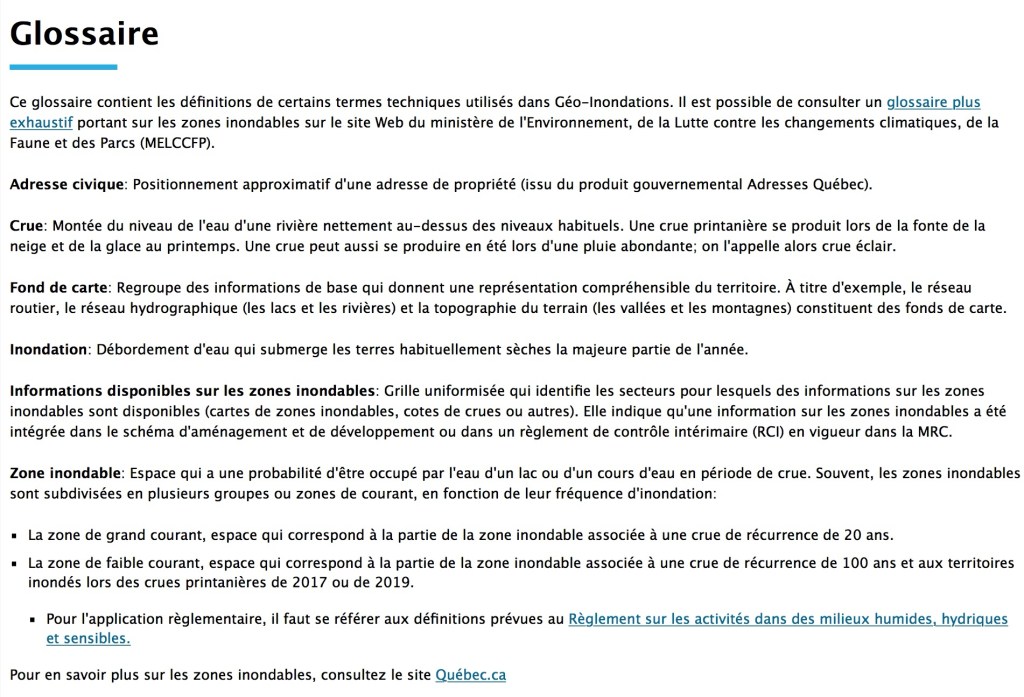
Glossary from geoinondations interactive map: Quebec wants out of paying compensation for climate change fallout.

Villa Wyman abandoned

Villa Wyman’s last parking proposal would satisfy both neighbours and town bylaws. So why did council vote to reject it?

Eight years in the planning, an 18-unit assisted-living facility in Hudson’s downtown sector is being withdrawn by its backers following council’s rejection of a proposed parking modification.

Although the Villa Wyman project was approved by council a year ago (Nov. 7/22), the configuration of parking spaces on the enclaved lot proved to be the devil in the details. 

According to Hudson mayor Chloe Hutchison, the project’s promoters could not reach agreement with its neighbours on the layout of the parking area shared with the former Wyman Memorial United Church, now a Sikh temple. 

At its December meeting, council voted to reject Villa Wyman’s request to modify the approved project to satisfy both its neighbours and the town’s bylaws. Council’s rejection was based on the lack of landscaping and vegetation on a parking lot that has existed in its current form since the church was built in 1909.

Council’s refusal to grant Villa Wyman a derogation of less than three feet was the last straw for Villa Wyman’s volunteer board.

 “Our Board of Directors […] decided on Thursday by resolution to abandon the project,” founding member Diane Ratcliffe told me Saturday. “If [this council] had wanted to wear us down, they’ve succeeded.”

The project’s financial backers, including Soulanges MNA Marilyne Picard, Vaudreuil-Soulanges MP Peter Schieke and the Town of Hudson will have received an email advising them of the board’s intent to terminate the endeavour, Ratcliffe added.

 The board’s decision triggers the lengthy process of unwinding years of work, beginning with the hiring of a professional evaluator early in the new year. The property — with a 2020 evaluation of $3,296,672 — will be listed for sale and close to $7 million in funding from the federal and provincial housing programs will be returned. Hudson’s only financial exposure is in the form of a 10-year tax holiday, representing $23,661 annually.

At some point in this process, the Town of Hudson is expected to file a preemptive reserve on the property. At the August 2023 council meeting, the mayor included “the Wyman Memorial parking lot where Villa Wyman is to be built” in a list of properties eligible for a pre-emptive reserve.

Adopted at that same meeting, Bylaw 762 enables the municipality to freeze the transfer of designated lots for up to 10 years while an expropriation tribunal determines its market value. (Companion legislation currently before the National Assembly would allow a municipality change zoning to lower a property’s market value.)

Ratcliffe questions the motives of the current council, which twice rejected approval of plans for the structure (in June and October 2022) before conditionally approving them in November. 

“Consistently, every single time, council would tell us to go back and redo the plans. They have not shown any good will. There has been zero co-operation…if you don’t have the support of the town, you won’t succeed.” 

She also wonders whether the temple’s executive has its own agenda for refusing to agree to a servitude in a shared parking lot when Villa Wyman already has 22 parking spaces, whereas the bylaws require 15. “At first they were very agreeable to a servitude, but after months of chasing after them to make it official, they said no.” 

Could it be that the temple hopes to buy the entire site for parking after the town refused to allow them to pave over the greenspace  at the corner of Main and Selkirk? Ratcliffe asks the question, but doesn’t expect an answer to this or any queries about council’s agenda.

After years living in Hudson, she and her husband Peter moved to Kingston to be closer to their daughter, son-in-law and grandchildren. Their son James, a Hudson volunteer firefighter, died in a nautical training accident June 7, 2005.

Sandy Beach: Nature gets a break

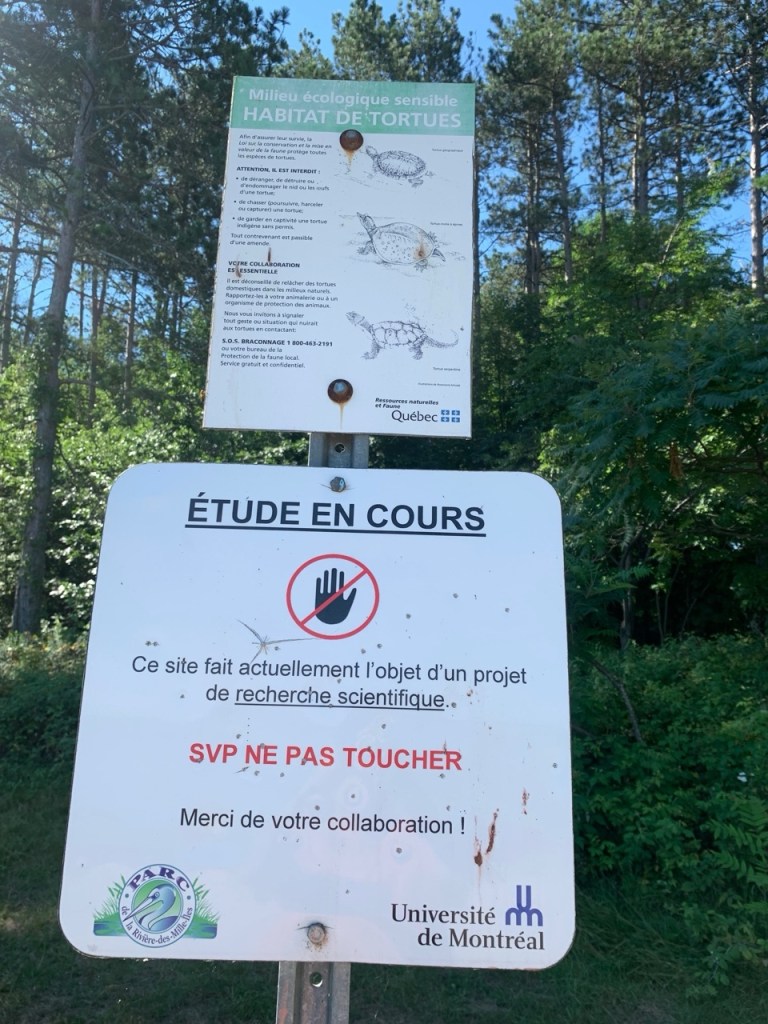
A map turtle sunning itself Saturday in a pond which drains into the Viviry. Give them peace and they’ll return to the Viviry estuary.

First, the good news in the latest twist in Hudson’s Sandy Beach saga — flora and fauna will get a much-needed break from years of public traffic and environmental degradation.

On Friday, the Town of Hudson announced the beach and access trails will be off limits until further notice as the administration considers its options. 

“The trails leading to the beach are currently on private property and are no longer accessible to the public,” the town posted on its Facebook page. “The [town] must now assess all possible scenarios to provide access to the beach in full compliance with government standards.”

The bad news? Access to the beach will be closed for at least the next year and possibly forever, depending on whether Quebec’s notoriously fickle environment ministry approves an alternative access trail in an ecologically fragile conservation zone. 

Wasn’t the current council elected on a promise to protect the environment, especially Sandy Beach? 

 At Monday’s May meeting, council will begin the long process with votes on modifications to existing parking and park-use bylaws. For residents, it’s the first opportunity to ask for details on how much of Sandy Beach Nature Park will remain accessible and where or how beach access will be blocked. Will the Town barricade the western end of the footbridge or will pedestrians be able to cross to connect with the entrance off Beach? Will the summer daytime dog ban remain in effect?

A key question is who will shoulder the cost of enforcing the no-parking rule on Beach road or policing the beach for trespassers. Another is the status of Beach road itself. Residents living on Royalview, a cul-de-sac at the far end of Beach, have a servitude to travel on it, but the stretch between Royalview and the exo right-of-way remains private and belongs to the developers. A recent request by Royalview residents to have their street revert to private was refused by the town because their lots weren’t buildable unless they faced on a public road — an MRC requirement.

UPDATE: responding to questions at last night’s meeting, Mayor Hutchison confirmed the town would shoulder the costs of policing Sandy Beach and enforcing a parking ban on Beach road. The town’s concern is that the 2017 development agreement includes clauses giving the landowner grounds to invalidate the beach servitude in the case of non-compliance

Residents requesting a copy of the 2017 agreement will need to file an Access to Information request and may receive a redacted version, the mayor told citizens.

In response to questions on where citizens will have legal access, the mayor said no-trespassing signage has been ordered but gave no further details.

A post on the Town’s website provides some insight into the elaborate approval process required to reopen the beach, beginning with the hiring of SAGIE Inc., an environmental consultant the Town has used in past dealings with the environment ministry.

It quotes SAGIE’s Gérald Renaud: “the area targeted by the project to relocate a section of the Sandy Beach trail is a riparian area of the Outaouais River subject to regulation by the Ministry of the Environment, Climate Change, Wildlife, and Parks. This control involves a study of the ecological characteristics (fauna, flora, and habitat) and water characteristics (coastline, shoreline, and flood zone), which will make it possible to establish whether the project needs to be submitted to the Ministry for authorization.” 

Only once the ministry’s approval has been confirmed can the town award a contract for a proposed access trail. “It is currently impossible to put forward a date for the reopening of the beach, as the Town does not control the deadlines for the stages that are the responsibility of other partners,” the town post reads.

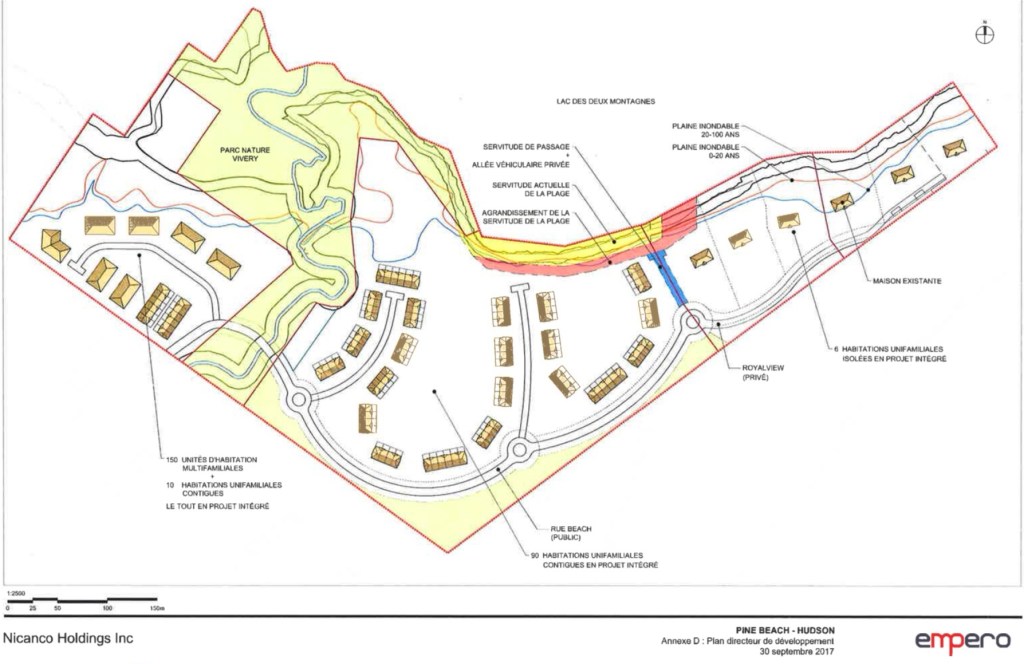
The area in light yellow is the land Nicanco deeded to the town as part of the 2017 development agreement. The darker yellow is the beach servitude and the orange is land the developer proposed to add. How much of this deal will be rolled back?

The easiest fix

The obvious solution is a waterfront trail or boardwalk between town-owned land and the beach, running parallel to the existing trail, which passes on the developers’ land. But for that to happen, the town will need a new certificate of authorization (CA) from the environment ministry for a legal walking path and the prep work that goes with it. 

The new path to the beach would pass along the waterfront of Lot # 3080946, the 10-acre parcel which Nicanco ceded to the town in a 2017 development agreement with the outgoing Prévost administration. This stretch of town property touches the beach servitude, but there’s no current CA for a trail.

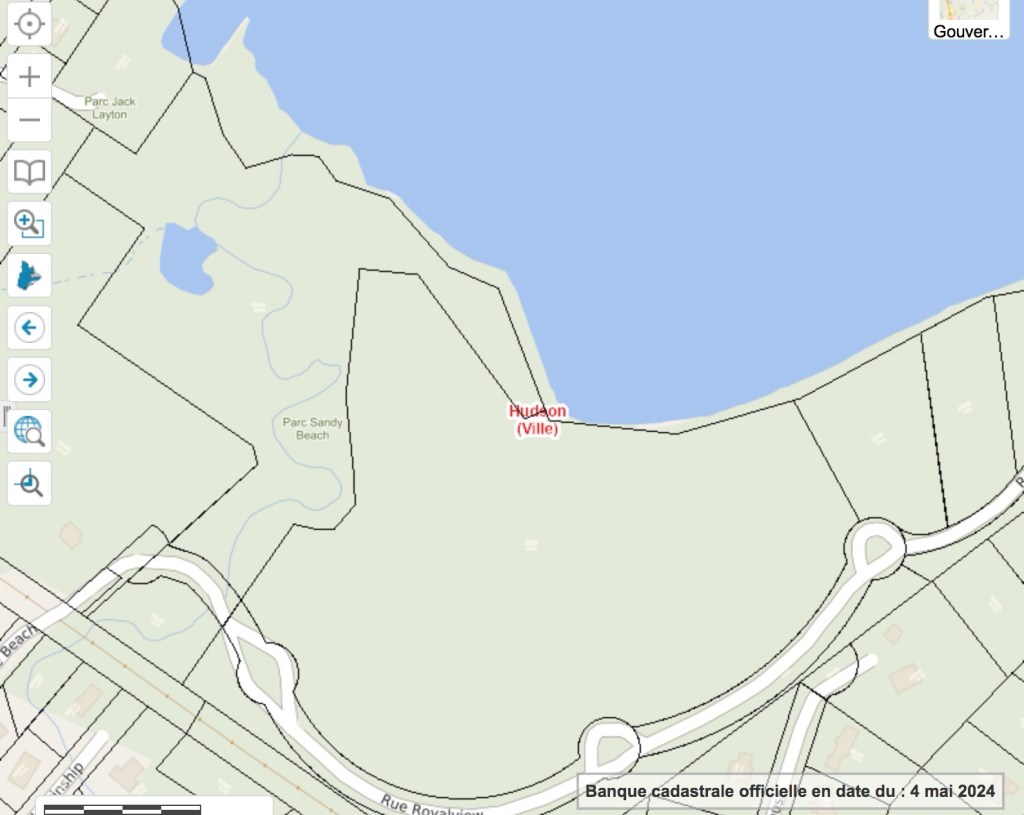
Infolot map shows the narrow ‘beak’ of town-owned land touching the beach servitude. The town needs permission from the environment ministry to create a trail to connect to the beach.

“If you go to the infolot website, and search for lot 3080946, this is the lot Nicanco ceded to the town,” explains someone familiar with the file. “You will notice a beak-like extension at the top right. The beak’s easternmost (right-most) limit is exactly where the beach servitude begins.”

The current walking path runs on Nicanco’s lot # 3080948, just below the beak-like extension. “So to get to the beach (unless one trespasses) the town needs to create a path through the “beak”. This will require a CA, and everything that goes into preparing said CA. Perhaps the current council is prepared to go for eco-compensation should any flora or fauna needs protection.”

My source predicts this will take many months, if not years to negotiate with the help of consultants, possibly putting taxpayers on the hook for ecological compensation.

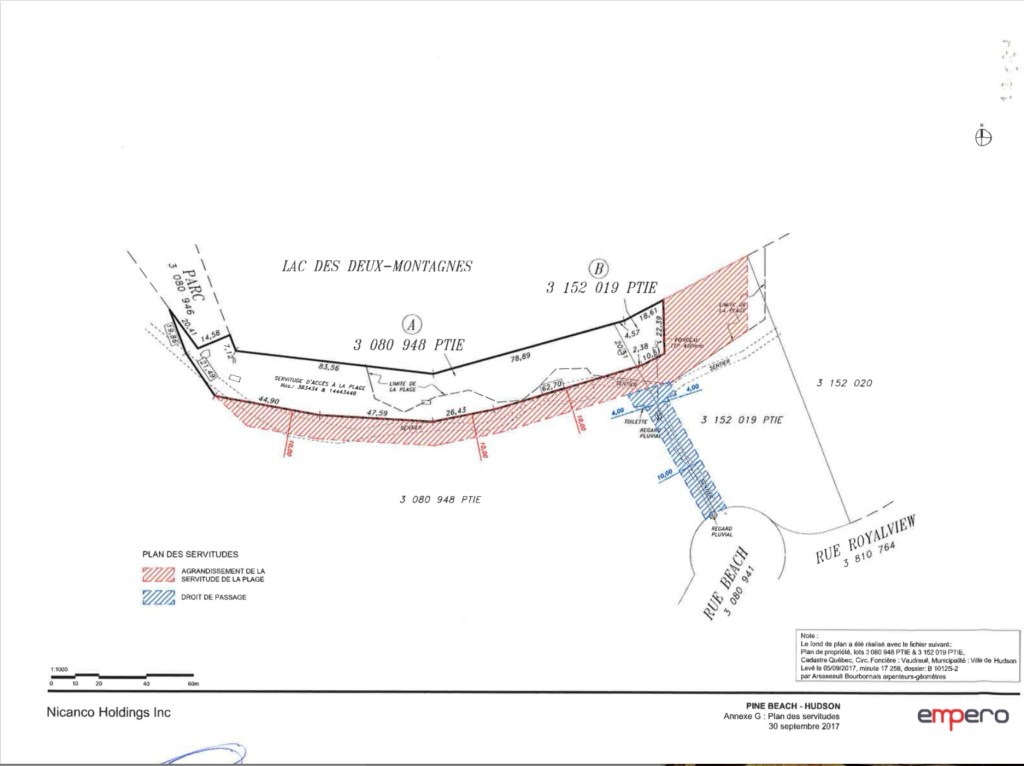
The beach servitude as delineated in the 2017 Nicanco-Hudson development agreement. Assume the access servitude (in blue) has already been nullified. How much more of the agreement will be rolled back as the sides continue their feud?

The biggest unknown is how much further the Hudson-Nicanco deal will unravel. Although a land transfer isn’t reversible in law, Nicanco could argue that the 20 plus years of covenants creating Sandy Beach Nature Park and the beach servitude were part of an overall agreement, now in pieces as the result of a cascade of events.

Because of the current council’s fixation on blocking Sandy Beach development, Hudson residents may never regain access to the town’s one public beach. The only glimmer of hope is that the environment they vowed to protect may actually be protected. At least for a year.

To what end?

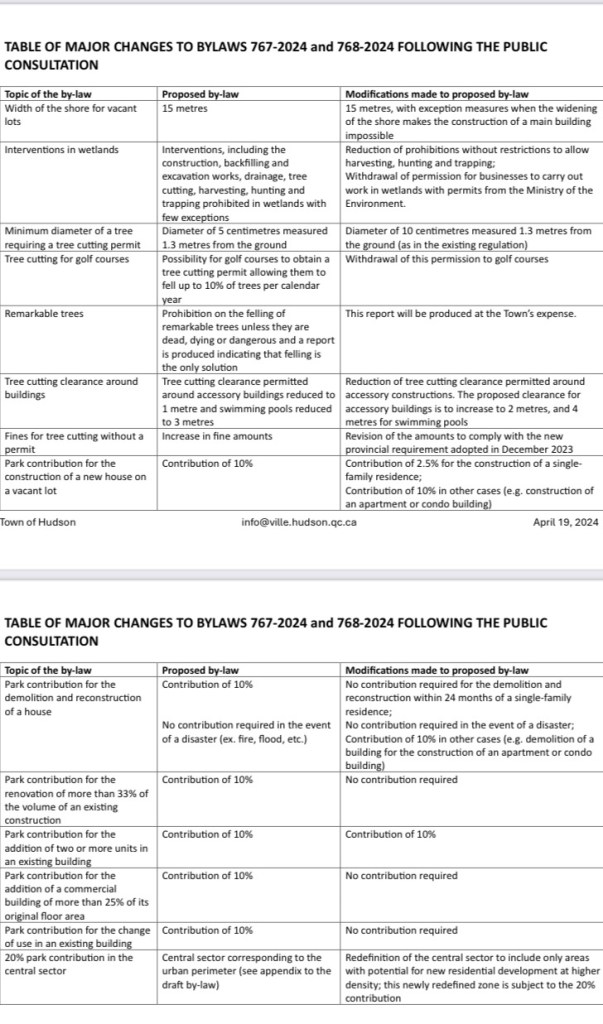
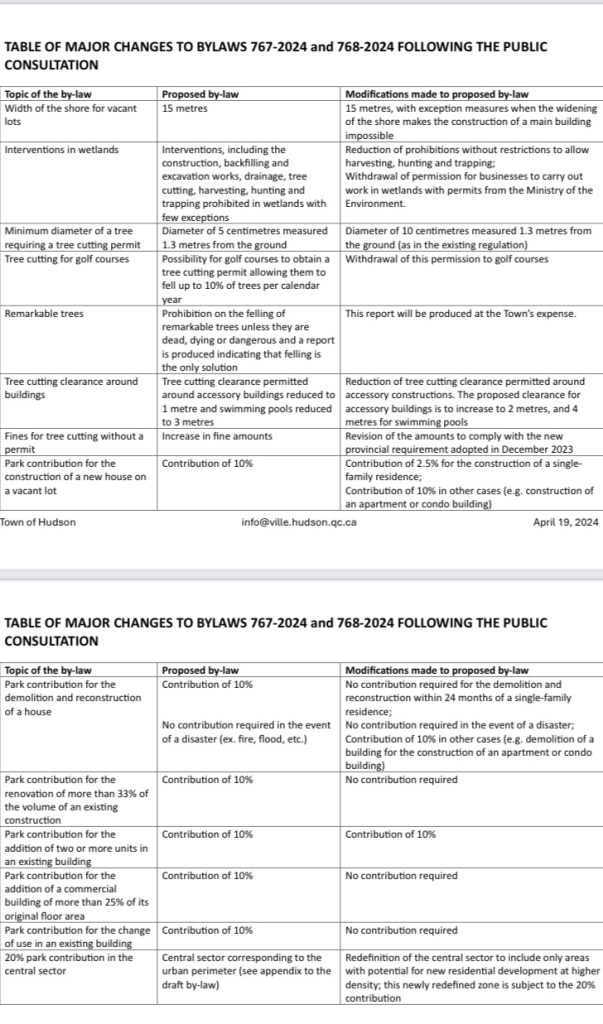
As promised, the Town of Hudson has posted a more detailed list of changes to proposed bylaws 767 and 768 replacing or modifying the the town’s urban planning regulations.

But it still hasn’t spelled out how the current council proposes to tax new or replacement residential development in the town centre — or what parts of town will be subject to this reinterpretation.

The list — posted Friday on the town’s website — compares only those sections changed as the result of concerns raised in the public consultation process. It does not permit comparison with urban planning bylaws currently in force. 

Still unclear is how the revisions to draft bylaw 767 will “redefine Hudson’s central sector to include only areas for potential for new residential development at higher density.”

The original draft bylaw had proposed to apply a 20% land/cash “contribution” on new residential development anywhere within Hudson’s urban perimeter, which represents nearly half of Hudson’s total land area (Hudson’s Valleys, Alstonvale and a handful of neighbourhoods in the east and west ends are excluded from the town’s urban perimeter because they are still classified as agricultural.)

The most significant changes:

Wetlands: 

— The 15-metre shoreline buffer will allow exceptions when the wider buffer makes it impossible to build;

— Withdrawal of the town’s permission to businesses with permits from the provincial environment ministry to carry out work in wetlands;  

— Withdrawal of restrictions on hunting, trapping and harvesting in wetlands.

Trees:

—The minimum diameter of trees allowed to be cut without a permit has been restored to 10 centimetres; 

— Tree-cutting fines have been revised to comply with provincial requirements adopted in December; 

— Golf courses lose the right to cut up to 10% of their trees per year;

— The Town will now pay for assessment of whether one of Hudson’s 188 “remarkable trees” needs to be felled;

— Tree-cutting setbacks around pools and accessory buildings have been increased.

Parks and greenspace tax: 

— The 10% parks tax has been removed for additions or renovations unless the purpose is to add two or more units to an existing building or to demolish an existing building to make way for an apartment or condo complex (still 10%);

— The contribution for construction of a new single-family residence is being cut from 10% to 2.5%;

— No contribution is required for the demolition and reconstruction within 24 months of of a single-family residence.

As announced, residents will be advised of the revisions at a public meeting (7 p.m. Wednesday, April 24 at the Community Centre). Like the draft bylaws, they are not subject to approval by referendum. Unlike the bylaws, they are not subject to further consultation prior to their adoption at the May council meeting.

The main concern should be how these revisions are worded in the revised bylaw. The conforming usages in Hudson’s residential and commercial sectors are clearly identified in bylaws 525 and 526, Hudson’s current zoning bylaws. How is this proposed central sector identified? One might infer that it would include the stretches of Main and Cameron where intensive development has long been rumoured, but it could also be applied to the quadrilateral between Mount Pleasant, Côte St. Charles, Lakeview and the railway right of way. 

We have received mixed signals from the current council over its intentions for the core. Mayor Chloe Hutchison has hinted in the past at the possibility of a plan particulier d’urbanisme, a provincial urban planning instrument that allows a municipality to consult with property owners to come up with a comprehensive redevelopment plan without citizen input. Council recently approved a money resolution to hire a facilitator in discussions with developers.  

Last week, District 6 councillor Daren Legault posted: How is this any different from the idea that some people have: that any new development, any new construction in town should pay a levy up front to cover their “buy in” to the town’s existing infrastructure. I believe that the levy I mention was something you pushed for? Please correct me if if I’m wrong. The results that you now say you were worried about with the bylaw proposals would be no different in my opinion.

It’s a fair question, especially in light of my written comments to council in response to the public consultation:

I was extremely disappointed to note the absence of a section imposing connection fees on the developer. Most municipalities in North America charge developers the entire cost of connecting to existing infrastructure, plus any unforeseen connection costs incurred by the town. (Example: a still-valid development agreement signed by the town and the developer of Sandy Beach saddled Hudson taxpayers with roughly $350,000 in expenses.) Quebec has given municipalities the power to require that these costs of hooking up to water, sewers, drainage, roads, trails and other public infrastructure, so why is it not part of these proposed bylaws?

I ask that council consider taking it a step further by assessing any existing or future residential or commercial expansion the cost of replacing the capacity of our drinking water, sewage treatment and other municipal systems consumed by their project. Surely this is a far easier way to fundraise for a parks and greenspace fund than taxing renovations?

In that context, a levy on large-scale densification projects is logical. But what may be fair and equitable for a 20-unit apartment or condo project is neither fair nor equitable for a small infill project somewhere in the quadrilateral that characterizes the downtown core. Until residents get a clear view of what is being proposed, it’s a legitimate question that remains to be answered.

Silencing the grousers

With the clock running out on its campaign to find legal ways to limit and shape development, Hudson’s administration is heading back to the people with minor tweaks to a controversial pair of draft zoning bylaws adopted in January.

In a message to residents sent out Tuesday (April 16), the town stated that modifications to bylaws 767 and 768 would be presented to residents at an information session (7 p.m. Wednesday, April 24 at the Shaar Community Centre, also broadcast live on Zoom).

Unlike two open houses and a mandatory public consultation in late January, it appears there will be minimal opportunity for public input, given the administration’s stated intent to vote on final adoption of the modified draft bylaws at the May 6 council meeting. They would come into force “approximately” 120 days later. 

Modifications highlighted: 

— Withdrawal of the financial contribution for parks, playgrounds, and natural area for renovations of 33% or more of the volume of a residential building; 

— Withdrawal of the financial contribution for the enlarging of commercial buildings; 

— Withdrawal of the financial contribution for changes of use of an existing building; 

— Reduction of the construction perimeter around accessory buildings and pools; 

— Withdrawal of the minimum diameter of 5 cm for a tree requiring a tree felling permit. The minimum diameter remains at 10 cm; 

— Withdrawal of the ban on hunting and harvesting in wetlands; 

— Update of the fines for tree felling without a permit to comply with the amounts established in the provincial law in effect since December 2023.

One significant change: the modifications propose to redefine the central sector to include only areas with potential for new residential development at higher density; this newly redefined zone is subject to the 20% contribution. We can assume this will directly impact property owners and developers along Main and Cameron.

The tweaks respond to the parts of the bylaw that elicited the greatest negative reaction at the Jan. 31 consultation and in the comments and responses from close to 800 people — 97% of them claiming to be Hudson residents — who answered an online survey. As well, more than 465 comments were submitted. 

Bylaw 767 proposed greater protection for Hudson’s trees, wetlands and bodies of water as well as a parks and greenspace surtax on a wide range of construction and renovation permits.

To gauge from the report by the consultant who oversaw the public meetings and survey, most residents reacted strongly to anything in the bylaw that could affect them. That included the reduction of the diameter of trees that could be cut without a permit from 10 to 5 cm and council’s proposal to levy a tax in cash, land or both on a list of permit applications for new construction and major renovations.  

Well over half of all respondents were either somewhat or very unfavourable to both, with close to 80% opposed to a tax grab on residential renovations of 33% or more by volume and a similar percentage opposed to a reduction in the size of trees requiring cutting permits. 

The best reading in consultant Marie-Helene Gauthier’s report are the condensed comments from residents on the rationale behind council’s parks and greenspace levy:

Participants call on the municipal council to conduct a comprehensive review of the section regarding contributions for parks, playgrounds, and natural areas in the draft by-law. They wonder if research has been conducted to explore more equitable alternatives and if a thorough assessment of the economic impacts on businesses and residential properties has been carried out. Although many recognize the importance of funding parks, especially to provide play spaces for children, they question the proposed approach to financing. For many, the current plan lacks clarity for proper understanding and represents a major obstacle to improving the living conditions of owners of already developed land. 

Several participants also question the need to increase revenues from this fund or seek additional sources of income, considering that the Town currently has a surplus. They point out that despite this surplus, parks and natural areas are barely maintained, and there is currently a deficit in recreational facilities. They therefore believe that the need for such a fund should be evaluated first and consider that the municipal council is currently proceeding with this process in reverse. 

In general, participants reject the idea of an additional financial contribution from them. They also express doubts about the actual use of these new revenues for parks, playgrounds, and natural areas, highlighting their lack of trust in this regard. They consider this contribution to be discriminatory and punitive, as it would result in double taxation, especially regarding renovation fees and the increase in property value resulting from these renovations. They fear that this contribution will penalize owners of small houses, those with more modest incomes or fixed budgets, retirees, first- time buyers, and discourage young families from settling in Hudson, which would have repercussions on the vitality of the town. Furthermore, they express concerns about the effects on the value of their properties. 

Participants raise several inconsistencies in the proposed activities to expand the contribution for parks, particularly in the context of establishing a fund for the protection of natural areas. They believe that the inclusion of various activities subject to this contribution could discourage densification. For example, many note that the inclusion of works, such as the development of an unfinished basement or the creation of intergenerational homes, in activities subject to a payment equivalent to 10 % of the land value, is nonsensical. These renovations do not increase the building’s footprint and do not require tree felling, unlike an extension or detached garages, which are exempt. Some feel that imposing a sum equivalent to 10 % of the land value or giving away a portion equivalent to 20 % of their land is extremely high and would require a study and evaluation based on projected revenues. Therefore, several believe that only activities with a negative impact on the environment should be subject to this contribution, to deter their realization. 

Moreover, several believe that the contribution for redevelopment projects is not justified and could discourage renovation projects or ensure that these projects escape municipal administration control. They also doubt the reliability of this source of funding. Furthermore, they unanimously oppose any additional financial burden for homeowners wishing to renovate their homes. Some also wonder how disagreements over the determination of the 33 % volume would be managed or if the land given up is appropriate for the intended purposes. They fear an additional burden on the urban planning department due to the complexity of implementation and question whether the costs of the disputes that will arise will be taken from the parks fund or will come from the general fund. 

Some wonder if the impacts on local businesses have been considered and point out that in commercial areas, many buildings require renovations and that it would be desirable to encourage these renovations to maintain a dynamic, viable, and healthy village instead of penalizing them. Others note that home construction has taken place in areas outside the central sectors and should therefore be included. For example, the Bellevue, Alstonvale, and Turtle Pond areas. 

Several suggestions have emerged from participants. For example, some suggest increasing the fees required for a permit, others propose keeping only the contribution for subdivisions, sparing landowners who have maintained land for several decades, using connectivity fees charged to real estate developers, reallocating the budget, taxing large developments, using existing provincial and federal grants, or adopting a borrowing by-law for the next 25 years to purchase lands targeted for development. 

In conclusion, Hudson residents invested time and thought in considering what is being presented as our roadmap for the future. If council’s response is summarized in a few minor tweaks to silence the loudest complainers, we’ve all wasted three years and hundreds of thousands of dollars on this exercise.

I had hoped for better.

CMQ audit forces Hudson to rethink spending

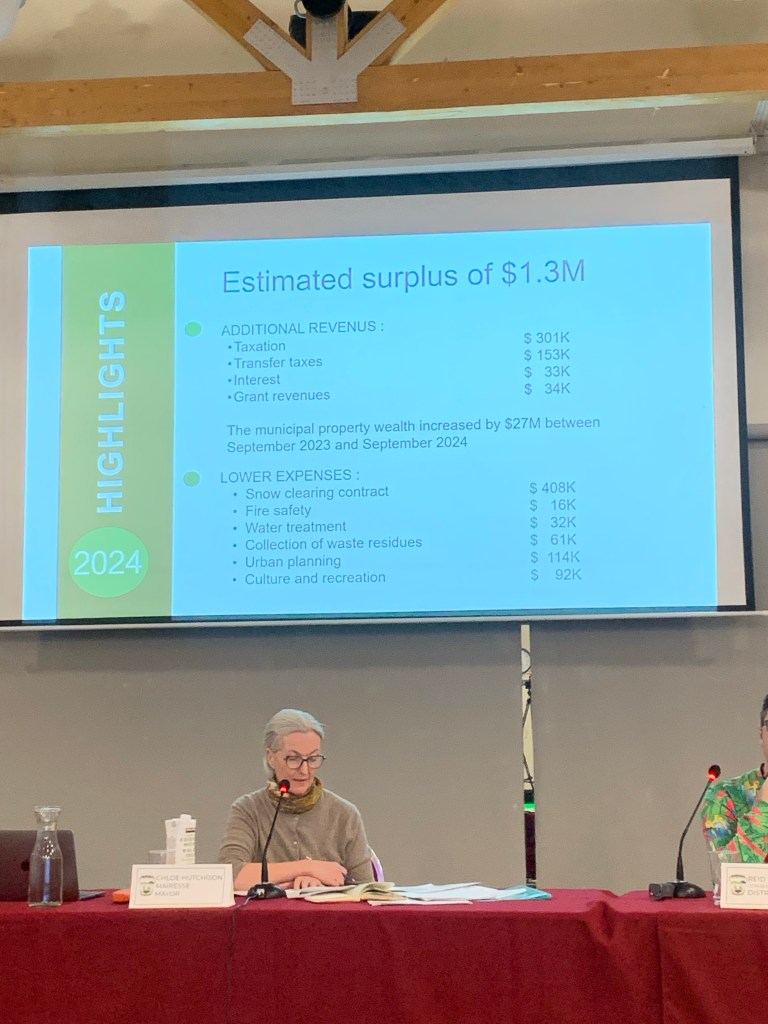
Between an accumulated surplus, assigned surplus, working fund, GICs and available balances of existing loan bylaws, the Town of Hudson is sitting on a nest egg well in excess of $8M. The CMQ wants to see a plan for how the town proposes to spend it and prevent another round of over-taxation.

The Town of Hudson isn’t using its multi-million-dollar surpluses and cash reserves to best advantage, according to an audit of its fiscal procedures by the Quebec Municipal Commission (CMQ), the municipal affairs minister’s governance arm.

Worse, says the CMQ, there has been an historic lack of accountability and followup when it comes to knowing how tax dollars are being spent until it’s too late to do anything about it.

With an accumulated surplus in excess of $8M and long-term debt of close to $23M at the end of 2023, Hudson was one of three similar-sized towns (with Saint-Gabriel-de-Valcartier and Saint-Roch-de-l’Achigan) flagged last May for in-depth audits to determine why they were piling up year-over-year cash reserves instead of providing residents with services, leveraging infrastructure improvements or paying down long-term debt.

In Hudson’s case, the municipal affairs ministry had already noted the town’s total debt load per resident — $1.85 per $100 evaluation — because anything over $1 per $100 is considered high.

Posted this morning (Tuesday, Feb. 27) on the CMQ website, the audit will be be tabled at the March 4 council meeting. On March 11, financial consultants RCGT (Raymond Chabot Grant Thornton), mandated in 2023 to prepare the Town’s financial portrait and projection for 2023 to 2028, will present their report to residents, a fact the CMQ audit took into consideration.

Hudson’s long-term debt status and paydown schedule for 2024. If it’s better to carry debt and have money in the bank, how much and for how long?

Most of the 31-page document applies to all three municipalities, beginning with the observation that surpluses and reserves are not well integrated with the planning process. Councils and staff didn’t prioritise how or where the monies should be spent. Triennial investment plans (PTIs), adopted along with annual budgets, were concocted with minimal public input and didn’t conform to Cities and Towns Act requirements that funding sources be included. Although councillors discussed how PTI projects were to be funded, this wasn’t shared with the population, leading to a possible transparency issue with residents.  

Without transparency, there can be no accountability, the report continued. “Without the accountability that the citizens have a right to, a municipality can’t guarantee sustainable finances.” Without sustainable finances, a town makes itself vulnerable to unforeseen situations.

The CMQ’s second observation: none of the three municipalities has a formal framework for how they earmark their surpluses and cash reserves. In the case of Hudson and St. Gabriel, a lack of followup mechanisms means the management of these surpluses and reserves is left to individuals, with no guarantee the funds will be spent according to the town’s long-term strategic plan — if there is one.

The audit singles Hudson out for special mention on issues dating back to 2013, including:

— taxing property owners before the enabling loan bylaws were approved by Quebec or shifted from bridge financing to long-term debt, then failing to compensate them for the excess collected;

— failing to make clear the funding source for spending bylaws until the end of the fiscal year, long after decisions had already been made;

— shifting funds between earmarked surpluses without enabling resolutions.

Most of the allegations have already been the subject of management letters from the town’s external auditors. The overtaxing of property owners connected to the municipal sewer system  was dealt with by the previous council, although the victims were never compensated. 

“The report makes clear to me that the CMQ is prepared to blame the past and point to the bright future,” said a source familiar with the file. “It is positive [and] points to a future plan. Still curious what that is.”

UPDATED: LAU timeline ‘doesn’t apply’

Mayor Hutchison mentioned it in passing but most people probably missed it. For the next four months, you won’t be allowed to do anything to your house, commercial building or property that will be affected by the bylaws the town wants to adopt. One way to find out who and what will change.

So don’t be cutting any two-inch trees without checking in with Urban Planning.

Under Quebec’s Land Use and Development Act (LAU), Hudson’s proposed planning bylaw revisions trigger a four-month freeze on any application or operation which would be altered or refused once the two bylaws are given final adoption.

But if council fails to adopt bylaws 767 and 768 within that window for whatever reason, the freeze is automatically lifted, leaving only the town’s stale-dated interim control bylaw (RCI) to block property owners from demanding permits under current bylaws.

Two months after that, the proposed replacements become what is known in municipal parlance as zombie bylaws — still on the books but inoperative.  

The countdown began at the Jan. 10 council meeting where notices of motion for draft bylaws 767 and 768 were presented, followed by their adoption.

LAU Art. 114: When a notice of motion has been given to adopt or amend a zoning by-law, no building plan may be approved nor may any permit or certificate be granted for the carrying out of works or use of an immovable which, if the by-law that is the subject of the notice of motion is adopted, will be prohibited in the zone concerned.

Because both bylaws were presented and adopted, council gains an additional two months for final adoption:

The first paragraph ceases to be applicable to the works or use in question on the date occurring two months after the filing of the notice of motion if the by-law has not been adopted by that date or, if the by-law has been adopted, on the date occurring four months after the date of its adoption if the by-law is not in force on that date.

Council can buy more time in the form of a replacement bylaw. (A revised bylaw could be based on citizen’s comments and recommendations): 

Where, however, within two months after the filing of the notice of motion, the amending by-law is the subject, under section 128, of a second draft by-law, the first paragraph ceases to be applicable to the works or use in question on the date occurring four months after the filing of the notice of motion if the by-law has not been adopted by that date or, if the by-law has been adopted, on the date occurring four months after the date of its adoption if the by-law is not in force on that date.

As the mayor explained at the Jan. 10 meeting, final adoption is planned for the April council meeting, after which the bylaws go to the Vaudreuil-Soulanges regional municipality to ensure they harmonize with the MRC’s master plan before the town can bring them into force. 

All this time, the LAU clock is ticking. 

UPDATE: Here’s the town’s response to my question about the freeze at the last council meeting (my translation):

As a follow-up to your question at the last city council, here is why there is no freeze that applies:

Currently, tree-cutting applications should not be suspended until the regulations come into force in the fall, because our notice of motion has no freezing effect.

Any adoption of a regulation must be preceded by a notice of motion and a tabling of the draft regulation. In urban planning, the notice of motion can have a freezing effect if it is a zoning (or amendment) by-law, subdivision, PIIA or on municipal works agreements. According to section 114 of the Planning and Urban Development Act, the freezing effect seems automatic. However, in 2012, the courts determined that a notice of motion must be specific enough to have a freezing effect. The purpose of the freeze effect on the filing of the notice of motion is to prevent the municipal will from being neutralized by the filing of substantially complete permit applications before the coming into force of the by-laws, Whereas the procedure for adopting urban planning regulations is longer than that for other regulations.

As we are already under a certain freeze with the Interim Control Regulation (RCI) in place, it was decided not to impose an additional freeze effect.

Once the revised bylaws are given final approval later this spring, the mayor has said council will vote to lift the RCI.

Those familiar with the LAU’s regulatory timeline say any delay in lifting the RCI increases the likelihood of a legal challenge. “An RCI is supposed to be an interim measure”, one municipal governance consultant told me. “By Year 3, a judge could agree with a plaintiff the clock has run out.”

So it’s no wonder that Hudson’s mayor and council are hoping to get away with “a few tweaks” in their rush to adopt 767 and 768 in their final versions. The alternative: a geriatric RCI, zombie bylaws and three years of squandered promises to their supporters.

Groundhog Day

Hudson public consultation, 2024 vesion. Why does it feel like the town is caught in a time warp?

“Groundhog Day”, Buddy said to me prior to this week’s public consultation on draft bylaws 767 and 768. “Remember?”

On Monday, Nov. 18, 2019, mayor Jamie Nicholls chaired a public consultation on draft bylaw 526.8 proposing to establish a 30-metre buffer zone around watercourses and wetlands.

The proposed bylaw — within council’s authority, according to an opinion from one of Quebec’s foremost environmental lawyers — would ban all tree-cutting as well as the owner’s use of machinery within any part of the setback on their own property, including lawn cutting. Any new projects — pools, sheds, decks, gazebos, even replacement of a failing sewage treatment system — would be prohibited.

In the leadup to the consult, the urban planning department was asked to create a map overlay showing the 30-metre line imposed on a municipal cadastral map. The overlay confirmed the proposed bylaw would directly impact hundreds of properties throughout the municipality.

The mayor opened the presentation by telling the room that councillors were deadlocked 3-3, so he had already decided to vote yes to break the deadlock. In other words, don’t waste your breath, folks.

“We’re not doing this to make people angry or to remove peoples’ rights,” Nicholls told the standing-room-only crowd at the Community Centre. “We’re doing this to protect the network of wetlands and watercourses which make up Hudson’s natural spaces.” 

Nicholls strove to convince residents this was the price taxpayers needed to pay for protecting Hudson’s natural heritage, thus opening the outrage floodgates and a pushback campaign by the bylaw’s supporters. By that December, the mayor had taken a leave of absence and caucus had agreed to let 526.8 expire without adoption. (It remains on the books, even though it has no effect, a so-called zombie bylaw.)

___________________________________________________

There may be those who have never seen the classic 1993 film Groundhog Day. In it, Bill Murray is a burnt-out weatherman and Allie McGraw the bubbly TV reporter trapped in a time loop centred on an annual celebration of the rodent’s storied ability to predict the weather. Groundhog Day has become a synonym for being trapped in an unpleasant situation without hope of a positive outcome.

On the eve of Groundhog Day, 2024, I’m listening to the recording of that 2019 public consultation. Many of the voices are those of people who spoke out at Thursday’s public consultation. The comments and the tone of the 2019 gathering were remarkably similar to those of 2024.

The difference was that this time, the mayor sat this one out. Apart from her opening and closing comments, Chloe Hutchison and councillors left it to former DG and special projects consultant Martin Houde, urban planning department deputy director Melissa Francis and Paré+ urban planning consultant Vincent Langevin to answer questions. Running the meeting was professional facilitator Marie-Hélene Gauthier. 

The mayor’s absence at the front of the room meant that questions concerning the intent of the bylaws went unanswered because they were political. Instead of taxing growth and improvement, why not finance park infrastructure upgrades and new acquisitions with Hudson’s $8 million accumulated surplus or the $1 million plus the town collects from the welcome tax? Or how about a townwide special tax, seeing as how parks and greenspace are for everyone’s benefit? 

That’s political, we heard. Save it for the next council meeting (at 7 p.m. next Monday, Feb. 5). 

From the outset, it became clear that those answering questions were not familiar with the contents of the draft bylaws or how they propose to modify Hudson’s current zoning, tariffs and land use bylaws. For the vast majority of residents, Sections 10 and 11 of draft bylaw 767 were hopelessly confusing and poorly explained. What renovations cross the 33% threshold by volume? Why is the commercial threshold — 25% of floor area — different than residential? Where does a building’s footprint enter into it? Why should council be the arbiter in determining whether the 20% tax grab in the urban core is in land, cash or both? What constitutes an intensification of existing activities? A change in usage? The difference between an extension and an addition?

The deeper they got into the weeds, the more people realized that the explanations and Cole’s notes they had been given at the two open houses were either misleading or just plain wrong.

Some of the answers came as a shock. The town has no clue what revenues they hope to raise through green fund “contributions,” which suggests to me they don’t know who and what will be taxed. Property owners would have no way of knowing they have triggered the parkland contribution threshold until they find out their building permit will cost them $40,000. The findings of an upcoming parks and recreation study could force a change in the tax structure.

Other sections of both bylaws were no clearer. The owners of a lot in Hudson Valleys were told their lot was unbuildable because it contained a wetland — regardless of the facts that suggest the wetland was created by the buildup of adjacent properties since the original subdivision. Many wondered whether a protected wetland had a minimum area to require a 15-metre buffer. (what, my frog pond?) A resident whose property abuts on one of the four zones slated for comprehensive development programs in draft bylaw 768 asked whether the developer would be required to ensure a minimum treed buffer on the property line (not in the bylaw). Would the town consider paying for the biologist’s report? Why not subsidize the cutting and replacement of ash trees on private land?

Because of the lack of clarity, emotions ran high. Ken Crombie’s questions — shouldn’t all citizens pay for greenspace instead of a small percentage and what can we do to force a referendum instead of letting six councillors decide — brought the first of many rounds of applause as resident after resident vented their frustrations. For many, it was purely personal. “With this bylaw, who will buy a fixer-upper,” one resident asked. 

I suspect that this council will be more cautious than our council was in the 2019 showdown. Wiser heads will prevail and the draft bylaws will be sent back for revision. But as several residents opined on Facebook, it makes it difficult to trust a council when something this full of holes is run up the flagpole. Again.

Dazed and confused

After two public consultation sessions, Hudson residents are voicing their frustration over the confusion surrounding the impact of a proposed parks and greenspace surtax on subdivision, construction and renovation permits in nearly half the municipality.

Termed a ‘contribution’ in the town’s documents and presentations, the proposed 10-20% levy — in cash, land or a combination of both — would add thousands to the cost of a major commercial or residential renovation — or change in usage, such as from commercial to residential.

The calculation of what a property owner will pay in cash, land or both would be based on the assessed value of the lot.  

For most residents, the grey area is what will trigger the surtax. The addition of a detached garage, new kitchen, bathroom, pool,  or shed won’t. Homeowners will be able to rebuild after a disaster, replace windows, a roof, flooring or siding without any impact. But new contruction on a vacant lot, rebuilding after a demolition or renovation of a third or more of their home will cost the owner 10% of the assessed value of their lot. Same goes for the addition of two or more residential units in an existing building or enlarging a commercial building by more than 25% of its original footprint.  

In examples cited in an explanatory sheet distributed at both open houses, the owner of a property with a taxable value of $400,000 would be billed $40,000 — a contribution equal to 10% of its assessment. If that property had been the result of a subdivision on which the owner had already paid 10% of its value in land, cash or both, the tax bill would be reduced to $30,000.

Several points in the explanation document appear to contradict the draft bylaw, perhaps the reason for the fine-print disclaimer at the bottom.

Questions most asked:

How many property owners are affected? 

Facilitators at last Wednesday’s open house tried to minimize the potential impact. A Hudson urban planning staff member told me that between January 2021 and December 2023, only five of the 112 major renovation permits issued by the town would have crossed the contribution threshold. However nobody running the event would hazard a guess as to the number of properties — commercial or residential — with a potential tax burden, should their owners apply for a permit. One resident told me they’re already planning renovations in phases in order to stay below the 33%.

Who came up with this scheme?

Draft bylaws 767 and 768 were the product of urban planning consultants Paré+, Hudson’s planning department and an ad-hoc conservation working group (CWG) which included councillors Mark Gray and Doug Smith and seven unelected residents. Created in January 2022 as part of the interim control process, the CWG was dissolved by a council vote at last month’s meeting because it had completed its’ mandate. Gray credited Donald Attwood, Tanja Bruns, JJ Corker, Sylvie Ferron, David Kalant, Briony Lalor, Kevin Solarik and non-resident resource person Lorraine Caron.

Whoever came up with Section 11, the part of draft bylaw 767 laying out the surtax framework, they’re not claiming responsibility. 

Why?

Besides creating a sustainable source of funding for greenspace acquisition and upkeep, the financial burden is concentrated on those with the financial resources to absorb the hit, as opposed to the entire taxpaying body. It also discourages would-be developers from coming anywhere near Hudson unless they’re ready to play by the town’s terms.

Couldn’t council use Hudson’s $8 million accumulated surplus instead of targeting those who want to improve their property?

Yes, they could. But the mayor has said the surplus should be used for social projects, such as affordable housing. 

Is there anything similar anywhere else in Quebec? 

Pare+ representative Vincent Langevin told me only one other Quebec municipality — on the West Island — charges a similar surtax on development. Consultant/facilitator Marie-Helene Gauthier said Hudson was taking a bold step with the proposed taxation structure. Bold isn’t the word I’d use. Foolhardy? Feckless?

Where does the land and/or money go? 

The cash will go to a segregated account, to be used only to acquire land for parks or to protect wetlands and woodlands of ecological value as well as to maintain existing parks, playgrounds and trails. However, the bylaw adds this: “the Town may, however, […] dispose of lands acquired under this section.” Simply, this bylaw will allow future councils to resell lands acquired under this bylaw as long as the proceeds go to the parks fund.

Last week I urged the administration to withdraw both bylaws and take the time to redraft them in light of generalized confusion. I reiterate: these bylaws are unadoptable as drafted. Fix them so they at least make sense.