Fly on the Hudson Town Hall wall: Could the town have leaked contents of its Barreau beef against lawyer/activist Veronique Fischer to discredit her in the court of public opinion?
The Local Journal didn’t want to be accused of leaking the story of how the Town of Hudson is taking lawyer and Hudson resident Veronique Fischer to the Barreau du Québec, alleging ethical breaches.
So it ran a story about the town’s shock and dismay that somebody sent a photocopy of the town’s Barreau beef against Fischer to the Journal reporter’s home.
The Journal attempted to claim the high road by noting that it withheld Fischer’s name and the details of the town’s complaint against the tax activist. But it was fooling no one, certainly not in a small town where everybody and his mother’s dog has heard Fischer’s name bandied about in connection with a number of files, including the withdrawal of the $1.5M repaving bylaw and the recent near-death experience of the $555,000 we’re-not-sure-what-it’s-for loan bylaw.
In an exclusive interview with thousandlashes.ca, a fly on a Hudson town hall wall has alleged the photocopy was sent by the town. I’ve agreed to keep the fly’s identity confidential due to fear of reprisals.
“There were just the two of them,” she said.” “It was after hours and everyone else had gone home. I’m paraphrasing here because my memory isn’t perfect, but they’re agreeing it’s a shame there’s no legal way to make the town’s complaint to the Barreau public. Such a magnificent document, so damning. They figure they can discredit her in her community and cause her financial embarrassment. They jawbone for a while before they hit on the idea of an anonymous leak. Leave it to me, says one of them. You will need plausible deniability. Then they leave.”
If proven, Ms. Fly’s allegation would place the town in a serious breach of Barreau ethics. Because the legal profession is self-regulating, the Barreau receives complaints and builds the file before placing it before the syndic, the tribunal which will determine the veracity of the complaint and possible sanctions.
In itself, the town’s decision to take Fischer to the Barreau is logical and understandable. As I posted in my blog Lawyer vs. Lawyer(thousandlashes.ca, April 21/17), Hudson’s current administration makes no secret of its determination to silence what it considers nuisance critics:
…I sat down with the DG for a 45-minute chat about how the town proposes to silence persistent critics without being accused of stifling free speech.
Roy began by making it clear the town would seek the means to neutralize residents who make it their business to monitor the decisions and practices of municipal administrations and have the know-how to research documents and the means to take their findings to provincial authorities.
Fischer has been highly effective in her ability to pry embarrassing and potentially damaging information loose through the use of Access to Information requests – so effective, the town asked the commission responsible for policing AI requests to impose a freeze until after the Nov. 5 municipal elections.
The core of the town’s Barreau complaint against Fischer is whether she violated the Barreau’s guidelines by conflating her legal responsibilities with her activities as a citizen activist. I know other lawyers who have become enmeshed in similar disputes because of their roles in civic matters. The Barreau seems to decide these matters on a case-by-case basis.
It’s by making this case public – if it is indeed responsible for the leak – that the town has committed a breach of ethics that would leave it open to possible civil action. Moreover, if it can be proven a Barreau member played any part in the breach, he or she would also be liable to sanctions.
It’s possible Fischer or someone close to her leaked the document to discredit the town’s action of taking her to the Barreau, but I tend to dismiss that possibility. No lawyer wants to be taken before the Barreau. It represents time, incurs out-of-pocket expense and could result in sanctions. Leaking the complaint does nothing to halt the town’s action.
Could it be someone with access to the file who thought leaking the report would help Fischer’s cause? Again, I can’t see that. Barreau proceedings are closed. Public opinion plays no role.
…which brings me back to Ms. Fly’s allegation. If true, it wasn’t enough for the town to launch Barreau procedures against Fischer. They’re a confidential administrative process and the results are seldom made public. My hunch: the administration wanted this to be tried simultaneously in the court of public opinion to make a public example of their vexatious critic.
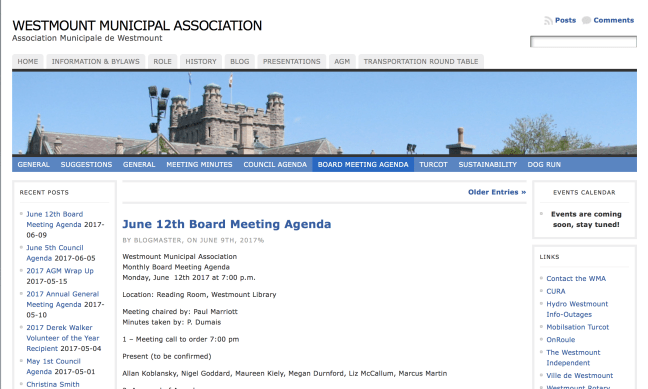
Westmount Municipal Association was to have provided inspiration at the founding meeting of a Hudson citizens’ advocacy group.
Although invitations were emailed to some 100 residents and members of council, less than two dozen people showed up for what was to have been the founding meeting of a Hudson resident’s association at St Mary’s Hall last evening. When the gathering broke up some two hours later, there was no agreement on the role of such an organization or whether another meeting would move the project forward.
Inspiration for the formation of a Hudson citizens’ group was to have come from the presence of Paul Marriott, president of the Westmount Municipal Association. Founded in 1908 to promote sound civic administration, the WMA is a volunteer organization which operates as a non-partisan community link between citizens and City Hall in dealing with traffic, parking and zoning problems. Membership, currently around 200, has risen as high as 3,000 in a city with a population of roughly 20,000.
Membership increases as a function of what’s happening in Westmount, Marriott explained. “People tend to focus on single-issue projects.” Fifteen years ago, the unifying issue was forced mergers and demerger referendums. Today, the WMA is seeking a voice in the impact of the MUHC superhospital on the city.
Marriott is a council regular, asking questions on behalf of WMA members, demanding answers and the supporting documentation. Notwithstanding the WMA’s long history with the city, cooperation isn’t automatic. Who decides what issues the WMA tackles? Members meet monthly and try to work a month ahead, not just for the next council meeting. The association posts everything, including town documentation.
Once the Q&A with Marriott had run its course, moderator Chloe Hutchison moved the meeting to a group membership discussion. In her invitation, she had emphasized the movement’s non-partisan role “in bringing focus to the community’s day-to-day needs and interests, to serve as a springboard where political platforms are discussed and shaped with respect to public long-term values.”
Hutchison wondered what it would take to grow local participation in municipal affairs where citizens who ask hard questions at council meetings are seen as troublemakers.
Could a citizen’s group stimulate meaningful communication with council members? Was there any possibility of citizen input in integrating sustainable measures in Town Planning regulations? Is it reasonable to ask for monthly updates on the Town’s actions relating to finance, infrastructure and planning?
She noted that public participation tools exist, such as citizen advisory committees mandated annually by the municipal councils. “These committees are important players in keeping the balance between personal interest, impact and benefits of development opportunities and the long-term public value.”
The ensuing discussion failed to produce the consensus needed to create a citizen’s advocacy movement. Instead, it showed that any grouping would have to be a coalition of single-issue advocates, most of them opposed to something – greenspace protection, anti-densification, anti-development. Some saw no way past the current level of confrontation. Others preferred the image of a glorified chat group centred on non-confrontational negotiating practices.
Faced with a scenario of squabbling factions and no persuasive unifying vision, people left.
“I guess I’m just at the point of giving up,” said one Hudson greenspace activist. “It’s like my neighbour […] said last night, “where are the 5,150 other people in Hudson?” Am I just a shit disturber? Should I just stay home, drink wine and watch the sunset?”
Not everyone thought it was a wasted evening.
“It shows every volunteer organization needs a spark plug,” said one participant. “You don’t fire people up with calls for balance and non-partisanship when this administration is practising exactly the opposite.”
Others were surprised to learn that even the WMA has to fight to be heard and informed. “There may not be any political value in having an association, but there’s definitely a moral value,” said one young attendee. “The most surprising? For me, it was hearing that it’s not just here in Hudson.”
• • •
Does Hudson need a citizen’s advocacy group? Yes, say those who don’t feel comfortable with how the current administration makes decisions that will affect residents without their knowledge or consent. Take the Villa Wyman project that will house two dozen seniors who need assisted care. It’s a crucial project in the wrong location, being engineered to solve Wyman’s financial problems. Those who have seen family and friends forced to leave their homes for a facility on the West Island know the injustice of this, but one injustice doesn’t justify another. A competent urban planner knows there won’t be enough parking on the current site for churchgoers, employees and visitors. Why is it wrong to ask hard questions, especially in light of Hudson’s sorry track record in dealing with previous development projects?
The argument against the creation of an independent non-partisan citizens’ movement? I’ll leave that to those who place their faith in Hudson’s voting public and bureaucratic infallibility.
Is it the end of the road for a Hudson citizens’ advocacy group? At the risk of disappointing the gloaters, I don’t think so. Several promising initiatives emerged from last night’s exercise. If they take off, they will transform the Nov. 5 municipal elections.
The truth is that most people don’t like questioning authority, especially in a small town where nobody wants to be the target of ridicule. We pay a social price for our fear of being seen on the wrong side of whatever it is. So, to cover up our shame and complicity, we go to ridiculous lengths to rationalize our disengagement and cheerlead the poor leadership choices we make.
The price of democracy is eternal vigilance. If eternal vigilance includes filing access to information requests and asking questions of our elected and appointed officials, so be it. I’m suspicious of anyone who has a problem with it.
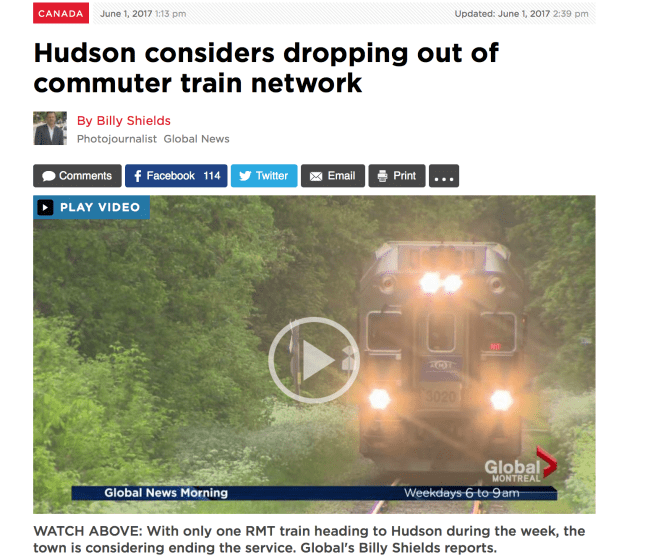
From the Global News June 1 morning show: Hudson mayor Ed Prévost says the town is considering asking the Régie municipal de transport to pull Hudson’s weekday train service to save $250,000. Wasn’t the train the pretext for ramrodding compliance bylaws through council?
Hudson’s June council meeting was so weird, I was looking for Monty Python characters somewhere in the audience.
Pro-mayor Natalie Best, subbing for the mayor, opened the meeting by reading a comment from Prévost, slamming residents for circulating fake news and denouncing candidates for using public meetings to campaign for November’s municipal elections and dupe their fellow citizens.
The nearly three-hour session was highlighted by incoherent retractions of previous comments and resolutions modified on the fly. Among the revisions: a bylaw clearing the way for construction of Villa Wyman, an assisted-care seniors’ residence next to Wyman Memorial United Church, will now be subjected to a June 20 public consultation, possible registry and referendum. The controversial proposal to move Wyman and its parking lot into a commercial zone (C-27) will not, since it is now part of the town’s compliance bylaws.
The packed agenda was book-ended by question periods comprised mainly of rants against the adoption of bylaws 688, 689 and 690. These bring the town’s master development and land use plan into compliance with those of the Montreal Metropolitan Community (MMC) and the Vaudreuil-Soulanges MRC. Critics charge the town with using them as the pretext to permit uncontested development.
The evening ended with the revelation that the absent Mayor Ed Prévost had bushwhacked his own council with a Trump-like blurt that raises serious questions about the legitimacy of his administration’s policy regarding densification of the town core. It also sparked a surreal exchange (“YOUR mayor! No, he’s YOUR mayor!”).
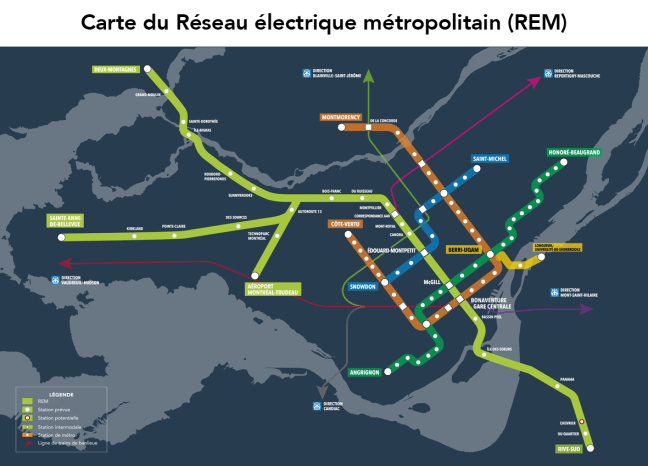
The issue: without consultation with this or previous town administrations, the MMC and MRC classified Hudson’s downtown core as a transport-oriented development, or TOD, on the basis of the single commuter train to and from Montreal on non-holiday weekday mornings and evenings and a shuttlebus service to Vaudreuil and West Island destinations.
Unlike previous administrations, this council has voiced no resistance to the imposition of the CMM/MRC guidelines despite the urging of residents who see it as a threat to Hudson’s small-town heritage. Council’s mantra: Compliance won’t change Hudson’s character.
The administration’s main argument in support of compliance: Hudson will have a stronger say in modifying or reversing CMM/MRC policy once it complies; until then, development projects are stalled. The sooner, the better.
The opposition sees a hidden agenda in the administration’s haste to pass the compliance bylaws: it allows the town to use the harmonized land-use and development regulations to ram through controversial projects. Over the past several weeks, council members and administrators have made comments since retracted or qualified, such as Hudson being the only MRC municipality not to have complied. (Five of the 11 MRC members in the CMM have not done so).
Delay supporters point to alternatives, such as moving the TOD circle east to a proposed intermodal passenger terminal located in the vicinity of where Como’s Montée Manson crosses the AMT right of way (ROW). Hudson would have its TOD and the possibility of a lateral access road to relieve Bellevue and Main Road of the traffic to and from the Oka ferry. Rail commuters living in St. Lazare and Vaudreuil-Dorion would have faster, easier access to a public transit facility with plenty of parking. More users would mean more trains.
Closure of the ROW would allow Hudson to plan and lobby for a non-motorized usage corridor and/or east-west road on the former ROW between Montée Manson and the centre of town. Either way, cyclists and pedestrians would have a safe alternative to having to share Hudson’s narrow streets.
The community centre was packed with a vocal crowd either for or against compliance, which commits the town to tripling the density of a one-kilometre semicircle around the railway station.
The sports-bar atmosphere was reinforced with the presence of two public security agents at the doors. The anti-compliance fans applauded whenever one of their stars scored on the council and walked out en masse when councillors voted to adopt the compliance bylaws.
Mayor Ed’s shocker came near the end of the second question period, when Charleswood resident Louise Craig asked when the town was proposing to close the railway station. Councillors clearly had no idea what she was referring to until she explained that the mayor was quoted in a June 1 Global News story on their Montreal morning show.
Billy Shields quotes Prévost saying that with a daily ridership of less than 50 people the town’s $250,000 bill is “preposterous.”
Shields’s story continues: “With the reformulation of the commuter rail agency into a new outfit dubbed the RTM [Réseau de transport métropolitain], Prevost said the town is thinking of closing its train station.”
Pro-mayor Best, who represents the town on the regional transit file, denied any knowledge of discussions to pull out of the RTM. (I can find no legal precedent for any CMM municipality pulling out of the RTM or its predecessor, the Agence métropolitaine de transport.)
I can think of three possibilities. One, Global misquoted Prévost and the mayor will demand a retraction. Two, Prévost doesn’t share with his council, which isn’t healthy. Three, the folks at the front of the room are excellent poker players and the conspiracy theorists were right when they saw the TOD as the pretext to densify.
Whatever, it sparked a lighthearted moment, or maybe it’s just me after too many evenings spent in consultations. Craig used the term “YOUR mayor” when referring to Prévost. “He’s YOUR mayor,” a council member shot back. Hmm. No love there.
New treasurer
Hudson has a new treasurer, Claudia Ouellette, a no-nonsense fiscalist who spent the past five years with a software provider for Quebec municipalities. Prior to that, she worked in finance departments in Côte St. Luc, Otterburn Park and elsewhere. Her aim is to get Hudson’s ledgers in order after a revolving door of treasurers.
Salaries to be made public
Town clerk Cassandra Comin Bergonzi reassured Eva McCartney the town will be releasing the salaries of non-unionized town employees as soon as possible. (Union wage scales are already public.) McCartney sharply questioned council in the wake of allegations the town was deliberately stalling their release. Comin Bergonzi blamed the volume of access to information requests for the delay.
Conservation plan tabled
The town’s conservation plan, an essential component of the land use compliance process, was tabled after getting the province’s approval. Residents were assured it will be posted on the town’s website, although the version currently posted dates back to last July. According to provincial regulation, it requires another public consultation and final adoption by council.
Another 60 grand
Hudson taxpayers peeled off another 60 grand for Dunton Rainville, the town’s legalists of choice. It sparked another who-are-we-suing-now query and assurances the town is down to maybe six, seven or eight files. But hey, who’s counting?
Wooing the Coast Guard
The Canadian Coast Guard wants to locate a high-speed search and rescue boat and shore facility somewhere on the Lake of Two Mountains, but has yet to make a final decision. The town says the Hudson Fire Department’s 21-foot rigid inflatable is too small to fill a patrol-boat mission and an expanded, rebuilt town wharf would be an ideal location for a larger craft. A number of other municipalities on the lake are in the competition, town director-general Jean-Pierre Roy said.
As I predicted they would, Hudson’s Prévost administration has discovered a way out of holding referendums on zoning projects the town perceives as beneficial. How this council did it — and how it justified removing the right to subject zoning changes to approval by referendum at the May 30 public consult on the proposed assisted-care seniors’ residence in the Wyman United Church parking lot— is an interesting exercise in bureaucratic manipulation.
(NOTE: Revised draft bylaw 692.1 tabled at the outset of the June 5 council meeting rezones lot #5 970 081 exclusively for a seniors’ residence and makes it subject to a public consultation June 20. The designation is therefore subject to citizen approval by referendum. Bylaw 691 removing Wyman Memorial United Church from Zone P-57 and adding it to Zone C-27 is a change to the town’s master plan and is therefore not subject to approval by referendum.
Before we get into that, something equally interesting emerged at the meeting. This was Daren Legault’s impassioned plea on behalf of the project. Legault’s argument: we’ve all seen how NIMBYism has blocked progress in Hudson. The town needs an assisted-living facility for seniors, so we should hold our noses and get it built.
It’s a tempting argument and I’ve been worrying at it since Tuesday evening’s consultation. Does the end justify the means? Or is this the Trojan Horse that will be used to re-engineer Hudson without the need to consult residents? It may be the right thing to do in this case, but is it ethical to place potentially disruptive projects like Sandy Beach (250 doors) two Cameron residential developments (36 doors) and a possible 40-unit densification east of Mount Pleasant beyond approval by referendum?
And the corollary: what projects should go to referendum and which should be exempt? Why should Daniel Rodrigue’s Mayfair townhouse project have gone to register (where the rezoning was pulled) while this project won’t?
Both consultations on May 23 and May 30 fulfilled the municipal affairs ministry’s legal requirements but left residents feeling cheated of a voice in the process. Worse, the administration failed to explain clearly what they were proposing to do and why. The way the truth emerged left residents feeling they were being hoodwinked.
There’s general agreement Hudson desperately needs an assisted care facility. If Hudson’s churches see fit to make eldercare part of their social mission, good. St. Thomas and St. James both own excellent sites. But Wyman’s site is far from ideal. Even its proponents agree it’s small for a three-storey structure 144 by 100 feet where parking and traffic will be an issue. Neighbours fear there won’t be enough trees left to provide a screen, especially in light of the town’s failure to deliver on past promises. They’re urging the promoters to move the project to the east side of Wyman, at the corner of Main and Selkirk.
Christine Redfern, whose house will be next door to the proposed facility, lived through this before when the town built the new firehall and extended the public works yard to her property line. She’s still giving me grief for failing to follow up on the town’s promises to mitigate the effects by building something similar to the big wooden noise barrier off Chemin St-Louis in St. Lazare.
“Blocks the view, blocks noise + has lovely plants growing up around it — about 10 different local varieties of shrubs, vines and trees have been planted,” she wrote me. “Then did you ever look at the fence you pushed for at the public works yard? The nice side facing inwards, not one tree planted and all winter long big trucks parked 6 feet from the neighbouring property where the town promised 21 feet of green space?”
Redfern says she’s had multiple meetings since with the town, with landscapers, with councillors and has sent some two dozen follow-up emails. “I always get a positive response, no action.”
Without the possibility of a referendum to leverage negotiations, Villa Wyman’s neighbours have one option. Once bylaws 691/692 are adopted at next Monday’s monthly council meeting, citizens have 30 days to collect five signatures and file a request with the Municipal Affairs Commission to determine whether the bylaws conform with the town’s planning program.
Then there’s the trust issue. The zoning change (call it what it is) moves Wyman and its parking lot, including the proposed site from P-57, the zone currently occupied by the church, firehall, public works and the town-owned 539 and 541 Main and into C-27, a commercial/residential zone with fewer restrictions. Why move the site into a commercial zone? Twice before, Hudson has been screwed by developers who promised to build assisted-care facilities if the town agreed to zoning changes. Kilteevan and R-55 are legacies of those broken promises. If the Villa Wyman project falls through, nothing prevents the owner from selling it to a developer for any multi-unit residential project.
Or for that matter, the United Church from selling Wyman Memorial.
…which brings us to the compliance loophole. Residents got a sneak peek at the May 23 public consultation for Bylaws 688, 689 and 690, the land use and density resolutions bringing the town’s planning process in line with those of the Montreal Metropolitan Community (CMM) and Vaudreuil-Soulanges MRC. Many of those attending that first meeting were still under the illusion that Hudson could dodge the MMC/MRC densification bullet on the basis of a municipal resolution asking to be excluded.
They were to learn this administration had no such intention.
“One thing you all must remember,” pro-mayor Deborah Woodhead said as she called the consultation to order, once the town brings its planning program into compliance with Vaudreuil-Soulanges MRC’s revised land use plan, “we will be in a much better position…we’re on the outside now. Once we’re on the inside we can discuss things like the TOD.”
Over the next two hours, the council and administrators attempted to convince residents transport-oriented development (TOD) is just a pretext. By agreeing to TOD-level densities in Hudson’s downtown core, the administration claims it will be able to exempt the rest of the community from MMC/MRC densification guidelines.
“They told us it would be possible after we were in compliance […] after the compliance, we will be able to regress [to lower average densities],” Hudson’s director-general Jean-Pierre Roy told residents.
Confusion continued into the May 30 meeting, where town clerk Cassandra Comin Bergonzi explained how the town could enact zoning changes without going through the usual procedures. Council, she said with a straight face, has the discretion to proceed in this way because it is in the midst of amending the planning program. It can make changes to a zoning bylaw because to not do so would create zoning which would no longer conform to the planning program. “If we don’t amend our zoning bylaw, our zoning bylaw won’t be conforming to our planning program.”
Hudson’s three compliance bylaws are based on the work of Jean-François Viens, an urban planning consultant for L’Atelier Urbain, the firm contracted last year to prepare Hudson’s compliance file. As Viens walked residents through the compliance process, it became clear that densification without consultation had been this administration’s goal from the outset of the process.
Following the meeting, Viens told me that Hudson doesn’t fit the TOD concept, a one-size-fits-all densification tool designed for suburban dormitory communities stretching from Boisbriand to Boucherville. The aim of the TODs was to encourage development like we see along Vaudreuil-Dorion’s de la Gare, with dozens of commuter trains and express buses to and from downtown Montreal and scores of shuttle buses between West Island and off-island destinations.
The core belief driving the CMM’s PMAD and these TODs is that urban sprawl is something to be avoided. New developments mean new services – roads, public transportation, water, sewage treatment, waste management, schools and other municipal infrastructure. Densification makes better use of existing infrastructure and helps local economies remain sustainable.
Hudson, with its two trains a day weekdays, ageing population, infrastructure issues and small-town heritage, isn’t what TOD’s originators had in mind, Viens said.
I asked him whether residents should fight the TOD designation. “It’s too late for that,” he told me. “Now is not the time for a great reflection…maybe in one or two years, with a strategic vision…”
Viens said any appeal for another delay would have to be directed to the municipal affairs minister. The concordance process in Hudson is clearly politicized with the approaching elections and it’s unlikely another delay would be granted.
Those who attended that first consultation were surprised at town hall’s haste in ramrodding concordance past residents, especially since it is not subject to approval by referendum. DG Jean-Pierre Roy said it would be adopted at the June 5 council meeting without further discussion or debate. His rationale – Hudson has already been granted two extensions (six and nine months) and is the last MRC holdout.
As we were to learn, that last statement wasn’t true.
The following night at the monthly MRC council meeting, residents Jamie Nicholls, Marcus Owen and Austin Rickley-Krindle were told Hudson is one of six of the 11 MRC municipalities in the CMM which have yet to harmonize their master plans with those of the CMM and MRC. Councillor Nicole Durand, who has been attending MRC council meetings in the mayor’s stead, said nothing. The next day, MRC spokesman Simon Richard confirmed that number to me.
Since then, we’ve learned that just 44% of the MMC’s 82 municipalities have passed concordance resolutions.
The facts suggest the town is willing to densify wherever it can. At the May 23 consult, a contingent of residents from the Hillside/Charleswood (non-TOD) sector demanded that the town un-tick a box in 689’s Appendix C which would have allowed multi-family dwellings as well as a seniors’ residence in R-55, a five-hectare lot that lies between Côte St. Charles, Oakland, Charleswood and Ridge.
The group’s spokesman, Keith Heller, noted that residents approved zoning in 2007 for a continuing-care seniors’ campus with fewer than 150 doors — but not for a development that would allow double that number of multi-family units.
Heller was especially incensed that two lots he owns at the site’s southern extremity linking the main body to Charleswood had been rezoned without his knowledge or consultation. Town planner Natalie Lavoie told him she did it to satisfy a potential developer.
The knowledge of the audience and the quality of questions at both meetings has been, and continues to be, the high point of this process. Those who stood in line at the mic represented three generations and included a former mayor (Elizabeth Corker), both declared candidates in November’s mayoral race (Bill Nash, Jamie Nicholls) and several potential council candidates. I counted half a dozen former Town Planning Advisory Committee members and probably missed some.
Most of the questions were focused and informed. Most who asked them succeeded in keeping their tempers. Some of the sharpest observations (“What sidewalks?”) came from young residents who will be voting in their first municipal elections this fall. It was tremendously heartening to see the youth and experience working in tandem. One result: the creation of a group tentatively calling itself the Hudson Group for Smart Development (that may end up being a working name, with an official shingle and structure to follow a June 19 gathering.
A lot still isn’t clear. We know there’s a draft bylaw in the works to bring Greenwood Centre for Living History into compliance. We can assume the town would like to make similar concessions for the Auberge Willow Place Inn, Como ferry and a list of grandfathered businesses operating in residential and agricultural zones. From what I’ve learned about Bill 122, the province’s draft legislation handing more power to municipalities, referendums will become the exception in zoning and land use.
Is this good or bad? Like all powers, this one depends on whose hands in which we place it.
This story was edited June 5/17 to make it clear the town is proposing to transfer both Wyman United and its parking lot from P-57 to C-27. It was further modified June 6/17 to reflect a land use bylaw revision making Bylaw 692.1 subject to approval by referendum.
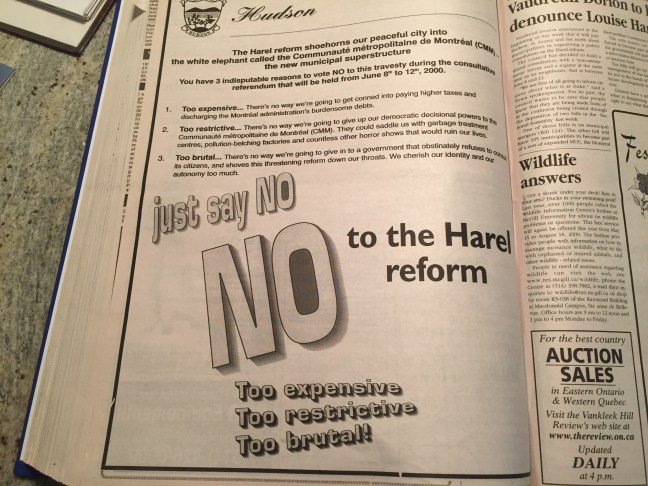
One of the Town of Hudson’s full-page ads in the Hudson Gazette prior to the town’s 1999 referendum on whether to become part of the Montreal Metropolitan Community.
Will the grassroots citizen activism taking root in Hudson translate into a more open, consultative council and administration on the far side of the Nov. 5 municipal elections?
It depends on who we elect.
Tuesday, May 30, the town’s rapidly evolving email thread (approaching 100 names) was urging the creation of online and paper petitions calling on the mayor and council to delay passage of changes to Hudson’s master development plan until after November’s election.
As the day wore on, several people I suspect will run for council, as well as a local institution with something to lose by seemingly siding with rebels and rabble-rousers, had asked that their names be taken off the mailing list.
By day’s end, the email thread had become Hudson Citizens for Smart Development, a Google Group that allows people to come and go without fanfare or obvious slamming of doors.
It’s a good, forward-thinking name and the right platform as we head into this politically charged next few months, with dozens of residents mulling whether to run for the mayoralty or a council seat.
Hudson’s current council is proposing to adopt five bylaws at the June 5 monthly council meeting, including three concordance bylaws and the two zoning changes. This administration pretends all five can be adopted without recourse to the usual approval procedures of register and referendum because they fall within the CMM/MRC concordance framework.
It’s typical of the covert, cowardly, convoluted, confrontational stance this administration has taken since taking power — an approach which, until six months ago, appeared to go unquestioned by the majority of citizens. (In fact, those who questioned this council were mocked as troublemakers by a number of those now jumping on the citizen-activist bandwagon, but I digress.)
This latest call to action came the same day the town’s second public consultation in a week was to present modifications to the town’s site planning and architectural integration programs (SPAIPs in English, PIIAs in French) to conform with those of the Vaudreuil-Soulanges MRC.
The May 23 consult, to bring Hudson’s planning and land-use bylaws into concordance with those of the MRC and the Montreal Metropolitan Community, turned into a contentious discussion of why the administration was in such a rush to get it done when five other MRC municipalities which, like Hudson, are also part of the CMM, are delaying the procedure for various reasons.
As I explain in a companion post (Trojan Horse), the administration itself confirmed last week the concordance – and the transport-oriented development zone (TOD) it enables – is the pretext to allow half a dozen multi-unit residential projects to proceed without the inconvenience of a referendum.
Also on the agenda for the May 30 consult: a zoning change in the commercial core to permit an assisted-care seniors’ residence adjacent to the Wyman United Church and a long-promised non-conforming usage derogation for the Greenwood Centre for Living History.
It would be premature to call Hudson’s fledgling citizen’s forum an organization. Those with a hand in its creation can’t agree on the need for a formal structure. Some think the energy wasted on creating a shadow opposition and organizing petitions would be better spent running for office.
Others would like to see the resurrection of various consultative committees even though this and previous Hudson councils have shown no interest in using their input for anything other than window dressing and pretence.
Still others urge delegations to attend CMM and MRC meetings, where citizen participation is limited and strictly controlled.
But what binds them is the conviction this is a battle to save Hudson’s soul.
In truth, Hudson’s battle to to save its soul began in the spring of 1999, when Lucien Bouchard’s Parti Québecois government proposed to enact the recommendations of a 1993 report urging the province to adopt measures to cut Quebec’s 1,600 municipalities by two thirds.
This existential threat to Hudson’s existence began life as the 115-municipality Greater Montreal Development Commission before morphing into the current 82-municipality Montreal Metropolitan Commission, the CMM. By that April, the PQ’s Bédard Commission recommended including 10 Vaudreuil-Soulanges municipalities in a new supra-municipal structure, the precursor to the 82-municipality Montreal Metropolitan Community that Hudson’s current stooges are hiding behind.
From the outset, Hudson mayor Steve Shaar made it clear he wanted nothing to do with the Montreal-centric péquiste juggernaut that would stretch from St. Jerome to the north, Chambly to the south, Contrecoeur to the east and Hudson to the west.
“Hudson is a special place, different from anywhere else,” he said. “There’s a sense of community. We’re not Montreal, we’re not typical of any other area in Vaudreuil-Soulanges. It’s a very special place, not only to ourselves, but in the province. That feeling, spirit, sense of belonging will be eroded if we are forced to merge.”
Hudson wasn’t alone. It would be the westernmost of 11 Vaudreuil-Soulanges MRC municipalities, along with St. Lazare, Vaudreuil-Dorion, Vaudreuil-sur-le-lac, L’Île-Cadieux, Les Cèdres, Pointe-des-Cascades and the four Île Perrot municipalities — Nôtre Dame, Pincourt, Terrasse-Vaudreuil and L’Île-Perrot.
Shaar urged Hudson residents to get involved in the fight. “I am against it, the councillors are against it. And I believe that 99.9% of the citizens are against it. I intend to be energetic in the defence of my community.”
He couldn’t do it alone, Shaar added. “It may become necessary to enlist the co-operation and involvement of citizens in a somewhat militant manner (no guns!).” As for a strategic merger with one or more of Hudson’s neighbours, “I will not accept any amalgamation with anyone. We like it [Hudson] the way it is.”
The government’s promise of negotiations proved to be a lie. Shaar and St. Lazare councillor Paul Laflamme returned from an April Fool’s meeting convinced there was no way out. Government statistics (which Shaar disputed) showed that more than half of Hudson’s population worked on Montreal island, one of two factors which determined whether an off-island municipality would be included in the CMM. The other was Hudson’s population density.
There was one bright spot. Shaar was assured Hudson would be able to keep its rural small-town character. There is no reason to believe that the MMC would refuse zoning intended to keep that character, chief negotiator Louis Bernard told him. “We may be able to maintain our integrity.”
Other off-island mayors weren’t as confident. On March 29, the 23 MRC municipalities unanimously adopted a resolution demanding that the 11 CMM inductees be excluded in order to respect the region’s distinct geographical and political nature. “Vaudreuil-Soulanges will not negotiate the partition of its territory, MRC prefect Normand Ménard said. “We don’t want to sell out our municipalities, our citizens, to the Montreal Metropolitan Community.” Ménard’s chief fear was that the MRC would lose control of its planning process.
Municipal morale hit a new low at the end of April when a leaked government white paper revealed Quebec was looking to force municipal mergers. In 1999, 85% of Quebec’s 1,300 municipalities had fewer than 5,000 residents; 552 had fewer than 1,000. The Bouchard government was looking at measures that would allow Quebec to demand that small municipalities seek mergers against their will. The aim: cut costs.
Mayor Steve Shaar with pre-referendum signage outside town hall: He was never one to surrender a principle.
That was enough for Shaar, who announced Hudson would join forces with 27 North Shore municipalities in holding a referendum asking residents whether they agreed with municipal affairs minister Louise Harel’s proposal to force Hudson to be part of the MMC. (Quebec had said it would ignore such referendums but Shaar felt it would set the legal bar when and if Quebec proceeded with its threat to force mergers.)
Shaar was especially incensed at a sentence in Harel’s white paper talking about the redistribution of growth revenues (a variant of that redistribution means our MRC pays for SQ policing in poorer regions). “That’s the Trojan Horse,” Shaar warned. “It could take bigger and bigger pieces of our revenues. I will do everything in my power to block this thing.”
Hudson’s referendum was held June 8-12,1999. (St. Lazare, in keeping with the conciliatory policies of the four South Shore MRCs, held a registry.) Shaar kept the question simple: Are you in agreement with Minister Harel’s reform project which forces Hudson to become part of the Montreal Metropolitan Community?
In his press conference, Shaar kept to his message: “A reorganization of this magnitude will have a profound impact on the lives of Hudson citizens and such changes should not be made without public consultation.”
Hudson voters knew the Bouchard government would disregard their votes but they turned out anyway.
Hudson residents proved Shaar right. Close to 74% of Hudson’s 4,000 eligible voters voted 99.73% No. Seven residents voted Yes. Among the five Vaudreuil-Soulanges municipalities to hold registers, tiny l’Île-Cadieux had the highest No vote and turnout — 89 of the 92 residents voted No unanimously. The three others were out of town.
The Bouchard government was true to its word on only one of its promises: it ignored the results of the referendums, Hudson’s included. The MMC was proclaimed into law in 2002 in the dying days of the PQ government but if anybody thought the Charest Liberals would reverse the process, they were fooling themselves. The consultation process continued.
Some of Harel’s white paper proposals, like forced mergers and wealth redistribution, have gone silent. They’ve been replaced by others that serve to concentrate political and economic power in the hands of Quebec’s major cities as central governments seek new revenue sources to cover the cost of their skyrocketing infrastructure deficits and worsening traffic gridlock.
Suburban densification is one of those tools. It makes sense in theory. Urban sprawl gobbles up farmland and greenspace while imposing costs for roads, public transit, schools, hospitals, daycares, sewer and water infrastructures and a long list of additional costs. But this isn’t a totalitarian society, where government can forbid people from looking for an exurban lifestyle, which is what the MMC set out to do with its master land use and development plan, or PMAD.
Adopted March 12, 2012 and approved by a Liberal government under Jean Charest, the PMAD has been an unmitigated disaster for Vaudreuil-Soulanges. It blocked the creation of a institutional hub that would have preserved close to 400 hectares of greenspace while providing our region with a hospital, CEGEP, schools and other facilities lacking.
At the same time, it unilaterally and without discussion, imposed ridiculous population densities on the serviced sectors of existing municipalities, beginning with transport-oriented developments. As L’Atelier Urbain’s Jean-François Viens says in Trojan Horse, my companion blog, TODs were never designed for Hudson. They’re for de la Gare in Vaudreuil-Dorion, for Brossard’s Dix30, for Candiac and Boisbriand. They’re not for picturesque small towns whose residents want them to stay that way.
Mayor Shaar was just 56 when he died of colon cancer in December 2004 but his successor Elizabeth Corker maintained his position vis-a-vis the MMC and its densification proposals. In a June 2005 brief, the Town of Hudson made it clear it wanted nothing to do with the PMAD. (http://cmm.qc.ca/psmad/avis/CS-A6.1_Avis_Ville_Hudson.pdf)
The brief begins by noting that Hudson was never consulted and that if it had been, some of the glaring inaccuracies in the MMC’s schema could have been corrected.
Its main points:
• The proposed master plan doesn’t take Hudson’s peculiarities into account;
• The MMC’s demand for an average 24-unit-per-hectare minimum would require more water than Hudson’s waterworks could supply and a sewer system (then unbuilt);
• Hudson Valleys and Alstonvale were left out of the MMC’s proposed master plan;
• A minimum density of 24 units per hectare would result in 1,600 units on 812 hectares, a density 12 times greater than that found within the town’s urban perimeter.
“These densities are clearly not applicable in a town like Hudson,” the town’s brief stated. To achieve such a density, it would be necessary to build triplexes or apartments next door to single-family dwellings on 40,000-square-foot lots. “Multi-family dwellings, row housing, triplexes and quadriplexes would completely transform the natural environment and unique character of Hudson.”
Notwithstanding Hudson’s objections, the PMAD passed into law with the Charest government’s blessing on March 12, 2012.
Before he died, Shaar told me the writing was on the wall in 1999, when the péquistes decided they were going to empower Montreal and Quebec City to collect more revenues.
So why, if he knew the MMC was a foregone conclusion, did he take the town through the exercise of a referendum?
It was a matter of principle, he said. “Hudson punches way above its weight politically. We had a reputation to uphold.”
How far can we go in criticizing the people who run the town we live in?
When does citizen activism overstep the boundaries of what’s legal?
What tools can a municipality use in protecting the reputations of its public and elected officials?
What protection does a citizen activist have against a vengeful administration bent on libel chill?
Is there a way to evaluate the damage done to a town’s reputation?
Hudson mayor Ed Prévost and director-general Jean-Pierre Roy have been wrestling with these issues following the events leading up to this week’s adoption of Bylaw 687.
It isn’t the first time this administration has tried to come up with a policy on the public’s right to comment and question. Shortly after taking office in November 2013, the current council found itself in a social media shootout with critics. I can’t find the Facebook threads, so all I have to go on is hearsay on what was posted and who was threatened with libel chill.
The fair-comment issue resurfaced this past Tuesday evening on Hudson’s town hall steps, the same steps that supply the backdrop for innumerable photos and TV standups about Hudson’s dirty laundry. The DG had just announced the results of a registry on Bylaw 687 allowing the town to borrow $550,000 to refurbish the Community Centre. The registry fell 65 signatures short of forcing a referendum or the bylaw’s withdrawal.
I asked Roy whether the town proposed to take action against Véronique Fischer, the Hudson lawyer who has been a persistent pain in the butt of Hudson’s current body politic. The week before, Fischer spent $500 to mail pamphlets to every Hudson household questioning the bylaw and urging residents to sign the register.
There have been several interpretations of Roy’s comments regarding the action the town proposes to take to silence Fischer. Roy didn’t use the word “actionner,” the closest translation for “sue.” He used the more euphemistic “prendre action,” which suggests anything from a lawyer’s letter to a lawsuit.
There’s a place for public debate, he continued, but citizens have the right to correct information. He and the mayor are in agreement that there must be “zero tolerance” for actions such as Fischer’s mailing.
On Thursday morning I sat down with the DG for a 45-minute chat about how the town proposes to silence persistent critics without being accused of stifling free speech.
Roy began by making it clear the town would seek the means to neutralize residents who make it their business to monitor the decisions and practices of municipal administrations and have the know-how to research documents and the means to take their findings to provincial authorities.
Are Hudson’s citizen activists and dissenting voices at risk of being sued? Quebec is the only jurisdiction in Canada with a law that protects citizen activists. Adopted in 2009, Bill 99 prevents businesses from filing strategic lawsuits against public participation, or SLAPPS. These are civil lawsuits filed with the specific purpose of silencing organizations without the finances to wage a lengthy court battle.
The law allows a court to declare a lawsuit abusive, order the plaintiff to provide for costs and to cover the legal bills of the defendant.
The original purpose of the bill was to protect ecologists targeted by major corporations. I can’t find jurisprudence on whether Quebec’s anti-SLAPP law has ever been used against a municipality, but I can’t see a reason why not – an excellent reason for the creation of a Hudson citizens’ association. There’s strength in numbers.
The DG walked me through the jurisprudence, the body of legal decisions on the subject. He began by showing me a legal opinion that a citizen cannot use a town’s name, crest, logo, etc. without authorization. The opinion cited a 1960 decision in favour of Montreal against the Fraternité des policiers which established fines of $1,000 per individual and $2,000 for the union.
Next was last month’s Superior Court ruling in favour of the City of Saint-Lambert in its defamation lawsuit against the St-Lambert Journal and its publisher, David Leonardo.
The judge found that the weekly newspaper had repeatedly published “false, inaccurate information that was factually incorrect and did not correlate with events“ and ordered the defendant to pay a total of $100,000 in moral damages and $30,000 in punitive damages “as compensation for moral damages caused by [the] wrongful, abusive and illegal conduct [of the defendants].”
The municipality’s position was that the newspaper had “significantly damaged the integrity and reputation of employees, managers, elected officials, and the municipal administration in general.”
Roy’s expert cited judgments involving half a dozen municipalities, all variations on the theme that accusations and insinuations are actionable. A couple of citations stood out: the right to speak doesn’t carry the right to defame” and “citizens who go into politics are no different than other citizens…they have the right to safeguard their reputation.”
Roy pointed out the cost to the municipality’s reputation as well as to those who represent it. Canadian courts have established that one can libel a corporation as well as an individual or individuals. Hudson’s bad press (“Just Google Hudson and see what comes up.”) makes it more difficult to find qualified managers and technicians.
Roy, too, is a lawyer, so we danced around the role Fischer has played and continues to play in town politics. Fischer represents Catherine Haulard, the former DG. Provincial labour relations tribunal judge Mylène Alder was to have submitted her ruling by today (Friday, April 21) on whether Haulard’s 2014 dismissal was unlawful. If it isn’t out by the time you read this, expect it any day.
The Prévost administration has a growing list of grievances against party or parties unknown. Did Robert Spencer have legal help drafting his complaint against the mayor to the Commission municipale du Québec? Who filed a complaint with MAMOT regarding the legitimacy of the loan bylaw authorizing the expenditure of $1.5M for the repaving of the town’s main arteries?
Roy’s only comment directed at Fischer? “She’s given me a lot of work.”
I questioned Roy on the town’s latest legal adventure. I scanned Fischer’s pamphlet. I couldn’t find a single legally actionable phrase. She questions actions but does not impute motives. She attacks no one. She makes no questionable assertions. The town’s only case against her – if there is a case – centres on her use of Hudson’s logo by copying the top of the loan bylaw.
I asked Fischer for comment for this post. Her response was to send me the results of her latest access to information requests, showing that as of January 2017, Hudson wasn’t on the list of approved Canada 150 projects. She also produced a May 2016 grant application for the Hudson Community Center presented by the Hudson Music Festival. The application is for $53,122 toward the $105,300 cost of installation and renovation of the Hudson Contemporary Arts Centre.
There’s an expression in French: Elle persiste et signe. Whatever she may or may not have accomplished in the past, Fischer shows no intention of stopping her campaign to have the Community Centre loan bylaw invalidated. Prévost and Roy will do their utmost to shut her down, but I suspect the damage has been done.
Now that the curling rink roof is off the table, what’s left? Loan Bylaw 687 makes no mention of matching grants or that to-do list citizens were promised. All it says is taxpayers are on the hook for $555,000 for the next 20 years.
But not if Fischer can help it.
Update posted Aug. 5/18 on FB Hudson and vicinity:
Here’s the context:
Municipalities throughout Quebec are having to find new ways to deal with social media and other platforms beyond the reach of traditional arm-twisting, like pulling town ads or the threat of libel actions. So municipalities are trying out new ways to control/stifle dissent.
Example: a Violence Zero Tolerance policy which allows town employees to file complaints alleging acts of physical or psychological violence making their workplace less safe.
Here’s how this would apply to social media:
Let’s say a FB forum is used to convey criticism about a certain practice or action by the town or its employees.
According to some of the more restrictive VZT policies I’ve come across, an offensive FB post need not specify an individual if it is obvious the practice being criticized is the result of one employee’s decision.
These VZT guidelines don’t spell it out, but my read is that the taxpayers end up paying for legal action a municipality may be forced to take as the result of anything someone working for the town alleges is a micro-aggression directed at them. In Hudson’s case, the current director-general indicated to me two years ago the town would be looking hard at this.
(Lawyer vs. Lawyer, thousandlashes.ca, April 21/17). From what I’ve been reading from across the province, I’d have to say FB forums such as this should anticipate adoption of a VZT policy and require posts on controversial topics to be moderated. When one of these VZT cases gets to court (and I’m sure one will) an ounce of prevention could make all the difference.
Hudson Legion Branch 115’s clubhouse roof leaks. So does the adjoining curling rink roof. According to the town’s new grants and certifications co-ordinator, the rink roof isn’t covered by the Canada 150 infrastructure grant the town has applied for. What is covered? We don’t know, but we handed the town a blank cheque for $555,000.
I daresay Hudson residents are thoroughly fed up hearing about that $555,000 loan bylaw for Community Centre renovations.
Because Tuesday’s register failed to gather enough signatures to force a referendum or withdrawal of the bylaw, this administration can move forward with the project on the vow that if it doesn’t get a federal Canada 150 infrastructure grant to cover half the cost, it won’t dip into the loan money.
But I think taxpayers should know the new Legion curling rink roof is suddenly no longer covered.
The following was published in today’s Local Journal:
According to Corriveau [Simon Corriveau is the town’s new temporary full-time co-ordinator of grants and certifications] there are items in the renovation project […] that the grant will not cover.
”The roof over the curling rink is the only portion not included,” said Corriveau. “The rest of the building is used by other groups as well as the Legion,” he added, clarifying that because the ice sheet is used for a sport, it would be covered by another type of grant. “We are hoping for a response by the beginning of May,” Corriveau concluded.
I asked the town’s director-general Jean-Pierre Roy why the town has not been specific about how it proposes to spend up to $555,000. He said the decision was to keep the renovation details deliberately vague so that the grant application wouldn’t risk disqualification.
Essentially, Tuesday’s failed register writes this administration a blank cheque for $555,000. This is fact, not Jim Duff’s opinion.
Bylaw 687 makes no reference to federal grants, matching funds or what is and isn’t eligible. All it says is that taxpayers are on the hook for the next 20 years. If you want to read it, it’s posted on the Town Hall bulletin board.
Curious taxpayers will find the administration’s to-do list on the town website. They should know this post has no legal status and isn’t binding on the current council, except perhaps ethically. This is the only public document where ‘roof’ is mentioned.
We would like to make the necessary repairs to the building such as replacing the roofing, electrical connections and upgrading the kitchen facilities. Also, since the community centre was designated as a place of refuge for emergency measures on February 25, 2016, some of the building’s mechanical components such as air conditioning, heating, lighting and sanitary installations must be redone. This will allow us to replace old energy-consuming equipment that uses a lot of water with newer installations that consume less, thereby saving us money. In addition, the windows must be changed as traces of water infiltration have been detected and several of them do not lock. Lock mechanisms and door locks must all be changed in order to ensure the safety of the users. In some areas, the floor is quite worn and it is possible to see the underlying concrete. We also want to redo the exterior parking lot and its lighting, build a bike stop for cyclists and set up an access ramp for people with reduced mobility to give them access to the youth centre. It is also planned to expand the kitchen and build small meeting rooms to allow community groups to meet.
Why an umbrella bylaw? This type of bylaw allows us to make various expenses (plans and specifications, repairs, additions, etc.) without limiting our options. As the Town must act quickly to complete the work before the end of the year and needs some flexibility, the decision was made to proceed with an umbrella bylaw. To carry out this multifaceted project, the Town will have to commission an architectural and engineering firm to evaluate the scope and costs of the work to be done. Only once the estimate has been produced will we be able to make judicious and informed choices regarding the project priorities in order to ensure that we respect the allocated budget.
The town’s post notes the work must be completed by Dec. 31 in order to qualify for federal funding.
Many interpret the results of Tuesday’s register as the end of the process and act as if it’s a victory. In fact it’s neither. It’s public recognition of the need to maintain an important component of Hudson’s public life, yes. But the same hard questioning that marked the process of adopting the bylaw must continue into the evaluation and renovation processes.
Why am I so suspicious? Some years back, I got a call from a former Hudson councillor. He told me how, during the original construction of the Community Centre, the council of that time quietly voted to transfer $150,000 earmarked for lighting and other improvements in St. Thomas Park to the Community Centre, which was running over budget.
I asked him why, after all that time, he was calling me with this. “I thought you should know how it works,” he said.
As I posted last week (Plan B), we know the town already has a $160,000 contingency plan to fund the new roof and kitchen upgrades in the event the grant application is rejected. I assume this is what will happen if there’s suddenly no federal cash for a curling rink roof.
This morning Maître Roy and I spent 45 minutes discussing the difference between fact and opinion (This will be a topic for another post). I will hereafter do my best to separate the two and alert readers before I shift from one to another.
The following is my opinion:
The price of democracy is eternal vigilance. Tuesday’s passage of the loan bylaw doesn’t change that responsibility. If anything, it makes it an imperative.
The Town of Hudson threatens to initiate legal action against resident Véronique Fischer for her pamphlet critical of the town’s proposed loan bylaw to pay for up to $555,000 for renovations to the Community Centre and Legion building. Residents have been assured the town has applied for a $225,000 grant with the federal government’s Canada 150 infrastructure program and none of the loan will be spent if the town doesn’t receive the matching funds.The Town of Hudson has been given the green light to proceed with its plan to borrow up to $555,000 for renovations to the Hudson Community Centre and Legion.
Tuesday’s register on loan bylaw 687 gathered 363 signatures, 65 short of the 428 which would have forced a referendum or the bylaw’s withdrawal.
In announcing the results Tuesday evening, Hudson’s Director-General Jean-Pierre Roy said the town has no news from the federal ministry responsible for administering the grants program under which the town says it has applied for up to $225,000.
Roy also served notice the town will initiate legal action against Olympic resident Veronique Fischer in connection with a pamphlet sent to Hudson households the week before the register.
Fischer’s mailing criticized the expenditure in the face of more pressing priorities, such as the town’s disintegrating roads and sidewalks and a potentially disastrous water shortage.
Its appearance in mailboxes triggered a lively debate about whether the administration has been transparent in its explanation of how it proposes to obtain a Canada 150 infrastructure grant.
It also generated a number of complaints to the town because Fischer’s pamphlet included the Hudson town logo, conceivably misleading residents to think the mailing originated with the town.
Asked whether the town proposes to take action against the author of the pamphlet, Roy said it contained false and misleading information. “This will not be tolerated,” he told a small group of journalists and citizens gathered on the front steps of the town hall, Fischer included.
“We’re in favour of a public debate, but people have the right to have correct information,” Roy continued. “There will be zero tolerance [for misinformation.]
Roy didn’t elaborate on misinformation allegedly contained in Fischer’s mailing, which pointed out that the loan bylaw contains no specifics about the grant application or on how the $555,000 is to be spent.
Fischer confirmed she was the author of the mailing, which cost her roughly $500, and said the administration’s threat didn’t scare her.
“I’m a lawyer, a litigator,” she added. “Cease-and-desists are my bread and butter.”
Although loan bylaws are usually accompanied by a public consultation where citizens can learn details and see plans and diagrams for themselves, the only information released to date was a short explanation by District 4 councillor Barbara Robinson at the April council meeting and a posting on the town website. which vowed that the town wouldn’t spend the loan if it doesn’t get the grant.
Fischer, who ran against Robinson in the 2013 municipal election, has been a persistent thorn in this administration’s side. One of her issues with the Prévost administration involved the plan to borrow $1.5 million to repave a number of streets.
It was suspended by the municipal affairs ministry, in part because the 15- or 20-year term of a loan bylaw cannot exceed the life of the repair it is used to pay for. Another factor in the suspension was due to the fact that many of Hudson’s so-called public roads are still privately owned, in whole or in part.
Fischer said the current administration has balked at voting for the funding to continue the notarial and survey procedures required to transfer those private roads to the public domain.
“I fully expect to be blamed for the roads, for Pine Lake,” she added. “But I’m not easily intimidated.”
This post was updated with the following correction: Barbara Robinson represents District 4, not District 2
According to the Town of Hudson’s 2017 budget documents, the municipality has a contingency plan in case the application for a federal infrastructure grant and/or loan bylaw 687 are rejected.
The Town of Hudson’s 2017 budget includes $160,000 for a new Legion roof and Community Centre kitchen upgrade even if the Canada 150 infrastructure grant request is rejected, according to a printout dated the day before the first 2017 budget was adopted.
Last Dec. 15, this administration adopted the first of two 2017 budgets. The day before the meeting, the town produced a spreadsheet which broke down the proposed 2017 disbursements to community organizations, events and causes.
The three-page document is the result of a resolution, R4280 adopted at the Sept. 6, 2016 council meeting. The Politique de reconnaissance de Hudson/Hudson reconnaissance policy was to “acknowledge receipt of a Town project for a Policy in recognition of organizations to be considered [by] Council first and thereafter presented for consultation by the citizens in a process to be determined by the Town.”
The spreadsheet names the cause, organization or event, the amount given in 2016, the amount demanded in 2017 and the amount the town was proposing to give in 2017.
Under Hudson Royal Canadian Legion, the requested 2017 disbursement was listed as “Roof (included in the Canada 150 infra. Grant request).
Council’s decision: “$500,000 if granted, $100,000 if not.”
There’s a similar entry for Meals on Wheels, the major user of the Community Centre kitchen: “grant request Canada 150th.” The request was for “kitchen renovation. Kitchen fan up to date, etc. $60,000. Council’s decision read “kitchen renovation. Kitchen fan up to date, etc. $60,000.”
The way I read this, council approved the $60,000 kitchen upgrade whether or not the grant is approved.
A posting on the town’s website includes the following disclaimer:
“We want to reaffirm that the acceptance of our project in the Canada 150 Community Infrastructure program (PIC150) is an absolute prerequisite to go forward with the loan bylaw 687-2017 as stated in the motion and in Section 5 of the bylaw. If the Town does not receive the grant, the loan bylaw will be cancelled.”
What the posting doesn’t say is whether the town will find other means of financing the upgrade.
As Hudson residents now know, this administration had to present a revised budget a month later, after it was revealed the town had erred in calculating the budget increase. So it’s possible this document was revised to allow council to cut approximately $1M from the 2017 budget to lower the average tax increase.
But this spreadsheet was adopted without discussion at the Dec. 15 council meeting and was not repealed or replaced when the new budget was adopted in January.
I think we’re seeing the town’s contingency plan if the grant is turned down.
The Pine Lake end of the Black Creek culvert prior to last Thursday’s emergency repairs. Shouldn’t this be a loan bylaw priority?
There’s another reason I’ll be signing the register in opposition to Hudson’s loan bylaw 687 next Tuesday.
We have no idea of the cost of repairing the Brookside and Viviry culverts under Cameron.
Clearly, one of the two main arteries in and out of town is at risk as long as the failed Pine Lake dam and both culverts are not removed and replaced.
If it comes to a choice between $500,000 for a renovated Community Centre and an unknown bill for a secure Cameron, which would be the sensible option?
Traffic on Cameron was squeezed to a single lane since the previous Friday after it was discovered that heavy rains had collapsed a section of the shoulder atop the Brookside culvert.
Last Thursday, April 13, Cameron was closed in both directions between 8:30 a.m. and 5 p.m. so emergency repairs could be made to the culvert and roadbed between Brookside Pond and Pine Flats.
The current administration has long feared that if Pine Lake regains its former size as a result of heavy rains or runoff, the increased water pressure and volume could easily carry the dam away — and Cameron with it.
I asked Hudson director-general Jean-Pierre Roy how the town proposes to pay for repairs to the Brookside culvert and whether emergency repairs could be extended to include the larger culvert under Cameron next to the failed Pine Lake dam.
“These repairs were urgent, necessitated by runoff,” Roy said in an emailed response to my questions. “The [Brookside] culvert was under increased surveillance for the past several months and we had publicly noted its fragile state several months back.
“We [had] no choice but to proceed with immediate emergency work without a council resolution,” Roy said. “We have advised our insurers, we will be applying to Sécurité civile for financial assistance of approximately 60% of the cost.”
The Vaudreuil-Soulanges MRC has authorized the work being done, he added. “We could also use a portion of the TECQ [ the fuel excise tax rebate available to municipalities].”
The town has been keeping its fingers crossed for months, Roy explained. Engineers had already been planning to install a replacement as soon as a reduction in the flow of water from Black Creek allowed, usually in the fall.
“We had hoped to repair this culvert as part of the $1.5M [road repair] loan bylaw against which a complaint had been made and was consequently suspended by ministry authorities. We had wanted to avoid having to repave the same sector twice.”
Roy termed the volume of runoff “exceptional,” threatening both the Brookside culvert and the footbridge that connects Jack Layton Park with the Sandy Beach nature trail.
“We couldn’t wait any longer. The break was caused by water. The culvert was old but without the increased volume we could have done the work together with other work in an efficient manner.”
Plans to install the replacement culvert will be finalized once the town receives authorization from the environment ministry, recommendations from the engineering consultants and authorization from the MRC, Roy said.
Closeup of the Black Creek culvert on the Pine Lake side. It was installed when Cameron was extended to Harwood Blvd. half a century ago.
I visited the scene of the crime last week, the day before Cameron was closed for emergency repairs. Last week’s rains appeared to have washed right through a rusted-out section of the 24-inch galvanized steel pipe draining Black Creek under Cameron into Pine Lake. The culvert was installed in 1961, when Cameron was extended through the woods up to Harwood to create the Fairhaven development.
The lake itself made a guest appearance, to the delight of passersby and nesting geese, who will be sorely disillusioned when the floodwaters recede. The 2014 AMEC hydrological study showed the Viviry acts as a retention basin that can contain more than 16,000 cubic metres of water during the spring runoff.
The Viviry collects the runoff from a watershed of 13.9 square kilometres stretching south to Ste. Angèlique, west to the Fief and east to Bellevue. AMEC estimated the theoretical 100-year flood of water through the dam culvert under Cameron at 26 cubic feet per second per foot, enough to make quick work of what remains of the Pine Lake dam.
In its report, AMEC refers to the galvanized iron culvert under Cameron but makes no mention of its condition or the volume of water it conveys. Black Creek drains a 2.8-square-kilometre watershed.
The EXP study conducted in early 2014 proposed five scenarios for Pine Lake. They ranged from $148,000 for the demolition and removal of the dam all the way to its replacement with a new dam for $481,504. That included $73,584 for contingencies and $40,000 for the engineering and lab tests.
That August, the current administration adopted a $750,000 loan bylaw to cover the cost of repairs to the dam. Repairs to Cameron and the two culverts were not included because the administration felt it could access government funds.
The loan bylaw was withdrawn after a sufficient number of residents, concerned at effectively presenting council with a blank cheque of up to $750,000, signed a register to force a referendum.
It’s a sad commentary on this administration that it can’t get borrowing or zoning bylaws passed without a big drama. Could it be because residents require more transparency and frankness than our current council is willing to provide? I refuse to accept the alternative explanation that we should shut up and suspend our collective disbelief. Hudson tried that for half a century. We know how that turned out.
This post was rewritten to correct certain facts regarding the 2014 loan bylaw to replace the Pine Lake dam, but not to repair the two culverts and Cameron.