Sandy Beach: Nature gets a break

A map turtle sunning itself Saturday in a pond which drains into the Viviry. Give them peace and they’ll return to the Viviry estuary.

First, the good news in the latest twist in Hudson’s Sandy Beach saga — flora and fauna will get a much-needed break from years of public traffic and environmental degradation.

On Friday, the Town of Hudson announced the beach and access trails will be off limits until further notice as the administration considers its options. 

“The trails leading to the beach are currently on private property and are no longer accessible to the public,” the town posted on its Facebook page. “The [town] must now assess all possible scenarios to provide access to the beach in full compliance with government standards.”

The bad news? Access to the beach will be closed for at least the next year and possibly forever, depending on whether Quebec’s notoriously fickle environment ministry approves an alternative access trail in an ecologically fragile conservation zone. 

Wasn’t the current council elected on a promise to protect the environment, especially Sandy Beach? 

 At Monday’s May meeting, council will begin the long process with votes on modifications to existing parking and park-use bylaws. For residents, it’s the first opportunity to ask for details on how much of Sandy Beach Nature Park will remain accessible and where or how beach access will be blocked. Will the Town barricade the western end of the footbridge or will pedestrians be able to cross to connect with the entrance off Beach? Will the summer daytime dog ban remain in effect?

A key question is who will shoulder the cost of enforcing the no-parking rule on Beach road or policing the beach for trespassers. Another is the status of Beach road itself. Residents living on Royalview, a cul-de-sac at the far end of Beach, have a servitude to travel on it, but the stretch between Royalview and the exo right-of-way remains private and belongs to the developers. A recent request by Royalview residents to have their street revert to private was refused by the town because their lots weren’t buildable unless they faced on a public road — an MRC requirement.

UPDATE: responding to questions at last night’s meeting, Mayor Hutchison confirmed the town would shoulder the costs of policing Sandy Beach and enforcing a parking ban on Beach road. The town’s concern is that the 2017 development agreement includes clauses giving the landowner grounds to invalidate the beach servitude in the case of non-compliance

Residents requesting a copy of the 2017 agreement will need to file an Access to Information request and may receive a redacted version, the mayor told citizens.

In response to questions on where citizens will have legal access, the mayor said no-trespassing signage has been ordered but gave no further details.

A post on the Town’s website provides some insight into the elaborate approval process required to reopen the beach, beginning with the hiring of SAGIE Inc., an environmental consultant the Town has used in past dealings with the environment ministry.

It quotes SAGIE’s Gérald Renaud: “the area targeted by the project to relocate a section of the Sandy Beach trail is a riparian area of the Outaouais River subject to regulation by the Ministry of the Environment, Climate Change, Wildlife, and Parks. This control involves a study of the ecological characteristics (fauna, flora, and habitat) and water characteristics (coastline, shoreline, and flood zone), which will make it possible to establish whether the project needs to be submitted to the Ministry for authorization.” 

Only once the ministry’s approval has been confirmed can the town award a contract for a proposed access trail. “It is currently impossible to put forward a date for the reopening of the beach, as the Town does not control the deadlines for the stages that are the responsibility of other partners,” the town post reads.
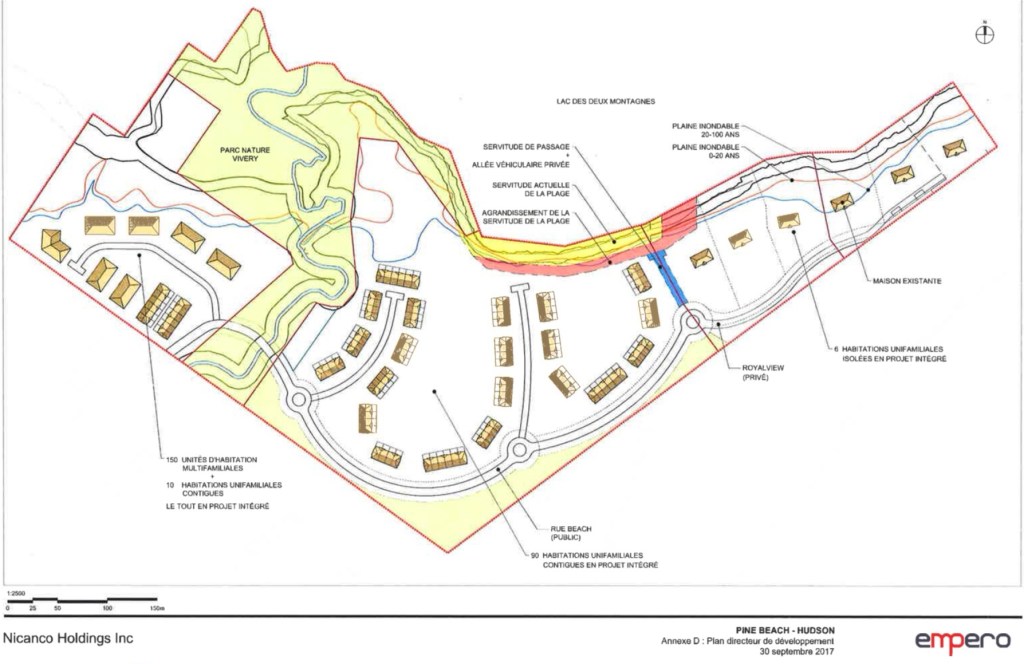
The area in light yellow is the land Nicanco deeded to the town as part of the 2017 development agreement. The darker yellow is the beach servitude and the orange is land the developer proposed to add. How much of this deal will be rolled back?

The easiest fix

The obvious solution is a waterfront trail or boardwalk between town-owned land and the beach, running parallel to the existing trail, which passes on the developers’ land. But for that to happen, the town will need a new certificate of authorization (CA) from the environment ministry for a legal walking path and the prep work that goes with it. 

The new path to the beach would pass along the waterfront of Lot # 3080946, the 10-acre parcel which Nicanco ceded to the town in a 2017 development agreement with the outgoing Prévost administration. This stretch of town property touches the beach servitude, but there’s no current CA for a trail.
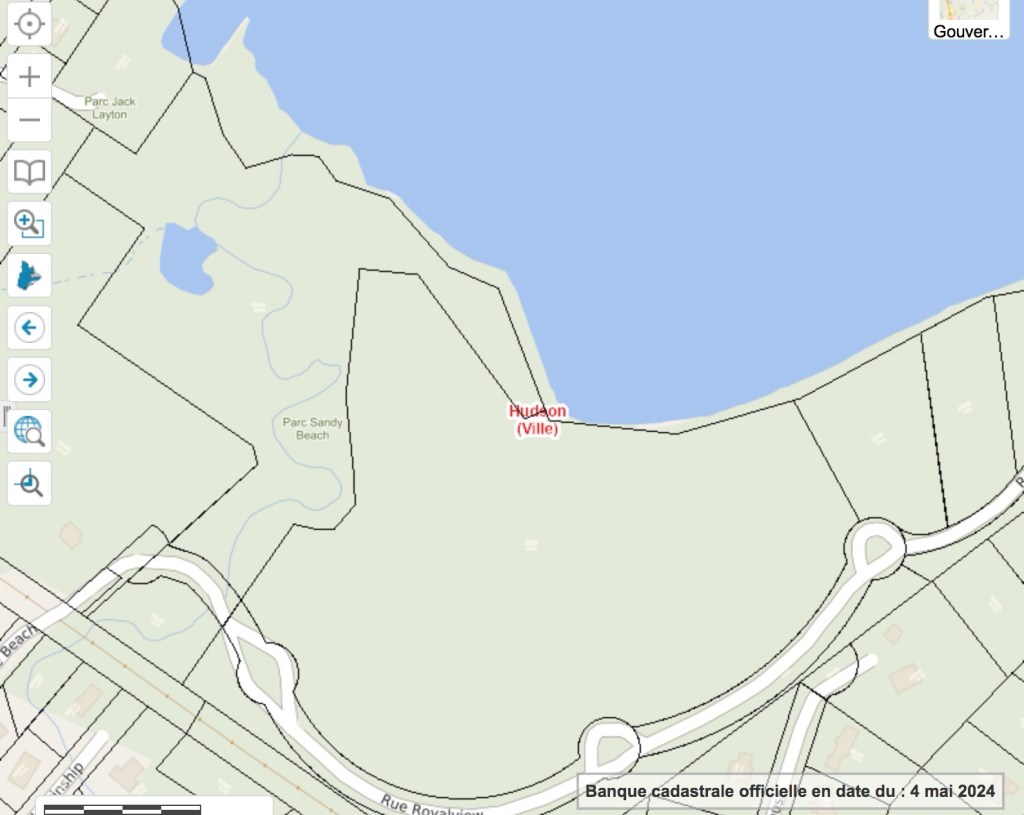
Infolot map shows the narrow ‘beak’ of town-owned land touching the beach servitude. The town needs permission from the environment ministry to create a trail to connect to the beach.

“If you go to the infolot website, and search for lot 3080946, this is the lot Nicanco ceded to the town,” explains someone familiar with the file. “You will notice a beak-like extension at the top right. The beak’s easternmost (right-most) limit is exactly where the beach servitude begins.”

The current walking path runs on Nicanco’s lot # 3080948, just below the beak-like extension. “So to get to the beach (unless one trespasses) the town needs to create a path through the “beak”. This will require a CA, and everything that goes into preparing said CA. Perhaps the current council is prepared to go for eco-compensation should any flora or fauna needs protection.”

My source predicts this will take many months, if not years to negotiate with the help of consultants, possibly putting taxpayers on the hook for ecological compensation.
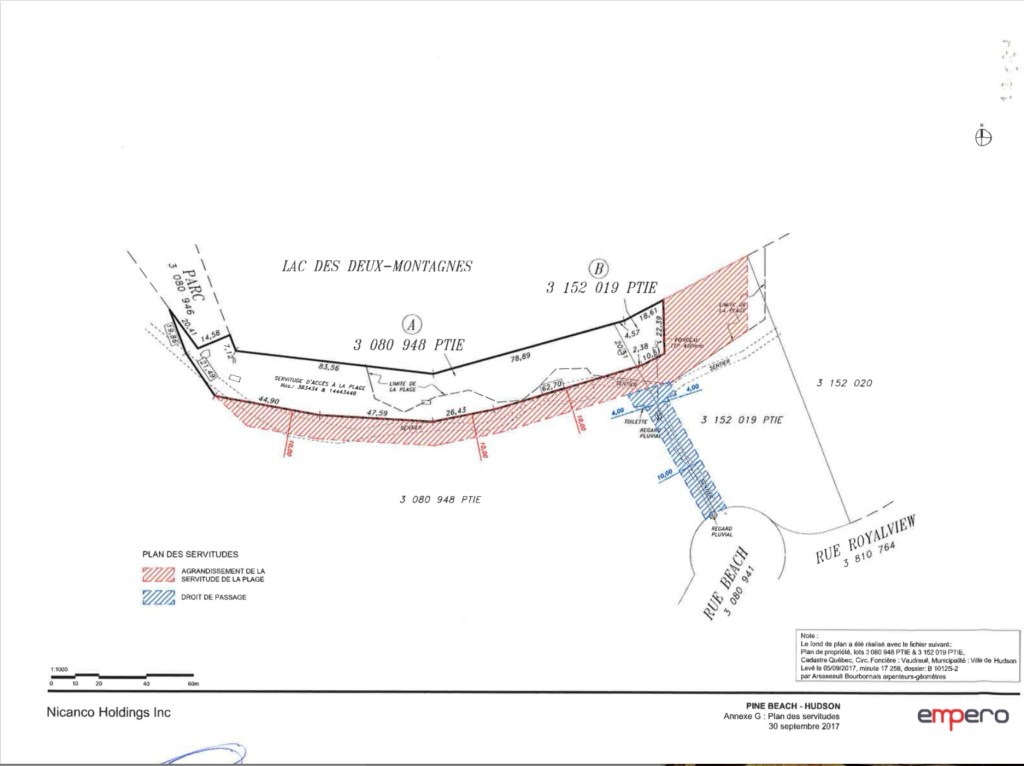
The beach servitude as delineated in the 2017 Nicanco-Hudson development agreement. Assume the access servitude (in blue) has already been nullified. How much more of the agreement will be rolled back as the sides continue their feud?

The biggest unknown is how much further the Hudson-Nicanco deal will unravel. Although a land transfer isn’t reversible in law, Nicanco could argue that the 20 plus years of covenants creating Sandy Beach Nature Park and the beach servitude were part of an overall agreement, now in pieces as the result of a cascade of events.

Because of the current council’s fixation on blocking Sandy Beach development, Hudson residents may never regain access to the town’s one public beach. The only glimmer of hope is that the environment they vowed to protect may actually be protected. At least for a year.

Sandy Beach: Nicanco’s game

Infolot_Sandy-Beach-green-trail-lots-serv.jpg
Unconfirmed: Nicanco’s proposed development according to one version of its rezoning proposal. The five single-family units on 40,000-square-foot lots are to the right. In the centre, 25 multi-unit structures, most likely with four townhouses per building. At left, on the far side of the Viviry conservation zone, two 50-unit structures would densify the project’s western sector. 

The following is what I expect will happen at next Thursday’s public meeting regarding Hudson’s Sandy Beach. This comes from a variety of sources, none of whom is authorized to speak on the record.

Nicanco Holdings Inc., owner of the 60-acre Sandy Beach parcel delineated in the map above, wants a zoning change to permit a greater density. Bylaws 408 and 409, adopted by referendum in September 2001, gave Nicanco the right to build up to 150 units.

Nicanco’s requested zoning change would allow 210 units, well short of MRC/PMAD densification guidelines.

Quebec requires all zoning bylaws to be subject to approval by referendum unless a municipality seeks provincial approval for a Plan particular d’urbanism, or PPU. There is no indication the town has made such a request.

However, even if citizens reject Nicanco’s bid for greater density, the municipal affairs ministry and other sources have confirmed that zoning reverts to the previous zoning, in this case Bylaws 408-409.

Bylaws 408-409 created three zones. R-6 (11.6 acres), the closest to Quarry Point, would allow five single-family residences on 40,000-square-foot waterfront lots. R-7 (23.65 acres), the largest sector, would permit four units per hectare, equivalent to 25 single-family units or 95 townhouses. R-8 (10.6 acres), across the tracks from Manoir Cavagnal and to the west of the Viviry footpath, would allow 12 single-family dwellings, 40 multi-family units or a 50-door seniors residence with a maximum height of three storeys, or 42 feet.

Back to Thursday’s meeting, where I’m told citizens will hear presentations from Nicanco and the Town of Hudson. As I write this, the meeting serves no legal purpose. Quebec’s rezoning protocols stipulate that any public consultation on a zoning proposal be preceded by a Notice of Motion and adoption of a draft bylaw. The administration could do both at a special public meeting prior to the meeting but would have to do so with 24 hours notice and post the time, place and date on the bulletin board at Hudson town hall. Such a meeting would be open to questions from residents.

I’m keeping an eye on the town hall bulletin board for a change in status. I’m also mindful that anything said at a public meeting (other than a council meeting) is subject to libel.

Nicanco’s presentation, likely given by urban planner Marc Perreault, will concentrate on aspects of the project such as architecture, construction standards, average density, structure footprints, parking, security and pedestrian walkways.

Perreault was Nicanco’s representative at the June 2001 public information meeting and has worked on the Sandy Beach development for most of his working life. He knows every detail, including how the 2008 Technika-HBA woodland/wetland audit overlays the 60-acre site. (Sandy Beach: the core problem, http://www.thousandlashes.ca)

We know Nicanco’s development plans hit an environmental barrier following the adoption of stricter environment ministry guidelines sometime after 2001. Nicanco’s problem was a 1.5-hectare wetland in R-7, the zone where it had hoped to build townhouses. The project was blocked until 2012, when a new provincial law (Bill 73) permitted wetland trades to unblock development of environmentally sensitive areas. As a result, developers could buy the right to backfill a wetland by preserving in perpetuity a wetland of equal or superior environmental value in the same watershed.

Nicanco moved quickly to take advantage of the new law, pressuring the municipal administration of the time to provide a wetland that would satisfy the ministry’s requirements.

The town, sensitive to the optics of spending tax dollars on land to satisfy a developer, tried everything short of buying wetland. It offered a wetland it had just acquired opposite the new sewage treatment plant. The ministry told the town it couldn’t protect what it already owned. Then the town offered a parcel of the Viviry Valley Conservation Area acquired as a result of the Whitlock West deal. The ministry told the town it couldn’t protect what it had already protected. In desperation the town offered a parcel in Como it would acquire in exchange for a tax credit. I don’t know what happened to that deal, which went down during Hudson’s darkest days between April and November 2013.

In the end, Nicanco came up with its own solution, reconfiguring its Sandy Beach development plan to guarantee 3.5 hectares of R-7 near the beach in exchange for the right to backfill 1.5 hectares of wetland closer to Royalview.

Sandy Beach wetland added.png
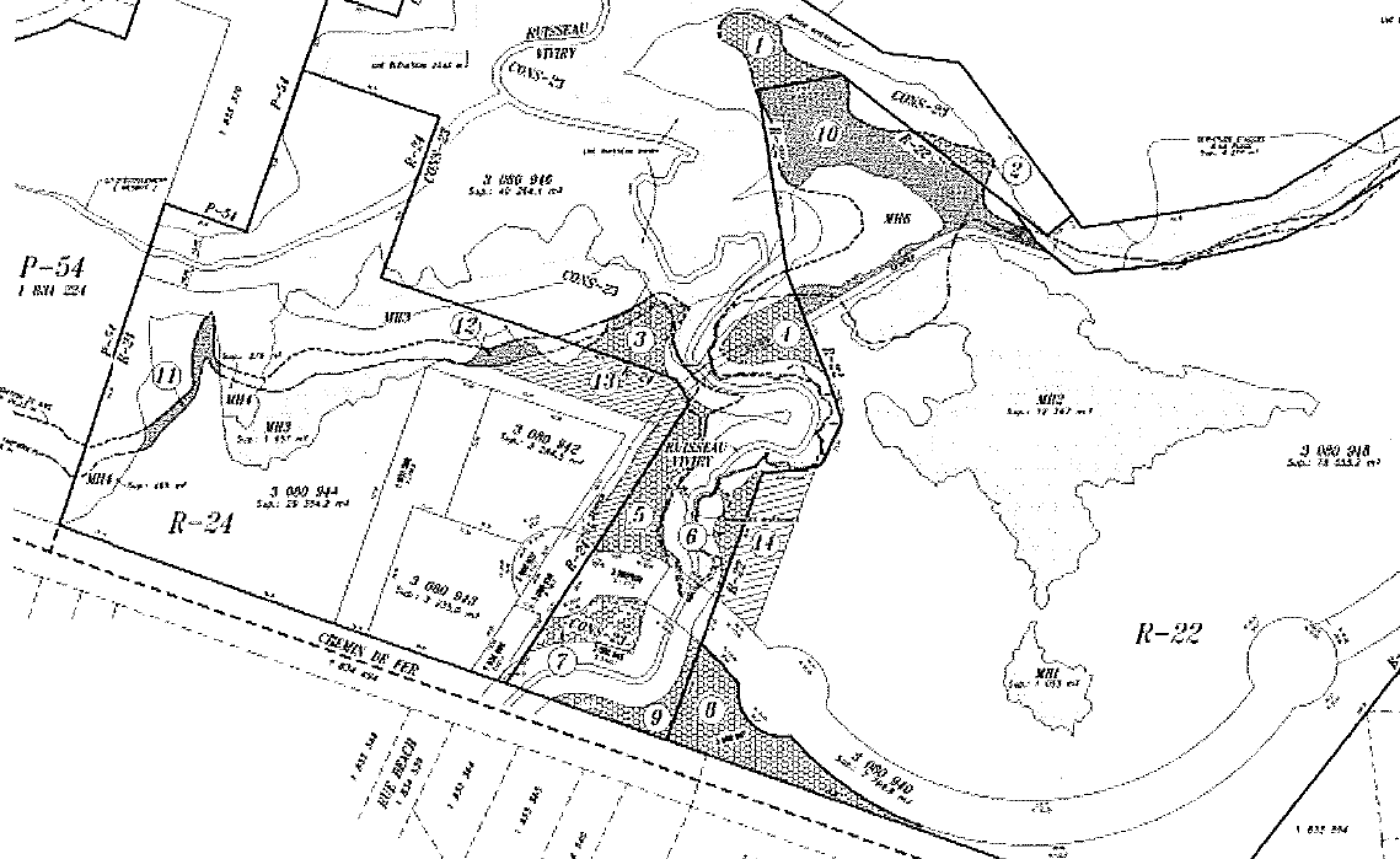
Unconfirmed: Wetland trades in the town’s favour appear to be the darker hatched areas, while the trades in Nicanco’s favour appear as the lighter hatched areas. 

I suspect this exchange is why Nicanco is rolling the dice in the hope of getting greater densification.

I’m told Nicanco’s latest proposal would limit its construction footprint to 12.5 hectares, or 31 acres, representing 56% of the total land area of Sandy Beach. I don’t know if the 56% includes roads, setbacks, footpaths and public space, but it may be less than the 2001 deal.

Bylaws 408-409 gave the town 20% of the total greenspace and preserved 75% of the pine forest and 50% of the total forest canopy. The town got the use of, and legal access to, 1,186 feet of beachfront and 11 acres of greenspace. Nobody can tell me whether those numbers have changed in the latest proposal.

So the big challenge at Thursday’s meeting will be to determine how this latest proposal compares with the 2001 status quo.

Meanwhile, the town will present details of its plan to ensure greater security and control access to Jack Layton Park, Sandy Beach Nature Park and the beach area. This will include fencing, public parking, lifeguards and regular water quality testing. The town intends to enforce curfews,, leash laws and nuisance bylaws targeting loud music, fires, alcohol and drug consumption. It will also ban watercraft from the beach area.

I expect the town to announce tariffs for non-residents. I don’t know how this will play, but it might be popular with residents who resent the wave of  humanity descending on the beach every summer weekend.

“Oka Provincial Park charges $25 for daily access,” I was told. “People come [to Sandy Beach] from all over and don’t pay. Hudson residents tell me they’re afraid to use the beach because of the broken glass, open alcohol consumption and dogs running in the water.”

Council has budgeted $250,000 in its 2017 triennial capital works (PTI) budget to cover the cost of securing the beach.

I’ve been following endless Facebook threads regarding the project, including those pushing the town to buy the site outright. Organizers of an online petition claim to have gathered 1,000+ signatures to pressure the Prévost administration to negotiate an outright purchase of Sandy Beach.

With respect to those who have expended their time and energy on this, we’ve been this way before (A Short History of Sandy Beach, http://www.thousandlashes.ca) and the path goes nowhere. As we saw in 1998, the public gets enthusiastic when someone proposes a simple solution to a complex problem, then quickly loses interest when there’s no immediate gratification.

We can rule out expropriation because of the legal costs and the risk of losing. It cost Hudson $575,000 to purchase from Graeme Nesbitt the wetland opposite the sewage treatment plant on Wharf Road. Nesbitt took the town to court because a storm sewer discharging onto Nesbitt’s land had killed all the trees. Nesbitt proposed to sell it to the town for less than $200,000 but the administration at that time wouldn’t hear of it and moved to expropriate. The town ended up paying Nesbitt $500,000. Another $75,000 disappeared into thin air, allegedly because former town manager and clerk Louise Villandré cut her phantom suppliers three $25,000 cheques.

Even without the fraud surtax, the expropriation attempt was a disaster because one never knows what the expropriation tribunal will decide. No sane administration would roll the dice for parkland its citizens already enjoy access to.

Others posting on Facebook would have us believe there’s a Hail Mary solution, like the cost of an overpass on the Beach Road crossing. The AMT owns the right of way (the AMT’s contribution in lieu of taxes forms part of the $113,430 the town will receive in 2017) and oversees roughly 100 of what the Canadian Transportation Safety Board characterizes as low-speed level crossings throughout its network. (Hudson alone accounts for Beach, Main, Bellevue plus a number of unsignalled crossings, such as the one on Montée Manson.)

At this point, the Save-the-Beach lobby is reduced to praying for rare and endangered species and hoping for a First Nations intervention.

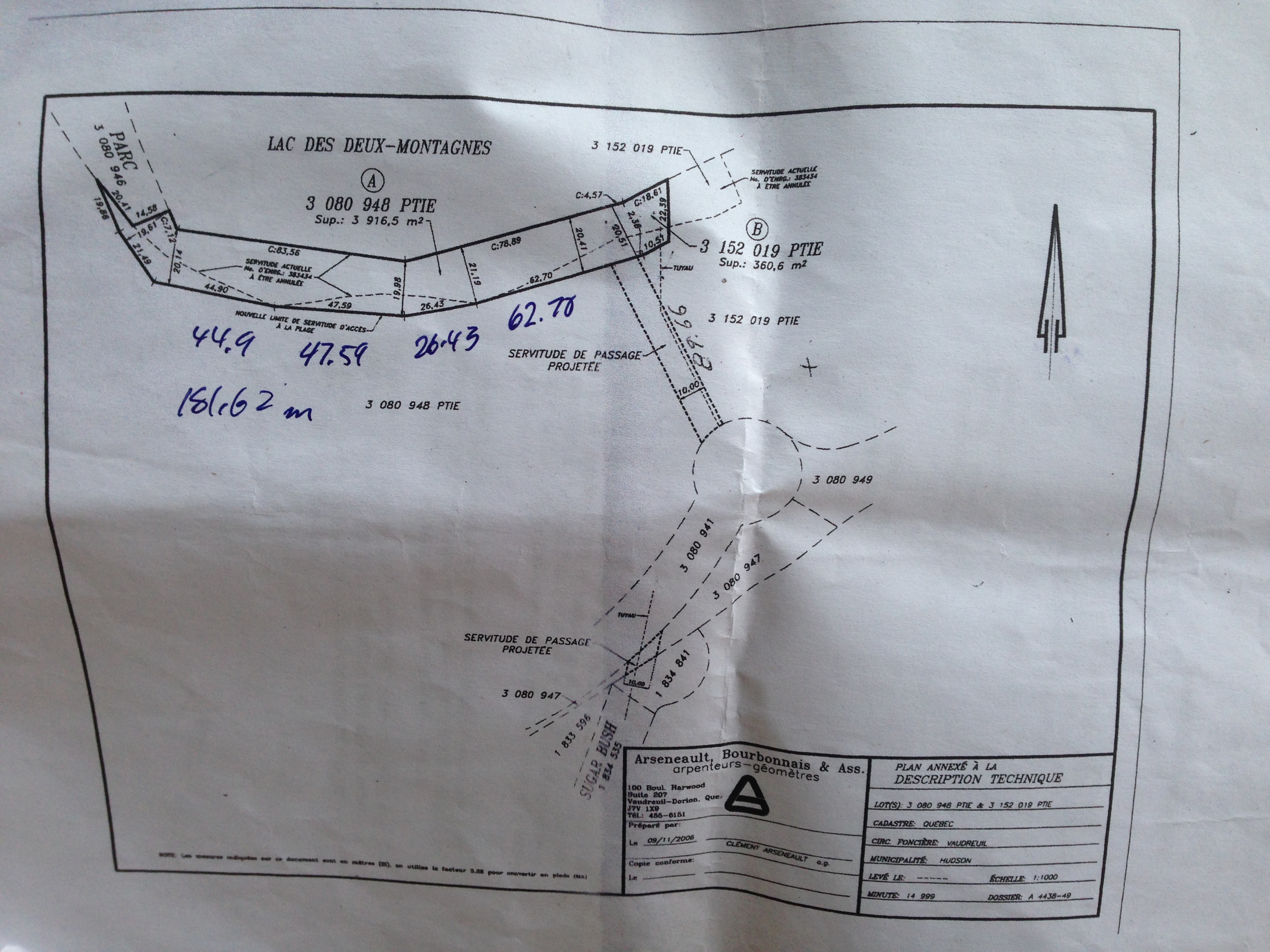
One possible issue might be legal lapses but I have yet to find any. Nicanco and the Town of Hudson have already concluded a number of enabling agreements. One is the beach servitude, posted here.SB_serv-plan_2007.JPG

Another is a March 2009 certificate of authorization signed by the environment ministry’s regional director Pierre Paquin, allowing Nicanco to connect to the town sewage system via the pumping station next to the Legion curling club. This agreement also stipulates exactly how Nicanco must run a sewer line across the Viviry next to the road bridge and decrees the protocol to be followed in the event of a sewage overflow.

ca_env_hud_pompage_doc2016-09-15

Without a cadastral map and access to the Registre immobilier du Québec, it’s next to impossible to determine whether the full and legal transfer of greenspace and servitudes described here has taken place.

servitude-2007

An outright purchase by the town, heritage protection body or other agency is wishful thinking, especially when its proponents argue that the selling price for Sandy Beach should be its municipal evaluation, roughly $1.5 million. Anyone familiar with real estate knows valuation has no bearing on asking or selling price.

Nicanco has already told the town it will claim a real ‘manque a gagner’ of $2 million as well as all costs incurred to date and the potential value under current zoning. I’ve been told it’s in excess of $23M. I’ve seen the letter exchange between Perreault and members of the group exploring outright purchase. It’s clear from Perreault’s dismissive tone he doesn’t propose to waste time on further discussions.

Here’s the bottom line: Nicanco is gambling that residents opposed to this latest rezoning request  will force it to a referendum, just as they did in 2001. And just as they did in 2001 – with 862 of 3,418 eligible voters voting 72% in favour of the project – a majority of residents will support the rezoning. Nicanco will get the greater density it needs to attract builders and repay stakeholders for the loss of income and interest incurred over the past 16 years.

If Nicanco loses, the zoning reverts to Bylaws 408-409.

Either way, Hudson residents will continue to enjoy the beach and trail network in perpetuity while Nicanco pays taxes on it.

It’s a purely financial equation that has nothing to do with saving Sandy Beach. The part of Sandy Beach we love and use has already been saved. The only question is how much more Nicanco can wring from the deal.