L’effet Trump

brossard-islamic-community-centre
Brossard’s Islamic Community Centre disavows link with a proposed Muslim community on Montreal’s South Shore.

This Friday, South-Shore developer Nabil Warda is scheduled to unveil plans for a proposed Muslim enclave in or near Brossard. Warda is looking for a 100-hectare parcel of land to build an entire Islamic community, with schools and daycare, a mosque and community centre, halal market – and housing for hundreds of families.

Given the uproar and subsequent political and religious backflips, I suspect Mr. Warda will be forced to cancel both his public unveiling and his project. And I wouldn’t be at all surprised if U.S. President-elect Donald Trump or France’s Marine Le Pen uses it as an example of what the world can look forward to if it doesn’t slam the door on Muslim immigration.

The reaction also speaks to the sociopolitical fault lines running through Quebec, fault lines that could very easily elect a revitalized Parti Quebecois government under new leader Jean-François Lisée. Lisée has been warning the Couillard government against watering down Bill 62, the Liberal version of what the Bouchard/Taylor Commission on religious accommodation had proposed.

News of Nabil Warda’s project broke on the Radio-Canada website Monday, prompting Health Minister Gaetan Barrette to say he supported the idea and compared it to Chinatown.

Tuesday, Barrette took it all back as the National Assembly voted unanimously — with one abstention — for a government motion calling on the municipal affairs minister to issue a directive to Quebec’s 1,600 or so municipalities that no residential housing project based on religion or ethnicity be approved.

Premier Couillard, in Morocco for another of those endless UN talkfests on climate change, was caught flat-footed after making what appears to be an unforced error. On Tuesday he told the travelling contingent of Canadian journalists he approved the right of Muslim women to cover their faces while undergoing testing for their driver’s licence, a practice currently allowed by Quebec’s Automobile Insurance Board (SAAQ)

Back home, Transport Minister Laurent Lessard and Justice Minister Stéphanie Vallée has a different take. Essentially both said the SAAQ should be anticipating the passage of Bill 62. Adopted in first reading Tuesday, the law will make it illegal for anyone to give or receive public services with their face covered.

Hard pressed on the contradiction, Couillard performed a backflip.

The premier wasn’t alone. On its website, Brossard’s Islamic Community Centre disavowed any connection with Warda’s project, adding that “…certain unprofessional media organizations are trying to link the Brossard Community Center to development projects that are not initiated or approved by ICC or its management. We ask all media organizations to please refrain from publishing any such unfounded news unless confirmed by ICC management. This only creates negative reactions among all living in Quebec and Canada. We promote full integration within Quebec Society and we are proud Quebecers and Canadians.”

Both in and outside the NatAss, the dispute has triggered lively debate over what constitutes a ghetto. Is Montreal’s Chinatown a ghetto? Would an evangelical Christian or Orthodox Jewish community be considered a ghetto? Or those gated Italian enclaves in Montreal North?

Warda’s community wouldn’t bar non-Muslims but it would force them to live according to the rules of the majority. Does that make it a Muslim ghetto? In that case, many Hutterite and Mennonite communities in Ontario and western Canada would qualify.

And yet no other province has – to my knowledge – ordered municipalities not to approve residential developments based on religion or ethnicity.

It’s likely Warda’s Islamic community project would have been torpedoed prior to last week’s Republican sweep, but in just three days? Moreover, Couillard’s reversal shows the Liberals will do whatever it takes to get in line with public opinion. Everyone in government remembers what happened to the Marois PQ government’s ill-fated Quebec Charter of Values.

It’s a whole new world out there, what with Trump, Brexit and the resurgent European right. Elections in France and Germany will almost certainly reward the right-wing parties whose leaders were among the first to congratulate the president-elect. If Couillard and the Quebec Liberals hope to retain power, they’ll play to Quebec’s us-versus-them default instincts.

In a province where mistrust for les autres (those others) lies just beneath the surface, it’s an easy and popular adaptation to the new reality. Why allow ghettos when you can have ghetto nations?

Are the Trudeau Libs downloading more corruption?

Update on my post The Great Canadian Cannabis Bandwagon Coming to a Town Near You! (Nov. 2/16):

With two weeks left until their Nov. 30 deadline, there’s still no word on when or whether the fed task force studying the pros and cons of allowing the recreational use of marijuana has completed or submitted its report.

I emailed the task force secretariat for an update and received this brushoff yesterday:

The Task Force on Marijuana Legalization and Regulation will submit their report to the Minister of Justice and Attorney General, the Minister of Public Safety and Emergency Preparedness and the Minister of Health in November 2016. It will be made public at a time to be determined by the three ministers.

My initial blog concerned a marijuana grow op on 28th Avenue in Ile Perrot which isn’t listed among the 36 growers you’ll find on Health Canada’s interactive map (http://www.hc-sc.gc.ca/dhp-mps/marihuana/info/list-eng.php)

Turns out it’s not the only unlisted Quebec producer.
Sûreté du Québec sources have confirmed they are aware of ‘several’ in the province although the sole licensed operator on the Health Canada map is Gatineau-based Hydropothecary.

So what, right?

What emerges is proof of a two-tiered approval system for legal grow ops. One we can see on Health Canada’s interactive map, those 36 licenced commercial producers. The other is a covert system of grey-area grow ops operated by persons who are authorized to produce a limited amount for their own medical purposes, either locally or nationally (Health Canada’s words, not mine). Nothing about these tier-two grow ops is public — size, location, ownership, clientele, product testing and certification – nothing.

Yet a 24/7 Health Canada hotline allows police forces to check whether an officially unlicensed operation has a licence to grow.

I get this from a series of questions I submitted to Health Canada, beginning with whether it’s possible for a medical/experimental marijuana producer to operate legally without a licence.

My other key question was whether it’s possible for a licenced medical/experimental marijuana producer to conduct operations without being listed on the Health Canada map.

The following comes from Anna Maddison, a senior media relations advisor :

Only producers who are authorized by Health Canada to produce and sell to the public may sell or provide dried marijuana, fresh marijuana, cannabis oil  or starting materials (e.g., seeds and plants) to eligible persons. There are only 36 authorized commercial licensed producers, as per the list you referenced on Health Canada’s website: http://www.hc-sc.gc.ca/dhp-mps/marihuana/info/list-eng.php. 
 
With the introduction of the Access to Cannabis for Medical Purposes Regulations (ACMPR) in August 2016, individuals who have the authorization of their health care practitioner can apply to Health Canada to produce a limited amount of cannabis for their own medical purposes.  
 
All persons registered or licensed by Health Canada must abide by the law and operate at all times within the limits set out when they are registered or licensed by Health Canada. Individuals are authorized to produce and possess for their own medical purposes only and it is illegal for them to share, provide or sell what they have produced with anyone else.
 
Health Canada supports law enforcement representatives by providing a dedicated phone line that is accessible 24 hours a day and seven days a week to confirm, when necessary, that specific individuals are authorized to possess or produce a limited amount of cannabis for medical purposes. Anyone who suspects the occurrence of activity that may violate a law should contact their local law or municipal enforcement authority.
 
Is there a limit to the number of licenced producers in a given area?

No. The regulations do not establish a limit on the number of licensed producers, or persons who are authorized to produce a limited amount for their own medical purposes, either locally or nationally.

What are the regulations concerning notification of neighbours?
Are local and/or regional law enforcement and municipal authorities notified of licence applications on their turf?

Prior to submitting an application to become a licensed producer of cannabis for medical purposes, the applicant must provide a written notice to local authorities to inform them of their intention to submit an application. The notice must include the applicant’s name, the activities for which the licence is sought (i.e., that activities are to be conducted in respect of cannabis), the site address at which the applicant proposes to conduct those activities (and of each building on the site, if applicable), as well as the date when the application will be submitted to Health Canada.
A notification must be provided to:
–      the local police force or Royal Canadian Mounted Police detachment responsible for providing policing services to the area in which the proposed site is located;
–      the local fire authority of that area; and
–      the local government (e.g., municipality.)
The same information must be provided to local authorities upon a change of status to the licence, such as issuance, suspension, revocation.
There is no requirement for licensed producers, or applicants to become a licensed producer, or persons registered with Health Canada to produce limited amount of cannabis for their own medical purposes, to notify neighbours or surrounding residents or businesses. 

Are licenced producers required to obtain business or other permits from their local governments?

Licensed producers are required to comply with all applicable provincial, territorial and municipal laws, including zoning restrictions, fire and electrical safety and waste management.

Can they intervene (i.e. do they have the right to oppose a permit application)?

During the application review process, municipalities may provide information to Health Canada regarding a specific application.  Health Canada considers all relevant information when making a decision to issue or refuse a licence. Municipalities can use the tools at their disposal, such as zoning and bylaws, to set parameters for the production of cannabis.

What I get from this is that anyone who wants to set up a grow op can apply for a medical-exemption permit and go into business as long as they have the blessing of their municipality. Health Canada’s blanket protection ensures they don’t get asked too many questions.

It’s doubtful the public will raise a fuss about people growing marijuana, what with the pendulum swinging toward the legalization of recreational use across North America. My problem with what I see is that it opens the door to recriminalization, in the form of municipal corruption. What’s to prevent a corrupt council from approving a grow op without the public’s awareness, let alone consultation?

I expected greater transparency from the Trudeau government. I didn’t expect them to use the pot file to download even more corruption possibilities on the provinces._dsc0033

Trump’s Credibility Bank


Now that we’ve dispensed with the handover niceties, let’s take a hard look at what really happened Tuesday. It boiled down to credibility.
In politics, credibility is like a bank account that allows only withdrawals, starting the day the account holders are elected.
Trump and the Republicans won big because the Clintons and the Democrats had no more credibility left. Eight Obama years and the previous eight under Clinton pretty much blew their cred wad.
In the cold light of the day after, it would seem it didn’t matter what Hillary Clinton has said over the past two years. What stuck with voters was her lack of credibility. Nothing else can begin to explain why the combined efforts of the Obamas, Clintons, Bernie Sanders, Elizabeth Warren and a parade of pop culture celebs failed to sway undecideds and abstainers.
As for Trump’s credibility account, it’s as full as it’s ever going to be – and withdrawals started today.
Clinton will not be indicted, let alone locked up.
That Mexican wall? Dream on.
NATO and NAFTA? Don’t bet against them.
The Muslim ban? Watch him try.
Tax breaks for the middle class? Sure.
Repeal Obamacare? There are 20 plus Republican governors whose states are happier with what is than what was because it costs them less. If Trump and his team can’t come up with something better before scrapping the Affordable Care Act, shit will fly. Republican shit.
The Supreme Court composition? Roe vs. Wade revisited? We’re talking about what differentiates America from sharia-law states where women are stoned for being raped.
It will take just one 12-year-old incest rape mother to force the U.S.S. Trump seriously off course with his evangelicals.
Because here’s Donald J. Trump’s new reality in the United States of Nonstop Campaigning.
The Republicans hold the Senate 51-47 (including two independents who vote with the Democrats), a bare majority. The midterm elections take place Nov. 6, 2018, when 33 of the 100 seats will be at stake. Of those 33 seats, 25 are held by Democrats and those two independents, while eight are currently held by Republicans. You can guarantee the Democrats will be using Trump’s first 730 days to wage a merciless, relentless campaign to force a turnover.
The Republicans hold the House 239-193. On Nov. 6, 2018, all 435 seats will be contested. Again, the Democrats will concentrate their efforts on winning control of Congress.
If Trump receives –and heeds – wise counsel, he won’t repeat Obama’s principled mistake of trying to build bipartisan consensus for his Affordable Care Act. Trump will ram his agenda through the Republican-controlled House and Senate in the 20 months he’s guaranteed an absolute majority.
So there it is. Trump has less than two years to remake America. After that, he risks becoming just another lame-duck American president at the mercy of the folks who run the credibility bank.

Walking wounded or living dead?

Venture capitalists will tell you the worst investments are the walking wounded, enterprises that neither fly nor die but bleed cash and stagger from crisis to crisis. The challenge is determining whether they’ll ever come back. Wouldn’t it be more merciful to end the suffering?

Postmedia is long past that. It’s the Undead. Dead man walking. A corporate zombie waiting for a financial stake through the heart from banks, investors, shareholders – everyone with skin in the game of weighing $650M in debt against the dream of actually recouping some of their losses.

What’s Postmedia worth if it’s carved up and the chunks sold? CEO Paul Godfrey said in September selling assets wasn’t on the table. That was during discussion of a debt restructuring proposal to convert $648M in old debt into $325M in new debt at a marginally lower interest rate. The proposal was accepted, wiping out $200M in shareholder value in exchange for a $50M annual reduction in interest payments made possible by an injection of cash from a U.S. venture capital firm.

So what, you say? It’s more of the same bad drug that poisoned Southam, Hollinger, and Canwest, beginning with convergence: the asinine notion that one can achieve economies of scale by merging radio, television and print newsrooms and firing all those redundant bodies. Wave after unholy wave of wannabe media barons and their financial dogsbodies looking to boost shareholder value have succeeded in silencing hundreds of community voices across Canada. What they haven’t destroyed, they’ve burdened with debt and stripped of human assets to the point that even the Montreal Gazette, an enterprise with intrinsic value, may not survive the final cuts.

I can’t help laughing when I hear pundits holding out hope that federal regulators will ride to the rescue. We thought so too when we went to Industry Canada’s Competition Bureau with proof TC Media was attempting to stifle competition. The complaint followed Quebecor’s surrender after a four-year war of the weeklies with TC. Quebecor sold 74 weekly newspapers, some of them essential voices in their respective communities, to TC for $75M. TC merged some with theirs, sold others and placed half up for auction. The Competition Bureau could have imposed tougher measures on TC to ensure the survival of the orphans. It chose not to.

We hear about the plight of the Postmedia dailies, and with reason. But what about all those little weeklies Postmedia obtained from Quebecor? We’re talking about papers all over Canada, many of them in small towns and rural communities fighting for survival. What hope is there for a little community weekly whose reporter is the only neutral face at the monthly council meetings?

The disease isn’t confined to print. Parallel processes are underway in radio and television, with newsrooms slashed and content generation centralized. No wonder the Canadian media-consuming public isn’t consuming mainstream media – everything reads and sounds the same because we’re losing the diversity of voices. Government bailouts will do nothing to reverse the damage generations of bad management have caused.

It’s not just me. Friends say they stay better informed about what’s happening in North America when they’re getting their news via the BBC, TV5, Eurovision and Al Jazeera’s successor. CNN Asia is infinitely better than the Americentric mother ship.

Many of us have stopped reading newspapers because smartphones, tablets and apps are more convenient. I pay for the electronic New York Times and Globe and Mail because they’re must reads for original-source junkies like me. La Presse, CBC, Torstar, CNBC, BBC and L’Observateur fill in the blanks. Why read one newspaper when you can triangulate the daily truth for yourself?

I feel guilty about not taking the Gaz. It was my mom and dad for the 10 years I worked there. I know and like a lot of its people and wish them well. But until it improves its website and paywall terms, I’m not buying. From the sad sounds coming from Postmedia’s boardroom, I’m not alone.


The Great Canadian Cannabis Bandwagon Coming to a Town Near You!


There’s a marijuana grow op located on a quiet cul-de-sac off 28th Avenue in Ile Perrot.
It hasn’t been busted so it would appear to be a federally licenced medical marijuana producer.
But nobody at Health Canada will confirm that.
Its neighbours learned of its existence only after it began operations.
Their beef isn’t with the operation itself, but with the increase in traffic.
Ile Perrot’s mayor reportedly told concerned residents the town needs the revenue.

A Sûrèté du Québec employee at regional headquarters in Vaudreuil-Dorion told me the SQ is aware of the locations of all licenced grow ops in the county, but refused to confirm this was one of them, or whether it even exists.
Our conversation two weeks ago was bizarre.
“You’re aware of the locations? Plural? How many marijuana grow ops are there in Vaudreuil-Soulanges?”
“I can’t say because they’re federally licenced. They’re not our responsibility.”
“But you know where they are?”
“We know which ones are legal so we can shut down those that aren’t.”
“So you’re telling me this one is legal?”
“I didn’t say that.”

Today I followed up with detachment commander Capt. Ginette Séguin. How many licenced grow ops are there in Vaudreuil-Soulanges? How does the SQ determine whether a grow op is licenced?

Séguin, off to her new posting in Quebec’s remote Abitibi,  declined to answer any of my questions and referred me to Health Canada.

According to Health Canada’s website, there are 36 licenced producers of medical marijuana in the entire country. Specifically, a licence permits the holder to “sell or provide dried marijuana, fresh marijuana, cannabis oil, or starting materials to eligible persons,” eligible persons being the roughly 50,000 Canadians with a doctor’s prescription enabling them to purchase from one of those 36 licences producers — or grow their own.

Health Canada’s interactive map shows Quebec’s sole licenced producer as Gatineau-based Hydropothecary.

I called Hydropothecary to ask whether they had branch operations elsewhere in Quebec.
Their spokesman told me their only operation is in Gatineau. However he said it was possible others might be operating pending licensing approval.
Isn’t that like running a blind pig while waiting for a Regie des alcools permit?

As I write this, there’s no transparency on the issue of who is growing what and where with whose permission. While the SQ is enthusiastically busting grow ops, including a bunch in Vaudreuil-Soulanges, police forces in Toronto, Vancouver and other major Canadian cities are turning a blind eye to the dispensaries where untested infested pot is sold to whoever comes through the door with a medical marijuana prescription. Wherever all that pot is being produced, it’s not in licenced facilities.

Sometime this month, the federal government’s marijuana task force is expected to table its recommendations concerning the legalization of the recreational use of cannabis. Canada’s medical marijuana industry expects the Trudeau Liberals to move quickly to adopt enabling legislation which would replace current regulation of medical marijuana production.

With what, we don’t know, but we’re getting hints, such as Loblaws’ application for a distribution licence for its more than 1,300 Shoppers Drug Mart and Pharmaprix locations across Canada. We can pretty well bet competitors will follow. (Jean Coutu Group operates 417 stores in Quebec, New Brunswick and Ontario. Pharmasave includes 550 independently owned stores in nine provinces. Uniprix operates 375 pharmacies in Quebec.)

The provinces — currently excluded from any potential tax windfall — will fight to the death to ensure they get the lion’s share of the cut by limiting the sale of recreational weed and derivatives to outlets under their control. Think LCBO, SAQ and their equivalents across the nation.

In other words, everyone and their cousin is poised to leap onto the Canadian recreational cannabis bandwagon the minute it starts rolling. Until then, the cannabis industry is keeping a low profile for fear of jinxing the deal. Hydropothecary’s Julie Beun had this to say: “At this point, we are awaiting the report and have no plans to comment on it until after it’s been assessed.”

However back in June, the CEO of NHP Consulting, Brian Wagner blogged this prediction:

“…recreational cultivation, distribution, sale and consumption, will be regulated and controlled as of late 2017. We anticipate that once the report of recommendations is made available in November this year, that there will be a flurry of new interest in applying to be a producer under the MMPR (medical); it is highly likely that MMPR producers will be grandfathered into recreational cultivation/distribution once the new regulations are published.”

Wagner expects current laws will continue to be enforced until new laws replace them. This means police will continue to shut down all but currently legal sources — licences producers.

What will this new gold rush mean to our communities? I sent the following questions Nov. 1/16 to Health Canada and to the B.C. offices of Cannabis Growers of Canada, the industry’s largest lobbying group:

– Is it possible for a medical/experimental marijuana producer to operate legally without a licence?
– Is it possible for a licenced medical/experimental marijuana producer to conduct operations without being listed on the Health Canada interactive map listing the 36 licenced producers?
– Is there a limit to the number of licenced medical cannabis producers in a given area?
– What are the regulations concerning notification of neighbours?
–  Are all licenced producers required to obtain business or other permits from their local governments?
– Do local/regional law enforcement authorities have the right to oppose a permit application?
– Are local law enforcement authorities notified of licence applications on their turf? If so, can they intervene?
– Are local and regional municipal authorities notified of licence applications on their turf?  If so, can they intervene?

The CGC website (https://cannagrowers.ca) describes itself as “an association of cannabis businesses in Canada that are dedicated to building a free and fair craft cannabis economy. It was founded on the belief that every Canadian has the right to access high-quality, locally grown cannabis from a craft cannabis producer of their choosing, and that the best way to legalize cannabis is to empower local entrepreneurs to create jobs and support their local economy.”

“The Cannabis Growers of Canada is an association of cannabis growers, dispensaries, resin extractors and other product experts, who are dedicated to creating a set of strong industry standards to govern the craft cannabis marketplace. It was founded on the belief that a vibrant craft cannabis marketplace can provide safe, tested product to be enjoy across Canada.”

Stickhandling licensing applications from prospective medical and experimental marijuana producers and processors has become an industry unto itself. One enterprise you’ll find at the top of a Google internet search for ‘medical marijuana licences’ is NHP Consulting Inc.
NHP’s website offers a basic primer on Health Canada’s small print. For example:

“Producers can only grow marijuana indoors and under heavy security precautions. Health Canada does not regulate the manner in which marijuana is grown otherwise, albeit to limit which fungicides can be used on the plants. End product must be tested for microbes and heavy metals, and be within the product specifications. The model was heavily adapted from a pharmaceutical approach. Producers cannot sell face to face, and must ship finished product by mail or courier (or secure transport) to the patient’s doctor or residence.”

NHP bills itself as a one-stop shop for anyone looking to licence a natural health product, food, OTC drug or medical device. Given the intricacies of Health Canada’s licensing process, it’s not surprising people pay for advice. Here’s NHP on experimental grower’s licensing:

“Two licences are required if a facility wishes to cultivate and processes marihuana for experimental purposes.  There are similarities between both applications. The average wait time for Health Canada to begin the review of these types of applications is 8-10 months.

NHP Consulting’s Wagner continues: “There is a specific application in order to cultivate marihuana for scientific purposes, and a separate application for processing manufacturing derivatives or transporting product to another location.  These applications are governed by the Controlled Drugs and Substance Act and its Regulations.  For both applications, the person in charge of the project requires a degree in a relevant science.  In order to qualify for a licence to cultivate, a full description of the research project will be required, security measures will have to be put in place, and record keeping procedures drafted.

“A Dealer’s Licence is required to process cultivated marihuana (such as creating extracts or derivatives) for the purpose of research.  As with the licence to cultivate, the site will require physical security measures and you will require a Qualified Person In Charge (QPIC) with a degree in science (better still, a pharmacist or practitioner).  As stated above, you will have to submit all record keeping procedures that will be evaluated by Health Canada prior to approving the Dealer’s Licence.”

And then there are the licencing requirements for derivative manufacturing. Here’s NHP’s synopsis:

“The two derivatives in marijuana considered therapeutic are delta-9-tetrahydrocannabinol (THC) and cannabidiol (CBD’s).  The cleanest method to prepare a derivative from marijuana is super critical C02 extraction.

“As a result of the recent Supreme Court of Canada decision, individuals authorized to possess marijuana under the MMPR may now possess marijuana derivatives for their own use. Based on this decision, Health Canada has issued a section 56 class exemption under the Controlled Drugs and Substances Act (CDSA), allowing licensed producers to produce and sell cannabis oil (under the MMPR).  The licensed producer must hold a supplemental licence issued by the Minister of Health for the purpose of authorizing the activities in relation cannabis oil.

“The two derivatives in marijuana considered therapeutic are delta-9-tetrahydrocannabinol (THC) and cannabidiol (CBD’s).  The cleanest method to prepare a derivative from marijuana is super critical C02 extraction. Other methods to extract isolated THC and CBD include the use of organic solvents (toxic and flammable).  You can further purify or concentrate the oil using chromatography.

“There are new rules for preparing and labelling the derivatives that must be taken into consideration prior to obtaining the right to produce the derivatives (oils).  There is a maximum allowable concentration, specific label requirements, and formulation implications concerning the amount of active per dosage unit and the use of non-medicinal ingredients.  There is also a requirement for enhanced documentation, including details of the extraction process.”

To summarize, Canada is on the verge of legalizing recreational use of cannabis. When and if that happens, it will trigger an unprecedented scramble for production licences. Who gets them, and the conditions attached will be of personal interest to any Canadian with concerns about recreational drugs, who owns or rents a property next to one of these facilities or has any other stake in the process. A mayor’s lame assertion that his town needs the revenue won’t suffice.

This means war

little_toaster
Is your toaster part of a Trump sleeper cell conspiracy to steal the U.S. presidential election?

My wife and I have just launched lechampignon.ca, a coworking enterprise in Hudson, a Quebec town on the highway between Ottawa and Montreal.

LeChampignon.ca’s website (www.lechampignon.ca) was unreachable yesterday, Friday Oct. 21 because Weebly, our host, was one of thousands of sites affected by an unprecedented cyberattack on Dyn, a New Hampshire domain name server (DNS).

The whos, whys and hows of the hack attack are hazy. Alt-right commentators in the U.S. and usually reliable European sources like L’Observateur and the BBC are connecting the Directed denial of service (DDoS) assault with last weekend’s internet silencing of WikiLeaks founder Julian Assange, still holed up in the Ecuadorean embassy in London.

The theory being bandied about is that the Clinton Democrats pressured the Brits to pressure the Ecuadoreans to shut Assange down because WikiLeaks was doing major damage to Hillary’s campaign with its leakage of her private emails. Ecuador’s socialist government was forced to comply but made the gag order public.

According to this morning’s L’Observateur (http://tempsreel.nouvelobs.com/monde/20161022.OBS0169/attaque-informatique-aux-etats-unis-ce-que-l-on-sait.html) and the Conservative Daily Post (https://conservativedailypost.com/breaking-assange-missing-for-days-announced-dead-embassy-stormed-after-airport-lockdown/ Assange’s internet silence triggered a cascade of events that led to the monster hack attack.

The first was a massive WikiLeaks data dump, unprecedented insofar as it didn’t follow protocol established by previous WikiLeaks releases. Some theorize it’s because the dump was triggered by the literal or virtual death of Assange, enabling a dead man’s switch akin to the failsafe used by suicide bombers.

The second was the revenge attack by Assange’s followers and other renegade hacker organizations like Anonymous. Earlier this year tech sites began reporting probes on internet chokepoints to determine where the worldwide web is most vulnerable. Today’s L’Observateur publishes a WikiLeaks tweet debunking rumours of Assange’s death or its own demise and calls for a truce in the internet assault because ‘you’ve made your point.’

The third factor – actually a prequel – was last year’s release of Mirai, a software virus which allows a hacker access to the Bluetooth-enabled internet of things – home routers, CCTV cameras, baby monitors and smartphone- accessible devices like thermostats, coffeemakers and toasters. Anything connected to the internet without a security key can be turned into a bot, remotely controlled by whomever has the code – without the owner’s knowledge.

There’s growing evidence an Mirai-infected army of everyday home devices crashed DNS provider Dyn’s servers, one of those internet chokepoints. Hypothesis has it Assange’s army and Anonymous led the hack attack. However the U.S. Department of Homeland Security suggested late yesterday they had the help of a major sovereign power. Russia and China weren’t named, but it’s pretty obvious given the escalating tensions between the three.

Simply put, an army of hackers, possibly with the help of Russia and China, brought the North American internet and enterprises who depend on it to their knees for the better part of the workday. Why? Because they’re pissed that their guru was stripped of the ability to influence the outcome of the U.S. Presidential election. Yeah, Don, maybe it is rigged – by your erstwhile allies who want a narcissistic stooge in the Oval Office.

The Conservative Daily Post takes it a step further. If Trump were to offer Assange sanctuary in the U.S., prepare to see Clinton’s deleted emails, including those between the Obamas and herself, made public. Trump’s utterances about Crooked Hillary and election rigging would suddenly find traction with the apathetic majority. Clinton’s lead in the polls – already cut to within the margin of error in today’s Ipsos survey – would be wiped out.

American filmmaker Michael Moore, an avid Clinton supporter and Democrat, has been sounding the alarm since this summer. He’s convinced Trump will win and explains why on his site (www.michaelmoore.com).

All this leads me to conclude Clinton is in far more trouble than anyone would have thought after the three debates and that Catholic charity dinner. All it takes is for Donald Trump to make a deal with the devil to unleash the Furies.

Who would have predicted this U.S. presidential election – and all of us collateral victims – would fall hostage to an army of toasters?

Reign of error

The Town of Hudson’s reign of error continued at the June council meeting with the revelation this administration won’t hold a byelection to replace the ailing Mayor Ed Prevost. Councillors appeared to be divided on whether to hold a byelection to replace dissident councillor Rob Spencer.

Neither Spencer nor Prevost have attended the last three council sessions. Article 317 of Quebec’s cities and towns act says a municipality MAY hold a byelection to replace council members if they miss four meetings and if more than a year remains to the end of the current mandate. That would be in November 2017.

But Article 317 is rife with weasel words and wormholes. The town is under no legal obligation to replace the missing council members if the remaining councillors agree it would be in Hudson’s interest to continue as is. Town clerk Vincent Maranda told residents he checked with the municipal affairs ministry (MAMOT) to nail it all down and they said it was kosher. I checked with Quebec’s director-general of elections and got referred to MAMOT. I asked the legalists at MAMOT whether citizens had any say. They told me I could file a complaint. Translated, there’s screw all anyone can do. In Quebec, municipal democracy is an oxymoron.

I get that the mayor may need the medical insurance that comes with the job. So be it. But what’s it say to you if this administration opts to keep Prevost on the payroll out of mercy and guns Spencer because he took Prevost before the Quebec Municipal Commission?

Likewise, I’m struggling with the word to describe this administration’s statement that Hudson’s business sector supports the installation of water meters in the commercial sector. This prevarication was delivered during question period by councillor Ron Goldenberg and town manager Jean-Pierre Roy, who as far as I can determine, attended none of the meetings where this was discussed. It was in response to my accusation the town has done nothing to prepare for this summer’s incipient water shortage and the inevitable ban on all lawn watering other than to restate its determination to stick it to Hudson’s hapless commercial sector yet again.

One of the local rags subsequently reported the exchange verbatim without fact-checking. In fact, businesses had reluctantly agreed to  water meters back in 2014 as a concession to arrive at a solution to the water tax crisis (engineered by the current council). Not that most residents care, but businesses were (and still are) being grossly overcharged for water in comparison to residents. (How many businesses have bathtubs? Swimming pools? Automatic lawn sprinklers? 2.5 bathrooms? Dishwashers? Laundry rooms?)

In 2014, Goldenberg gathered a water tax committee which consisted of both business owners and residents to review and make recommendations with regards to installing water meters. From the outset, business owners and commercial landlords were led to believe the entire town would eventually be metered and that they were to be the first step in the process. So the consensus was that businesses would be the guinea pigs. In exchange, the town would agree to meter some 50 residential properties to establish a comparative sample to properly measure consumption. Furthermore, public buildings would also have to be metered, including schools, churches, town buildings, etc. (Basically anything that is not residential).

The only part of those 2014 discussions to have survived was “businesses agreed to be metered.” The rest? Conveniently forgotten.

Also conveniently forgotten was council’s vow to post details of the litigation embroiling the town (50 grand this month, I’m told.) There was a Gazette story reporting the vow in early March. There was a repeat at last week’s council meeting. Unless they’ve artfully hidden the list somewhere on the town’s expensive new website, it’s still not there.


All this to say there’s a good reason why transparency and accountability are nowhere to be found on the town’s $5,000 mission statement. Old-fashioned virtues have no place in Hudson’s new branding. Take solace in the growing assurance that meters are no more likely to this inept administration of dreamers and schemers than the Mohawk performing arts centre or the wholesale giveaway of public greenspace. Fair trade, my ass.

Energy

For those of us who have occasion to drive the 401, there’s a community called Ingleside which is fast becoming the solar power generating capital of Canada. Solar-array contractor H.B. White (they were landscape contractors until they discovered how lucrative the alternative energy business can be) have completed two kilometre-square arrays and are working of two more. They were also the prime contractors for Europe’s largest array in Germany. Montebello charging station

There are plenty of arguments against wind and solar. Can’t be stored. Ugly. Disruptive. Not cost effective. I agree – to a point. Windfarms are no uglier than a line of 1.5MV transmission towers on a picturesque skyline. Solar arrays are ideally located alongside major highways, where planners are already looking past gas and diesel to next-generation fossil fuels – liquified natural gas, methane – and electricity.

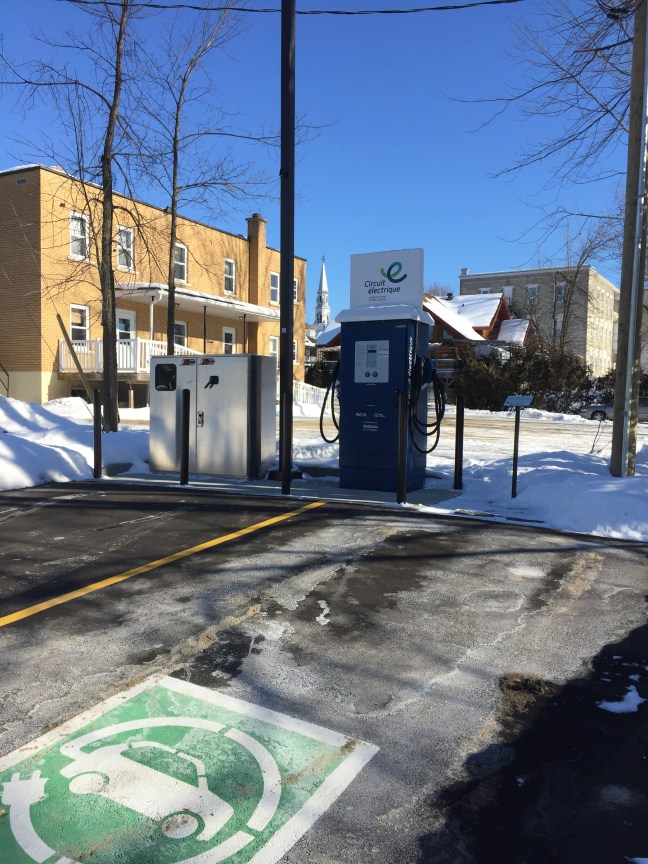
The growing electric vehicle fleet is an effective decentralized alternative energy storage facility, so it’s starting to make economic sense for municipalities to offer high-output electric vehicle charging. I snapped the shot above in Montebello, Quebec. Outside the former railway station, now a died-and-gone-to-heaven chocolaterie in the centre of town, is this Circuit Electrique charging station, one of more than 600 in Quebec. (VerNetwork has 150 across Canada, while TeslaThe Pointe Claire pool parking lot is equipped with a Circuit Electrique charging station with parking for two electric vehicles. It’s not free, but it’s comparable with dollar-a-litre gas. Even with oil at $30 a barrel the price of a litre of gas doesn’t seem to drop much below that.

Car manufacturers find themselves like the guy trying to change canoes standing up. They know they have to switch their fleets over to alternate fuels but they have to move cautiously. Gas may be cheap and gas stations everywhere, but that will change quickly as western governments impose ever-higher taxes on fossil fuels in response to public pressure to stop subsidizing petrocratic tyrannies and murderous zealots. I realize most of us don’t give a rat’s ass whether the oil we pump into our SUV comes from Saudi Arabia, Algeria, Nigeria, Iran, Iraq or the Emirates, but what happens when we put our domestic producers out of business? Wouldn’t it be smart to have an alternative source of sustainable energy to move our economies when the Middle Eastern shit hits the fan?

Hybrids are a transitional technology, good as long as gas is more convenient than the alternatives and potential electric-vehicle buyers agonize over range anxiety. People who drive hybrids swear by them. A guy I swim with is thinking of buying a secondhand Toyota Prius after talking with Montreal cab drivers. According to him, they’re getting 300,000 km from a set of batteries. But they’re not cheap, even with Quebec’s green energy rebate. GM’s 2016 Chevy Volt ($39,590 base price) boasts 85 km in electric mode on a 4.5-hour charge, after which a 1.5-litre gas-powered generator cuts in “to help keep you going.” According to the fine print, that 4.5-hour charge rate is with a 240-volt fast-charge circuit. A 120-volt plug-in will take anywhere from 13 to 19 hours.

Pure electric cars are a tougher sell, mainly because lithium battery technology have yet to catch up to buyer expectations. Nissan’s Leaf, a pure electric car with no generator to ease range anxiety, starts at $32,698 and boasts 133 km of range. According to the VerNetwork site, the Leaf, with a maximum charge rate of 3.3KWh, takes more than three hours to fully recharge from a half-charged state. It gets 44 kilometres per hour of charge. The newest 400-volt fast chargers ($10 an hour, billed by the minute) take maybe half an hour to recharge from 50% but can be used by a fraction of the total electric-vehicle fleet. And they’re few and far between.

Tesla is closing the expectation/reality gap with its Model S, the new Model X crossover (https://www.teslamotors.com/en_CA/modelx) and the promised Model 3, a pure electric vehicle for the masses. Their range is approaching that of comparably priced gas vehicle and they have the performance options wealthy customers expect. Tesla offers more than 600 Supercharger stations across the continent with 400-volt plugins for 3,500 vehicles, but in Canada they’re confined to markets where Tesla is selling cars. Don’t look for any major jump in those numbers anytime soon. Tesla CEO Elon Musk  recently conceded the oil swoon is causing the alternative energy sector considerable near-term pain. But he’s hanging in, as are Nissan, Toyota, GM, Kia, Porsche, Daimler-Benz and BMW. (Volkwagen/Audi is taking Ballard’s fuel cell technologies for a test drive.)

Canadians are at the energy crossroads. Do we allow petrocracies to destroy our oil production, refining and petrochemical industries with domestic carbon taxes and unrealistic demands on pipeline operators? Or do we use domestic tax revenues to help build the alternative to the fossil fuel economy?

This is a question for everyone from the Trudeau government to our local municipal councils. We have to get this one right.


PMAD basics

Seems there’s confusion over the Montreal Metropolitan Community’s master development plan, better known by its French acronym. I was the only journalist from our region at the public hearings on the West Island and at the plenary in St. Constant, where our MRC delegation explained why Vaudreuil-Soulanges needed changes to the draft PMAD. We didn’t get them, but the passage of time and the provincial government’s election vows and austerity measures have further muddied the waters. All this to say there’s plenty of slack. This is far from being a strait jacket.
PMAD basics:
One size fits all, so there’s one PMAD for 82 MMC municipalities. Out here, half of the Vaudreuil-Soulanges MRC municipalities are in the MMC because of a formula which determines how many of their residents work and shop on the island. Once in, there’s no way out. Blustering and threatening to sue will accomplish nothing because the PMAD is fixated on the following precepts:
Urban sprawl costs money.
Bigger isn’t better because it means more roads to maintain, more services to instal and upgrade, etc.
Montreal Island is choking to death in its own traffic, most of it from commuters who refuse to use public transit because they live too far out and the services aren’t as fast and reliable as driving oneself or carpooling, even when we factor in the average 2.5 hours a day commuting.
Farmland, greenspace protection and doubling down on densities in already populated areas are the three main goals.
There’s been considerable flap about Transport-Oriented Development (TOD), as if the town of Hudson abandoned its one train a day it would somehow be exempted. That’s not how the PMAD works. If you’re served by any form of public transit, such as the CIT shuttlebuses, even if your burg is within a 15-minute commute of a railway station or express bus terminus, chances are it will be characterized as a potential TOD. For example, St. Lazare and Les Cedres don’t have train service to their territories but both are within the MMC and both urban cores are considered TODable.
Having followed the PMAD since its inception (Hudson, like most VS MRC municipalities, can kick itself for not having gotten involved in the process early enough) I think we have to alter our way of thinking.
Being labelled as a TOD doesn’t force a town to develop, but it does require subsequent development to adhere to unreasonably high densities. This is why it’s best that Hudson plans for a few high-density projects in the sewered part of town. Half a dozen multi-unit residential projects on Main, Cameron and Lakeview would go a long way to satisfying the PMAD’s densification goal without substantially altering the unique character of the Quartier francais.
Ellerbeck, R-55 and the zoning already approved for Sandy Beach would add the number of doors required to defray the cost of the sewer/water infrastructure currently being downloaded on a fraction of the town’s ratepayers. The current tax burden split is neither smart nor equitable.
Proper planning is the key. Rather than blowing dough on pie-in-the-sky wish lists, municipalities have to be frugal, careful stewards of the public purse. Forget the skateboard parks and the vanity publicity. Concentrate on lasting, sustainable investments in commercialization and public convenience, such as a dedicated, covered outdoor market and more, better-planned public parking. What about that secure pedestrian path alongside Main and Cote St. Charles, before somebody is killed or seriously hurt? Get the planning right and everything else will follow naturally. Above all, learn to live with the PMAD by seeing at as an opportunity to be seized upon.

Hudson: Another fiscal crisis?

I have in front of me documents dealing with the Town of Hudson’s finances, beginning with the Prévisions budgétaires 2014. This is the official version of how the administration spent the budget it adopted Jan. 20, 2014. It was filed with the municipal affairs ministry Feb. 4, 2014 by then treasurer Sylvain Bernard, another of the growing list of victims of Hudson Town Hall’s lethal revolving door.

I have yet to see the 2015 version. It was supposed to have been filed by now but I’m told it has been delayed due to unforeseen circumstances. I hear the failure to file is provoking another crisis at town hall. Municipal affairs isn’t known for its patience, especially in dealing with a municipality that can’t seem to get its act together. We shouldn’t be surprised if Hudson is assessed a penalty for late filing. I’d counsel less emphasis on unimportant stuff. Stick to the basics, like feeding Quebec the numbers they want, when they want them.

I’ve already voiced my concern: last year’s numbers don’t add up and there’s no way they can be tweaked. The town has burned through two treasurers for undisclosed reasons. Transparency on this issue would be welcome.