Flashbacks

I resurrected two columns published prior to presentation of Hudson’s water and sewer loan bylaws. Here’s what Peter Ratcliffe had to say: pg-09

My Oct. 30 2006 Hudson Gazette column follows. The water and sewer loan bylaws were presented a month later, raising the total cost from $16 million to $24 million. Conclusion: Hudson went into this project knowing the west end water question was unresolved. I wish we had pushed the issue even if others didn’t.

When later becomes now
Elsewhere in this week’s paper, Hudson resident François Hudon argues the case that every one of Hudson’s 2,200 addresses should be taxed equally for the proposed sewer treatment system and upgrades to the Town’s waterworks.
Hudon isn’t alone. This past weekend, I was waylaid by a prominent resident who demanded why any household not served by the sewer system should have to pay for it. I had scarcely finished that conversation when I ran into a couple from the west end whose water pressure had just dropped off for the umpteenth time, wanting to know why their taxes aren’t worth as much as everyone else’s.
Scarcely a day goes by that I don’t hear from another resident of Birch Hill, Brisbane and Upper or Lower Whitlock, threatening to vote against the bylaw if they’re not connected to the sewer system.
As I predicted, the Town’s delay in tabling a loan bylaw for the water and sewer works is giving rise to rebellion.
Before I wade deeper into this debate, I’m 100 percent in favour of this project. I’m tired of drinking water that tastes like blood (and get off my case about water softeners!). I’m disgusted with the sight of raw sewage flowing in the Lake of Two Mountains. I’m sick of the pervasive smell of fecal matter in our ditches and streams.
It’s going to cost us. As a business in the centre of town, the Hudson/St. Lazare Gazette will be assessed its share of the 75 percent of the cost of the sewer project. As an unsewered Hudson household, we’ll continue to shoulder the cost of maintaining an aeration system at our home.
But voting against the loan bylaw may end up costing us even more. As I wrote in August, municipalities that take their drinking water from the Ottawa River are demanding that Quebec force Hudson to stop dumping its untreated sewage. Since then, I’ve been told that if Hudson votes aginst the loan bylaw, the feds and the province may well pull their money, force Hudson to clean up its act — and foot the sewage component of the bill all by its lonesome.
If the sewer project dies, so will the continuing-care seniors’ residence and the proposed medical centre, neither of which is economically viable if it has to build its own treatment plant.
So why hasn’t the Town of Hudson presented its case to the people? It’s now November, more than a month after public information sessions were supposed to have been held to brief taxpayers. Here’s the dilemma I suspect is facing the Town:
Sewerage: The original plan connected homes, businesses and public buildings in a quadrilateral bounded by Main Road, Côte St. Charles, Cameron and Lakeview, plus Mount Pleasant Elementary and Westwood Senior High schools and the proposed seniors’ residence on Charleswood. A separate network collected sewage from residences on Bellevue, Sanderson, Seignieurie, Parsons and Wilkinson. Everything fed into a new waste-water treatment plant next to the municipal snow dump on Wharf Road. Now that the folks of Birch Hill and Brisbane are militating for connection, why not the homes around Pine Lake and everyone above Lakeview? It’s mushrooming.
Cost: The federal and provincial governments are committed to $9.8 million, or slightly less than two-thirds of the original $15.5 million cost. That would have left $5.6 million to be picked up by Hudson’s ratepayers according to a cost-sharing arrangement to be presented at a public consultation prior to the tabling of the loan bylaw (or bylaws, depending on how the Town decides to divvy up the cost.) Some 1,300 addresses would be liable for anywhere from 60 to 75 percent of the sewerage bill, with the remaining 900 paying the rest. A number of unsewered homeowners aren’t happy because they’ll end up paying for a sewer system while having to maintain a septic tank, weeper field and all the rest.
Water: Again, who should pay? Not all 2,200 addresses will benefit from improvements to the Town of Hudson’s drinking water treatment infrastructure. Originally, the Town had hoped to be able to solve the west end’s chronic water woes with a new reservoir connected to Rigaud’s two new wells, but that plan fell through when it learned that the proposal carried a $1 million price tag. Does the Town float a separate loan bylaw for the reservoir and tax the 55 west end homes it serves for the full cost? Or does the Town write the cost of laying pipe from the top of Macauley Hill to the Hudson border into the overall water-system upgrade?
Bottom line: Pay now or pay later. For nearly 40 years, Hudson has evaded its duty to the environment and its neighbours. Whatever the reason for the incompetent handling of the water/sewer file, this project MUST be completed.


What I’d say to JT

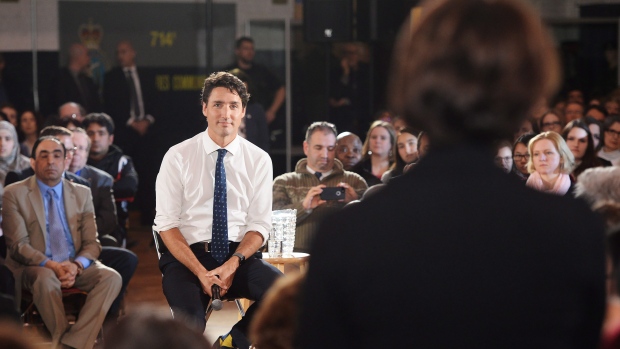
trudeau-tour-20170117
Mental Health Estrie founder Judy Ross asks Justin Trudeau what he can do to make health and social services more accessible to English-speaking Townshippers. The PM tells her he’ll answer her in French.

When you’re blaming someone for the uproar in Sherbrooke, I hope you’re looking in the mirror.

It wasn’t the fault of your town hall advance team that nobody briefed you on the woman asking you that question about health and social service availability in English.

It wasn’t the fault of the media that your fartbrained decision to answer an English question in French escalated into a Facebook feeding frenzy. You’ve been a Quebec MP long enough to know federal politicians always answer in the questioner’s language if they’re able to. Your father was a stickler for federal bilingualism protocol. Frankly, everyone thought you were past that petty linguistic bullshit.

Yes, you sort of apologized but it only compounded the problem. You had a second chance to admit your mistake and make amends to perhaps the one person in that entire room who has personal experience dealing with Quebec’s systemic linguistic discrimination. You blew it.

Judy Ross is the name of the woman who asked you that question in English. She’s the founder and longtime executive director of Mental Health Estrie. If your handlers do their job, they’ll discover that Mental Health Estrie does incredible work on a shoestring for English-speaking Townshippers living with mental illness. They run peer support groups for patients, caregivers and their families. They run social integration projects for patients attempting to reintegrate into their communities.

Each year from November until March, Mental Health Estrie runs its annual HUGS for the Homeless for the Acceuil Poirier homeless shelter in Sherbrooke. HUGS stands for hats, underwear, gloves and mittens, socks and scarves but they accept new articles of clothing that will keep people warm in subzero temperatures. (Mental Health Estrie’s website notes that Sherbrooke is one of 11 Canadian cities that can expect at least one night of -30.)

HUGS was started because Quebec has been cutting the number of psychiatric beds in its hospitals since Jean Rochon was Lucien Bouchard’s health minister. Outreach funding was supposed to bridge the gap but a succession of governments has slashed those budgets as well. Of the 600 or so homeless people the Acceuil Poirier provides for, at least 75% of the men and 90% of the women are dealing with a persistent mental illness.

Maybe you’re getting a glimmer of why Judy Ross was so put out by you switching into French. Mental Health Estrie exists mainly because Quebec anglos are at an even greater disadvantage when it comes to accessing health and social services in English. If you’re dealing with a mental health crisis, your only option is the Hotel Dieu Hospital, where you’ll be lucky if there’s a clinician available who speaks English.

It’s the same for English-speaking communities everywhere off the Island of Montreal. It doesn’t matter whether it’s getting your slow learner child assessed, arranging respite care for a spouse with Alzheimer or dealing with persistent mental illness. The average wait time for English-speaking patients and their families is half again as long as it is for French speakers because of Quebec’s specific demands. For example, files must be in French even if the care provider and patient are both anglos. Bilingual providers must be paid a premium so there’s less incentive to hire bilingual staff. Ottawa, through the Health Care Act and the federally funded CHSSN, has some influence, but every dollar going to minority-language health and social services in Quebec is measured against an equivalent amount for francophones in the rest of Canada. It’s an old, old fight and there are no winners.

So, Mr. Trudeau Jr., this is why Judy Ross reacted like you’d slapped her. How were you to know? These town halls across Canada are supposed to be feel-good photo ops and soundbites of scrubbed, respectful Canadians listening intently to your self-congratulatory speechifying and queuing up for selfies. One can imagine the horror among your handlers when angry, disrespectful Canadians puncture the PMO bubble and the fickle media zoom in on their outrage. Those of us who have spent their working lives chronicling this are never surprised. The longer the honeymoon, the greater the fall.

In a Facebook post this morning I compared Canada’s relationship with you and your government to any personal relationship. Most of us have gotten over the initial puppy-love giddiness. We’re beginning to see the things that attracted us to you are becoming the things that piss us off. We still can’t resist a selfie with you at Smoked Meat Pete’s but we’re beginning to hate ourselves for our weakness. Most of us are still hoping you’ll move past the narcissism, the self-love and the bogus I-care-about-you act to a place where you can be both yourself and politically honest.

Wise up, and quickly. Learn from your father’s experiences. PET won grudging acceptance in Quebec because he never tried to suck up. Trudeaumania had a fast, rude trip back to earth during the 1968 St. Jean Baptiste riot where PET’s presence enraged a coalition of violent Quebec secessionists and union militants. Thirty months later, he was dealing with the FLQ insurgency and an apprehended insurrection that would have seen a popular common front take over the government of the province from the rookie Liberal premier Robert Bourassa.

More free advice: Don’t expect worshipful, happy crowds in Alberta unless you’re ready to Trump the hecklers. I just got off the phone with Garth Pritchard, who is hoping to get into one of your town halls to ask you who you represent — Canada or Quebec. Like most Albertans, he’s angry at his premier Rachel Notley for not taking a stronger stand against carbon taxes. He’s angry on behalf of the 200,000 unemployed Albertans, angry about the average $2 billion a year Alberta still transfers to Quebec.

Like most Albertans, Garth can’t grasp why you’re going around bragging about how your government plans to phase out the oilsands while approving new pipelines. Which is it?

I was at a riding environment committee meeting last night in Hudson where someone asked that same question. There’s a conspiracy theory out there that Ottawa promised $40-50 billion to B.C. to approve the Kinder Morgan project. There’s another conspiracy theory that your government’s picks for the reconstituted National Energy Board have a mandate to ensure Energy East gets its pipeline to Montreal and its tankers downriver passage to the Irving refinery. You should know your credibility in environmental circles is melting faster than the Greenland icecap.

You’re a smart, likeable guy. You’ve done well in making Canada cool. But you’re losing credibility for no good reason and when that’s gone, Canadians will begin to wonder what’s left.

Looking back…

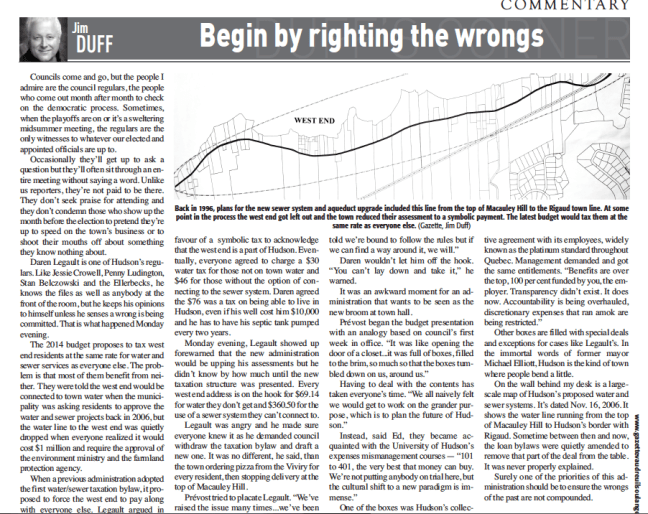
I wrote this column back in January 2014. I was sick of hearing a succession of councils weaselling out of the Town of Hudson’s 2006 promise to west end residents the water bylaw included a line to the west end.

The photo is of part of the map drawn up by LBCD which was presented at two public loan-bylaw meetings in November 2006. The map formed part of LBCD’s funding proposal to the federal and provincial governments. The administration of that period claims the west end aqueduct was removed from LBCD’s proposal because it would have driven up the cost of the project. Who made the decision? LBCD? Quebec? The administration?

Before this and future administrations spend a dime on wish-list projects, they have to attend to this. It’s an open wound, a reminder of promises made for the sake of political expediency and an insurmountable obstacle to equitable taxation. A competent administration would have dealt with this in their first budget.
screen-shot-2017-01-18-at-5-18-08-pm

What promises were made during those loan bylaw consultations in return for citizen support? These are from the Nov. 29, 2006 Hudson Gazette:   pg-01   pg-04  pg-14  pg-44

On Dec. 6, 2006, Mayor Elizabeth Corker first brought up the possibility of metered water for businesses.

Hudson mulling water meters
By Elyse Amend

HUDSON — Businesses on Main Road may be seeing water meters installed to determine how much they should be paying for sewerage.
Originally the Town of Hudson had proposed to tax buildings and businesses their share of the new sewer system on the basis of how much water they consume, but widespread dissatisfaction forced the town to rethink the formula.
The original taxation structure would have seen businesses taxed according to their daily estimated water use in litres. While most offices and stores, would end up paying on the basis of one residential unit, or 675 litres per day, restaurants would be taxed on the basis of 135 litres per seat per day, reflecting how much water is used for food preparation, cooking and cleanup. Beauty salons would be assessed on 650 litres per day per cutting chair, while bars would pay taxes on eight litres per day per client. Doctors and dentists would be taxed on 275 litres per day per professional, while cleaners would be assessed on 2000 litres a day.
Many businesses complained that the formula doesn’t represent the amount of water they really use, so the Town of Hudson is proposing to instal water meters in the business district, said Mayor Elizabeth Corker.
“It looks like the most logical thing to do. Certainly for some businesses that have installed more efficient equipment, they’re likely to use less water,” Corker said. “The idea’s not to undercharge and the idea’s not to overcharge. We’re trying to make it fair for everybody.”
Complexes that house several businesses, such as Shaars, Lancaster Place, and Poiriers, will have one meter installed for all the units. Property owners will be taxed for the entire complex, and will be responsible for passing on the charges to their tenants.
Meter readings would be done over the course of a year to establish actual consumption.
“Probably what we’re leaning towards right now is, we’ll have at least a year to figure out what their consumption is, rather than basing it on hypothesis,” Corker said.
If the loan bylaw is approved, sewer installation could start as soon as this spring, but may be pushed to the fall if there are delays. The Town proposes to ensure that major traffic disruptions won’t take place during the peak summer months, the mayor added.

On Dec. 13, the Gazette ran this story on how costs would be split. This is the first mention that west-end residents would be getting and paying for town water:

Water-system improvements by the numbers:
Total cost: $6.4M
Minus: federal/provincial infrastructure grants: $1.6M
Cost to ratepayers: $4.8 million ($2.4M over 25 years plus $2.4M over 40 years
Annual cost per address: $145 ($122 for loan bylaw, $23 for operation)
Note: Everyone drawing Town water will pay the $240 water tax as a separate line item on their tax bills. West-end residents may choose to continue drawing water from a private well, but will pay $122 because nearby fire hydrants will reduce their insurance costs.

Sewer project by the numbers:
Total cost: $14.8M
Minus: federal/provincial infrastructure grants, excise tax rebate: ($9.1M + $825,000)
Cost to ratepayers: $5.7M ($1.8M over 25 years plus $3.9M over 40 years
Cost split: 70% paid by 30% of all addresses, the remaining 30% paid by the unserviced 70%.
Proposed annual cost per residence: 789 serviced addresses would pay approximately $474 per year ($335 + $139 in operating costs), while 1995 unserviced addresses would pay $60 per year.
Proposed annual cost per business: To be determined on the basis of ongoing negotiations.
Note: The Town proposes to tax the 144 businesses in 122 serviced buildings on the basis of how much water they consume, and therefore how much they discharge into the sewer system. Water consumption was to have been calculated on a per-unit basis derived from provincial guidelines. Those guidelines define a residential unit as 675 litres of water per day — 270 litres of water per person per day, multiplied by 2.5 persons per address.
Guidelines:
• Restaurant water consumption would have been rated on the basis of 135 litres per seat per day, a reflection of the amount of water used for dishwashing, food preparation and equipment cleaning. The number of terrace seats would be divided by two. An 80-seat restaurant serving three meals a day, seven days a week would pay more than a 90-seat establishment open five days a week for breakfast and lunch.
• Daycares: 75 litres/person/day
• Professional offices: 50 litres/employee/day
• Retailers: 50 litres/ employee/day
• Bars: number of clients multiplied by eight litres of water/day.
• Dry cleaners: 2,000 litres per day.
• Medical and dental offices: 275 litres/day per professional, 75 litres/day for office personnel and 25 litres/day per patient.
• Hairdressers: 650 litres per cutting chair per day.
• B&Bs: 180 litres/guest/day.

I have yet to find a story reporting on the loan bylaw’s approval or how many, if any, residents signed a register which would have forced either or both bylaws to a referendum.

I recall a story in 2007 quoting Corker as saying the west end water line was off the table, but I can’t find it. Next step is to go through all the bound copies and page PDFs for 2007 and 2008.

This March 12, 2014 update marks the entry of the Prévost administration in the file.

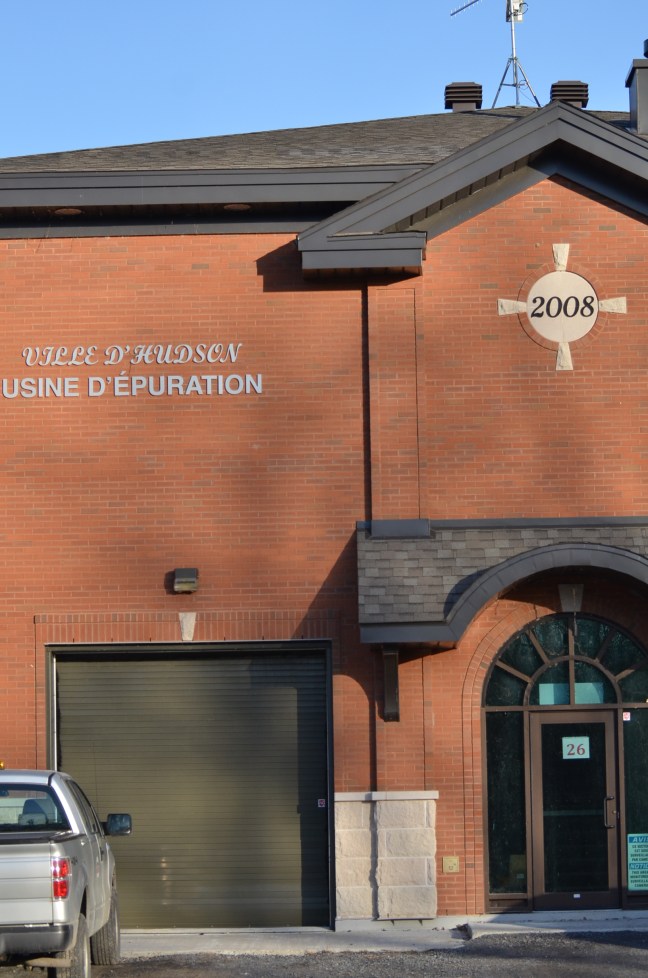
PHOTO: Hudson’s sewage treatment plant was a $5.5 million piece of a $23.3 million puzzle. If unserviced sectors are exempt and Hudson’s three schools can’t be forced to pay, who is left to foot the bill? (Gazette, Jim Duff)

HUDSON
Town grapples with long-term debt scenarios
By Jim Duff
What percentage of Hudson’s $32.5 million in long-term debt represents the cost of the sewage treatment system? The waterworks upgrade? How much represents a dozen other loan bylaws approved over a dozen or more years?
What happens if Quebec upholds a citizen’s complaint at having to pay for a service they’ll never get?
It’s challenge facing mayor Ed Prévost and the administration as the town braces for two municipal affairs ministry (MAMROT) decisions.
The first is on the legality of $23.3 million in waterworks and sewer loans authorized under three borrowing bylaws already approved by MAMROT. Last week, town manager Catherine Haulard urged citizens to complain to MAMROT on the basis taxpayers can’t be forced to pay for services they can never hope to receive.
If MAMROT acts on those complaints, the town could be required to rewrite and re-adopt one or more of the original loan bylaws.
The second is whether Quebec will honour its commitment to service more than $6.5 million of Hudson’s long-term debt.
Late last year, MAMROT informed the town it won’t begin paying the interest and carrying charges on its $6,572,428 share of the deal until the audit of every contract is completed. Prévost said the town has heard nothing more.
Earlier this week, Prévost cited figures showing Hudson requested a total of $15,085,331 to install sewers, build a treatment plant and upgrade the town’s waterworks under the federal-provincial infrastructures program. Of that, $13,074,428 was entered in the town’s books as receivable.
So far, $6,502,000 has been received from the federal government in a lump sum.
If and when MAMROT agrees to pay what it committed to, Hudson taxpayers are on the hook for $10,225,572 over 25 years.
But if MAMROT refuses outright or delays the decision on the basis of the audit, add the annual cost of servicing an additional $6,572,428.
The 2014 budget earmarked $896,742 to finance the town’s total long term debt and $905,056 for repayment of principal.
The mayor assured residents they would be getting adjustments to their tax bills in coming days and said that if MAMROT forces the town to rewrite the original loan bylaws, council has the option of extending the term to 40 years.
Former mayor Elizabeth Corker says MAMROT signed off on every one of the water and sewer loan bylaws at the time. “Never once in 16 years did we have a loan bylaw returned,” Corker added Monday.
“Why are they opening this Pandora’s Box? We spent two years negotiating with MAMROT, traipsing down there every week with the engineers.”




Rewrite!

The Town of Hudson will table a revised 2017 budget as soon as possible after discovering it had understated this year’s tax increase by two thirds. 

A subdued Ron Goldenberg, the councillor responsible for fiscal policy, told tonight’s January council meeting they had used the wrong mil rate for 2016. Instead of the average 1.6% increase he had quoted to reporters, Hudson taxpayers face an average 4.9% increase before tariffs – exactly what I predicted in my blog Hudson’s true tax load, published a week ago.

Goldenberg and mayor Ed Prevost said it was an honest mistake, but it means the town will have to find ways to slash in the budget adopted Dec. 21. It puts the town in a quandary, especially with a long list of organizations already having received assurances they’ll be receiving municipal grants. There was some indication of that tonight when resident Trevor Smith asked why the list of recipients and the amounts they’ll receive hasn’t been released even though the announcement was made at that same Dec. 21 meeting.

Once letters go out to hopeful recipients the amounts of the grants will be made public, councillor Barbara Robinson replied. Recipients include the Hudson Village Theatre, Greenwood, the music festival, St Patrick’s Parade and more.

Goldenberg confirmed the revised budget will tax those whose properties are located on the sewer system who have never paid sewer taxes because they never connected. Some 250 doors, roughly a third of the eligible total, haven’t paid sewer taxes and tariffs since the system came on line nearly 10 years ago.

Following the meeting I asked Goldenberg when residents could expect the revised budget. He said he was hoping to get it done in time for the February council meeting.

It also came out that the town faced a potentially critical water shortage following the Jan. 4 fire in the town’s Como sector. A mother and her two daughters escaped with their lives after being rescued by a passing Hydro Quebec crew. Town DG J.P. Roy told resident Richard Rothschild the combination of the fire and four leaks in the system together significantly lowered the town’s water reserves. Rothschild noted the town would have been in serious trouble, had there been another fire in town. Roy said later that while the level was of concern, the town never faced an emergency situation. 

More to come once I’ve listened to the tape and gone through my notes.

Waiting for Bill 122

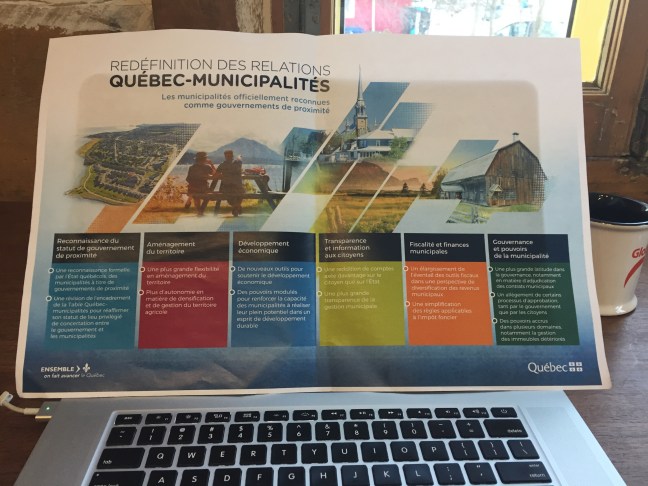
Warning: some elected officials may find this dangerously boring. Do not attempt to understand while doing anything which requires wakefulness.img_0798

Bill 122 was introduced in Quebec’s National Assembly Dec. 6, “an Act mainly to recognize that municipalities are local governments and to increase their autonomy and powers.”

When it is adopted sometime in 2017, it will give Quebec’s 1,600 municipalities broader powers over urban planning, including zoning. It will change how municipalities are allowed to ask for the 10% greenspace requirement for a proposed subdivision. It will govern how municipalities plan their spending priorities. It will lay down tough new freedom-of-information and fiscal reporting requirements.

It will make public consultation a cornerstone of development policy.

Municipalities will no longer be required to post public notices in local newspapers. Instead, they will face tougher transparency requirements, including the obligation to post every public document on a municipal website.

Once Bill 122 is adopted, municipalities will have far greater autonomy over zoning and development. Section 85.5 deals with a new word, requalification. A municipality may identify requalification zones in its planning policy, where redevelopment such as densification or urban renewal wouldn’t require a rezoning bylaw subject to referendum. Until Bill 122, a municipality wishing to direct development or renewal had to adopt a plan particuler d’urbanisme, or PPU. Vaudreuil-Dorion used a PPU to bigfoot opponents to the sunless canyons on de la Gare. L’Île-Perrot used a PPU to rehabilitate Grand and Perrot Blvds., but in both cases all it required was Quebec’s blessing.

Here’s what the new law says (boldface type and quotation marks denote exerpts lifted verbatim from the draft bill’s English version available on the National Assembly website):

Every municipality that wishes to avail itself of the power provided
for in section 85.5 shall first adopt an information and consultation policy.
The policy must contain measures that are complementary to those in this
Act and are designed to foster public participation and the dissemination of
information. The policy must enable the public to make comments or
suggestions, orally or in writing, and provide for dissemination of information via the Internet.
The policy must also provide for the production of a consultation report and
its tabling before the council of the municipality.
The Minister may, by regulation, fix any other requirement concerning the
content of an information and consultation policy.
The policy applies, throughout the territory of the municipality, to any
amendment or revision of the planning program. 
Every municipality that wishes to amend or revise its zoning or
subdivision by-law in a way that significantly modifies the standards applicable
in a territory situated within a requalification zone must first produce and make
public an analysis of the probable social, economic and environmental effects
of these new standards. The analysis must draw a connection between the
modifications and the directions and objectives contained in the planning
program.

Another major change governs the 10% greenspace requirement from developers.

The rules must also take into account, in favour of the owner, any transfer
or payment made previously in respect of all or part of the site.”
[…] The municipality may require the
transfer of land whose surface area is greater than 10% of the surface area of
the site if the land in respect of which the subdivision or building permit is
applied for is situated within a central sector of the municipality and if all or
part of the immovable is green space. […] If the municipality requires both
the transfer of land and the payment of a sum, the amount paid must not exceed 10% of the value of the site.
The council shall, by by-law, determine the boundaries of the central sectors
of the municipality and define what constitutes green space for the purposes
of the third paragraph.

Bill 122 also imposes stricter fiscal reporting requirements on municipalities. For example, a municipality’s treasurer must submit to Quebec by May 15:
– a financial report;
– the chief auditor’s report;
– the external auditor’s report.
Any revisions must be tabled at the next public council meeting. Moreover, “the treasurer shall table two comparative statements at the last regular
sitting of the council held at least four weeks before the sitting at which the
budget for the following fiscal year is to be adopted.”

Municipalities will be forced to clean up their procedural act. No longer will they be able to present a notice of motion of a proposed bylaw, then adopt said bylaw later in the same meeting.

Every by-law must, on pain of nullity [declared null and void],
be preceded by a notice of motion and a draft by-law tabled at a sitting
of the council and be adopted at a subsequent sitting held on a later day.
The notice of motion and the draft by-law may be tabled at the same sitting
or at separate sittings, but the draft by-law may not precede the notice of
motion.

Finally, Bill 122 will make Quebec the final arbiter in determining “what information every municipality is required to disseminate in an open document format on a storage medium so that it can be reused.

The regulation must set out the terms governing the dissemination of such
information, which terms may vary according to the different classes of
municipalities.”

When will Bill 122 be adopted? We don’t know. The Couillard government and Quebec’s two major municipal associations have been trumpeting its virtues for the past year but it could take another year before it becomes law.

In the meantime, the old rules apply. Municipalities should keep this in mind before attempting to justify policy changes based on legislation yet to be adopted.

Buy a ticket!

water-filtration-rgb
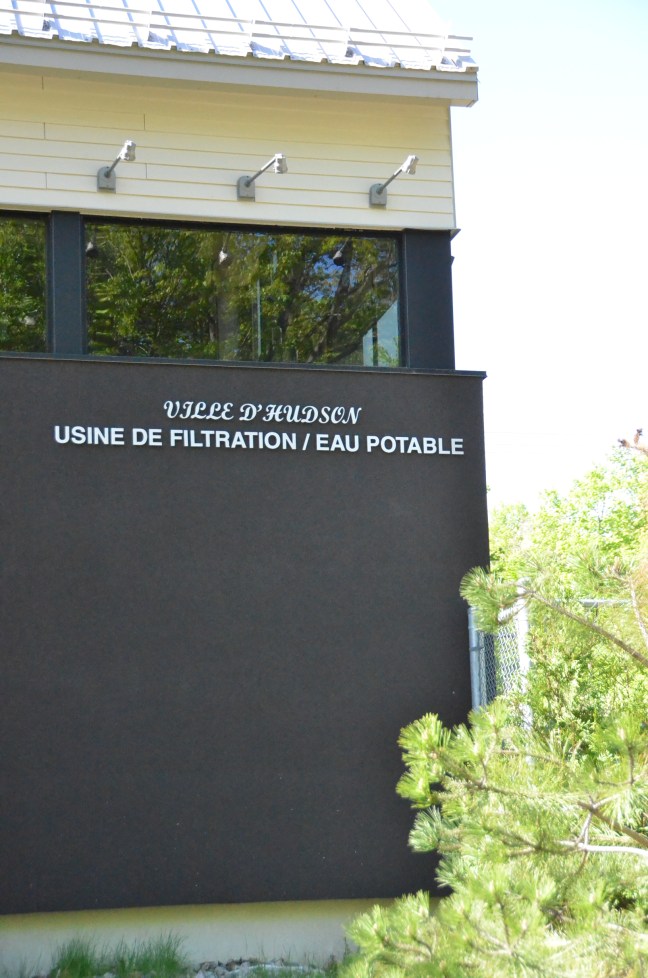
Hudson, the fourth largest water consumer in the MRC, is dealing with  a serious peak-consumption shortfall, yet is in no position to apply for federal and provincial money.

There’s that ancient joke about the guy who prays to win the lottery. Week after week, he lists his financial problems and repeats his plea for divine intervention. As time goes by, his prayers grow bitter with recrimination until one day, the skies open, the clouds part and the Voice of G-d roars “YOU WANT ME TO HELP YOU? BUY A TICKET!”

That geriatric knee-slapper comes to mind as I ponder the Town of Hudson’s mission to seek funding for its growing list of infrastructure projects, beginning with water.

Yesterday, I spoke with Peter Scheifke, our federal MP for Vaudreuil-Soulanges and Parliamentary Secretary to the Prime Minister for Youth. Scheifke briefed me on the money currently and coming available for infrastructure projects.

He began by noting $170 million in federal money available to Quebec municipalities of fewer than 100,000 residents for new potable water infrastructure and repairs to existing infrastructure. Costs are split three ways, with Ottawa and Quebec shouldering two thirds. Quebec racked up a $2.1 billion surplus in 2016, allowing an additional $400 million to be earmarked for municipal infrastructure.

Then there’s the Trudeau government’s new infrastructure program, under which Ottawa pays half, Quebec a third and the municipality just 17%.

But there’s a catch. A provincial law passed during the Duplessis era requires the feds to go through Quebec to fund municipal projects. Quebec is the only province with such a requirement.

Despite its infrastructure needs, Hudson isn’t on the list because it can’t satisfy Quebec’s requirements. “Hudson is not currently ready [for anything to be approved],” Scheifke told me.

Hudson’s council adopted a resolution at the town’s December budget meeting to hire a full-time grant chaser, but the town’s DG Jean-Pierre Roy told me this morning the town must file a public works intervention plan with the municipal affairs ministry (MAMOT) before filing grant-eligible proposals.

To draft a public works intervention plan, the town must first hire a consulting firm to compile data on every aspect of municipal infrastructure – roads, aqueducts, sewage and storm sewers, sidewalks, even streetlights.  “They want us to pay what’s broken first,” Roy explained.

I was blown away when the DG said the town should have filed an intervention plan 10 years ago. Hudson has to play catchup and under Quebec’s grant guidelines, must re-prioritize its to-do list. It’s possible Hudson’s bumpy roads and treacherous sidewalks will take priority over waterworks upgrades for infrastructure funding.

Here’s the kicker: Under Quebec’s guidelines, Hudson may not qualify for potable-water infrastructure spending because it uses too much water.

According to an MRC Vaudreuil-Soulanges-funded study (Put Water on the Table, http://www.thousandlashes.ca, February 2016) Hudson’s residents consume 1,123,024 cubic metres of water a year, the fourth highest in the MRC. Quebec municipalities average between 200 and 300 litres per day per person; Hudson’s consumption tops 400. The southwestern sector consumes more than a thousand litres per day per person.

Hudson’s administration hopes to address overconsumption by sensitizing property owners, but if people don’t pay, they don’t care until their toilets stop flushing. And as I posted (Downtown, downtown, http://www.thousandlashes.ca Jan. 3) the usage differential between business and residential sectors is astronomical:

Hudson residents who volunteered for this council’s strategic planning committee looking at the water issue learned from the town’s water technician that Alstonvale and Hudson Valleys consume three times the amount of water used by the centre of Hudson. One participant told me the technician held up his smartphone so the committee could see how the town is able to monitor real-time usage and compare it with archival data. “We saw how it spiked when Alstonvale’s sprinklers went on.”

I’ve also learned the town faces a deadline for the installation of water meters in the  business sector. Originally, MAMOT required business sectors to be metered by September 2017, but that deadline has been extended a year. Bottom line: Hudson must meter business water consumption and ensure the accuracy of its well and filtration-plant flowmeters by September 2018.

Roy said the town may agree to meter a sampling of residential properties to establish a basis for comparison, but is not obliged to do so.

The DG also told me the administration is still wrestling with water and sewer taxation issues beginning with those whose properties are located on the sewer system but are not connected. Roy confirmed these unconnected sewer dwellers do not pay either sewer tax. The municipality has never set a sewer connection deadline, so approximately 250 of the 700 eligible properties haven’t connected or paid sewer taxes in 10 years.

Water meters, sewer taxes and related infrastructure issues will be on the agenda for Monday’s January council meeting as this administration gets its house in order. Until that’s done, there will be no point in applying for infrastructure money, let alone any of those fanciful projects on the strategic planning list town hall spent so much time and money selling to Hudsonites.

Sadly, there’s no depanneur selling tickets for the infrastructure lottery.

Put water on the table

This was first published last February. I’m hoping Hudson residents will develop a sense of urgency on this issue. Maybe when their toilets no longer flush…

jimduff's avatarthousandlashesdotca

No discussions about development in Hudson, Rigaud and St. Lazare should exclude the impact on the water table supplying our drinking water.

A study released in June 2015 found that precipitation falling on Rigaud Mountain and the Hudson and St. Lazare plateaus represents 41% of the total replenishment of the Vaudreuil-Soulanges aquifer, the water table supplying drinking water to more than 100,000 Vaudreuil-Soulanges residents. (FYI, St. Lazare is the largest municipality in Quebec entirely dependent on well water.)

The chief concern expressed in the Programme d’acquisition de connaissances sur les eaux souterraines (PACES) report is that the zones with the highest replenishment rate — Mont Rigaud, Hudson and St. Lazare — also happen to be the most vulnerable to contamination.

The study was carried out over a two-year period by a multidisciplinary team from the Université du Québec à Montréal, École Polytechnique and GéoMont, the agency mandated to map the…

View original post 652 more words

Public service prerequisites

gavel.jpg

In his farewell address, Barak Obama made his usual eloquent plea to get politically involved. If you don’t like the way your school board, town, city, state or country is run, jump in. The outgoing U.S. president’s subliminal message: Donald Trump won because of apathetic, disengaged Americans who don’t vote, don’t show at meetings and don’t inform themselves. Want to see Trump and the Republicans ousted? Show up ready to work. Bring a lunch.

At the heart of Obama’s message, this reality: The I-don’t-give-a-damn lobby is far and away the largest voting bloc in North America. I use the term ‘voting bloc’ because of the effect not voting has on the democratic process. Non-voters give those who vote greater influence and bestow unearned legitimacy on those elected.

Trump was chosen by less than half of the 52 per cent of eligible voters who actually voted, roughly 23% of the U.S. voting population. Lest we get smug, Canadians elected the Trudeau Liberals with 27% of the total eligible vote.

…which brings me to a thread on my WordPress site suggesting those who challenge the words and actions of elected politicians should either put up or shut up.

Let’s start with the meaning of the words ‘public service.’ Public service doesn’t begin on Election Day. It doesn’t begin when one files one’s nomination papers or when one is sworn in. Public service starts with a basic grasp of how society’s political, legal and economic systems work. Public service prerequisites include learning how to read a financial statement, how to access information, citizens rights and the responsibilities of elected officials. Some of this is taught in school. The rest is what I call lifelong learning.

For me, the process started in high school. I joined the debating team. We were taught Roberts’ Rules. We learned the elements of Socratic discourse, Marxist dialectic and parliamentary debate. We were educated in how different political systems work and don’t work.

I went on to Loyola College, which in those days was affiliated to the Université de Montréal and run by the Jesuits. There, this Presbyterian was exposed to liberation theology and the Jesuit belief that one must be able to take either side in a debate to earn the right to an opinion.

Most of what I know about Canadian democracy was acquired in my 50 years as a reporter, editor and commentator. I covered both generations of Trudeaumania, René Lévesque and his PQ successors, Brian Mulroney and Jean Charest, both referendums, the October and Oka crises, Claude Ryan and Reed Scowen. I also got to know mayors and city managers – Jean Drapeau, Mae Cutler, Peter Trent, Hazel McCallion, Malcolm Knox, Bill McMurchie, Jean Doré, Michael Fainstat, Pierre Bourque, Gérald Tremblay, Gérald Vaillancourt, Michael Appelbaum, Frank Zampino and scores more. Some are deceased, some are in jail or headed there, but every one of them taught me something about how politics works and the meaning of public service.

Throughout my journalistic career I’ve avoided being sucked into politics. Twice I broke that rule. Once was when I was invited to participate in a 1991 estates-general where Quebec’s Liberal interprovincial affairs minister Gil Remillard laid out the five conditions for Quebec’s signature on the 1982 Patriation Act. I was working as a CBC TV reporter and had been cautioned by my boss against being caught in a conflict of interest. I counted on my presence going unnoticed until my name appeared in Joe Armstrong’s 1995 diatribe Farewell the Peaceful Kingdom: The Seduction and Rape of Canada. It was my lesson in the essential nature of journalistic objectivity.

The second time was over a five-year period beginning in 1995. I was a talk show barker, first on CJAD, then on CIQC. I deliberately scrapped my journalistic objectivity in interviews and discussions involving Quebec independence. I spoke at anglo-rights rallies. I derided my French-language colleagues for what I saw as their biased coverage. My rants got me sued by then deputy PQ premier Bernard Landry. I acquired — and still own — the Bloc Québéois name in Quebec so I could mock them for being a federally chartered political party dedicated to the breakup of Canada. I grew to love being able to polarize opinion. My ratings showed how easy it was to fire people up.

I found no satisfaction on radio because I knew I was betraying the trust of journalistic objectivity and the discipline imposed by the written word. I still miss radio’s immediacy and reach, but it was far too easy to play to one’s audience, to pander to their prejudices and fears. When the radio gig ended (that’s showbiz!) I returned to print journalism with a vow to keep the faith of journalistic objectivity when it came to reporting the news.

Eventually I moved back to Hudson because Louise and the Gazette Vaudreuil-Soulanges needed me. The last 15 years I’ve spent exploring the distinctions between objectivity, neutrality, balance and equivalency with the help of a succession of incredibly bright, driven young reporters who quickly grasped the nuances. We were objective without being neutral, balanced without striving for equivalency. We broke major stories by digging while others would send their stenographers to news events, regurgitate the content onto newsprint and airwaves and go home. Together, we re-wrote the book on community journalism.

Since the October 2014 closure of the paper for reasons beyond my control, I’ve concentrated my efforts on developing a virtual community newspaper on social media. This week, Facebook announced it was doing the same, leading Canada’s remaining publishers to announce their own initiative to keep social-network advertising dollars in Canada. Watch for this sector to explode within the next year or two as news consumers seek voices they know and trust.

In the meantime, I keep my writing and newsgathering instincts alive by blogging on WordPress and posting on Facebook. Both are transitional. As Louise is fond of reminding me, people who spend their time on social media are looking for affirmation, not information. Most Facebook threads remind me of those overnight talk shows where the same people call to say the same things night in, night out. We can and will do better. Much better.

As of today, Jan. 12, the municipal elections are in 278 days. According to my calculations based on the DGEQ website, nominations for council positions open Sept. 22 and close Oct. 6. Independents can register before that, but as of today, nobody has registered or reserved the name of an official party and nobody has registered as an independent candidate.

Although we’ve all heard the rumours about people intending to seek election or re-election, the only person who has confirmed to me that he is running is Rod Hodgson, one of Hudson’s longest-serving town employees. Rod says he’ll be running in District 1 (Como). I’m sure Rod will be a valuable member of council. He knows Hudson’s nooks and crannies, having crawled into most of them. The way I measure prerequisites, Rod is seriously overqualified for the job.

I’m sure there are plenty of other Hudson residents out there equally qualified. From the comments posted on thousandlashes, I sense there’s general interest in taking our conversation to the next step. Here’s what I’d like to see accomplished before nominations close:

– The creation of a citizen’s caucus. Some will see this as a direct challenge to the authority of the council and administration. With respect, how is an unelected, unrepresentative citizens’ group able to challenge anyone’s authority? Residents who volunteered for this administration’s strategic planning subcommittees have told me of their disillusionment with the process. I can’t bring myself to blame anyone. We elect a mayor and council to oversee the administration in the performance of their duties on behalf of all citizens. Whatever their expectations, advisory groups are not elected and therefore unaccountable.

I see an arm’s-length citizen’s caucus as an essential first step in recruiting qualified candidates. I’ve often wondered why Hudson has never had much luck attracting enough quality candidates to make most municipal elections a real choice. As Eva McCartney notes, council seats are far too often filled by acclamation or if, there’s a contest, to prevent an acclamation. That isn’t much of a reason.

– Discussion of real issues without polarization, confrontation or publicity. My New Year’s resolution is to fight the temptation to rag on the current administration and its elected members (there will be plenty of that once the campaign begins). Nor should anybody expect a coherent, informed discussion at a monthly council meeting, especially during a question period. People need to understand that for the mayor and council, the public meeting is the final step in a process which included a working table with town hall staff and a caucus meeting the week before. By the time they’re presented at council meetings, resolutions have already been discussed and approved. Adoption is a legal formality.

– Set new governance goalposts, beginning with transparency and accountability. I’ve watched Westmount’s Peter Trent redefine the planning process to add public consultation on any project that could impact on public spaces. Hudson residents have been told time and again council’s hands are tied when it comes to planning secrecy. I don’t believe that to be true. Likewise, essential data should be posted on the town website as soon as it can be made available. The municipality complains about being swamped with access-to-information requests. Why not post everything as soon as possible as a matter of routine unless there’s a specific reason not to do so? Better still, why not stream council meetings live?

– Get more people involved in the process. Anyone thinking of seeking office should begin attending council meetings, starting next week (the agenda should be posted on the town website by the end of the day tomorrow). Attend. Listen. Observe. Read the documents handed out. Learn what they mean. Repeat for the next nine months, when this council is dissolved prior to the election. Watch for special meetings called with 24 hours notice.

To summarize: it’s way premature to talk about candidates for the mayoralty and council. My public service assignment is helping others set up a framework for discussion, possibly but not necessarily leading to nominations. As Obama said, democracy isn’t pretty and it can be bloody. I’ll settle for not drawing blood.

I’m curious about your reactions. Anyone interested in talking about this in confidentiality can email me at duffcraig48@gmail.com, message me on Facebook or call me at 450-458-5353.

Adios, amigos

web-po-saudi-arms
Stéphane Dion, replaced as Canada’s foreign minister by Chrystia Freeland, was a passionate spokesman for a worldwide reduction in greenhouse gases. As Canada prepares to battle Mexico for a special trade deal with the Trump Republican White House, there was no room in Trudeau’s cabinet for a man who believed in doing the right thing regardless of the political cost.

Canada and Mexico could join forces to challenge Donald Trump’s plans for a wall on the Mexican border and a repeal of the North American Free Trade Agreement, but they’re not.

Instead, Justin Trudeau and Enrique Peña Nieto are each lobbying for a special relationship with the U.S. president-elect and both Republican-controlled houses.
To nobody’s surprise, Chrystia Freeland replaces Stéphane Dion as Canada’s foreign affairs minister, while in Mexico, Peña has named Luis Videgaray foreign minister.

There was no way Dion’s environmental baggage could pass inspection in Washington, where fossil fuels are back in fashion and climate-change researchers are updating their resumés. As international trade minister, Freeland rescued a free trade agreement with the 28-country European Union when it looked like it was headed for another Brexit shipwreck. Trudeau advisors Katie Telford and Gerald Butts spent several days last week laying the groundwork for Freeland to connect with Canada’s allies in the Republican-dominated Congress and Senate.

Likewise, Videgaray’s return to cabinet was a pragmatic decision. He quit as Mexico’s finance minister days after Trump’s pre-election visit in September, a visit insiders say Videgaray set up. Once Trump’s election was confirmed, Peña Nieto did what he had to do to reinstall a certified Trump whisperer.

Dion was an easy target. I believe he should have halted the $115 million deal that saw Canadian armed vehicles shipped to Saudi Arabia for use in subjugating its Shiite minority.  I thought he was inept in his refusal to get harsh with the Saudis over the 10-year, 1,000-lashes sentence meted out to blogger Raif Badawi, whose plight and Quebec family convinced me to start blogging.

What I find surprising is Trudeau’s ruthlessness. I recall watching the young MP, a Dion-green scarf around his neck, joining a celebratory conga line to parade the newly elected Liberal leader through Montreal’s Palais de Congrès. That was in 2006. Now that they’re in power, the Liberals would like nothing better than to erase memories of those ideology-driven days in the political weeds. Kyoto? A city in Japan, the name of Dion’s dog. In Trudeau’s comments on the shuffle, he made no mention of Dion’s 21 years – including two years as Liberal leader – as Canada’s voice of environmental responsibility.

In Donald Trump’s post-fact world, this alarms me. Why is Canada so quick to acknowledge the new reality? What priority will Canada’s environmental concerns be given? How will Freeland reconcile Trudeau’s national carbon tax with Canada’s place in the continental supply chain?

The optics aren’t encouraging. For Dion and fellow veteran John McCallum, there were no cabinet openings. McCallum, who as Canada’s immigration minister opened the door to 25,000 Syrian refugees, becomes Canada’s ambassador to China. It’s been variously reported that Dion was offered the ambassadorship to France or Germany, but said he’s reflecting on his options.

I’ve always liked Dion the humanist. Mostly it’s because of his passionate efforts on behalf of those who believe in a united Canada. Thanks to Dion, the Chrétien government adopted the Clarity Act in the wake of the 1998 Supreme Court reference on Quebec’s right to secede unilaterally.

Thanks to Dion, Quebec’s independence movement lost the momentum it might have carried out of the 1995 referendum.

But that was then. Now, Trudeau’s Liberals depend on Quebec for their re-election and the last thing they need is a resurgent PQ under Jean-François Lisée resurrecting old humiliations on Canada’s 150th birthday. Another reason Dion had to go, given that Quebec’s National Assembly voted unanimously for a motion that Quebec, and only Quebec, has a say on future referendums and terms of secession in the event of a yes vote.

I also understand the PM’s need to empty the Liberal closets of noisy, rattling old bones as it heads into a trade war with the world’s greatest consumer nation. Trudeau knows Peña Nieto will play Mexican wages against Canadian social entitlements, Mexican versus Canadian oil, Mexico’s fierce war on drugs versus Canadian cannabis and Canadian needle exchanges. Trump hasn’t even taken power, yet he has the two amigos scrapping on the threat to scrap NAFTA.

Dion exited with a comment I hope Trudeau remembers when it’s his turn to jump.

“I loved politics, especially every time I could make a difference for the benefit of my fellow citizens. I’m leaving filled with energy – renewable. But politics isn’t the only way I can serve my country. Happily.”

Hudson’s true tax load

What is the Town of Hudson’s average tax increase for 2017?

Finance committee mouthpiece Ron Goldenberg told the West Island Gazette the increase was in the neighbourhood of 1.6 per cent on the average home, excluding tariffs. (My boldface).

According to my calculations based on a comparison of the estimated 2016 and 2017 tax bills of nine Hudson homes, the true increase is close to 7%. (See table below)

The 2017 budget establishes four property tax rates – residential (76 cents per $100), agricultural (ditto), non-residential (81.47 cents per $100) and vacant land (91.22 cents per $100).

Then there’s something called the Total Debt Service tax – approximately nine cents per $100. This pays the debt service on 13 loan bylaws covering everything from the new firehall to culvert replacement but excluding water and sewer bylaws.

So all property owners pay two taxes – property tax and that TDS tax. To figure out your property tax bill, multiply your evaluation minus the last two digits by the property tax rate which applies to you. (Example: if your home is evaluated at $459,500, multiply 4595 by .76.) Do the same with the .0885 TDS tax. Add the two to get your basic tax bill.

Which brings us to those tariffs.

Let’s begin with water. Everyone on town water pays three tariffs. One depends on where you live. For most Hudson residents, it’s $137. Hudson Valleys and Alstonvale residents pay $287. West end residents connected to Rigaud’s Pointe à Raquette system pay $$375.

The second tariff ($78 in 2017, $65 last year) covers the debt service on Bylaw 504, which represents most of the roughly $8 million cost of a new well (now failing), the water filtration plant next to Harwood Blvd. west of Cameron and improvements to the town’s aqueducts.

The third tariff ($57 in 2017; $55.40 in 2016) is also levied on every resident on town water. Described as a tariff to repay interest and principal on Bylaw 554, this one is questionable because it relates to both the sewage treatment plant and the water filtration plant.

Next: waste management. The 2017 bill for green and blue box collection is $266 per household, up from $195 in 2016.

Now to sewer tariffs and one of Hudson’s tax fairness issues.

First, the tariffs. Residential property owners pay $314. Businesses pay between $320 and $2,750. For example, most commercial spaces pay the minimum. Hair salons, dry cleaners, pool and spa businesses, caterers and farms pay $470. Bakeries, restaurants, bars, garages and daycares pay $750. Pharmacies and grocery stores pay $2,500. Golf clubs, the yacht club, car washes and the ferry pay $2,750.

Everyone connected to the sewer system also pays $116 to cover the cost of loan Bylaw 505.

Approximately 750 of Hudson’s 2,200 doors are able to connect to the sewer system. That number includes Hudson’s three schools and both downtown churches as well as municipal buildings, but these big users are exempt from all taxes and tariffs. In lieu of taxes, the town gets a pittance from Quebec.
Now, the fairness issue.

Ten years after the sewer system’s completion, a third, or approximately 250 doors, still have not connected. According to Goldenberg, those 250 doors are exempt from sewer tariffs because they choose not to connect. If you knew you could save $436 a year on your tax bill, would you connect?

Despite repeated urgings, three administrations have refused to order reluctant sewer-dwellers to connect. Provincial regulations oblige the town to ensure all septic tanks are pumped out every second year, but many installations are due for replacement. This is why residents of Hazelwood and Kilteevan agreed to loan bylaws that cost homeowners an additional $1,150 and $1,141 respectively. Previous administrations have offered similar options other sectors of the community.

Hudson’s businesses are now on notice that the town proposes to install water meters at the property owner’s expense and tax water consumption.  Goldenberg and town manager J.P. Roy revealed at the December budget evening that the town has no plans to meter water consumption in the residential sector even though it accounts for 95% of the town’s total consumption.

I’ll get to the commercial sector when the town provides me with requested data.

All tax data by address is available online via the town’s website. The following figures are for a sampling of nine homes throughout the municipality.  Figures may be garbled, depending on the platform you’re using.

Address          Valuation         Property tax     Other taxes/tariffs*     % change        Total

Residential/ agricultural                                                                             +6.7% average
Mil rate 2017@.7602/$100
Mil rate 2016@.6973/$100

West end agricultural        $433,800       $3,300                   $650 (6,7)      +6.8% $3,950
2016                                                                  $3,025                   $672                             $3,697

West end                                 $244,900         $1,862                $482 (6,7)         +8% $2,344
2016                                     $1,708                $464                                                             $2,172

West end                    $1,145,900         $8,711                $1,014 (6,7)               +5.8% $9,991
2016                                                           $7,990               $1,455                                      $9,445

Hudson urban                $463,700        $3,525                 $810 (1,3,5,6,7)       +6.8% $4,335
2016                                                             $3,233                 $825                                       $4,058

Hudson urban             $396,900        $3,017                 $889 (1,3,5,6,7)         +5.6%  $3,906
2016                                       $2768                  $850                                                              $3,605

Hudson centre            $440,900      $3,352     $907 (1,2,3,4,5,6,)                  +6.9%  $4,259
2016                                                        $3,074     $909                                                         $3,983

Hudson urban                      $533,000       $4,052               $910 (1,3,5,6,7)        +7% $4,962
2016                                                              $3,716                    $901                                     $4,617

* Other residential taxes/tariffs

1: Water networks tariffs: Urban, $136.96; Hudson Valleys, $286.57; Pointe à Raquette, $375
2016: $97.50; Hudson Valleys, $408.50; Pointe à Raquette, $331.73
2: Urban sewer network tariff $314
2016: $345
3: Bylaw 504 (water) $78
2016: $65
4: Bylaw 505 (sewer) $116
2016: $108.62
5: Bylaw 554 (sewage, water treatment operational activities) $56.53
2106: $55.40
6: Total debt service (13 other loan bylaws) @$.0885/$100
2016: @.11/$100
7: trash and recycling $266
2016: $195