
Adopted at a special meeting Monday (Dec. 16), Hudson’s 2025 budget pushes spending over the $17 million bar — but without significant impact on residential homeowners despite a 40% increase in residential property evaluations in the latest three-year tax roll.
The $17,687,200 exercise pegs the total 2025 tax bill (including water and three-bin waste collection) at $3,938 on the average Hudson home, a 1.92% increase on a property worth $635,650 in the new three-year roll. (That same home carried a $450,000 assessment in the 2022-2024 roll.) Residential properties of similar value capable of connecting to the municipal sewer system will see their tax bills increase to $4,334 (+2.61%).
A residential property with water and three-bin waste pickup currently evaluated at $617,300 will pay $5,189, a 2% increase on a revised evaluation of almost $872,000. Adding a sewer connection will raise the bill to $5,585, a 2.53% increase.
A million-dollar home in 2024 is now a $1.4M home, but the tax increase remains below 2.5%.
Next year’s budget is the first based on the 2025-2027 valuation roll presented in September. Based on real estate transactions over the last three years, Hudson’s total valuation increased by 40%, from $1.6 billion to $2.2B, so to maintain tax revenues at the current level, the administration had to cut tax rates.
Draft Bylaw 774, tabled as a notice of motion during Monday’s two-part budget adoption process, reduces next year’s residential rate from 64.2 cents per $100 evaluation to 46.6 cents. There’s less of a drop in the commercial rate — from 65.4 cents to 55 cents per $100. The mil rate on serviced vacant land — the town’s highest tax rate — goes from 81.7 cents per $100 to 59.4 cents. Farmland and woodlot owners will see their tax rates reduced to 46.6 cents from the current 64.2. The surtax on long-term debt bylaws drops from 9 to 6.2 cents per $100.
Tariffs listed in Bylaw 774 will increase across most categories, some significantly.
— Drinking water remains unmetered, at a $240 per address base rate.
— the base rate for residences connected or able to connect to the municipal sewer system rises from $360 to $396.
— Household green bin pickup increases $3 to $128.
— Blue-bin residential pickup is now free, financed by the recovery and sale of recycleables at the provincial level.
— Brown bin composting pickup, currently $120 per household, increases to $139.
— Eco-centre use, currently free, will cost $68 per household.
Mayor Chloe Hutchison and CPA Serge Courchesne, the town’s latest consulting fiscalist (absent a full-time treasurer) tag-teamed the presentation before a sparsely attended meeting, where the sole surprise was councillors Doug Smith and Benoit Blais voting against the budget’s adoption for the second year straight.
Explaining his dissent, Blais noted that Hudson’s budgets have increased steadily since this council took office ($10.8M in 2021, $13.7M in 2022, $16.3 in 2023, $16.9 in 2024). Blais, who railed constantly against the last council’s lack of fiscal discipline, confirmed he won’t be seeking re-election in next fall’s municipal elections, as did Smith, who last year wondered why successive administrations don’t consider zero-based budgeting — starting the drafting exercise from scratch instead of adding onto the previous year’s exercise.
“I’m tired of wasting my time,” Blais said following the meeting.
Municipal tax bills, now mailed at the end of March, will be sent before the end of January, with the first payment due in March. Second and third payment deadlines will remain the same.
“This is now common practice in many municipalities,” the mayor told residents.
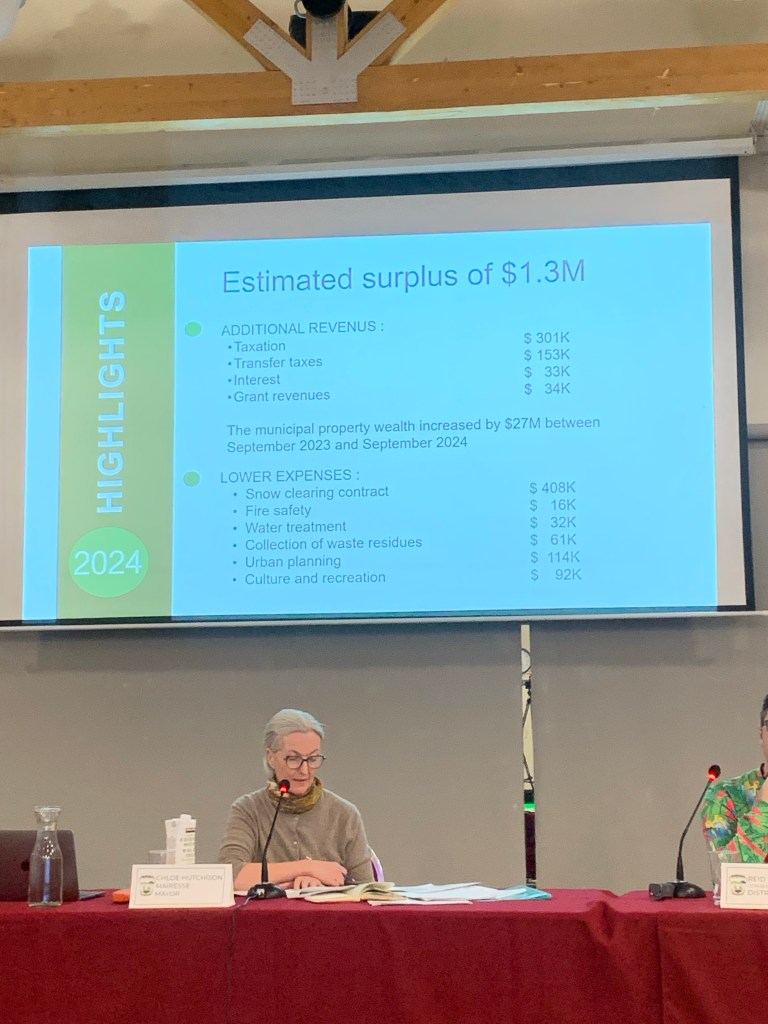
Briefing keynotes included confirmation that the town is carrying over a $1.3M surplus from 2024, the result of:
— $301K more in property/services tax revenues than budgeted;
— $153K more than budgeted in welcome tax revenues;
— $33K more in interest;
— $34K in additional grant revenues;
— $600K+ less than budgeted for snow clearing ($408K), fire safety, water treatment, waste collection, urban planning, culture and recreation.
The town’s capital-expenses program (PTI) adopted Monday proposes to invest $23.4M over the next three years on a wish list which includes $3M for a new town hall, $3.6M for a new municipal garage, restoration of the existing town hall, essential repairs and upgrades to the Community Centre and firehall, repaving of Lakeview ($4M) reconstruction of the Viviry Creek culvert under Cameron ($645K) and a slew of smaller — but potentially more pressing — priorities.
Despite an ambitious list of capital improvements, council intends to whittle away at a long-term debt load which peaked at over $35 million a decade ago. By the end of 2023, it stood at $23.4M, with most of the new debt incurred by repaving projects on Main and Bellevue. A year later, long-term debt stood at $22.6M despite the repaving on Main in the east end ($232,000) and the replacement of a filtration membrane in the wastewater treatment facility serving Whitlock West. The 2025 budget projection pegs debt at $21.7M.
 thousandlashesdotca