
To what end?

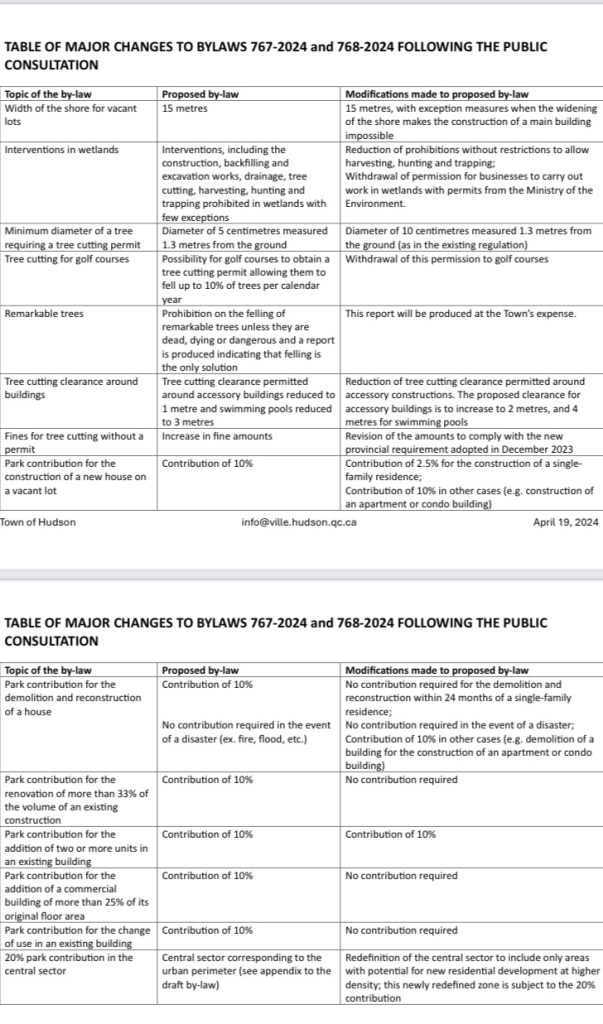
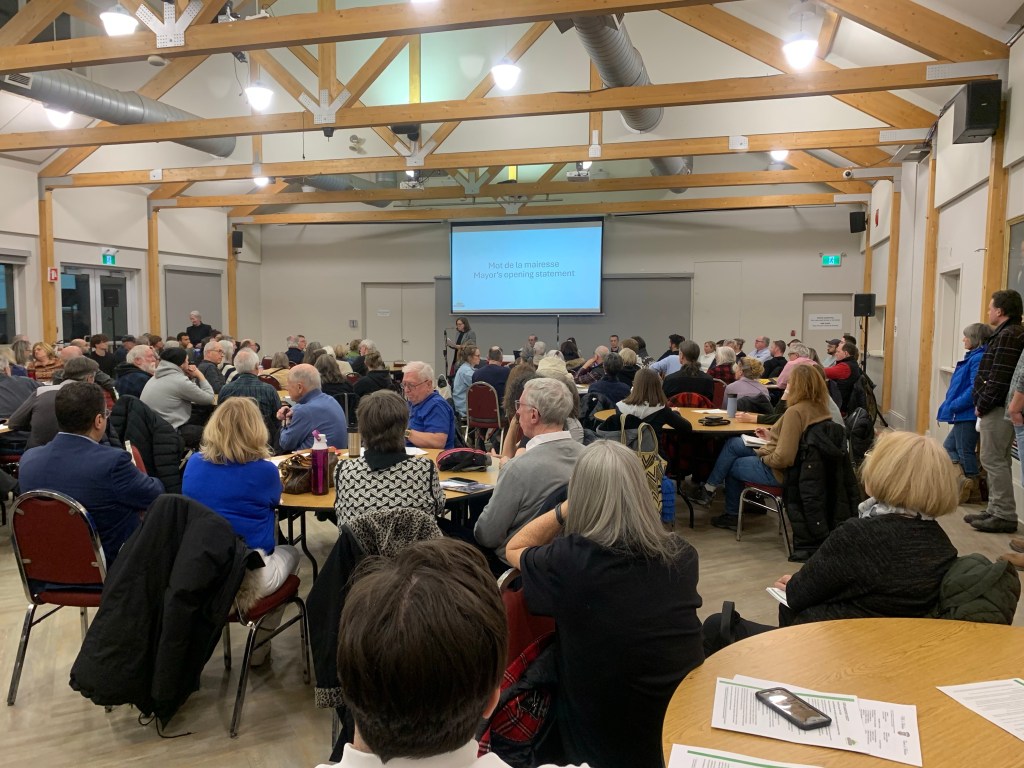
As promised, the Town of Hudson has posted a more detailed list of changes to proposed bylaws 767 and 768 replacing or modifying the the town’s urban planning regulations.

But it still hasn’t spelled out how the current council proposes to tax new or replacement residential development in the town centre — or what parts of town will be subject to this reinterpretation.

The list — posted Friday on the town’s website — compares only those sections changed as the result of concerns raised in the public consultation process. It does not permit comparison with urban planning bylaws currently in force. 

Still unclear is how the revisions to draft bylaw 767 will “redefine Hudson’s central sector to include only areas for potential for new residential development at higher density.”

The original draft bylaw had proposed to apply a 20% land/cash “contribution” on new residential development anywhere within Hudson’s urban perimeter, which represents nearly half of Hudson’s total land area (Hudson’s Valleys, Alstonvale and a handful of neighbourhoods in the east and west ends are excluded from the town’s urban perimeter because they are still classified as agricultural.)

The most significant changes:

Wetlands: 

— The 15-metre shoreline buffer will allow exceptions when the wider buffer makes it impossible to build;

— Withdrawal of the town’s permission to businesses with permits from the provincial environment ministry to carry out work in wetlands;  

— Withdrawal of restrictions on hunting, trapping and harvesting in wetlands.

Trees:

—The minimum diameter of trees allowed to be cut without a permit has been restored to 10 centimetres; 

— Tree-cutting fines have been revised to comply with provincial requirements adopted in December; 

— Golf courses lose the right to cut up to 10% of their trees per year;

— The Town will now pay for assessment of whether one of Hudson’s 188 “remarkable trees” needs to be felled;

— Tree-cutting setbacks around pools and accessory buildings have been increased.

Parks and greenspace tax: 

— The 10% parks tax has been removed for additions or renovations unless the purpose is to add two or more units to an existing building or to demolish an existing building to make way for an apartment or condo complex (still 10%);

— The contribution for construction of a new single-family residence is being cut from 10% to 2.5%;

— No contribution is required for the demolition and reconstruction within 24 months of of a single-family residence.

As announced, residents will be advised of the revisions at a public meeting (7 p.m. Wednesday, April 24 at the Community Centre). Like the draft bylaws, they are not subject to approval by referendum. Unlike the bylaws, they are not subject to further consultation prior to their adoption at the May council meeting.

The main concern should be how these revisions are worded in the revised bylaw. The conforming usages in Hudson’s residential and commercial sectors are clearly identified in bylaws 525 and 526, Hudson’s current zoning bylaws. How is this proposed central sector identified? One might infer that it would include the stretches of Main and Cameron where intensive development has long been rumoured, but it could also be applied to the quadrilateral between Mount Pleasant, Côte St. Charles, Lakeview and the railway right of way. 

We have received mixed signals from the current council over its intentions for the core. Mayor Chloe Hutchison has hinted in the past at the possibility of a plan particulier d’urbanisme, a provincial urban planning instrument that allows a municipality to consult with property owners to come up with a comprehensive redevelopment plan without citizen input. Council recently approved a money resolution to hire a facilitator in discussions with developers.  

Last week, District 6 councillor Daren Legault posted: How is this any different from the idea that some people have: that any new development, any new construction in town should pay a levy up front to cover their “buy in” to the town’s existing infrastructure. I believe that the levy I mention was something you pushed for? Please correct me if if I’m wrong. The results that you now say you were worried about with the bylaw proposals would be no different in my opinion.

It’s a fair question, especially in light of my written comments to council in response to the public consultation:

I was extremely disappointed to note the absence of a section imposing connection fees on the developer. Most municipalities in North America charge developers the entire cost of connecting to existing infrastructure, plus any unforeseen connection costs incurred by the town. (Example: a still-valid development agreement signed by the town and the developer of Sandy Beach saddled Hudson taxpayers with roughly $350,000 in expenses.) Quebec has given municipalities the power to require that these costs of hooking up to water, sewers, drainage, roads, trails and other public infrastructure, so why is it not part of these proposed bylaws?

I ask that council consider taking it a step further by assessing any existing or future residential or commercial expansion the cost of replacing the capacity of our drinking water, sewage treatment and other municipal systems consumed by their project. Surely this is a far easier way to fundraise for a parks and greenspace fund than taxing renovations?

In that context, a levy on large-scale densification projects is logical. But what may be fair and equitable for a 20-unit apartment or condo project is neither fair nor equitable for a small infill project somewhere in the quadrilateral that characterizes the downtown core. Until residents get a clear view of what is being proposed, it’s a legitimate question that remains to be answered.
Silencing the grousers

With the clock running out on its campaign to find legal ways to limit and shape development, Hudson’s administration is heading back to the people with minor tweaks to a controversial pair of draft zoning bylaws adopted in January.

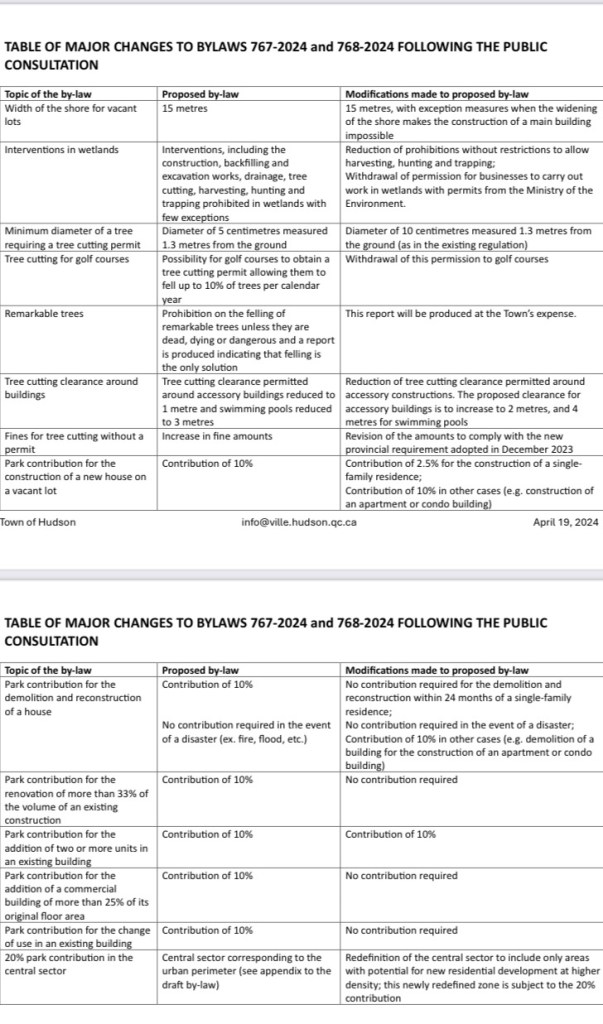
In a message to residents sent out Tuesday (April 16), the town stated that modifications to bylaws 767 and 768 would be presented to residents at an information session (7 p.m. Wednesday, April 24 at the Shaar Community Centre, also broadcast live on Zoom).

Unlike two open houses and a mandatory public consultation in late January, it appears there will be minimal opportunity for public input, given the administration’s stated intent to vote on final adoption of the modified draft bylaws at the May 6 council meeting. They would come into force “approximately” 120 days later. 

Modifications highlighted: 

— Withdrawal of the financial contribution for parks, playgrounds, and natural area for renovations of 33% or more of the volume of a residential building; 

— Withdrawal of the financial contribution for the enlarging of commercial buildings; 

— Withdrawal of the financial contribution for changes of use of an existing building; 

— Reduction of the construction perimeter around accessory buildings and pools; 

— Withdrawal of the minimum diameter of 5 cm for a tree requiring a tree felling permit. The minimum diameter remains at 10 cm; 

— Withdrawal of the ban on hunting and harvesting in wetlands; 

— Update of the fines for tree felling without a permit to comply with the amounts established in the provincial law in effect since December 2023.

One significant change: the modifications propose to redefine the central sector to include only areas with potential for new residential development at higher density; this newly redefined zone is subject to the 20% contribution. We can assume this will directly impact property owners and developers along Main and Cameron.

The tweaks respond to the parts of the bylaw that elicited the greatest negative reaction at the Jan. 31 consultation and in the comments and responses from close to 800 people — 97% of them claiming to be Hudson residents — who answered an online survey. As well, more than 465 comments were submitted. 

Bylaw 767 proposed greater protection for Hudson’s trees, wetlands and bodies of water as well as a parks and greenspace surtax on a wide range of construction and renovation permits.

To gauge from the report by the consultant who oversaw the public meetings and survey, most residents reacted strongly to anything in the bylaw that could affect them. That included the reduction of the diameter of trees that could be cut without a permit from 10 to 5 cm and council’s proposal to levy a tax in cash, land or both on a list of permit applications for new construction and major renovations.  

Well over half of all respondents were either somewhat or very unfavourable to both, with close to 80% opposed to a tax grab on residential renovations of 33% or more by volume and a similar percentage opposed to a reduction in the size of trees requiring cutting permits. 

The best reading in consultant Marie-Helene Gauthier’s report are the condensed comments from residents on the rationale behind council’s parks and greenspace levy:

Participants call on the municipal council to conduct a comprehensive review of the section regarding contributions for parks, playgrounds, and natural areas in the draft by-law. They wonder if research has been conducted to explore more equitable alternatives and if a thorough assessment of the economic impacts on businesses and residential properties has been carried out. Although many recognize the importance of funding parks, especially to provide play spaces for children, they question the proposed approach to financing. For many, the current plan lacks clarity for proper understanding and represents a major obstacle to improving the living conditions of owners of already developed land. 

Several participants also question the need to increase revenues from this fund or seek additional sources of income, considering that the Town currently has a surplus. They point out that despite this surplus, parks and natural areas are barely maintained, and there is currently a deficit in recreational facilities. They therefore believe that the need for such a fund should be evaluated first and consider that the municipal council is currently proceeding with this process in reverse. 

In general, participants reject the idea of an additional financial contribution from them. They also express doubts about the actual use of these new revenues for parks, playgrounds, and natural areas, highlighting their lack of trust in this regard. They consider this contribution to be discriminatory and punitive, as it would result in double taxation, especially regarding renovation fees and the increase in property value resulting from these renovations. They fear that this contribution will penalize owners of small houses, those with more modest incomes or fixed budgets, retirees, first- time buyers, and discourage young families from settling in Hudson, which would have repercussions on the vitality of the town. Furthermore, they express concerns about the effects on the value of their properties. 

Participants raise several inconsistencies in the proposed activities to expand the contribution for parks, particularly in the context of establishing a fund for the protection of natural areas. They believe that the inclusion of various activities subject to this contribution could discourage densification. For example, many note that the inclusion of works, such as the development of an unfinished basement or the creation of intergenerational homes, in activities subject to a payment equivalent to 10 % of the land value, is nonsensical. These renovations do not increase the building’s footprint and do not require tree felling, unlike an extension or detached garages, which are exempt. Some feel that imposing a sum equivalent to 10 % of the land value or giving away a portion equivalent to 20 % of their land is extremely high and would require a study and evaluation based on projected revenues. Therefore, several believe that only activities with a negative impact on the environment should be subject to this contribution, to deter their realization. 

Moreover, several believe that the contribution for redevelopment projects is not justified and could discourage renovation projects or ensure that these projects escape municipal administration control. They also doubt the reliability of this source of funding. Furthermore, they unanimously oppose any additional financial burden for homeowners wishing to renovate their homes. Some also wonder how disagreements over the determination of the 33 % volume would be managed or if the land given up is appropriate for the intended purposes. They fear an additional burden on the urban planning department due to the complexity of implementation and question whether the costs of the disputes that will arise will be taken from the parks fund or will come from the general fund. 

Some wonder if the impacts on local businesses have been considered and point out that in commercial areas, many buildings require renovations and that it would be desirable to encourage these renovations to maintain a dynamic, viable, and healthy village instead of penalizing them. Others note that home construction has taken place in areas outside the central sectors and should therefore be included. For example, the Bellevue, Alstonvale, and Turtle Pond areas. 

Several suggestions have emerged from participants. For example, some suggest increasing the fees required for a permit, others propose keeping only the contribution for subdivisions, sparing landowners who have maintained land for several decades, using connectivity fees charged to real estate developers, reallocating the budget, taxing large developments, using existing provincial and federal grants, or adopting a borrowing by-law for the next 25 years to purchase lands targeted for development. 

In conclusion, Hudson residents invested time and thought in considering what is being presented as our roadmap for the future. If council’s response is summarized in a few minor tweaks to silence the loudest complainers, we’ve all wasted three years and hundreds of thousands of dollars on this exercise.

I had hoped for better.