
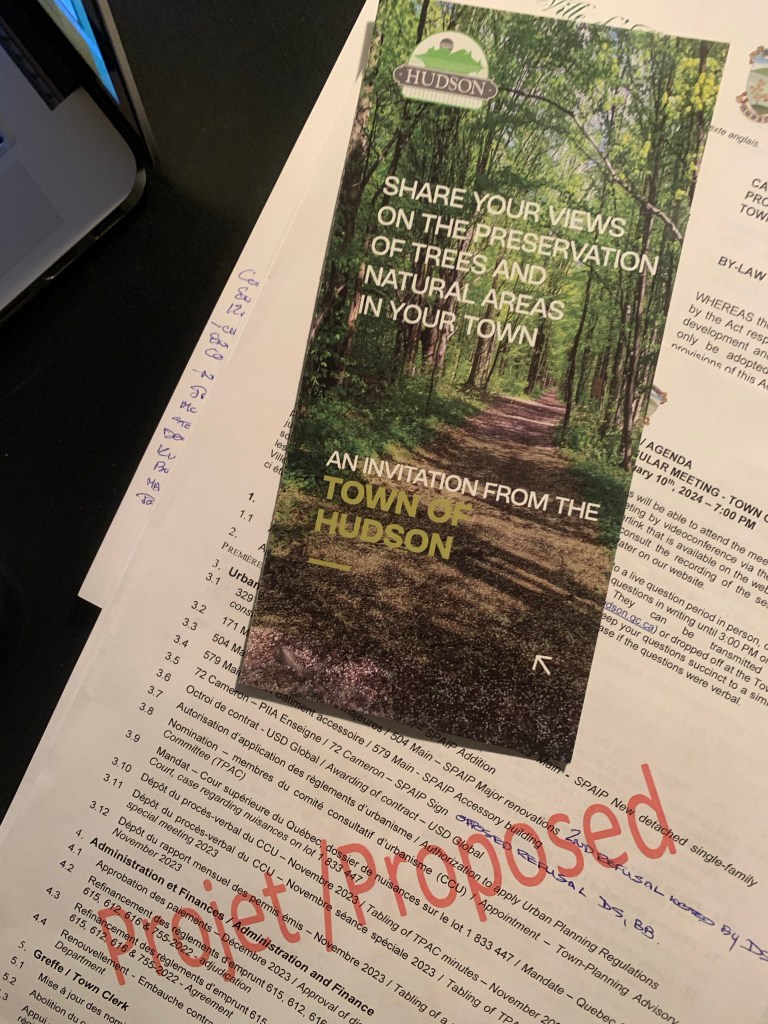
Hudson households will be getting a pamphlet in the mail from the town, advising them of the consultation process required for adoption of two bylaws imposing new constraints on future residential development.
But despite extensive lobbying by Save Sandy Beach activists and those opposed to Como’s Willowbrook, nothing in either bylaw blocks their development.
Bylaws 767 and 768 have been in the works since December 2021, when the current council adopted an interim control resolution, or RCI, imposing a 90-day subdivision and construction freeze on any lot falling within wetlands or woodlots characterized in a conservation plan adopted by the previous council. Residents were told at the time the 90-day freeze was required to buy time to revise Hudson’s planning program so that development could not proceed.
The 90-day freeze stretched into more than two years, during which mayor Chloe Hutchison would regularly tell concerned residents the bylaw rewrite was delayed for a variety of reasons, most of them having to do with staffing issues. The delay froze almost all new multi-unit residential development, including projects approved by previous councils and triggered an undisclosed number of lawsuits. In adopting the freeze, Hutchison said hundreds of lots would be impacted, although construction on many has been approved following third-party analyses of their ecological value.
Replying to questions at Wednesday’s first council meeting of 2024, Hutchison predicted that the interim control measure, or RCI, won’t likely be lifted until August because of delays built into the approval process. Although neither proposed bylaw adopted this week is subject to approval by referendum, both make public consultation an integral part of their adoption.
The consultation process agreed to by the town and its urban planning consultants calls for three meetings (open houses Thursday, Jan. 25 and Saturday Jan. 27, plus a Q&A Wednesday, Jan. 31). Residents have two weeks after that to submit their observations and suggestions, which may or may not result in changes to either or both draft bylaws. Hutchison said the target for final adption is April 2.
Next, the draft bylaws must be submitted to the Vaudreuil-Soulanges MRC to ensure they don’t clash with the MRC’s master development plan, or SADR3, and by extension, the Montreal Metropolitan Community’s PMAD. The MRC has 150 days to respond.
Bylaw 767 is what is termed an omnibus because it amends sections of existing bylaws without replacing the bylaws themselves. Parts of zoning bylaw 526, subdivision bylaw 527, permits and certificates bylaw 529 and architectural control bylaw 571 are being replaced with new definitions and tighter rules on everything from tree protection and replacement to the acquisition and sale of private and town-owned greenspace. Remarkable trees — a new protection category — lists 187 trees by address and GPS co-ordinates and will require a consultant’s finding that the tree is dead, dying or dangerous before one can be felled. Fines for violations range between $100 and $15,000.
Bylaw 768 “on comprehensive development programs” imposes tighter development constraints on the four largest parcels of undeveloped land in the urban perimeter: Willowbrook (R-7, R-15); Sandy Beach (R-22, R-24); Charleswood/Côte St. Charles (R-55) and a site on the north side of Main Road opposite Somerset.
The bylaw defines comprehensive development programs thus:
“When one or more owners wish to enhance one or more properties in the sectors concerned by theis bylaw, they must prepare a comprehensive development program (CDP/PAE) before making any request to modify the current urban planning bylaws…” To be eligible for submission to the town planning advisory committee (TPAC), a CDP must be in the form of a booklet which must satisfy a lengthy list of requirements. These include studies and concepts for the preservation of natural and built structures, plus allowances for transportation, recreation and other public amenities such as underground energy and communications infrastructure.
Any CDP of more than 10 pages must also include an executive summary of up to six pages.
The bylaw also establishes the town’s right to demand that developers shoulder the bill for connection to existing infrastructure.
Noteworthy in light of the town’s potential exposure to legal action by thwarted developers and property owners is Section 4: “this bylaw is adopted in parts, so that if any division of this bylaw is declared nul and void by a court, such a decision would have no effect on other parts of the bylaw.”
Also noteworthy are the built-in delays and the revised role of TPAC in draft bylaw 768.
The town’s urban planners have up to 60 days to determine whether a file is complete or requires additional material before passing it to TPAC, which can take as long as it wants to draft its recommendation for acceptance, modification or rejection of the project. TPAC may also request additional information from the CDP applicant and defer its recommendation indefinitely.
The bylaw’s second chapter deals with Willowbrook, with permitted densities of between five and 15 units per hectare depending on whether they are single-family, townhouses or row housing, all of which are open for consideration as long as the result is more greenspace. “The planning of any development must be subordinate to the respect for natural environments and ecosystem balance.” The goal is to preserve a minimum proportion of greenspace for the overall project, rather that per lot.
In summary, the bylaw would allow Habitation Robert to proceed with future phases of Willowbrook if the developer agrees to protect additional greenspace.
Regarding the proposed 214-unit Sandy Beach development, Bylaw 768 holds out the possibility the town could approve single-family, semi-detached two and three-family dwellings with an gross density of 17.5 to 35 units per hectare. Again, the claimed goal is to preserve greenspace by encouraging greater densities in sectors of the project.
For both R-55 and Sandy Beach, the bylaw offers the conceptual underpinning for creation of residential sectors where people aren’t dependent on their cars. “The comprehensive development plan […] is close to the village core and at a short distance from the Hudson train station…Therefore particular attention must be paid to reducing facilities favouring automobile use, both in housing offerings and outdoor facilities.”
Neither bylaw addresses the fate of multi-unit residential projects in the town core, of which three were approved by previous councils. Only one, the 18-unit assisted-care Villa Wyman, has been cancelled by its promoters.
But despite extensive lobbying by Save Sandy Beach activists and those opposed to Como’s Willowbrook, nothing in either bylaw blocks their development.
 thousandlashesdotca