
Dazed and confused

After two public consultation sessions, Hudson residents are voicing their frustration over the confusion surrounding the impact of a proposed parks and greenspace surtax on subdivision, construction and renovation permits in nearly half the municipality.

Termed a ‘contribution’ in the town’s documents and presentations, the proposed 10-20% levy — in cash, land or a combination of both — would add thousands to the cost of a major commercial or residential renovation — or change in usage, such as from commercial to residential.

The calculation of what a property owner will pay in cash, land or both would be based on the assessed value of the lot.  

For most residents, the grey area is what will trigger the surtax. The addition of a detached garage, new kitchen, bathroom, pool,  or shed won’t. Homeowners will be able to rebuild after a disaster, replace windows, a roof, flooring or siding without any impact. But new contruction on a vacant lot, rebuilding after a demolition or renovation of a third or more of their home will cost the owner 10% of the assessed value of their lot. Same goes for the addition of two or more residential units in an existing building or enlarging a commercial building by more than 25% of its original footprint.  

In examples cited in an explanatory sheet distributed at both open houses, the owner of a property with a taxable value of $400,000 would be billed $40,000 — a contribution equal to 10% of its assessment. If that property had been the result of a subdivision on which the owner had already paid 10% of its value in land, cash or both, the tax bill would be reduced to $30,000.

Several points in the explanation document appear to contradict the draft bylaw, perhaps the reason for the fine-print disclaimer at the bottom.

Questions most asked:

How many property owners are affected? 

Facilitators at last Wednesday’s open house tried to minimize the potential impact. A Hudson urban planning staff member told me that between January 2021 and December 2023, only five of the 112 major renovation permits issued by the town would have crossed the contribution threshold. However nobody running the event would hazard a guess as to the number of properties — commercial or residential — with a potential tax burden, should their owners apply for a permit. One resident told me they’re already planning renovations in phases in order to stay below the 33%.

Who came up with this scheme?

Draft bylaws 767 and 768 were the product of urban planning consultants Paré+, Hudson’s planning department and an ad-hoc conservation working group (CWG) which included councillors Mark Gray and Doug Smith and seven unelected residents. Created in January 2022 as part of the interim control process, the CWG was dissolved by a council vote at last month’s meeting because it had completed its’ mandate. Gray credited Donald Attwood, Tanja Bruns, JJ Corker, Sylvie Ferron, David Kalant, Briony Lalor, Kevin Solarik and non-resident resource person Lorraine Caron.

Whoever came up with Section 11, the part of draft bylaw 767 laying out the surtax framework, they’re not claiming responsibility. 

Why?

Besides creating a sustainable source of funding for greenspace acquisition and upkeep, the financial burden is concentrated on those with the financial resources to absorb the hit, as opposed to the entire taxpaying body. It also discourages would-be developers from coming anywhere near Hudson unless they’re ready to play by the town’s terms.

Couldn’t council use Hudson’s $8 million accumulated surplus instead of targeting those who want to improve their property?

Yes, they could. But the mayor has said the surplus should be used for social projects, such as affordable housing. 

Is there anything similar anywhere else in Quebec? 

Pare+ representative Vincent Langevin told me only one other Quebec municipality — on the West Island — charges a similar surtax on development. Consultant/facilitator Marie-Helene Gauthier said Hudson was taking a bold step with the proposed taxation structure. Bold isn’t the word I’d use. Foolhardy? Feckless?

Where does the land and/or money go? 

The cash will go to a segregated account, to be used only to acquire land for parks or to protect wetlands and woodlands of ecological value as well as to maintain existing parks, playgrounds and trails. However, the bylaw adds this: “the Town may, however, […] dispose of lands acquired under this section.” Simply, this bylaw will allow future councils to resell lands acquired under this bylaw as long as the proceeds go to the parks fund.

Last week I urged the administration to withdraw both bylaws and take the time to redraft them in light of generalized confusion. I reiterate: these bylaws are unadoptable as drafted. Fix them so they at least make sense.
Unadoptable as drafted

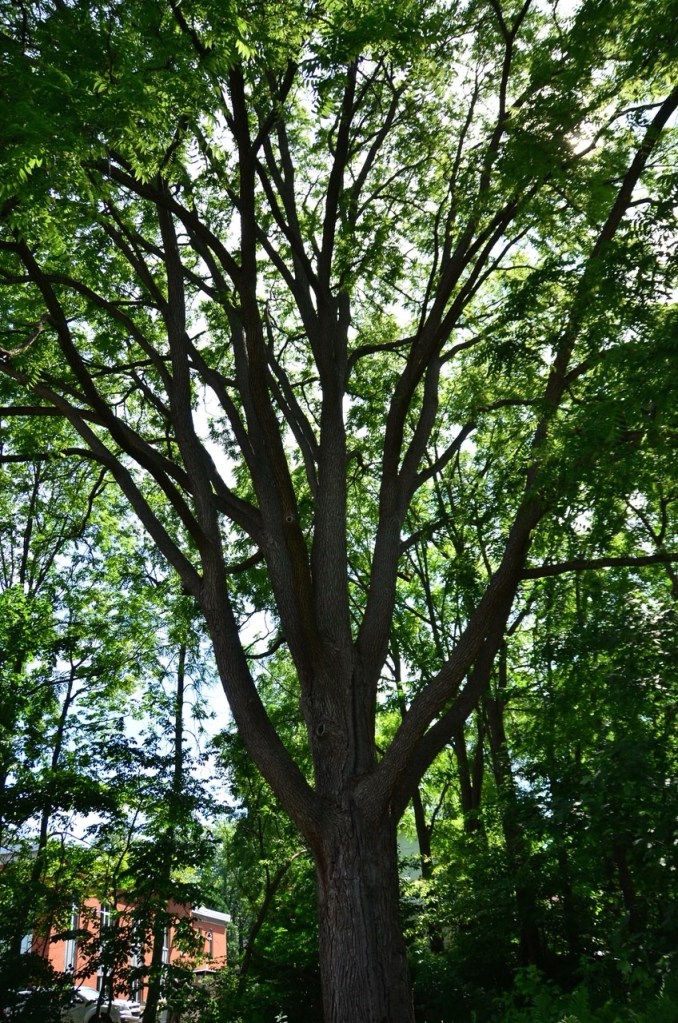
Black walnut behind 541 Main: residents should check Remarkable Trees list.

The twin bylaws comprising Hudson’s proposed urban planning program overhaul are seriously flawed — so much so that this council must take whatever time it takes to have them redrafted.

But that’s just my opinion, which I’ll explain below.

This week, residents are being asked to weigh the impact of bylaw changes that would impose a 10-20% surtax in land, cash or a combination of both on a subdivision, major renovation, expansion or change in usage of any residential or commercial property in Hudson.

As Hudsonites will learn at two open houses (7-9 this Thursday evening and 9-noon Saturday) as well as at a public consultation (7 p.m. Wednesday, Jan. 31), the administration’s intent is to finance acquisition of lands for future parks and recreation areas as well as to encourage landowners to sign over their properties.

Among other proposed changes are mandatory 15-metre no-touch zones on properties adjacent to wetlands or shorelines and the protection of close to 200 ‘remarkable’ trees throughout the urban core. (Demand to know whether your trees are on the list.)

Draft bylaws 767 and 768 were presented at the Jan. 10 council meeting with final adoption planned for the April 2 session. Bylaw 767 amends four existing bylaws — 526 (zoning); 527 (subdivision); 529 (permits and certificates) and 571 (site planning and architectural integration programs).

Bylaw 768 ordains a new set of rules for future development of four large non-agricultural blocs of land including Willowbrook, Sandy Beach, the site of a proposed continuing-care seniors’ campus off Côte St. Charles, and a woodlot between Main Road and the rail line east of Mount Pleasant.

Neither bylaw is subject to approval by referendum as long as citizens are given the opportunity to comment. Council is not obliged to withdraw or modify either bylaw regardless of public concerns, which can be submitted in writing until Feb. 14. Mayor Chloe Hutchison has said the target date for final adoption is the April 2 council meeting.

Depending on input from the Vaudreuil-Soulanges MRC, Hutchison hopes to lift the Dec. 2021 interim control measures by August. 

____________________________________________________

Here’s why I think council should redraft these bylaws:

1) It’s a laudable goal, building a fund for parks and recreation. But on the backs of property owners? This change wasn’t thought through in light of higher mortgage interest rates and construction costs and Ottawa’s threat to penalize municipalities that refuse to densify their housing stock.

Residents should know that Hudson already has a parks fund containing monies collected in lieu of land for Quebec’s mandatory 10% subdivision levy in either land or cash. The municipality decides which.

Council must be brought to realize the draconian fiscal impact of an improvement surtax/land grab over and above the table d’hote of taxes Hudson property owners already pay.

It’s not because Hudson needs the revenue. The town is sitting on an $8 million accumulated surplus that can easily be accessed for parks and greenspaces, so let’s hear council’s justification for hammering anyone who wants to upgrade their residence or commercial property.

Draft bylaw 767 defines a major renovation as any project involving 33% and more of the volume of an existing construction, which currently requires a building permit — and in the case of a property located in one of Hudson’s SPAIPs, a yes vote from council on a recommendation from TPAC.

The addition of a garage, a kitchen/bathroom upgrade, family room, basement living quarters or intergenerational suite would likely trigger the 33% parks threshold.

The median price for a house in Hudson is close to $600k. Most buyers will want to upgrade to meet their requirements, so the question becomes whether the Hudson cachet is worth an additional 10% — over and above the transfer tax. So do sellers of unimproved properties compensate for the added charge by lowering their asking price?

If adopted, Bylaw 767 would give the town the power to dictate the combination of cash and greenspace in any subdivision, renovation or usage change. This has been abused in the past and I can understand why council would hang tough on this one. But Sections 401.1 through 401.5 create an obligation on the property owner to transfer land or pay a sum of money for parks, playgrounds or natural areas for the following:

— Any subdivision permit application for approval of a cadastral operation;

— Any building permit application related to construction of a new main building on a property whose registration as a separate lot has not been the subject of a subdivision permit resulting from Quebec’s 1994 cadastral reform;

— Any building permit application for a redevelopment project on a property (described above);

— Any building permit application for the intensification of existing activities on a property (defined in the bylaw as any construction project with the aim of adding two or more residential units in a building or enlarging a commercial building by more than 25% of its existing floor area);

— Any building permit application to allow new activities on a property. (Nowhere is this defined in the draft bylaw. Would the Chateau du Lac be obliged to sign over cash and greenspace for renting to healthcare professionals? Would any of Hudson’s commercial landlords be billed for a change in tenants? Clearly, this clause is both incoherent and beyond the town’s authority to enforce.  

2) Section 15 of draft bylaw 768 bestows on the Town Planning Advisory Committee the power to defer its recommendation on a developer’s comprehensive development program (CDP, or PAE in French) application on the basis that it needs further information. This has been a standard go-to excuse by TPAC to stall a council vote and has led to past turf wars, such as those over Willowbrook and condo projects at 426 Main and 98 Cameron. I see this as a rationalization for more stalling tactics on politically difficult files, like what happened to Villa Wyman.

Even more concerning are these clauses from Section 17 Approval by the town council:

— Once it votes to approve TPAC’s positive recommendation, “council may also require as the condition for approval of an application, that the owners of the buildings located in the area covered by the comprehensive development program […] bear the cost of certain elements of the CDP, including infrastructure or equipment.”  I’m not a lawyer, but surely requiring neighbours and residents of a new subdivision project to complete the project within a specified period and provide financial guarantees is beyond a town’s powers.

Even more baffling is the following weasel clause:

“The approval of a CDP/PAE in no way commits the town council to undertake a modification to urban planning regulations and issue corresponding permits, nor does it constitute an obligation for the town to accept the proposed roads appearing in the CDP, decree their opening, bear the construction and maintenance costs or assume civil responsibilities.”

In other words, even if council approves a subdivision development, it is under no obligation to municipalize the road network. Quebec already requires the developer to build, pave and pay for all CDP/PAE infrastructure, roads included, so why would this bylaw allow council to wriggle out of taking them over? So that the town can then ban winter snow plowing, waste collection, school bus service and other municipal services? Smells like another stalling tactic to make those pesky developers and their needy buyers go away.

I’ll be submitting these and other concerns, both orally during the Jan. 31 consult, and in writing for the two weeks following. I have no illusions that this council will heed my or anyone’s advice.

Please take the time to attend either of the two open houses, or failing that, the public consultation on Jan. 31. The only reason we live with bad laws is because we don’t demand better.

Hudson’s RCI replacements won’t block development

Draft bylaws will require public consultation, MRC checkoff before approval.

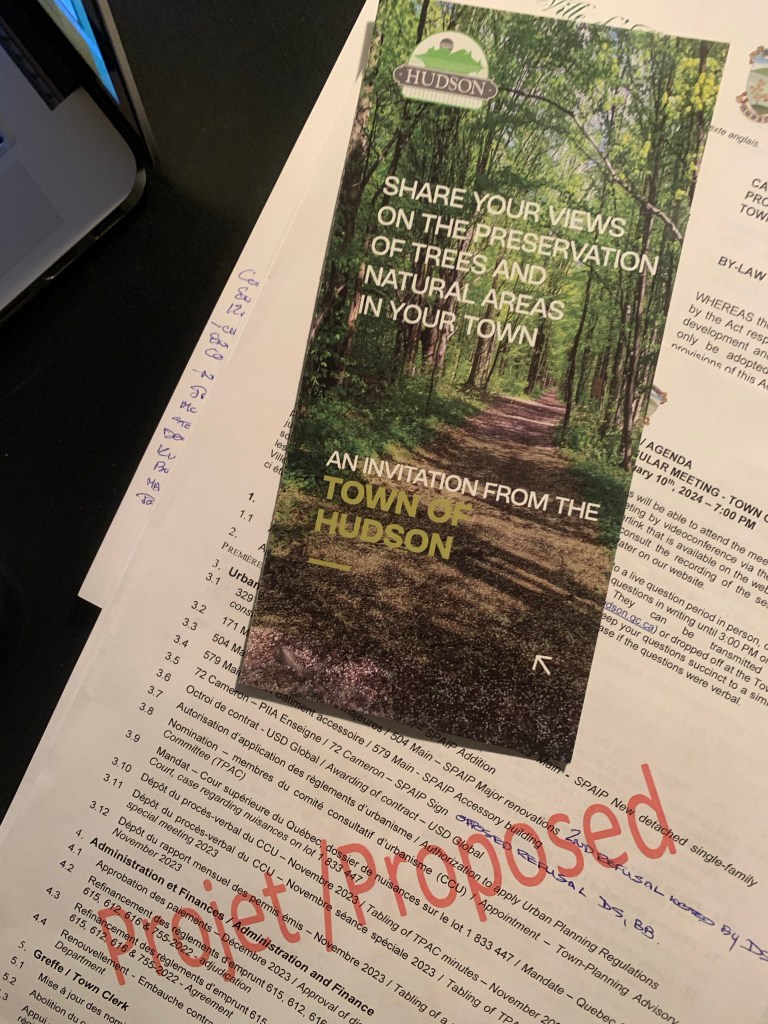
Hudson households will be getting a pamphlet in the mail from the town, advising them of the consultation process required for adoption of two bylaws imposing new constraints on future residential development.

But despite extensive lobbying by Save Sandy Beach activists and those opposed to Como’s Willowbrook, nothing in either bylaw blocks their development.

Bylaws 767 and 768 have been in the works since December 2021, when the current council adopted an interim control resolution, or RCI, imposing a 90-day subdivision and construction freeze on any lot falling within wetlands or woodlots characterized in a conservation plan adopted by the previous council. Residents were told at the time the 90-day freeze was required to buy time to revise Hudson’s planning program so that development could not proceed. 

The 90-day freeze stretched into more than two years, during which mayor Chloe Hutchison would regularly tell concerned residents the bylaw rewrite was delayed for a variety of reasons, most of them having to do with staffing issues. The delay froze almost all new multi-unit residential development, including projects approved by previous councils and triggered an undisclosed number of lawsuits. In adopting the freeze, Hutchison said hundreds of lots would be impacted, although construction on many has been approved following third-party analyses of their ecological value.

Replying to questions at Wednesday’s first council meeting of 2024, Hutchison predicted that the interim control measure, or RCI, won’t likely be lifted until August because of delays built into the approval process. Although neither proposed bylaw adopted this week is subject to approval by referendum, both make public consultation an integral part of their adoption. 

The consultation process agreed to by the town and its urban planning consultants calls for three meetings (open houses Thursday, Jan. 25 and Saturday Jan. 27, plus a Q&A Wednesday, Jan. 31). Residents have two weeks after that to submit their observations and suggestions, which may or may not result in changes to either or both draft bylaws. Hutchison said the target for final adption is April 2.

Next, the draft bylaws must be submitted to the Vaudreuil-Soulanges MRC to ensure they don’t clash with the MRC’s master development plan, or SADR3, and by extension, the Montreal Metropolitan Community’s PMAD. The MRC has 150 days to respond.

Bylaw 767 is what is termed an omnibus because it amends sections of existing bylaws without replacing the bylaws themselves. Parts of zoning bylaw 526, subdivision bylaw 527, permits and certificates bylaw 529 and architectural control bylaw 571 are being replaced with new definitions and tighter rules on everything from tree protection and replacement to the acquisition and sale of private and town-owned greenspace. Remarkable trees — a new protection category — lists 187 trees by address and GPS co-ordinates and will require a consultant’s finding that the tree is dead, dying or dangerous before one can be felled. Fines for violations range between $100 and $15,000.

Bylaw 768 “on comprehensive development programs” imposes tighter development constraints  on the four largest parcels of undeveloped land in the urban perimeter: Willowbrook (R-7, R-15); Sandy Beach (R-22, R-24); Charleswood/Côte St. Charles (R-55) and a site on the north side of Main Road opposite Somerset.

The bylaw defines comprehensive development programs thus: 

“When one or more owners wish to enhance one or more properties in the sectors concerned by theis bylaw, they must prepare a comprehensive development program (CDP/PAE) before making any request to modify the current urban planning bylaws…” To be eligible for submission to the town planning advisory committee (TPAC), a CDP must be in the form of a booklet which must satisfy a lengthy list of requirements. These include studies and concepts for the preservation of natural and built structures, plus allowances for transportation, recreation and other public amenities such as underground energy and communications infrastructure. 

Any CDP of more than 10 pages must also include an executive summary of up to six pages.

The bylaw also establishes the town’s right to demand that developers shoulder the bill for connection to existing infrastructure.   

Noteworthy in light of the town’s potential exposure to legal action by thwarted developers and  property owners is Section 4: “this bylaw is adopted in parts, so that if any division of this bylaw is declared nul and void by a court, such a decision would have no effect on other parts of the bylaw.” 

Also noteworthy are the built-in delays and the revised role of TPAC in draft bylaw 768.

The town’s urban planners have up to 60 days to determine whether a file is complete or requires additional material before passing it to TPAC, which can take as long as it wants  to draft its recommendation for acceptance, modification or rejection of the project. TPAC may also request additional information from the CDP applicant and defer its recommendation indefinitely.

The bylaw’s second chapter deals with Willowbrook, with permitted densities of between five and 15 units per hectare depending on whether they are single-family, townhouses or row housing, all of which are open for consideration as long as the result is more greenspace. “The planning of any development must be subordinate to the respect for natural environments and ecosystem balance.” The goal is to preserve a minimum proportion of greenspace for the overall project, rather that per lot.

In summary, the bylaw would allow Habitation Robert to proceed with future phases of Willowbrook if the developer agrees to protect additional greenspace.

Regarding the proposed 214-unit Sandy Beach development, Bylaw 768 holds out the possibility the town could approve single-family, semi-detached two and three-family dwellings with an gross density of 17.5 to 35 units per hectare. Again, the claimed goal is to preserve greenspace by encouraging greater densities in sectors of the project. 

For both R-55 and Sandy Beach, the bylaw offers the conceptual underpinning for creation of residential sectors where people aren’t dependent on their cars. “The comprehensive development plan […] is close to the village core and at a short distance from the Hudson train station…Therefore particular attention must be paid to reducing facilities favouring automobile use, both in housing offerings and outdoor facilities.”

Neither bylaw addresses the fate of multi-unit residential projects in the town core, of which three were approved by previous councils. Only one, the 18-unit assisted-care Villa Wyman, has been cancelled by its promoters.

But despite extensive lobbying by Save Sandy Beach activists and those opposed to Como’s Willowbrook, nothing in either bylaw blocks their development.